
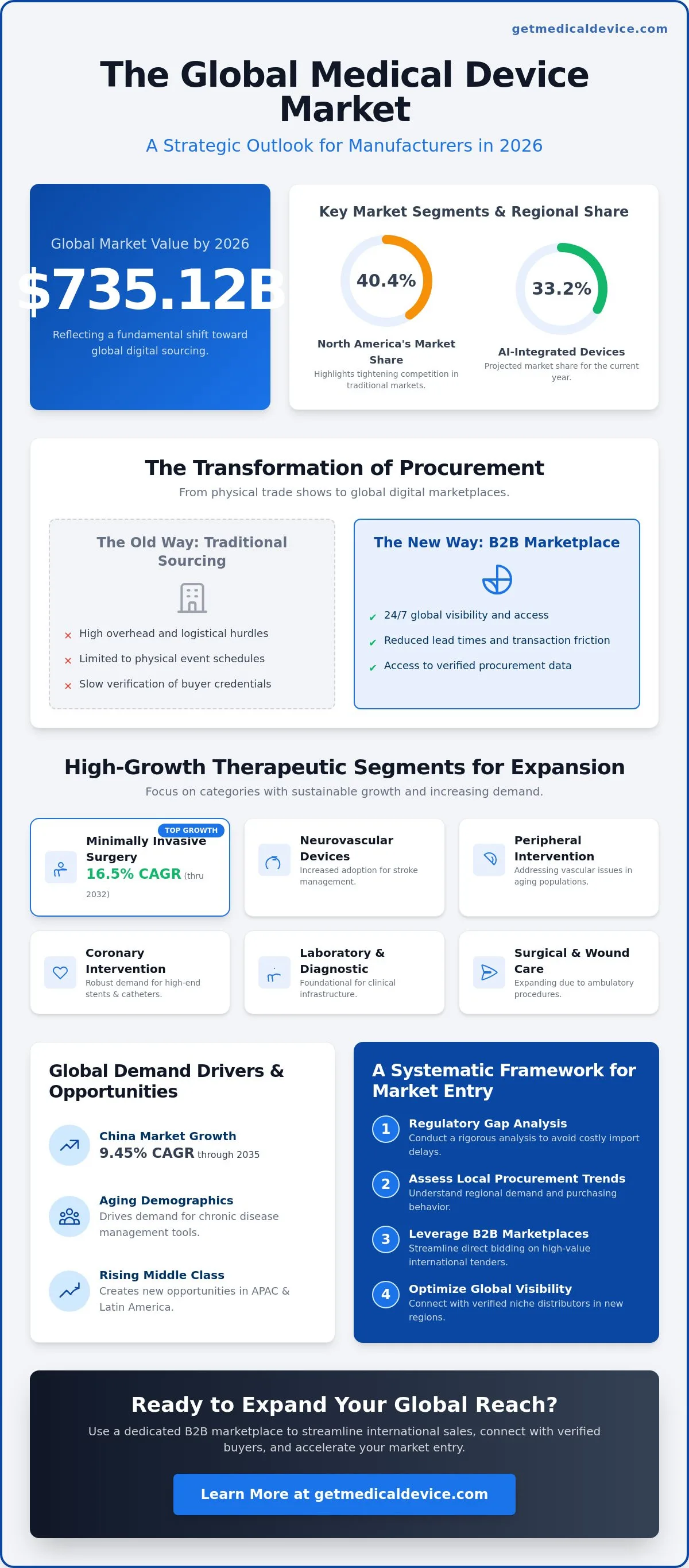
By 2026, the global medical device market is valued at approximately $735.12 billion, yet North America's 40.4% share highlights tightening competition in traditional sectors. You're likely facing the challenges of oversaturated domestic markets and the high cost of maintaining regulatory compliance across diverse jurisdictions. Identifying and verifying reliable buyers abroad remains a significant logistical hurdle for many firms. Understanding how to use a b2b marketplace to sell medical devices is now a requirement for manufacturers who need to access international procurement officers without the overhead of traditional physical expansion.
This article provides a systematic framework for entering emerging territories and identifies the therapeutic segments, such as AI-integrated devices, that are projected to account for 33.2% of the market this year. You'll gain clarity on the shift toward digital-first procurement and the specific impacts of the FDA’s Quality Management System Regulation (QMSR). We'll also examine mandatory EUDAMED modules to help you establish a low-friction market entry strategy for 2026 and beyond.
Key Takeaways
- Analyze the transition toward global digital sourcing models to address the rising demand for chronic disease management.
- Identify specific growth drivers in the minimally invasive surgery and neurovascular therapeutic categories.
- Execute a systematic market entry strategy starting with a rigorous regulatory gap analysis and an assessment of local procurement trends.
- Learn how to use a b2b marketplace to sell medical devices to streamline direct bidding on high-value international tenders.
- Optimize global visibility through premium listings to connect with verified niche distributors in previously inaccessible regions.
Table of Contents
- Global Medical Device Market Trends: The 2026 Landscape
- Identifying High-Growth Therapeutic Segments for Expansion
- A Strategic Framework for Entering New Territories
- Leveraging B2B Marketplaces for Rapid Market Entry
Global Medical Device Market Trends: The 2026 Landscape
The global medical device market is valued at approximately $735.12 billion in 2026. This valuation reflects a fundamental transition from localized distribution networks to decentralized, global digital sourcing. Manufacturers are re-evaluating their supply chains to prioritize resilience and transparency. Knowing how to use a b2b marketplace to sell medical devices has become a core competency for firms targeting high-growth regions outside of North America. While the U.S. remains a dominant force with a 40.4% market share, the highest acceleration rates are now found in emerging economies.
Macro-Drivers of 2026 Demand
Aging demographics across Europe and East Asia continue to drive consistent demand for chronic disease management tools. The surge in middle-class incomes in the Asia-Pacific and Latin American regions is creating new opportunities in elective surgical segments. China's market, for instance, is projected to grow at a CAGR of 9.45% through 2035. There's also a clear trend toward decentralized healthcare. This shift increases the requirement for portable diagnostic equipment and remote monitoring tools that can function outside traditional hospital settings.
The Digital Transformation of Procurement
Traditional trade shows no longer serve as the primary vehicle for international trade. Organizations now rely on a b2b medical device marketplace to maintain 24/7 visibility and facilitate rapid verification of credentials. Digital Procurement is the systematic use of online platforms to source and verify medical equipment. This model reduces the friction associated with cross-border transactions and allows for real-time adjustments to inventory and pricing based on global demand signals. Mastering how to use a b2b marketplace to sell medical devices ensures that technical specifications remain accessible to qualified buyers across multiple time zones.
- Reduced logistical lead times through direct buyer-to-supplier communication.
- Standardized documentation for regulatory compliance across different jurisdictions.
- Access to verified procurement data for strategic forecasting.
Identifying High-Growth Therapeutic Segments for Expansion
Strategic expansion requires a granular analysis of therapeutic segments that demonstrate sustainable growth. Minimally invasive surgery devices represent a significant opportunity, with a projected CAGR of 16.5% through 2032. This growth is mirrored in interventional radiology as hospitals shift toward procedures that reduce patient recovery times and improve clinical throughput. Within these fields, specialized neurovascular devices are seeing increased adoption for stroke management protocols. Emerging healthcare systems are also prioritizing peripheral intervention to address vascular complications associated with aging populations. Understanding how to use a b2b marketplace to sell medical devices allows manufacturers to position these specialized products directly in front of procurement teams searching for high-specification technical solutions.
Developing regions often show a strong secondary demand for laboratory and diagnostic equipment. This trend is driven by the need to establish foundational clinical infrastructure before transitioning to advanced interventional procedures. Manufacturers must ensure their offerings align with the specific regulatory framework for medical devices in each target territory to avoid costly delays during the import phase.
Cardiovascular and Coronary Intervention
Global demand for high-end stents and catheters remains robust. Brands such as Boston Scientific and Terumo continue to lead in innovation, but the procurement shift toward digital sourcing allows newer, verified suppliers to compete on technical merit. The coronary intervention category specifically requires high-precision instrumentation that meets international ISO 13485:2016 standards. Suppliers can leverage verified membership programs to demonstrate compliance and reliability to global hospital networks.
Specialized Surgical and Wound Care
Outpatient clinics are increasingly sourcing advanced surgical products to accommodate the rise in ambulatory procedures. Additionally, the wound care segment is expanding due to the global prevalence of diabetic complications. These categories benefit from clear, technical product listings that allow procurement officers to compare material specifications and clinical efficacy data efficiently. Learning how to use a b2b marketplace to sell medical devices in these niches streamlines the RFQ process and ensures that critical supplies reach clinics without traditional distribution bottlenecks.
A Strategic Framework for Entering New Territories
Entry into new geographic markets requires a methodical alignment of regulatory compliance and commercial visibility. Manufacturers who understand how to use a b2b marketplace to sell medical devices can bypass traditional infrastructure requirements. This systematic framework ensures that expansion efforts are both scalable and compliant with evolving international standards.
- Step 1: Conduct a regulatory gap analysis. Ensure your Medical Device File (MDF) aligns with the latest standards, such as the FDA’s Quality Management System Regulation (QMSR) effective February 2, 2026, or the mandatory EUDAMED modules required as of May 28, 2026.
- Step 2: Identify local reimbursement models. Determine whether the target territory utilizes centralized public tenders or decentralized private procurement trends.
- Step 3: Establish a digital presence. Utilize a medical device wholesaler platform to gain immediate exposure to pre-qualified buyers.
- Step 4: Secure verified supplier status. High-stakes procurement teams prioritize risk mitigation. Verification serves as a prerequisite for participating in global hospital tenders.
Mitigating International Trade Risks
Regulatory complexity often deters manufacturers from high-growth regions. Implementing a tiered market entry strategy allows firms to prioritize territories with high regulatory harmonization, such as those recognizing ISO 13485:2016. A robust medical device sourcing and procurement strategy should account for these overlaps to reduce administrative overhead and accelerate time-to-market.
Establishing Trust Through Verification
In many emerging markets, the absence of a local physical office is a significant barrier to securing high-value contracts. Verified status acts as a reliable proxy for local presence, signaling that the supplier has undergone rigorous third-party auditing of their credentials and quality systems. Detailed instructions on this process are available in our Verified Medical Device Suppliers Guide. Mastering how to use a b2b marketplace to sell medical devices effectively hinges on this trust-building phase. Procurement officers in 2026 rely on these digital verification markers to shortlist partners for long-term supply agreements.
Manufacturers seeking to accelerate their global reach should apply for a Verified Supplier Membership to start bidding on active international tenders immediately.
Leveraging B2B Marketplaces for Rapid Market Entry
Market entry in 2026 is an exercise in digital visibility and rapid response. While regulatory alignment is foundational, the commercial discovery phase determines the speed of revenue generation. Utilizing a medical device RFQ platform provides manufacturers with immediate access to active hospital tenders and procurement requests. This bypasses the need for local sales infrastructure during the initial validation phase. By employing premium medical product listings, suppliers ensure their technical specifications are indexed and visible to niche distributors in high-growth regions like the Asia-Pacific.
Direct Access to Global Sourcing Leads
Responding to active procurement requests from international clinics requires a systematic approach to lead management. A credit-based RFQ system allows firms to allocate resources toward specific geographic or therapeutic interests without committing to permanent regional overhead. This flexibility is essential for testing market demand in territories where the competitive landscape isn't yet fully defined. A Verified Supplier Membership on GetMedicalDevice facilitates this process by providing the necessary credentials to participate in high-value bidding cycles immediately.
The Role of Established Brands in New Markets
Strategic inventory selection acts as a primary driver for market penetration. Offering recognized brands such as Abbott Vascular or Asahi Intecc serves as a technical door opener, establishing immediate credibility with clinical staff. You can optimize your reach by learning how to use a b2b marketplace to sell medical devices by responding to RFQs with high-quality inventory data and verified certification documents. This approach ensures that your offerings meet the rigorous selection criteria of global procurement officers who prioritize established performance metrics.
The transition toward global digital sourcing is complete. Success in 2026 depends on positioning your inventory precisely where global buyers are already conducting their searches. By integrating into a verified B2B ecosystem, manufacturers can transform complex international expansion into a series of manageable, data-driven procurement interactions.
Scaling Global Operations in the Digital-First Era
Successfully entering emerging markets in 2026 requires a rigorous alignment of technical precision and verified digital visibility. Manufacturers must prioritize high-growth therapeutic segments while adhering to updated regulatory standards such as the FDA’s Quality Management System Regulation. Understanding how to use a b2b marketplace to sell medical devices allows your organization to bypass traditional distribution hurdles and engage directly with international procurement officers. This shift from physical to digital-first expansion reduces entry friction and accelerates revenue cycles in competitive regions.
Establishing a stable presence in new territories is now a data-driven process. A verified status provides the necessary documentation to build immediate trust with global hospital networks. You can Access Global Sourcing Leads with a Verified Supplier Membership to start bidding on active RFQs for leading brands like Boston Scientific and Abbott Vascular. This global reach ensures your inventory remains visible across critical coronary, neurovascular, and surgical categories. Systematic digital integration is the most efficient path toward sustainable international growth.
Frequently Asked Questions
What are the fastest-growing medical device markets in 2026?
China represents the most significant growth opportunity with a projected CAGR of 9.45% through 2035. Other high-acceleration regions include Southeast Asia and Latin America, where rising middle-class incomes are driving demand for elective surgical procedures. Therapeutic segments such as AI-integrated diagnostics and minimally invasive surgical tools are currently outpacing traditional growth rates in these territories.
How do I verify a medical device buyer in a new international market?
Verification requires a systematic review of the entity's clinical credentials and import licenses within their specific jurisdiction. You should leverage the internal verification protocols of a professional B2B platform to confirm the buyer's transaction history and regulatory standing. Cross-referencing organizations against international databases, such as the mandatory EUDAMED modules in the European Union, provides an additional layer of security before executing high-value contracts.
What is the role of a B2B marketplace in medical device export?
A B2B marketplace serves as a centralized infrastructure for lead generation and technical documentation management. It streamlines the export process by providing a standardized framework for Request for Quotation (RFQ) responses and credential verification. Knowing how to use a b2b marketplace to sell medical devices allows manufacturers to maintain constant visibility to global procurement officers, effectively acting as a digital bridge between complex regulatory environments.
Can I sell medical devices globally without a local distributor?
You can facilitate direct-to-hospital sales by utilizing digital procurement platforms to engage with international buyers directly. While this approach reduces reliance on traditional distribution markups, most jurisdictions still require a legal local representative to manage regulatory reporting. A B2B marketplace handles the commercial discovery phase, while your compliance team ensures that all necessary legal registrations are maintained in each target territory.
What regulatory documents are typically required for international medical device trade?
International trade necessitates a standardized set of documentation to verify safety and quality compliance across borders. Critical documents include the ISO 13485:2016 certificate, the Medical Device File (MDF), and a Certificate of Free Sale (CFS) from the country of origin. Understanding how to use a b2b marketplace to sell medical devices involves ensuring these documents, along with the Declaration of Conformity, are readily accessible to verified procurement teams during the RFQ process.