
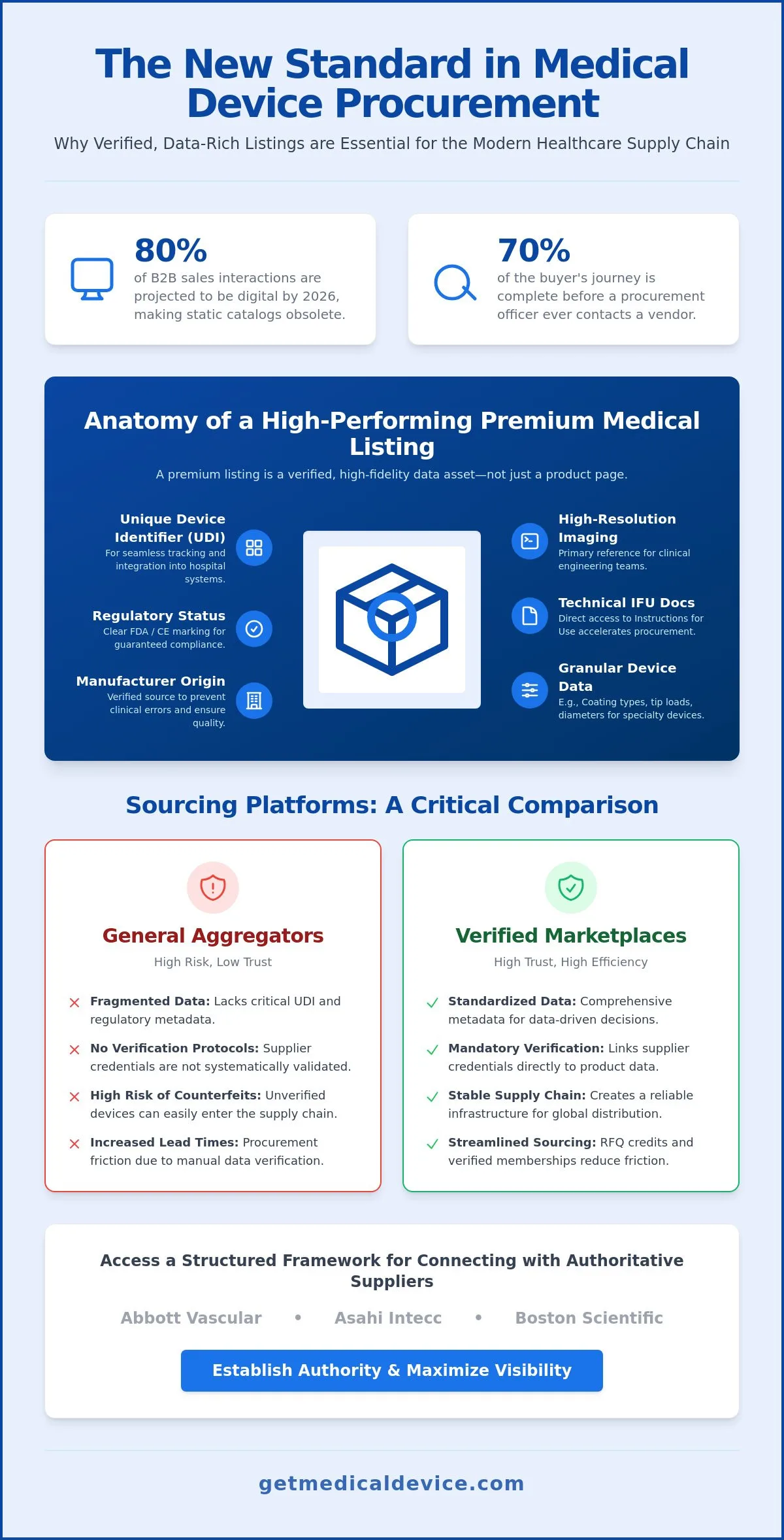
With 80% of B2B sales interactions expected to occur through digital channels in 2026, a static online presence is no longer a viable strategy for medical device suppliers. Procurement officers are now approximately 70% through their decision-making process before they ever initiate contact with a vendor. You understand that unreliable supplier data and the risk of unverified devices create significant bottlenecks in the global supply chain. These inefficiencies often lead to prolonged lead times and a diminished return on your B2B marketing spend.
This article demonstrates how to leverage premium medical product listings to establish immediate authority and streamline the procurement of critical devices. You'll learn how to utilize a verified network featuring brands like Abbott Vascular and Asahi Intecc to bypass the risks associated with general marketplaces. We will outline the systematic processes for utilizing RFQ response credits and verified memberships to reduce procurement friction and maximize visibility in a competitive global market.
Key Takeaways
- Analyze the shift toward dynamic B2B marketplaces and why specialized platforms are necessary to maintain clinical procurement standards.
- Define the specific metadata, including UDI and regulatory approvals, that distinguish high-performing premium medical product listings from standard entries.
- Contrast the efficiency of verified networks against general aggregators to mitigate risks associated with fragmented global supply chains.
- Implement a methodical approach to sourcing by leveraging RFQ response credits to streamline the competitive bidding process.
- Access a structured framework for connecting with authoritative suppliers such as Abbott Vascular and Boston Scientific through verified membership tiers.
Table of Contents
- The Evolution of B2B Medical Procurement and Digital Listings
- Anatomy of a High-Performing Premium Medical Product Listing
- Comparing Sourcing Platforms: General Aggregators vs. Verified Marketplaces
- Strategic Implementation: Using Premium Listings for Global Procurement
- GetMedicalDevice: A Unified Solution for Verified Supplier Visibility
The Evolution of B2B Medical Procurement and Digital Listings
Traditional reliance on static PDF catalogs and manual procurement workflows is rapidly dissolving. By 2026, the medical device industry has fully embraced digital-first interactions. Current B2B e-commerce trends indicate that 80% of supplier-buyer engagements now occur through structured online environments. This shift isn't merely about convenience. It represents a fundamental restructuring of how hospitals and clinics identify, evaluate, and acquire high-stakes surgical equipment. General e-commerce platforms fail to meet the rigorous standards of healthcare because they lack the granular technical metadata and regulatory verification required for patient safety. With the FDA annual establishment registration fee set at $11,423 for fiscal year 2026, the financial and regulatory stakes for maintaining accurate data are absolute.
From Catalogs to Real-Time Procurement Portals
Digital portals have effectively eliminated the information asymmetry that once plagued global medical trade. Historically, local hospitals struggled to verify the inventory status or regulatory compliance of international suppliers without extensive manual correspondence. Modern marketplaces provide real-time visibility into stock levels, which is critical for surgical planning and emergency inventory management. A premium medical product listing is a verified, high-fidelity data asset for B2B trade that ensures every technical parameter is accurate and current. By moving away from fragmented systems, procurement teams access standardized data that facilitates faster decision-making and reduces lead times.
The Critical Role of Verification in High-Stakes Sourcing
In specialized fields such as interventional cardiology and neurovascular surgery, the cost of data inaccuracy is exceptionally high. When sourcing devices from brands like Asahi Intecc or Abbott Vascular, buyers require absolute certainty regarding manufacturer origin and regulatory approvals. Premium medical product listings address this trust gap by incorporating mandatory verification protocols that general aggregators ignore. This systematic approach links supplier credentials directly to product data, creating a stable infrastructure for international distribution. Verified supplier memberships ensure that the entities providing these devices adhere to the same stringent standards as the manufacturers themselves. This level of oversight is indispensable for maintaining patient safety outcomes and minimizing the risk of unverified or counterfeit devices entering the clinical environment.
Anatomy of a High-Performing Premium Medical Product Listing
Effective digital procurement requires a standardized approach to product documentation. A high-performing listing functions as a technical bridge between supplier inventory and clinical requirements. Essential metadata must include the Unique Device Identifier (UDI), current regulatory status such as FDA or CE marking, and the specific manufacturer origin. These parameters allow for seamless integration with Request for Quote (RFQ) systems, ensuring that procurement officers compare options based on verified technical data rather than marketing claims. This transition aligns with broader Healthcare Procurement Trends 2026, which emphasize data-driven operations and supply chain resilience over traditional cost-control measures.
The integration of high-resolution imaging and technical Instructions for Use (IFU) documentation is equally critical. In a professional B2B context, these assets are not decorative. They serve as primary reference materials for clinical engineering departments and surgical planning teams. Providing direct access to these documents within premium medical product listings reduces the administrative burden on both the buyer and the supplier. It eliminates the need for repeated manual requests for technical data sheets, thereby accelerating the overall procurement cycle.
Technical Data Requirements for Interventional Devices
Interventional devices like catheters, guidewires, and stents require extreme technical granularity. For brands such as Asahi Intecc or Abbott Vascular, a listing must specify coating types, tip loads, and distal outer diameters. Cross-referencing the manufacturer name with the exact model number is non-negotiable to prevent clinical errors and ensure compatibility with existing hospital systems. Detailed technical specifications improve searchability within procurement portals, allowing users to filter by specific procedural needs. This precision is what separates a professional medical listing from a generic product entry found on non-specialized marketplaces.
The Trust Layer: Verification Badges and Supplier Credentials
Verification badges serve as a critical trust proxy in the digital marketplace. When a listing carries a "Verified Supplier" badge, it signals that the entity has undergone a rigorous credentialing process. This verification includes documenting ISO 13485 compliance and confirming legal authorization to distribute specific brands like Boston Scientific or Terumo. Listings that feature these trust markers achieve significantly higher engagement levels from hospital procurement departments. Establishing this level of transparency is essential for reducing the trust gap in international trade. Organizations seeking to enhance their market presence should consider a Verified Supplier Membership to formalize their standing within the global network.
Comparing Sourcing Platforms: General Aggregators vs. Verified Marketplaces
General marketplaces like Alibaba present a significant challenge for medical procurement officers. These platforms often host unverified brokers who lack the necessary regulatory documentation, forcing buyers to spend excessive time sifting through unreliable data. Engaging with these entities increases administrative overhead and introduces substantial liability into the supply chain. In contrast, verified marketplaces utilize structured vetting processes to ensure that every participant holds the required certifications. This systematic verification is a cornerstone of digital transformation in medical supply chains. By prioritizing accuracy over volume, specialized platforms reduce the time-to-quote by providing high-fidelity data from the outset.
Subscription-based models offer a superior cost-benefit ratio compared to free directories. While free platforms appear cost-effective initially, they lack the data integrity required for high-stakes medical transactions. Premium medical product listings serve as a primary filter, ensuring that only established suppliers with verified inventory are visible to buyers. This reduces the likelihood of engaging with "ghost" inventory, which occurs when entities list products they don't actually possess in physical stock. By focusing on verified networks, procurement teams can allocate their budgets toward reliable partners rather than sifting through fragmented data sets.
The Hidden Costs of Unverified Sourcing
The hidden costs of unverified sourcing are substantial and often extend beyond the purchase price. Regulatory non-compliance can lead to legal sanctions and hospital-wide audits. More critically, reliance on unverified data often results in delayed surgeries when ordered devices fail to arrive or don't meet technical specifications. Professional procurement requires a stable infrastructure where data accuracy is guaranteed. Using premium medical product listings minimizes these operational risks by linking product data directly to verified supplier credentials. This ensures that every transaction is backed by a legitimate entity capable of meeting clinical demands.
Why Interventional Radiology and Surgery Demand Specialized Portals
Interventional radiology and neurovascular surgery demand a level of expertise that general aggregators cannot provide. Sourcing complex tools from brands like Terumo or Boston Scientific requires a platform that understands clinical nuances. A specialized portal distinguishes between a standard IV line and a specialized microcatheter, ensuring that technical parameters like tip load and trackability are accurately represented. This technical depth is essential for global distribution networks handling sophisticated devices from manufacturers like Abbott Vascular or Asahi Intecc. Specialized portals provide the necessary framework to solicit competitive bids through RFQ response credits, ensuring that the procurement process remains transparent and efficient.
Strategic Implementation: Using Premium Listings for Global Procurement
Strategic implementation begins with a systematic identification process. Procurement officers must first filter the global database to identify verified suppliers within specific therapeutic areas like interventional cardiology or neurovascular surgery. This initial step ensures that all subsequent interactions occur within a pre-vetted network. By utilizing premium medical product listings, buyers can immediately access detailed technical specifications and regulatory documentation for devices from manufacturers like Terumo and Boston Scientific. This methodical approach eliminates the uncertainty often found in fragmented supply chains.
Once a shortlist is established, the next stage involves utilizing RFQ response credits to solicit competitive bids. This mechanism allows buyers to reach multiple distributors simultaneously while maintaining a high standard of response quality. Evaluating these responses requires a focus on three critical parameters: lead times, current regulatory status, and tiered bulk pricing. A standardized evaluation framework prevents the procurement process from becoming fragmented and ensures that final selections align with clinical requirements. Successfully navigating these steps leads to the final phase: establishing long-term supply agreements through platform-verified channels that ensure consistent device availability for surgical schedules.
Optimizing the RFQ Process for Surgical Supplies
Precision in the RFQ draft is essential for attracting top-tier suppliers. A well-structured request must include specific model numbers, required quantities, and clear delivery timelines. RFQ response credits act as a critical gatekeeping mechanism, ensuring that only qualified suppliers with genuine inventory commit resources to a bid, which effectively eliminates low-value spam from unverified brokers. This ensures that the time spent by procurement teams is focused on actionable, high-fidelity offers rather than sifting through incomplete data. When suppliers know that a credit is required to respond, they provide more accurate and competitive technical data from the outset.
Scaling International Distribution via Premium Visibility
Distributors can leverage the global network provided by premium medical product listings to enter new geographic markets with minimal friction. This visibility allows them to identify untapped hospital demand in regions where they don't have a physical sales presence. Integrating this listing data with internal CRM and inventory management systems creates a seamless workflow that supports long-term supply agreements. This digital integration ensures that stock levels are updated in real-time, preventing the "ghost inventory" issues that often disrupt clinical workflows. Distributors who maintain high-fidelity data across their portfolios can more easily secure recurring contracts with major hospital groups. To begin scaling your international visibility, you can apply for a Verified Supplier Membership to formalize your standing in the global marketplace.
GetMedicalDevice: A Unified Solution for Verified Supplier Visibility
GetMedicalDevice operates as a centralized nexus for global medical procurement. It effectively bridges the gap between high-tier manufacturers and professional buyers who require immediate access to verified data. By consolidating inventory from market leaders such as Abbott Vascular, Terumo, and Asahi Intecc into a single portal, the platform eliminates the need for fragmented sourcing across multiple unverified directories. The credit-based RFQ system ensures that B2B matchmaking is both efficient and high-fidelity, as it requires suppliers to commit specific response credits to every bid they submit. This systematic approach ensures that premium medical product listings remain accurate and that every response is backed by legitimate inventory. It creates a stable environment where technical requirements meet organizational competence.
Why Verified Supplier Membership is the Standard for 2026
The "Verified" status on GetMedicalDevice is not a mere label; it is a rigorous data standard. For procurement officers, this status serves as a primary filter for risk mitigation in an increasingly complex global market. Suppliers who maintain a Verified Supplier Membership demonstrate a commitment to transparency and regulatory compliance that is essential for international trade in 2026. This membership provides a distinct competitive edge during high-value procurement requests because it pre-authorizes the supplier's credentials. It eliminates the need for repetitive verification steps, allowing hospitals to reduce their procurement lead times significantly. With digital interactions accounting for 80% of sales, having a verified profile is the baseline for professional authority and market access.
Sourcing Authentic Brands with Confidence
Procurement professionals can source interventional and surgical products from Boston Scientific and Abbott with absolute confidence. The marketplace is structured specifically to handle the technical nuances of medical devices, ensuring that model numbers and technical specifications are accurate. This specialized environment provides a level of security that general B2B platforms cannot replicate. By focusing exclusively on the medical sector, GetMedicalDevice maintains a stable infrastructure for the distribution of high-stakes equipment. Every entry within the premium medical product listings is designed to meet the technical depth requirements of clinical departments. Organizations ready to optimize their supply chain and increase their global visibility should Explore Premium Product Listings on GetMedicalDevice to access the global network.
Scaling Global Reach through Verified Digital Infrastructure
The transition toward structured digital marketplaces is an operational necessity in 2026. High-fidelity metadata and UDI verification now create the transparency required for high-stakes surgical procurement. By utilizing premium medical product listings, you establish a trust-proxy that general aggregators cannot provide. This systematic approach ensures your inventory remains visible to a global network of qualified buyers who prioritize clinical accuracy and regulatory compliance. It's a methodical way to bypass the inefficiencies of fragmented supply chains.
Maintaining a verified status for authoritative brands like Abbott and Terumo positions your organization as a reliable bridge in the global supply chain. The credit-based RFQ system further refines your workflow by focusing resources on high-intent leads. This ensures that your technical data reaches the right procurement officers without administrative friction. You can now access over 10,000 global medical buyers through a single, unified portal designed for professional intent. Take the final step to secure your position as a preferred distributor in the international market. Upgrade to a Verified Supplier Membership Today. A stable, data-driven infrastructure is the most effective tool for scaling your professional reach.
Frequently Asked Questions
What are premium medical product listings?
Premium medical product listings are verified digital data assets that provide technical specifications and regulatory documentation for medical devices within a structured B2B marketplace. Unlike generic entries, these listings are systematically vetted to ensure that the information regarding manufacturer origin and device parameters is accurate and current for professional procurement.
How do premium listings differ from standard directory entries?
Premium listings provide verified regulatory credentials and priority placement within the search architecture of the platform. Standard directory entries often contain unverified or obsolete data, whereas premium entries require mandatory verification of ISO 13485 compliance and legal distribution rights to maintain their status.
Are the suppliers on GetMedicalDevice verified for regulatory compliance?
Every supplier holding a Verified Supplier Membership has undergone a systematic credentialing process to confirm their regulatory standing. This process ensures that procurement officers interact only with entities that meet the necessary international standards for medical device distribution. This verification acts as a trust-proxy for high-stakes surgical supply chains.
How does the RFQ credit system work for medical device suppliers?
The RFQ credit system requires suppliers to utilize a specific credit to respond to a buyer's Request for Quote. This mechanism ensures that only qualified suppliers with genuine inventory participate in the bidding process. It effectively eliminates low-value responses and ensures that the matchmaking between global buyers and distributors remains efficient and professional.
Can I source specific brands like Boston Scientific or Terumo through the platform?
You can source devices from authoritative brands such as Abbott Vascular, Boston Scientific, Terumo, and Asahi Intecc through the portal. The platform consolidates listings from verified distributors who possess the legal authorization to sell these specific brands. This allows procurement teams to identify authentic products within a single, unified digital environment.
What is the ROI of a Verified Supplier Membership for a medical distributor?
The ROI is realized through direct access to a network of over 10,000 global medical buyers and a reduction in the trust gap. By decreasing the administrative burden of manual verification, you achieve a higher conversion rate on B2B marketing spend. This systematic visibility reduces the lead times associated with traditional sourcing methods.
How do premium listings improve my visibility in global medical markets?
Premium listings improve global visibility by ensuring your inventory appears at the top of search results for specific therapeutic categories. This priority placement signals organizational competence to international procurement officers who are often 70% through their decision-making process before first contact. It establishes an immediate presence in new geographic markets through premium medical product listings.
What information should be included in a high-quality medical device listing?
A high-quality listing must include the Unique Device Identifier (UDI), technical model numbers, and Instructions for Use (IFU) documentation. It's also essential to provide high-resolution technical imaging and clear regulatory status, such as FDA or CE markings. These parameters allow clinical engineering departments to conduct thorough technical evaluations without requiring additional manual data requests.

