A single documentation error in 2026 can lead to a 14-day impoundment of critical neurovascular devices at international borders. You've likely encountered the operational friction caused by fragmented global supply chains and the persistent risk of non-compliant devices entering your inventory. Establishing a network of verified medical device suppliers is now a critical prerequisite for maintaining inventory continuity and patient safety. It requires a systematic approach to ensure every partner complies with the FDA Quality Management System Regulation (QMSR) and the mandatory EUDAMED reporting modules effective as of May 28, 2026.
This guide outlines the technical parameters necessary to master global procurement and mitigate supply chain risks through rigorous verification. You'll understand the transition requirements for Class III and Class IIb implantable devices and the mandatory shift toward digital-only customs documentation. We provide a categorical framework to identify pre-vetted suppliers, which reduces manual auditing time and guarantees adherence to ISO 13485:2016 standards. By following these protocols, you can access reliable medical device supplier networks that prioritize regulatory transparency and lowered lead times.
Key Takeaways
- Identify the structural shift from open marketplaces to verified networks to eliminate the hidden operational costs and lead-time delays associated with unverified sourcing.
- Establish a systematic vetting process that prioritizes ISO 13485 certification and current FDA registration to secure your global supply chain against regulatory lapses.
- Utilize structured RFQ protocols to reach multiple verified medical device suppliers simultaneously, ensuring technical alignment for high-stakes vascular and surgical equipment.
- Leverage a centralized global infrastructure to source authentic interventional products from Tier-1 manufacturers including Terumo, Abbott Vascular, and Boston Scientific.
Table of Contents
- The Critical Role of Verified Medical Device Suppliers in Global Healthcare
- Core Verification Standards: How Leading B2B Platforms Vet Suppliers
- Verified Networks vs. Open Marketplaces: A Procurement Risk Analysis
- Implementing a Verified Sourcing Strategy for High-Stakes Devices
- GetMedicalDevice: Accessing a Global Network of Verified Manufacturers
The Critical Role of Verified Medical Device Suppliers in Global Healthcare
In 2026, verification represents a rigorous, data-driven credential rather than a static endorsement. It encompasses a supplier's real-time regulatory standing, inventory transparency, and RFQ responsiveness. As global medical device regulations tighten, procurement teams must distinguish between compliant entities and high-risk intermediaries. Sourcing from verified medical device suppliers ensures that every component meets the latest FDA and EU MDR requirements. This shift is accelerating because open marketplaces often fail to provide the necessary oversight for high-stakes clinical environments. Procurement professionals don't just need products; they need guaranteed compliance data.
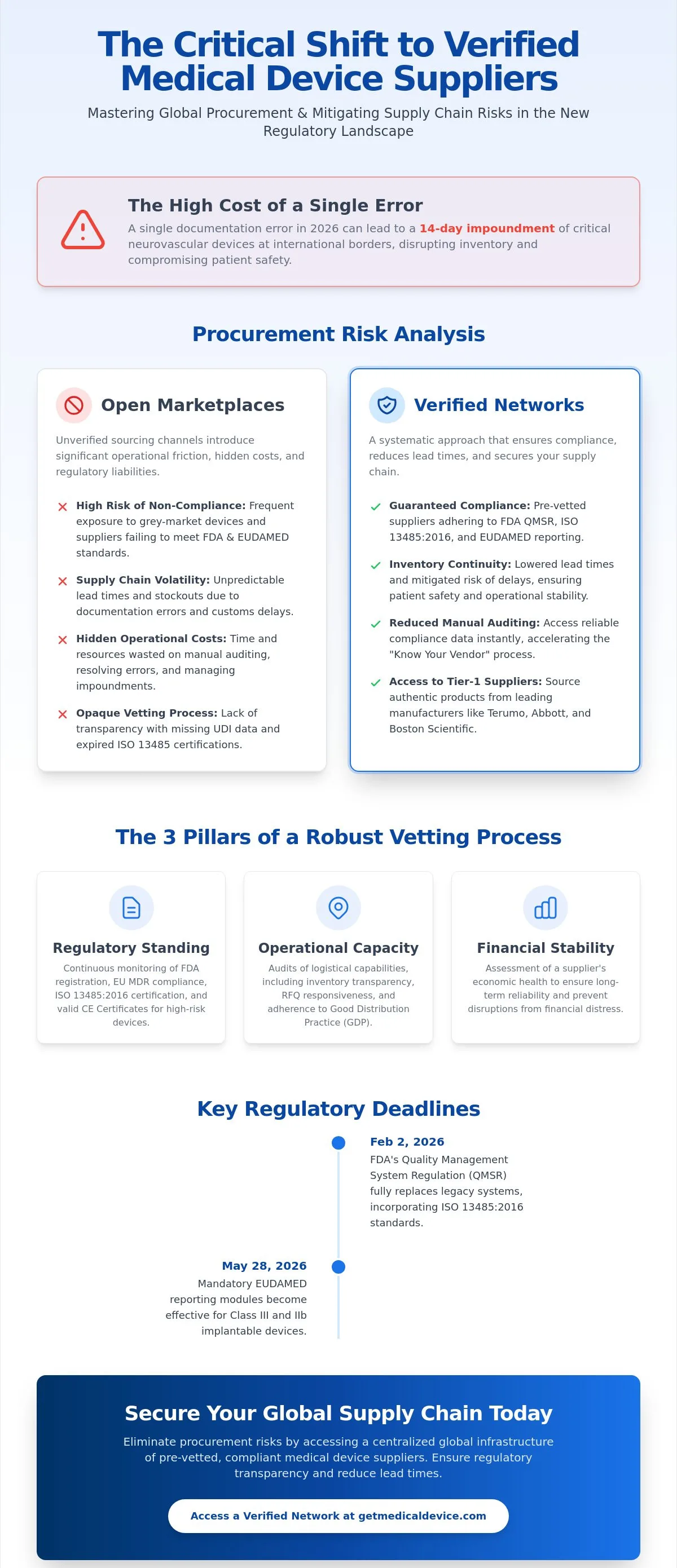
The economic impact of verification extends beyond simple unit costs. Open marketplaces introduce hidden expenses through documentation errors and supply chain volatility. A single documentation error can lead to a 14-day impoundment of critical neurovascular devices at international borders. Verified networks mitigate this risk by enforcing strict adherence to the FDA Quality Management System Regulation (QMSR), which replaced legacy systems on February 2, 2026. By utilizing pre-vetted channels, hospitals and distributors protect themselves from the liability associated with non-compliant or grey-market devices. This systematic approach ensures that patient safety remains the primary focus of every transaction.
Mitigating Supply Chain Risks through Verification
Identifying red flags in unverified global supplier listings is a mandatory skill for modern procurement managers. Common indicators of risk include missing Unique Device Identification (UDI) data or expired ISO 13485:2016 certifications. These gaps often signal that a supplier hasn't transitioned to the mandatory EUDAMED reporting modules required as of May 28, 2026. Verification acts as a filter that prevents grey-market entry and ensures the continuity of supply for critical interventional devices. When sourcing high-stakes equipment, relying on verified medical device suppliers is the only way to maintain a stable, compliant inventory.
The Evolution of Medical B2B Procurement
Medical procurement has moved away from manual directories toward real-time verified platforms. This evolution significantly accelerates the "Know Your Vendor" (KYV) process by providing immediate access to a supplier's technical credentials. Digital verification ensures that electronic Technical Files are formatted correctly for international trade, as paper-based documentation is no longer accepted in major trade zones. These platforms act as a knowledgeable bridge between complex global entities, handling intricate cross-border requirements with ease. Centralizing this documentation allows for a methodical business workflow that eliminates unnecessary delays and ambiguity in the procurement cycle.
Core Verification Standards: How Leading B2B Platforms Vet Suppliers
Vetting protocols for verified medical device suppliers must transition from periodic reviews to continuous monitoring systems. A robust verification framework prioritizes three pillars: regulatory standing, operational capacity, and financial stability. Leading B2B platforms utilize automated data feeds to verify that a supplier's Quality Management System (QMS) aligns with the FDA's Quality Management System Regulation (QMSR). This regulation, which incorporated ISO 13485:2016 as of February 2, 2026, ensures that the supplier's internal processes meet international standards for safety and efficacy. Static documentation is no longer sufficient for high-stakes procurement.
Understanding How to Verify FDA Device Status is fundamental to this process. Verification involves cross-referencing registration numbers against live databases to confirm active status. Beyond registration, platforms assess EU MDR compliance, specifically checking for valid CE Certificates for Class III and Class IIb implantable devices before the 2026 transition deadline. This systematic check prevents the acquisition of products that may lose their legal marketing status mid-contract. It's a necessary step to maintain regulatory continuity.
Logistical auditing is equally critical. Verification includes confirming that carriers possess Good Distribution Practice (GDP) certification, which was updated for 2026 compliance. This ensures the integrity of temperature-sensitive devices through the entire transit route. Real-time inventory transparency prevents the common procurement failure of ordering "ghost stock" that isn't actually available for dispatch. A verified network provides a clear view of current stock levels and logistical readiness.
- Verification of active FDA registration and EU MDR certification status.
- Audit of ISO 13485:2016 compliance under the new FDA QMSR framework.
- Assessment of GDP-certified logistics for temperature-sensitive equipment.
- Analysis of RFQ response history and historical fulfillment data.
Regulatory and Compliance Documentation
Verification requires proof of 510(k) clearances and CE markings through official Technical Files. International sourcing necessitates a designated Authorized Representative to handle regulatory queries within specific trade zones. Platforms now automate the monitoring of FDA warning letters and global recall databases to ensure that verified medical device suppliers maintain an unblemished safety record. This automated oversight reduces the manual burden on procurement teams while increasing the accuracy of the "Know Your Vendor" (KYV) process.
Operational and Logistical Auditing
Warehouse standards must be audited for sterile storage and environmental controls. Reliability is measured through historical lead times and RFQ response rates. A high RFQ response frequency indicates a supplier's organizational competence and readiness to fulfill high-volume orders. You can streamline your procurement by accessing a verified supplier membership to view these performance metrics directly. This data-driven approach ensures that selected partners can meet the technical requirements of surgical and vascular equipment without delay.
Verified Networks vs. Open Marketplaces: A Procurement Risk Analysis
Open marketplaces often prioritize quantity over technical accuracy, which introduces significant risk into the procurement cycle. While broad directories might suggest a high volume of options, they lack the rigorous vetting required to verify a supplier's current regulatory standing. Procurement professionals who utilize unverified sources face hidden costs, including the time-intensive manual verification of ISO 13485:2016 certifications and FDA registration status. In contrast, verified medical device suppliers within a structured network have already undergone these audits. This reduces the risk of sourcing grey-market products and ensures that all technical files align with the 2026 digital reporting mandates.
Vetted networks significantly outperform manual sourcing in lead-time efficiency. Manual vendor identification and auditing can take weeks; however, a professional B2B platform provides immediate access to pre-qualified entities. These platforms also offer transaction protection and data security protocols that open marketplaces often overlook. Identifying top-tier partners is further simplified through Premium Product Listings, which highlight suppliers with a proven track record of regulatory compliance and fulfillment reliability. This categorical framework allows project managers to allocate resources more efficiently without sacrificing safety.
The Cost of Procurement Failure
The ROI of a verified network membership is measured by the avoidance of stock-outs and legal liabilities. Sourcing from unverified suppliers increases the probability of receiving devices that don't possess a valid CE Certificate under the EU MDR rules for Class III implantables. Such failures lead to immediate impoundment and potential legal action. By utilizing verified medical device suppliers, hospitals can maintain lower stock-out rates for critical interventional devices. The cost of a single impoundment often exceeds the annual investment in a professional verified membership program.
Transparency and Communication Flow
Professional B2B platforms facilitate direct communication with manufacturers, eliminating the fragmentation caused by multiple middlemen. This transparency is reinforced through the use of RFQ Response Credits, which ensure that interactions between buyers and sellers remain serious and goal-oriented. Standardizing the data format for medical device technical files is another advantage of these systems. It ensures that all documentation is ready for the mandatory EUDAMED modules, which became mandatory on May 28, 2026. This streamlined communication flow is essential for handling intricate cross-border requirements with precision.
Implementing a Verified Sourcing Strategy for High-Stakes Devices
Implementing a sourcing strategy for high-stakes devices requires a linear, four-step progression to ensure regulatory alignment and operational efficiency. First, define the exact technical requirements for vascular and surgical equipment, including specific product codes and UDI parameters. This precision prevents requisition errors. Second, utilize specialized RFQ platforms to transmit these requirements to multiple verified medical device suppliers simultaneously. This parallel processing creates competitive tension and provides a broader view of current global inventory. It's a methodical approach that replaces the inefficiency of manual outreach.
Comparing bids involves more than price analysis. Evaluate submissions based on the supplier's verification tier, documented lead times, and their history of RFQ responsiveness. High-tier suppliers often provide more robust data security and transaction protection. Finally, establish long-term supply agreements within the platform to lock in availability for critical components. These agreements should include clauses for automatic technical file updates to remain compliant with the mandatory EUDAMED modules. This systematic workflow ensures no detail is overlooked during the procurement cycle.
Optimizing the RFQ Process
Crafting precise RFQs for established brands like Boston Scientific and Abbott Vascular is essential for technical accuracy. You should interpret supplier "Verified" badges as a confirmation of active ISO 13485:2016 certification under the current FDA QMSR framework. These badges indicate that the supplier has passed rigorous documentation audits. By using platform analytics, you can predict supplier performance based on historical fulfillment data. To start engaging with these entities, you can purchase RFQ Response Credits to initiate high-value professional interactions.
Global Sourcing Considerations
Managing cross-border regulatory differences is a primary challenge in 2026. You must verify that products intended for the European Union meet the Class III and Class IIb implantable device deadlines for CE Certificates. Simultaneously, ensure that US-bound inventory complies with the FDA's revised inspection program. Verified distributors play a vital role in emerging markets by acting as a knowledgeable bridge for complex cross-border requirements. For a deeper analysis of the available infrastructure, consider Evaluating Medical Device Wholesaler Platforms to determine which network best supports your regional compliance needs.
GetMedicalDevice: Accessing a Global Network of Verified Manufacturers
GetMedicalDevice functions as a sophisticated global infrastructure for the procurement of high-stakes interventional equipment. The platform's verified supplier membership program requires participants to maintain documented compliance with the latest international standards, including ISO 13485:2016. By utilizing this centralized system, procurement managers can identify verified medical device suppliers that possess the technical files necessary for 2026 regulatory submissions. The platform categorizes inventory through Premium Product Listings, allowing for the rapid identification of specific neurovascular and cardiology components that are often restricted in open markets.
The efficacy of the interaction is maintained through a credit-based RFQ system. By requiring RFQ Response Credits, the platform ensures that every inquiry represents a serious intent to purchase, which prioritizes high-quality responses from manufacturers. This methodical approach eliminates the noise associated with casual inquiries and allows for a steady, predictable business workflow. It's an indispensable tool for handling intricate cross-border requirements with clinical precision. The flow of data is linear, moving from technical requirement identification to verified fulfillment without the friction of unvetted middlemen.
Why Join a Verified Supplier Network?
Suppliers who join a verified network gain immediate global visibility and build trust through a rigorous auditing process. For buyers, the benefit is direct access to restricted inventory and pre-vetted partners who understand the 2026 regulatory environment. The future of medical device trading is moving toward these secure, digital-only frameworks where verification is a dynamic credential. This systematic approach reduces the risk of non-compliant devices entering the supply chain. It's a stable, well-oiled machine designed to handle high-value professional interactions without unnecessary delays.
Direct Access to Leading Brands
Sourcing authentic interventional products from Abbott Vascular, Terumo, and Asahi Intecc requires a transparent supply chain. GetMedicalDevice facilitates this by providing a knowledgeable bridge to these manufacturers through verified channels. Whether you're procuring Boston Scientific stents or Asahi Intecc guide wires, the platform ensures that all technical documentation is current and ready for EUDAMED reporting modules. Authenticity in high-value surgical equipment is guaranteed through these verified pathways. Join GetMedicalDevice as a Verified Supplier Today to begin optimizing your global procurement strategy and securing your position in the 2026 medical device landscape.
Securing Global Supply Chains for 2026 and Beyond
The medical procurement landscape in 2026 requires a definitive shift from manual auditing to data-driven verification. By aligning your strategy with the FDA's Quality Management System Regulation and mandatory EUDAMED reporting modules, your organization can effectively eliminate the risk of product impoundment at international borders. Utilizing verified medical device suppliers ensures that every interventional component, from neurovascular stents to cardiology guide wires, meets the highest regulatory thresholds for safety and efficacy. This systematic approach protects your inventory from the volatility of open marketplaces while guaranteeing the authenticity of high-value surgical equipment.
You can streamline your procurement workflow by joining a stable global infrastructure of verified professionals. Access the Verified Supplier Network on GetMedicalDevice to secure authentic products from Abbott, Boston Scientific, and Terumo through our rigorous 5-point verification process. This platform acts as an indispensable tool for handling intricate cross-border requirements with clinical precision. Establishing these verified connections today ensures operational continuity and patient safety in an increasingly complex global market.
Frequently Asked Questions
What is a verified medical device supplier?
A verified medical device supplier is an entity that has undergone a rigorous auditing process to confirm its regulatory compliance and operational stability. This includes active FDA registration, valid CE Certificates under EU MDR, and adherence to ISO 13485:2016 quality standards. Verification ensures the supplier is authorized to distribute specific medical equipment within designated trade zones and possesses the necessary technical documentation for international trade.
How does GetMedicalDevice verify its supplier members?
GetMedicalDevice employs a systematic 5-point verification process to vet all supplier members. This protocol involves cross-referencing FDA and EUDAMED databases, auditing Quality Management System documentation, and assessing historical fulfillment data. Only entities that demonstrate full transparency in their regulatory standing and inventory reliability are granted verified status on the platform, ensuring a secure procurement environment for buyers.
Why is ISO 13485 important when choosing a medical device supplier?
ISO 13485:2016 is the international standard for medical device quality management systems and is now incorporated into the FDA's Quality Management System Regulation (QMSR). Choosing verified medical device suppliers with this certification ensures that their internal processes prioritize safety and regulatory consistency. It provides a documented framework for risk management and traceability throughout the global supply chain.
Can I source brand-name devices like Boston Scientific through verified platforms?
Professional B2B platforms provide access to authentic interventional products from Tier-1 manufacturers such as Boston Scientific, Terumo, and Abbott Vascular. These platforms act as a knowledgeable bridge between buyers and authorized distributors, ensuring that high-value surgical equipment is sourced through legitimate channels. Verification prevents the entry of grey-market or counterfeit devices into your clinical inventory by requiring proof of authorized distribution status.
What are the risks of using unverified B2B marketplaces for medical equipment?
Unverified marketplaces introduce significant risks, including the acquisition of non-compliant devices and exposure to supply chain volatility. Sourcing from unvetted entities can lead to documentation errors that cause 14-day impoundments at international borders. These platforms often lack the oversight required to prevent the distribution of devices that fail to meet 2026 digital reporting mandates or EU MDR transition rules for Class III implantables.
How does the RFQ credit system work for medical device procurement?
The RFQ credit system requires participants to use credits to initiate or respond to technical inquiries. This mechanism ensures that every interaction represents a serious intent to transact, which reduces the volume of casual or non-qualified leads. It streamlines the procurement workflow by prioritizing high-quality data exchanges between professionals and authorized manufacturers, ensuring that technical requirements are addressed with precision.
What regulatory documents should I request from a new supplier?
You should request current FDA registration numbers, ISO 13485:2016 certificates, and valid CE Certificates for products entering the European Union. In 2026, it's also necessary to confirm the availability of electronic Technical Files and Unique Device Identification (UDI) data for all exported devices. These documents provide the objective evidence required to satisfy international customs and internal quality management audits.
How does verification impact medical device shipping and logistics?
Verification ensures that carriers and distributors adhere to Good Distribution Practice (GDP) standards, which were updated for 2026 compliance. This is critical for maintaining the integrity of temperature-sensitive devices during transit. Verified medical device suppliers utilize logistical partners that are pre-vetted for their ability to handle sterile surgical equipment and provide real-time tracking through mandatory digital customs portals.