What if the lowest unit price in your medical device contract is actually the most expensive mistake your organization makes this year? Negotiating medical device contracts in 2026 requires a shift from price-centric bargaining to a rigorous, data-driven strategy. With the FDA Quality Management System Regulation (QMSR) now in full effect as of February 2, 2026, and tariffs on specific components reaching as high as 145%, the margin for error has disappeared.
You understand that unforeseen supply chain disruptions and complex international regulatory standards create significant pressure on procurement teams. It's difficult to maintain clinical precision when hidden costs beyond the initial unit price threaten your budget. This article provides the framework to master the complexities of medical device contract negotiation by identifying and neutralizing hidden procurement risks. We will debunk five common myths to ensure you achieve a reduced total cost of ownership and establish verified, reliable partnerships with global suppliers. Additionally, for clinical staff who must stay current on the medications used alongside these devices, PharmEDU offers specialized pharmacology reviews to ensure professional excellence.
Key Takeaways
- Identify hidden operational expenses in sterilization and maintenance by transitioning from a price-centric model to a Total Cost of Ownership (TCO) framework.
- Replace outdated boilerplate clauses with specialized Quality Agreements that address the specific regulatory shifts and cybersecurity mandates of 2026.
- Enhance your strategic leverage when negotiating medical device contracts by establishing technical specifications before initiating contact with supplier sales teams.
- Move beyond the "one-time check" myth by implementing continuous monitoring protocols for ISO 13485 and evolving international quality standards.
- Utilize multi-source RFQ strategies to generate competitive tension and secure more robust legal protections within global supply agreements.
Table of Contents
- The Fallacy of Price-Centric Negotiation in Medical Device Procurement
- Debunking the "Standard Contract" Safety Net
- Strategic RFQ Management: Shifting the Power Dynamic
- The Verification Myth: Is a One-Time Check Enough?
The Fallacy of Price-Centric Negotiation in Medical Device Procurement
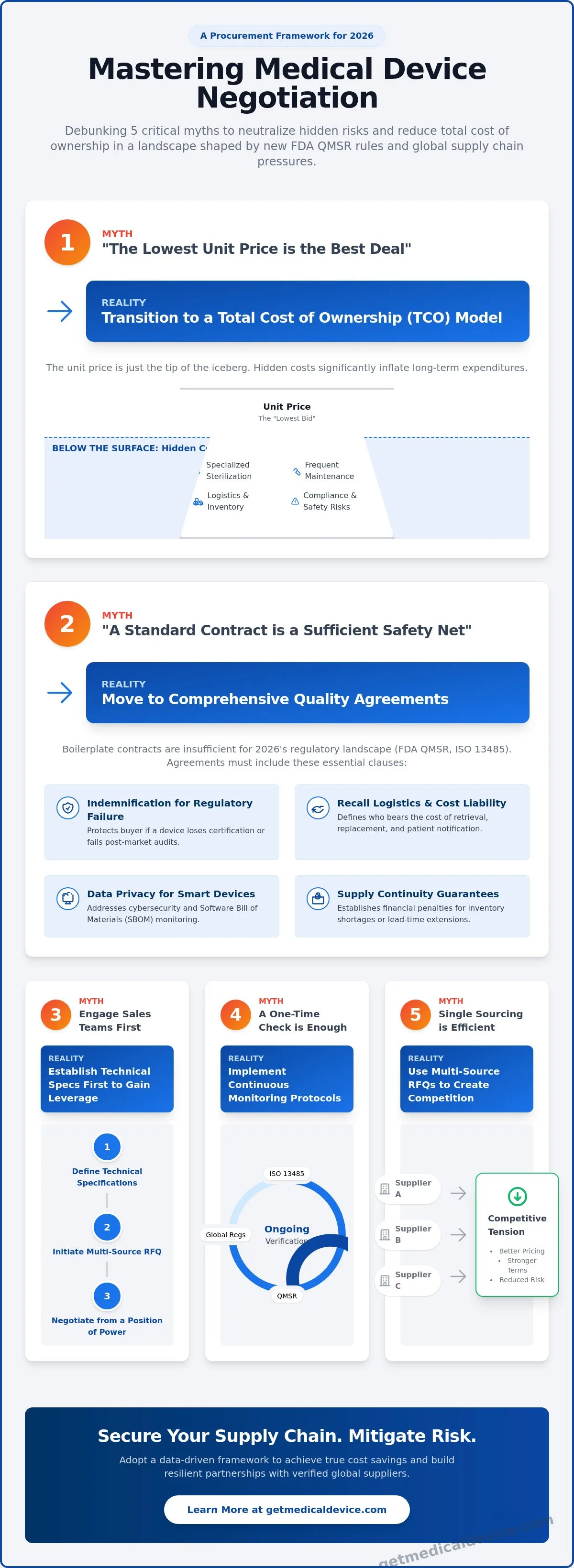
Procurement teams often equate success with securing the lowest unit price. This approach is fundamentally flawed in the high-stakes environment of 2026. Effective negotiating medical device contracts requires a transition to a Total Cost of Ownership (TCO) model. TCO is the sum of all costs associated with the purchase, operation, and maintenance of a medical device over its entire lifecycle. Relying on the "lowest bid" myth frequently results in inflated long-term expenditures. These costs manifest through specialized sterilization requirements, frequent maintenance cycles, and the logistical burden of managing short-dated inventory.
Many hospitals utilize a Group Purchasing Organization (GPO) to leverage collective buying power. While GPOs offer significant initial discounts, they don't always account for the technical nuances of specific clinical applications. A narrow focus on price increases the risk of acquiring "gray market" products. These items often lack verified provenance, which compromises patient safety and violates the FDA Quality Management System Regulation (QMSR) standards that became effective on February 2, 2026.
Identifying Hidden Costs in Interventional Cardiology Contracts
Precision is critical when procuring coronary intervention products. Contracts must account for shelf-life management and rapid replenishment protocols to prevent procedural delays. For complex catheters, the service level agreement (SLA) often dictates more of the contract's real-world value than the unit price. High-performance devices require consistent availability and technical support. If an SLA doesn't guarantee immediate replacement for defective units, the operational cost of a cancelled procedure far outweighs any initial savings.
The Myth of Fixed Pricing with Global Manufacturers
Procurement officers shouldn't assume that list prices from major brands like Abbott Vascular or Boston Scientific are immovable. Volume-based discounting remains a primary lever for cost reduction. Strategic buyers align their projected clinical volume with tiered pricing structures to capture value. It's essential to balance these unit prices against logistics certainties. In 2026, a slightly higher price from a supplier with verified, stable freight forwarding is often more cost-effective than a cheaper alternative prone to supply chain disruptions.
This focus on reliability extends to specialized surgical fields. For those interested in how high-quality medical devices impact aesthetic results, you can explore Breast Augmentation at MG Plastic Surgery, where procurement standards meet clinical excellence.
Debunking the "Standard Contract" Safety Net
Standard boilerplate contracts are insufficient for the regulatory environment of 2026. With the FDA Quality Management System Regulation (QMSR) now aligning with ISO 13485:2016 and the mandatory use of EUDAMED modules as of May 28, 2026, generic terms leave procurement teams exposed. Successful negotiating medical device contracts involves moving beyond simple purchase orders to comprehensive Quality Agreements. These documents serve as technical appendices that define specific performance criteria and compliance obligations. They ensure that both parties understand the technical requirements for device safety and efficacy.
Professional procurement follows rigorous frameworks similar to those found in Contracting by Negotiation. To protect against systemic risks, every agreement should incorporate these four essential clauses:
- Indemnification for regulatory failure: This protects the buyer if the device loses certification or fails post-market surveillance audits.
- Recall logistics: This explicitly defines who bears the cost of retrieval, replacement, and patient notification during a field safety corrective action.
- Data privacy for smart devices: This addresses cybersecurity requirements and Software Bill of Materials (SBOM) monitoring mandated by the 2026 QMSR.
- Supply continuity guarantees: This establishes financial penalties for unannounced inventory shortages or lead-time extensions.
For a structured approach to these requirements, refer to the 2026 Medical Device Procurement Checklist. This framework helps verify that all necessary legal protections are present before execution.
Specific Safeguards for Neurovascular and Surgical Products
High-precision neurovascular equipment requires contracts that specify exact tolerances and specialized delivery conditions. For surgical products, the focus shifts to Sterility Assurance Levels (SAL). Standard contracts often omit these technical parameters; this omission risks clinical complications and regulatory non-compliance during audits.
Regulatory Compliance vs. Contractual Liability
A common myth suggests that FDA clearance automatically places all liability on the supplier. In reality, contracts must define liability boundaries for off-label use or improper hospital storage. Organizations can mitigate these risks by sourcing through a verified medical device supplier to ensure that all technical documentation and liability clauses are current and accurate.
Strategic RFQ Management: Shifting the Power Dynamic
The Request for Quotation (RFQ) is often misused as a mere price-gathering exercise. In reality, it's a primary instrument for negotiating medical device contracts with precision. A structured RFQ process allows procurement officers to dictate terms rather than reacting to supplier proposals. A rigorous NIH contract evaluation model prioritizes technical merit and past performance alongside cost; this provides a blueprint for private sector procurement to move toward "best value" outcomes.
To maximize leverage, organizations must follow a methodical three-step approach:
- Step 1: Define comprehensive technical specifications internally before initiating contact with sales teams. This prevents vendors from shaping the requirements around their specific product features.
- Step 2: Implement a multi-source RFQ strategy. Engaging at least three verified suppliers creates the competitive tension necessary to secure favorable terms.
- Step 3: Analyze responses for transparency in logistical parameters. Evaluate lead times, shipping responsibilities (Incoterms), and rapid replenishment capabilities.
For detailed tactical steps, follow the Strategic Medical Device RFQ Process. This guide outlines the specific data points required to neutralize supplier advantages during the bidding phase.
Leveraging Data from Verified Supplier Platforms
Verified supplier memberships provide a baseline of trust that accelerates the legal review phase. By using platforms that pre-vet manufacturers, procurement teams eliminate the need for redundant foundational audits. Organizations can optimize their bidding process by utilizing RFQ response credits to engage with multiple pre-vetted manufacturers simultaneously. This is particularly effective when sourcing specialized interventional radiology devices, where technical specifications are narrow and supplier reliability is paramount.
Negotiating Delivery and Lead Time Guarantees
In the current global climate, lead time is often more negotiable than unit price. Suppliers may have fixed production costs but maintain flexibility in their inventory allocation. Contracts in 2026 should include tiered penalty clauses for delivery delays. A reasonable standard involves a percentage-based credit for every 48 hours a shipment is delayed beyond the agreed window. This ensures the supplier prioritizes your facility's orders during periods of high demand or logistical instability.
The Verification Myth: Is a One-Time Check Enough?
A common misconception in procurement is that supplier risk is eliminated once the initial vetting process is complete. This "verification myth" creates significant vulnerability over the duration of a long-term agreement. In the regulatory climate of 2026, a supplier's compliance status is dynamic. ISO 13485 certifications, FDA registration standing, and EUDAMED actor status can change due to audit findings or internal quality failures. Effective negotiating medical device contracts requires shifting from a static "snapshot" of a supplier to a model of continuous oversight.
Digital verification portals address this challenge by providing real-time access to a supplier's credentials. These platforms reduce negotiation friction by automating the collection of updated certificates and audit reports, which simplifies the audit trail for hospital procurement departments. Utilizing the Global Medical Device Sourcing and Procurement Framework ensures that your organization maintains a standardized, data-driven approach to ongoing supplier management throughout the contract lifecycle.
Integrating Verification into the Contract Lifecycle
Master Service Agreements (MSAs) must mandate periodic documentation updates as a condition of continued partnership. Relying on a one-time check at the start of a three-year contract is insufficient. Third-party verification services play a critical role here; they reduce the administrative burden on internal procurement teams by acting as an independent clearinghouse for regulatory data. This systematic approach ensures that every device in your inventory remains backed by current, verified technical documentation.
Future-Proofing Contracts for 2026 and Beyond
Modern contracts must also address evolving Environmental, Social, and Governance (ESG) requirements. Sustainability benchmarks are no longer optional additions but core components of resilient supply chains. Building long-term B2B success depends on establishing partnerships with suppliers who demonstrate transparency in both regulatory compliance and ethical manufacturing. By embedding these verification requirements directly into your agreements, you create a stable infrastructure capable of withstanding global market shifts and maintaining uninterrupted clinical operations.
Beyond operational stability, maintaining high standards in contract management is a key factor in the overall appraisal of a medical facility. When evaluating the market value of your business, Healthcare Biz Brokers, Inc. provides specialized brokerage and valuation services to help healthcare owners navigate transitions.
Shifting to a Risk-Mitigation Procurement Strategy
Success in 2026 requires a fundamental departure from legacy procurement habits. By prioritizing Total Cost of Ownership over initial unit price and replacing boilerplate terms with rigorous Quality Agreements, organizations can effectively neutralize hidden supply chain risks. Just as GoBuid enables organizations to maintain precise digital records for complex operations, mastering the process of negotiating medical device contracts now relies on ensuring operational continuity through verified data and continuous supplier oversight. This methodical approach transforms procurement from a reactive administrative function into a strategic asset for the entire healthcare facility.
Beyond organizational assets, the individuals who make these facilities run also benefit from specialized risk management. For professionals in high-stakes fields or those with complex health histories, Special Risk Term provides a way to secure life insurance when traditional providers might decline coverage due to specialized risk factors.
To execute this strategy with precision, procurement teams need access to a stable, global infrastructure. Utilizing a strategic RFQ system allows for maximum sourcing efficiency while maintaining strict adherence to international regulatory standards. You can secure your supply chain today by gaining direct access to leading brands such as Boston Scientific, Abbott, and Terumo through a platform designed for professional transparency. Access Verified Medical Device Suppliers for Your Next Procurement Cycle to leverage our Verified Supplier Membership status for trusted B2B transactions. Transitioning to a data-driven negotiation model ensures your organization remains resilient in an evolving global market.
Frequently Asked Questions
What are the most common risks in medical device procurement negotiations?
Primary risks include overlooking the Total Cost of Ownership (TCO) and failing to account for 2026 regulatory shifts such as the FDA's QMSR. Negotiations often stall when parties don't explicitly define liability for cybersecurity or recall logistics. These omissions lead to significant financial exposure during post-market surveillance audits or unexpected supply chain disruptions.
How do I negotiate with large medical device brands like Terumo or Asahi Intecc?
Negotiating with major manufacturers like Terumo or Asahi Intecc requires a data-driven approach centered on projected clinical volume. Procurement teams should utilize a multi-source RFQ strategy to create competitive tension between verified suppliers. By defining technical requirements before engagement, you prevent these large entities from dictating contract terms based on proprietary features.
Can I modify a Group Purchasing Organization (GPO) contract?
Organizations can modify the operational impact of a GPO contract by attaching specialized technical appendices or Quality Agreements. While the base pricing and terms are often fixed, these supplemental documents allow for the customization of service levels and delivery guarantees. This ensures the agreement meets specific institutional needs without violating the master GPO structure.
What is the role of a Quality Agreement in medical device sales?
A Quality Agreement acts as a critical technical bridge that defines the specific quality standards and regulatory responsibilities for each party. In 2026, these agreements are essential for documenting compliance with ISO 13485 and the new FDA QMSR mandates. They provide the legal framework for managing device lifecycle accountability and mandatory post-market reporting requirements.
How does supplier verification reduce the time spent on contract negotiations?
Supplier verification streamlines negotiating medical device contracts by providing a pre-vetted baseline of regulatory and financial data. When manufacturers are already verified against international standards, legal teams spend significantly less time on foundational due diligence. This automation allows procurement departments to focus on strategic terms such as lead-time guarantees and tiered discounting structures.