
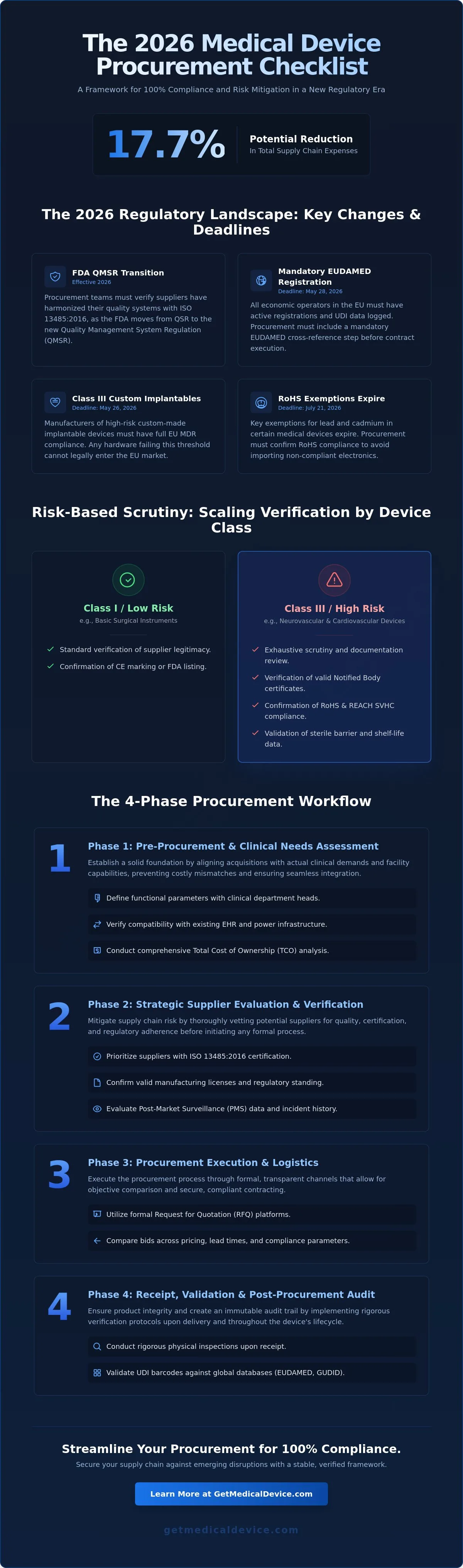
Optimizing healthcare procurement processes can reduce total supply chain expenses by up to 17.7 percent according to the Healthcare Supply Chain Association. However, achieving these savings requires navigating a regulatory landscape that has become significantly more complex in 2026. You're likely managing the transition to mandatory EUDAMED registration on May 28 and the strict May 26 deadline for Class III custom-made implantable devices. This medical device procurement checklist provides the structural framework necessary to maintain 100 percent compliance while mitigating the risks of counterfeit or substandard hardware.
We recognize that procurement is now a matter of digital verification and precise regulatory data synchronization. This article outlines a repeatable workflow to streamline your sourcing of Class III devices and ensure all documentation meets the latest EU MDR and FDA QMSR standards. You'll learn how to manage expiring RoHS exemptions and implement systematic verification steps that reduce lead times and secure your global supply chain against emerging disruptions. This framework ensures your procurement office functions as a stable, verified bridge between complex global manufacturers and clinical requirements.
Key Takeaways
- Understand how the 2026 transition to FDA QMSR and EU MDR mandates a shift from manual logs to digital data synchronization.
- Implement a systematic medical device procurement checklist to standardize clinical needs assessments and infrastructure compatibility checks.
- Identify high-quality components from verified medical device suppliers by prioritizing ISO 13485:2016 certification and valid manufacturing licenses.
- Optimize procurement execution by utilizing formal RFQ platforms to compare bids across pricing, lead times, and regulatory compliance parameters.
- Ensure product integrity through rigorous post-procurement audits, including physical inspections and UDI barcode validation against global databases.
Table of Contents
- The 2026 Regulatory Landscape for Medical Device Procurement
- Phase 1: Pre-Procurement and Clinical Needs Assessment
- Phase 2: Strategic Supplier Evaluation and Verification
- Phase 3: Procurement Execution and Logistics Checklist
- Phase 4: Receipt, Validation, and Post-Procurement Audit
The 2026 Regulatory Landscape for Medical Device Procurement
Medical device procurement is a multi-stage risk management process that dictates patient safety and institutional liability. It's no longer a simple transactional exchange; it's a rigorous data-verification cycle. Effective procurement requires a systematic approach to ensure every piece of hardware meets the intensified global standards of 2026. Utilizing a standardized medical device procurement checklist is now a requirement for maintaining ISO 13485:2016 compliance, as it provides the necessary audit trail for quality assurance and regulatory alignment. This process sits at the center of the Medical Equipment Management Lifecycle, ensuring that acquisition protocols match the technical complexity of modern clinical tools.
Key Regulatory Changes Effective in 2026
The regulatory environment underwent a fundamental shift this year. The FDA has completed its transition from the Quality System Regulation (QSR) to the Quality Management System Regulation (QMSR). Procurement teams must now verify that every medical device supplier has harmonized their internal processes with ISO 13485:2016. Verification of these updated Quality Management Systems is essential to prevent supply chain rejection at the point of receipt.
In the European market, May 28, 2026, marked the deadline for mandatory EUDAMED registration. All economic operators, including manufacturers and distributors, must have active registrations and Unique Device Identification (UDI) data logged in the system. Procurement cycles must now include a mandatory step to cross-reference EUDAMED data before final contract execution. Additionally, post-market surveillance (PMS) data requirements are now integrated into the procurement phase. You must evaluate a manufacturer's clinical evidence and incident reporting history as part of the initial selection criteria to mitigate long-term operational risks.
Risk Categorization by Device Class
Procurement rigor must scale according to the risk classification of the hardware. Class I devices, such as basic surgical instruments, require standard verification of CE marking or FDA listing. However, Class III devices demand an exhaustive level of scrutiny. Manufacturers of Class III custom-made implantable devices faced a critical May 26, 2026, deadline for full EU MDR compliance. Any hardware failing this threshold cannot legally enter the market.
High-stakes hardware, particularly neurovascular and cardiovascular devices from brands like Terumo, Abbott Vascular, or Boston Scientific, requires specialized documentation thresholds. When sourcing these items, your medical device procurement checklist should prioritize the following:
- Verification of valid Notified Body certificates for EU-bound Class III devices.
- Confirmation of RoHS compliance, specifically regarding lead and cadmium exemptions that expired on July 21, 2026.
- Evidence of REACH SVHC notifications for any substances exceeding 0.1% w/w concentration.
- Validation of sterile barrier integrity and shelf-life stability data for implantable interventional hardware.
By categorizing devices by risk, procurement offices can allocate resources where they're most needed. This ensures that complex devices from suppliers like Asahi Intecc or Abbott receive the technical oversight required for safe clinical deployment.
Phase 1: Pre-Procurement and Clinical Needs Assessment
The foundation of a successful acquisition cycle begins with a rigorous clinical needs assessment. This phase ensures that every purchase aligns with actual patient volume and the technical capabilities of the facility. Establishing clinical requirements requires direct consultation with department heads to define the functional parameters of the hardware. This proactive step prevents the acquisition of redundant technology and ensures that the medical device procurement checklist reflects the specific procedural demands of the hospital. Verification of device compatibility with existing infrastructure is equally critical. You must confirm that new hardware integrates with current electronic health records (EHR) and power systems without requiring unplanned modifications.
A comprehensive Total Cost of Ownership (TCO) analysis is mandatory during this phase. Procurement teams shouldn't focus solely on the initial purchase price. You must account for long-term expenses, including specialized staff training, recurring maintenance contracts, and the cost of proprietary consumables. Utilizing Hospital Procurement Resources can assist in identifying these hidden costs and evaluating the sustainability of the supply chain. Before moving to the evaluation stage, you must confirm that the device holds the necessary regulatory certifications, such as a CE Mark or FDA 510(k) clearance, as established in the 2026 regulatory framework.
Defining Technical and Clinical Specifications
Drafting functional requirements for specialized interventional tools requires a high level of precision. When sourcing high-stakes hardware, you must distinguish between brand-specific features and essential performance benchmarks. For example, the requirements for cardiovascular tools from Abbott Vascular may differ significantly from the specifications of Terumo or Asahi Intecc systems. You must set minimum performance thresholds for surgical equipment, including torque response, trackability, and radiopacity for interventional devices. Defining these technical parameters early allows you to filter out inadequate options before the formal bidding process begins. To start identifying hardware that meets these strict criteria, you can research a verified medical device supplier to ensure quality from the outset.
Budgetary and Administrative Approval
Aligning procurement requests with quarterly hospital budgets is a logistical necessity. High-value Class III devices often require multi-departmental sign-offs, involving clinical, financial, and risk management leads. This collaborative approval process ensures that the acquisition is financially viable and clinically justified. Given the extended 2026 lead times for complex implantable hardware, you must establish a realistic procurement timeline. This timeline should account for the mandatory EUDAMED registration checks and the potential for manufacturing delays in high-demand categories like neurovascular hardware from Boston Scientific. Securing administrative approval early in the medical device procurement checklist prevents bottlenecks during the final execution phase.
Phase 2: Strategic Supplier Evaluation and Verification
Strategic evaluation in 2026 demands a shift toward digital-first verification protocols. The traditional reliance on paper-based certifications is insufficient for modern compliance standards. You must utilize digital platforms to identify verified medical device suppliers who demonstrate a consistent history of regulatory adherence. This stage of the medical device procurement checklist focuses on vetting the operational integrity of a partner before any financial commitment is made. It's a critical step to ensure that the infrastructure supporting your clinical tools is as reliable as the devices themselves.
The Digital Verification Framework
Inventory transparency is a non-negotiable requirement for maintaining a stable supply chain. You can leverage premium product listings to gain real-time visibility into available stock levels and technical specifications. A supplier's 'Verified' status on global B2B marketplaces serves as an initial filter, but it doesn't replace formal due diligence. You must cross-reference all provided supplier data with the EUDAMED database and FDA registration listings to ensure active compliance status. This dual-layer verification prevents the onboarding of manufacturers who may have lost their legal standing in specific jurisdictions or those who've failed to update their actor registration.
Verification of ISO 13485:2016 certification is the minimum threshold for quality management. Beyond this, you must conduct a thorough review of previous regulatory recalls or FDA warning letters associated with the supplier. Analyzing these records provides insight into the manufacturer's internal quality controls and their responsiveness to safety concerns. Additionally, you must assess the supplier's capacity to provide technical support and clinical training. Complex hardware from brands such as Terumo or Abbott Vascular requires specialized instruction to ensure safe deployment in clinical settings. A supplier's inability to provide on-site or remote technical assistance should be viewed as a significant risk factor.
Performance and Reliability Audits
Historical performance is the most reliable predictor of future fulfillment. You should review the accuracy of previous RFQ responses and fulfillment rates to identify potential bottlenecks. Requesting and verifying references from similar healthcare facilities provides a practical perspective on the supplier's reliability. For temperature-sensitive or fragile devices, such as those from Asahi Intecc, you must evaluate the supplier's logistical capabilities. Confirming that a partner has the necessary infrastructure to maintain sterile barrier integrity during transit is a non-negotiable step in the medical device procurement checklist. This evaluation ensures that products arrive in clinical-ready condition, preventing costly delays and patient safety risks.
Phase 3: Procurement Execution and Logistics Checklist
Standardization of the bidding process is the primary objective of Phase 3. After defining clinical requirements and vetting suppliers, you must issue formal requests for quotes through a medical device RFQ platform. This centralized approach ensures that all vendors receive identical specifications, which is essential for an objective comparison. An effective medical device procurement checklist at this stage focuses on the structural alignment of the bid with the hospital's technical and budgetary constraints. It's the point where theoretical needs meet market availability, requiring a high degree of administrative precision to avoid future logistical bottlenecks.
The RFQ and Bidding Process
Reviewing bids requires a methodical analysis of more than just the unit price. You must evaluate lead times and compliance status against the 2026 regulatory benchmarks, such as the May 26 deadline for Class C in-vitro diagnostic devices to lodge applications with Notified Bodies. For interventional cardiology devices, such as those from Abbott Vascular or Boston Scientific, you must analyze technical data sheets to ensure torque and trackability meet clinical benchmarks. Negotiation should focus on finalizing Quality Agreements and Purchase Orders (POs) that clearly define warranty terms, service level agreements (SLAs), and necessary staff training. This documentation acts as the legal safeguard for the institution's investment. You don't want to finalize a contract only to discover the supplier's Quality Management System (QMS) hasn't fully transitioned to the 2026 FDA QMSR standards.
Logistics and International Trade Compliance
International sourcing introduces specific logistical complexities that require precise documentation. You must verify all export and import paperwork, including Incoterms and Certificates of Origin, to prevent delays at customs. Every piece of packaging must demonstrate UDI compliance, a mandatory requirement as of May 2026. Managing the customs clearance for specialized hardware, such as guidewires from Asahi Intecc or catheters from Terumo, requires proactive tracking. This prevents sterile barrier integrity from being compromised by unnecessary storage at transit hubs. Additionally, you must verify that components are compliant with the July 21, 2026, RoHS lead and cadmium exemption expirations. Integrating these specific checks into your medical device procurement checklist ensures a predictable delivery schedule for high-stakes hardware. To initiate your next procurement cycle with verified data, use a medical device RFQ platform to connect with leading global suppliers and secure compliant inventory.
Phase 4: Receipt, Validation, and Post-Procurement Audit
The final stage of the medical device procurement checklist involves the physical transition of the asset into the clinical environment. This phase establishes the formal operational record of the device within the hospital's infrastructure. Upon arrival, you must perform an immediate inspection of the physical condition and packaging integrity. Any breach in the sterile barrier of interventional tools, such as stents from Abbott Vascular or catheters from Terumo, renders the device unusable. You must verify UDI barcodes against the original purchase order and the EUDAMED database to confirm the hardware matches the registered specifications. This verification step is a mandatory requirement following the May 2026 implementation of mandatory actor and device registration in the EU.
Incoming Quality Control (IQC)
A systematic physical inspection protocol is necessary for all sterile devices. You must confirm that the sterile packaging hasn't been compromised during transit and that all tamper-evident seals remain intact. Verification of lot numbers and expiration dates for consumable medical devices is the next priority. For high-volume consumables, such as guidewires from Asahi Intecc, cross-referencing lot numbers ensures that the inventory is part of a compliant production run. If you identify non-conformities, such as damaged packaging or documentation gaps, you must initiate the supplier return process immediately. Documenting these discrepancies is essential for maintaining an accurate quality record and holding the manufacturer accountable for transit-related failures.
Once the physical inspection is complete, you must conduct Acceptance Testing (AT) and functional validation. This process ensures the hardware operates according to the manufacturer's stated performance benchmarks. For durable equipment, this includes electrical safety checks and software version verification to ensure alignment with the 2026 FDA QMSR standards. After successful validation, you must log the device into the hospital’s Asset Management System, assigning a unique internal tracking ID that links back to the original UDI data.
Training and Lifecycle Management
Closing the procurement cycle requires a commitment to staff competency and long-term maintenance. You must schedule clinical staff training for any new interventional technology, particularly for complex systems from brands like Boston Scientific. Training should be documented and linked to the specific device serial numbers to satisfy regulatory audit requirements. Establishing a preventative maintenance (PM) schedule is the final administrative step for durable equipment. This schedule must adhere to the manufacturer's guidelines to prevent premature failure and ensure patient safety throughout the device's lifecycle.
The loop is finally closed by updating your Approved Supplier List (ASL) based on the supplier's performance during this cycle. You should evaluate the partner on delivery accuracy, documentation quality, and the responsiveness of their technical support. Maintaining a high-performance ASL is simplified when you utilize a Verified Supplier Membership to track manufacturer credentials and compliance history. This data-driven approach ensures that your medical device procurement checklist remains a dynamic tool that improves with every acquisition cycle.
Standardizing Global Procurement Excellence
The 2026 regulatory environment mandates a shift from manual oversight to automated, data-driven verification. By implementing this medical device procurement checklist, your organization ensures that every acquisition aligns with the latest FDA QMSR and EU MDR requirements. You've established a workflow that prioritizes clinical necessity, verifies supplier integrity through digital frameworks, and maintains sterile barrier safety during complex logistical transitions. This systematic approach isn't just about compliance; it's about building a resilient, high-performance supply chain that handles Class III hardware with clinical precision.
Securing inventory from manufacturers like Abbott, Terumo, and Boston Scientific requires a platform that mirrors these rigorous standards. Our 2026 compliance-ready infrastructure provides the transparency needed to verify supplier status and manage premium product listings with confidence. You can access our global network of verified medical device suppliers today to streamline your next procurement cycle. Establishing these verified connections now ensures your facility remains a stable link in the global healthcare infrastructure.
Frequently Asked Questions
What is the most critical step in the medical device procurement checklist for 2026?
Digital verification of the manufacturer's registration status in the EUDAMED database is the most critical step. As of May 28, 2026, all economic operators must be registered to place devices on the EU market. Failure to verify this status during the medical device procurement checklist process results in the acquisition of hardware that lacks legal standing for clinical use.
How has the FDA QMSR changed the procurement process for US-based facilities?
The FDA Quality Management System Regulation (QMSR) transition requires US facilities to verify that their suppliers have aligned internal quality systems with ISO 13485:2016. Procurement teams must now evaluate a supplier's quality management documentation through the lens of this international standard rather than the legacy QSR. This ensures a harmonized global approach to device safety and manufacturing consistency across the supply chain.
Why is UDI (Unique Device Identification) mandatory in the procurement cycle?
Unique Device Identification is mandatory because it provides the foundation for global traceability and post-market surveillance. In 2026, UDI data must be logged in regulatory databases to facilitate rapid recalls and monitor device performance in clinical settings. This identification ensures that every component can be tracked through its entire lifecycle, reducing the risk of using substandard or expired hardware.
How can I verify if a medical device supplier is legitimate and compliant?
You can verify a supplier's legitimacy by cross-referencing their registration data in the EUDAMED and FDA databases against their provided ISO 13485:2016 certificates. Legitimate suppliers often maintain a Verified Supplier Membership, which provides an additional layer of third-party credentialing. This verification process should also include a review of previous regulatory warning letters or recall histories to assess operational reliability.
What documentation is required for international medical device sourcing?
International sourcing requires a comprehensive set of documentation, including standardized Incoterms, Certificates of Origin, and evidence of RoHS compliance. Specifically, you must verify that hardware meets the July 21, 2026, deadline regarding lead and cadmium exemptions. Technical data sheets and sterile barrier validation reports are also essential for clearing customs and ensuring the hardware meets local clinical standards.
How do B2B marketplaces like GetMedicalDevice simplify the procurement process?
B2B marketplaces simplify procurement by centralizing access to premium product listings from recognized brands like Boston Scientific, Terumo, and Abbott Vascular. These platforms provide immediate inventory transparency and standardized RFQ templates, which reduce administrative friction. By using a pre-vetted network, procurement offices can bypass the initial manual screening phase and focus on technical evaluation and contract finalization.
What are the risks of skipping a formal procurement checklist?
Skipping a formal medical device procurement checklist increases the risk of acquiring non-compliant or counterfeit hardware, which leads to significant legal liability. You also face the potential for supply chain disruptions if devices are rejected at the point of receipt due to documentation gaps. This negligence can compromise patient safety and result in the loss of institutional accreditation or severe regulatory fines.
How often should the Approved Supplier List (ASL) be audited?
The Approved Supplier List should be audited at least annually, though high-risk Class III suppliers often require quarterly reviews. These audits should evaluate the manufacturer's ongoing adherence to 2026 regulatory updates and their performance regarding lead times and product quality. Regular monitoring ensures that your supply chain remains stable and that all partners maintain their verified status in a fluctuating global market.