
What if the Terumo guidewire for sale in your current procurement queue originated from an unverified grey-market source rather than a documented distribution channel? In a global market valued at approximately $2.1 billion in 2026, the risk of counterfeit interventional consumables remains a critical threat to hospital operations. You understand that sourcing these devices requires more than locating inventory; it necessitates a rigorous verification process to mitigate supply chain disruptions and address the lack of transparency in international B2B pricing.
This guide establishes a professional framework for hospital supply chain managers to secure authentic Terumo products at scale. You'll gain the specific tools needed to verify supplier credentials and optimize procurement costs through data-driven RFQ bidding. We'll outline the systematic steps for inventory stabilization and provide a technical overview of the current guidewire market to ensure your procurement strategy aligns with clinical requirements and regulatory standards.
Key Takeaways
- Identify the technical specifications of Nitinol-core technology and hydrophilic coatings that ensure kink resistance and precise torque control during interventional procedures.
- Analyze the most frequently utilized diameter and length variants to select the optimal Terumo guidewire for sale for specific clinical access requirements.
- Execute a rigorous 5-step verification protocol to secure your supply chain against counterfeit products and grey-market inconsistencies.
- Evaluate global distribution requirements and regulatory documentation, such as FDA 510(k) and CE Mark MDR, to ensure cross-border procurement compliance.
- Utilize Verified Supplier Memberships and structured RFQ bidding to optimize procurement costs and establish reliable relationships with medical device suppliers.
Table of Contents
- The Terumo Guidewire Portfolio: Clinical and Procurement Overview
- Technical Roundup: Comparing Terumo Guidewire Variants
- Strategic Procurement: How to Buy Terumo Guidewires Safely
- Global Sourcing and Logistics for International Buyers
- Secure Your Terumo Supply Chain with GetMedicalDevice
The Terumo Guidewire Portfolio: Clinical and Procurement Overview
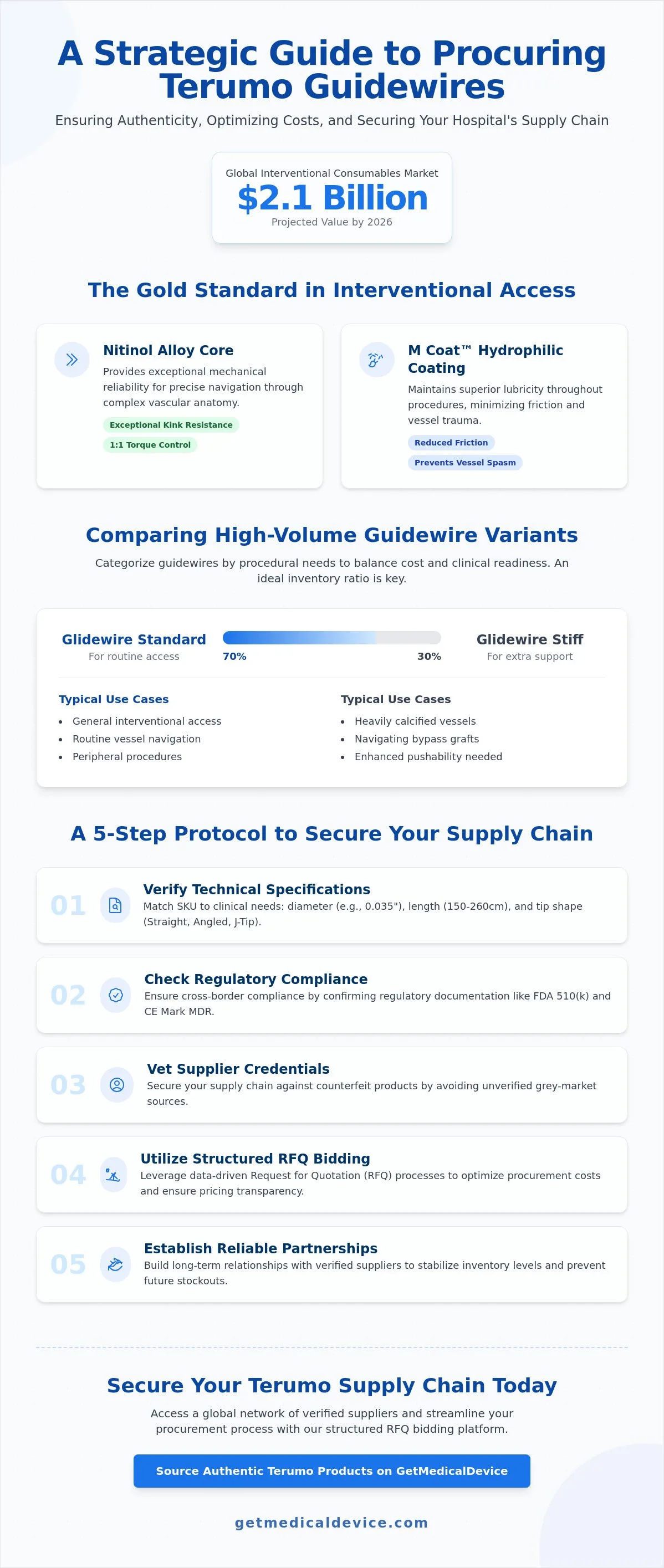
Terumo guidewires represent the industry standard for hydrophilic-coated interventional access. The Terumo Corporation has engineered these devices to facilitate precise navigation through complex vascular anatomy. The core technology relies on a Nitinol alloy core, which provides exceptional kink resistance and 1:1 torque control. This mechanical reliability ensures that the proximal manipulation of the wire translates directly to the distal tip, which is a critical factor for successful catheter placement. For procurement officers, understanding these technical attributes is vital when evaluating a Terumo guidewire for sale from various suppliers.
The proprietary M Coat hydrophilic coating remains the gold standard in 2026. This coating maintains lubricity throughout prolonged procedures, minimizing friction during insertion and advancement. By reducing resistance, the coating helps prevent vessel wall trauma and spasm. High clinical demand for these wires makes them a mandatory inventory item for interventional radiology suites. Securing a stable supply of a Terumo guidewire for sale via verified channels is essential to maintain procedural throughput and patient safety standards within high-volume medical facilities.
Key Clinical Benefits for Supply Chain Justification
Operational efficiency in the interventional suite depends on predictable device performance. Terumo guidewires offer specific advantages that justify their inclusion in standardized procurement lists:
- Reduced procedure times: Superior vessel navigation allows clinicians to reach target sites faster, which increases room turnover rates and optimizes hospital resources.
- Lower complication rates: Atraumatic tip designs minimize the risk of dissections or perforations during tortuous vessel access, reducing the potential for costly post-procedure interventions.
- Universal compatibility: These wires integrate seamlessly with a broad range of microcatheters, balloons, and stents, simplifying inventory requirements across different clinical departments.
Standard vs. Specialty Guidewire Categories
The portfolio is divided into distinct families based on clinical application. The Glidewire family is the primary choice for peripheral and general interventional access, whereas the Runthrough coronary wires are optimized for cardiac procedures. Procurement teams should identify high-volume SKUs, particularly in the 0.035 inch and 0.018 inch diameters, to establish baseline inventory levels that prevent stockouts. For neurovascular access, the Gold and GT series provide the specialized flexibility required for intracranial navigation. When you're searching for a Terumo guidewire for sale, it's necessary to verify the specific series and tip configuration to match the clinical department's technical requirements.
Technical Roundup: Comparing Terumo Guidewire Variants
Procurement managers must categorize Terumo guidewires based on specific procedural requirements to ensure clinical efficacy and cost control. The three most sought-after families include the Standard Glidewire, the Glidewire Stiff, and the Advantage series. Diameters typically range from 0.018 inches for micro-access to 0.035 inches for standard diagnostic and interventional procedures. Lengths vary between 150cm and 260cm to accommodate different catheter systems and exchange techniques. When evaluating a Terumo guidewire for sale, verify that the SKU matches the required tip shape. Straight, angled, and J-tip configurations serve distinct navigational purposes within the vascular system. Technical documentation, such as the FDA 510(k) clearance for Terumo Radifocus Glidewire, confirms the device's intended use and performance parameters, providing a baseline for quality assurance during the sourcing process.
Glidewire Standard vs. Glidewire Stiff
The Standard Glidewire is the baseline for most interventional suites, providing the flexibility needed for routine vessel access. The Stiff variant is necessary for navigating heavily calcified vessels or bypass grafts where extra support is required. Many facilities maintain an inventory ratio of approximately 70% standard to 30% stiff variants to balance cost and clinical readiness. The stiff variant features a shorter taper length and a more robust core-to-tip transition. This design enhances pushability without sacrificing the lubricity of the hydrophilic coating. Identifying these procurement patterns helps prevent overstocking of specialty items while ensuring clinicians have the necessary tools for complex cases.
Specialized Wires: Glidewire Advantage and GT Series
The Glidewire Advantage serves as a hybrid solution for transitionless access. It combines a stiff proximal shaft for device support with a hydrophilic distal end for atraumatic navigation. This design often eliminates the need for wire exchanges, which reduces procedure time and equipment waste. The Glidewire GT series incorporates gold markers to provide high visibility under fluoroscopy, which is vital for precise neurovascular or peripheral measurements. Sourcing these specialty wires often involves longer lead times compared to standard SKUs. Procurement professionals can streamline this by engaging with a verified medical device supplier to secure consistent stock levels and mitigate supply chain disruptions. When you find a Terumo guidewire for sale in these specialized categories, it's essential to confirm the manufacturer's lead times to maintain inventory stability.
Strategic Procurement: How to Buy Terumo Guidewires Safely
Buying medical devices at scale requires a systematic approach to risk mitigation. When a procurement manager identifies a Terumo guidewire for sale through a non-traditional channel, the immediate priority must be verification. Spot-buying from unverified sources threatens patient safety and hospital compliance, as it bypasses established quality management systems. A structured 5-step verification process ensures that every unit entering the interventional suite meets the rigorous standards established by the manufacturer. This process includes supplier credentialing, provenance verification, documentation review, regulatory cross-referencing, and final quality inspection upon arrival. It's essential to remember that clinical reliability begins with the integrity of the supply chain.
Documentation remains the primary defense against supply chain infiltration. Buyers should mandate the provision of Certificates of Analysis (COAs) and sterilization records for every batch. Cross-referencing these documents with the Terumo Radifocus Glidewire FDA 510(k) Clearance allows procurement teams to confirm that the technical specifications of the product match the cleared regulatory profile. Discrepancies in material composition or performance data are significant red flags that require immediate investigation.
Verifying Supplier Credentials and Provenance
Secondary distributors must demonstrate adherence to ISO 13485 standards for medical device quality management. Procurement teams should inspect product packaging for grey market indicators, such as altered labels, inconsistent typography, or missing manufacturer addresses. Lot number tracking is indispensable for recall management; any supplier unable to provide electronic tracking data for specific lots should be disqualified. This level of scrutiny ensures that any Terumo guidewire for sale through your distribution network has a transparent chain of custody from the factory to the hospital dock. Don't overlook the importance of verifying the physical condition of the outer cartons, as damaged packaging can compromise the sterile barrier of the device.
Utilizing RFQs for Competitive B2B Pricing
Leveraging a Request for Quote (RFQ) process is the most effective method to secure volume-based pricing. A well-structured RFQ for Terumo consumables should specify the exact SKUs, expected annual volumes, and required delivery schedules to attract verified bids. When evaluating these bids, focus on the total cost of ownership rather than the unit price alone. This calculation must include shipping costs, import duties, and the potential impact of longer lead times on inventory carrying costs. Negotiating multi-year supply contracts for interventional radiology departments provides price stability and ensures a consistent flow of critical consumables. This strategic approach protects the facility against sudden market fluctuations or supply chain bottlenecks that could otherwise delay urgent clinical procedures.
Global Sourcing and Logistics for International Buyers
Managing a global supply chain for interventional consumables requires precise coordination between regional distributors and hospital procurement offices. The Terumo global distribution network in 2026 operates across multiple jurisdictions, each with specific regulatory requirements. Sourcing a Terumo guidewire for sale internationally necessitates verification of FDA 510(k) clearance for North American markets or CE Mark (MDR) certification for European distribution. Local health authority registrations must be active in the destination country to prevent seizure at the border. Diversifying supplier sourcing across different geographic regions mitigates the risk of localized supply chain disruptions and ensures a consistent flow of critical access devices.
Storage conditions are a technical requirement that procurement teams often overlook. Hydrophilic coatings are sensitive to extreme temperature fluctuations and humidity. Standard logistics protocols must include climate controlled environments to maintain the integrity of the coating. Failure to adhere to these storage parameters can lead to coating delamination or reduced lubricity, compromising clinical outcomes. Procurement managers should demand temperature logs from logistics providers for high-volume international shipments. This level of oversight ensures that the device performance remains consistent with the manufacturer's specifications upon arrival at the clinical site.
Import/Export Compliance for Medical Devices
Efficiency in international transit depends on accurate documentation and classification. Guidewires are classified under HS Code 9018.39. Incorrect classification often results in significant customs delays and additional duties. International buyers must ensure that all commercial invoices, packing lists, and certificates of origin are meticulously prepared. In regions like the EU or North America, maintaining a relationship with an authorized representative is a legal necessity for non-resident manufacturers. These entities act as the primary point of contact for regulatory bodies and facilitate the legal entry of medical devices into the market. Verification of these credentials is a prerequisite for any international procurement contract.
Managing Inventory in Volatile Supply Chains
Safety stock calculations are essential for high-turnover products like the Glidewire series. Hospitals typically calculate safety stock based on lead-time variability and average daily consumption rates. Using digital portals to track global inventory levels in real-time allows procurement officers to anticipate shortages before they impact clinical operations. Regional sourcing offers a strategic balance between unit cost and proximity. While offshore suppliers might offer lower prices, the reduced logistical risk of a regional medical device supplier often justifies the investment. Balancing these factors ensures that a Terumo guidewire for sale is always available when required for urgent interventional procedures.
Secure Your Terumo Supply Chain with GetMedicalDevice
Managing a high-stakes supply chain requires an intermediary that prioritizes verification over mere transaction. GetMedicalDevice bridges the gap between global procurement offices and verified Terumo suppliers through a structured B2B marketplace. By centralizing the search for a Terumo guidewire for sale, the platform eliminates the risks associated with unverified digital searches. This professional infrastructure is designed to support hospital supply chain managers who require consistent access to authentic interventional consumables without the typical administrative friction of global sourcing.
The platform functions as a knowledgeable bridge, connecting detail-oriented buyers with a network of pre-screened medical device suppliers. Accessing Premium Product Listings provides immediate visibility into stock availability for high-demand SKUs, which is essential for maintaining procedural throughput. When your facility requires specific volume commitments or custom delivery schedules, utilizing RFQ Response Credits allows you to engage suppliers in a transparent bidding process. This methodical approach ensures that every interaction is backed by a framework of professional accountability and documentation.
The Verified Supplier Advantage
Trust in a medical device supplier is established through rigorous vetting rather than marketing claims. Our Verified Supplier Membership ensures that wholesalers and distributors undergo a thorough review of their credentials and supply chain documentation before they can list products. This vetting process reduces procurement friction by pre-screening entities, ensuring they meet the high-level professional standards required for medical device distribution. It's a systematic approach to ensuring product authenticity and maintaining the integrity of the supply chain for sensitive devices like hydrophilic-coated guidewires.
A centralized marketplace provides a more efficient alternative to fragmented sourcing methods. By using a structured environment, you can verify supplier credentials and product provenance within a single interface. This transparency is vital for recall management and regulatory compliance. It ensures that any Terumo guidewire for sale through the platform has a documented chain of custody. This commitment to order and industry standards helps procurement professionals mitigate the risks of counterfeit or grey-market infiltration.
Next Steps for Procurement Professionals
Securing your inventory begins with a structured review of available resources. You can browse current listings to identify the specific diameters and lengths required for your interventional radiology suites. Registering for a buyer account provides the necessary interface to submit your first RFQ and engage with pre-vetted suppliers who understand the technical requirements of the industry. This process is designed to be linear and predictable, mirroring a professional business workflow that prioritizes accuracy and verified data.
Register as a Verified Buyer to source Terumo Guidewires and establish a more resilient supply chain. This step ensures your facility maintains access to genuine interventional products while optimizing total procurement costs through competitive, verified bidding. By integrating your procurement strategy with a specialized B2B marketplace, you gain the security and clarity needed to handle high-value professional interactions with ease.
Optimizing Your Interventional Supply Chain
Securing essential interventional radiology consumables requires a transition from reactive purchasing to a structured, data-driven procurement strategy. You've identified the technical superiority of Nitinol core technology and established the necessity of a 5-step verification protocol to safeguard your clinical operations. By prioritizing an ISO-compliant sourcing framework, your facility effectively mitigates the risks of supply chain volatility and counterfeit infiltration. Finding a legitimate Terumo guidewire for sale depends on your ability to leverage verified distribution networks and transparent pricing models that reflect current market conditions.
Utilize our global RFQ bidding system. This tool provides direct access to verified Terumo distributors and streamlines your international logistics. This methodical approach ensures that every transaction is backed by the documentation required for regulatory compliance and patient safety. Source Authentic Terumo Guidewires via Verified Suppliers to ensure your procurement process meets the highest industry standards for transparency and reliability. We're ready to help you build a more resilient and efficient medical device inventory today.
Frequently Asked Questions
What is the typical shelf life of a Terumo Glidewire?
The typical shelf life for a Terumo Glidewire is approximately 36 to 60 months from the date of sterilization. You must verify the specific expiration date printed on the individual Tyvek pouch or outer carton before clinical use. Proper storage in a climate-controlled environment is necessary to maintain the integrity of the M Coat hydrophilic coating throughout this period. Expired units must be discarded according to hospital biohazard protocols.
How can I verify if a Terumo guidewire for sale is authentic?
Authenticity verification requires a multi-step inspection of the product's provenance and physical characteristics. When evaluating a Terumo guidewire for sale, you should cross-reference the lot number and GTIN with official manufacturer databases. Inspect the packaging for consistent typography, high-resolution logos, and intact tamper-evident seals. Legitimate suppliers will provide a complete chain of custody and a Certificate of Analysis upon request to confirm the device's origin.
Are Terumo guidewires compatible with other brands' microcatheters?
Yes, Terumo guidewires are engineered for universal compatibility with standard microcatheters and interventional devices from other manufacturers. The 0.014 inch, 0.018 inch, and 0.035 inch diameters adhere to international sizing standards, ensuring seamless integration within the suite. This compatibility allows procurement managers to standardize their wire inventory while maintaining flexibility across different catheter platforms. You should always verify the internal diameter of the catheter against the wire's outer diameter.
What is the difference between Glidewire and Glidewire Advantage?
The primary difference lies in the core construction and mechanical support profile. The standard Glidewire features a Nitinol core with a consistent flexibility profile and full hydrophilic coating for smooth navigation. In contrast, the Glidewire Advantage utilizes a hybrid design with a stiff proximal shaft for increased support and a 25cm hydrophilic distal segment for atraumatic access. This hybrid structure often eliminates the need for exchange wires during complex interventional procedures.
Can Terumo guidewires be re-sterilized and reused?
No, Terumo guidewires are strictly classified as single-use disposable devices. Re-sterilization is prohibited because it compromises the Nitinol core's mechanical properties and damages the proprietary M Coat hydrophilic coating. Attempting to reuse these devices increases the risk of cross-contamination, material failure, and vessel trauma. Hospital compliance officers must ensure that all used guidewires are processed through established sharps disposal systems immediately following the completion of the procedure.
What are the common packaging indicators of a genuine Terumo product?
Genuine Terumo packaging features high-quality offset printing with precise alignment and no ink bleeding. The outer box should include a clear barcode, a valid expiration date, and a lot number that matches the internal sterile pouch. Look for the Radifocus or Glidewire trademarked branding and a secure, heat-sealed Tyvek barrier. Any signs of re-labeling or inconsistent font styles are significant indicators of potential grey-market or counterfeit products in a Terumo guidewire for sale listing.
How do I request a bulk quote for Terumo products on GetMedicalDevice?
You can request a bulk quote by utilizing the centralized RFQ bidding system on the GetMedicalDevice platform. After registering for a buyer account, you should specify the required SKUs, quantities, and delivery timelines in your request. Verified suppliers will then submit competitive bids based on your specific volume requirements. This process allows you to compare total procurement costs and supplier credentials within a single, structured interface, ensuring maximum efficiency and transparency.
What regulatory certifications should I look for in a Terumo supplier?
You should prioritize suppliers who maintain ISO 13485 certification for medical device quality management systems. International distributors must also provide documentation for FDA 510(k) clearance or CE Mark MDR compliance depending on your geographic region. Verification of these certifications ensures that the supplier adheres to rigorous standards for storage, handling, and traceability. Always request copies of these certificates during the initial vendor credentialing process to ensure total supply chain alignment.