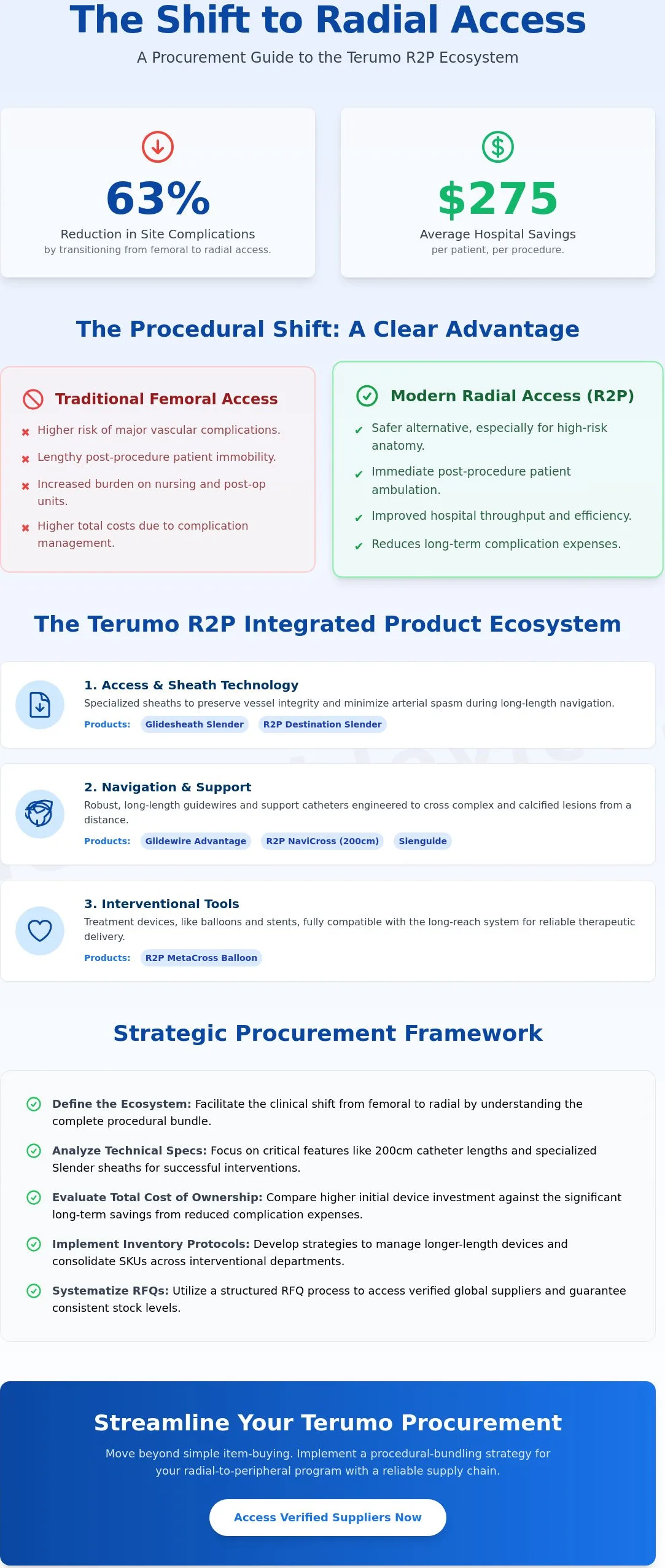
Did you know that transitioning from femoral to radial access can reduce site complications by up to 63% while saving hospitals an average of $275 per patient? For procurement teams, implementing this clinical shift requires a reliable supply of Terumo R2P radial access products. These tools are specifically engineered for the increased trackability and length required in peripheral interventions. We understand that managing inventory for longer-length devices and identifying verified suppliers presents significant logistical challenges for modern medical facilities.
This guide provides a comprehensive framework for acquiring the Terumo R2P portfolio, moving beyond simple item-buying toward a procedural-bundling strategy. You'll gain a clear understanding of the technical specifications for the 2024 NaviCross launch and the broader R2P ecosystem. We detail clinical applications and strategic sourcing methods to help you maximize the ROI of your radial-to-peripheral program. The following sections provide a categorized breakdown of essential R2P components and a methodical approach to streamlining your RFQ process for professional B2B procurement.
Key Takeaways
- Define the R2P procedural ecosystem to facilitate a clinical shift from femoral to radial access for peripheral interventions.
- Analyze the technical specifications of Terumo R2P radial access products, including the 200cm NaviCross catheter and specialized Slender sheaths.
- Evaluate the total cost of ownership by comparing initial device investment against the reduction of long-term complication expenses.
- Implement strategic inventory management protocols to handle longer-length devices and consolidate SKUs across interventional departments.
- Utilize a systematic RFQ process to access a global network of verified suppliers and ensure consistent stock levels.
Table of Contents
- Understanding the Terumo R2P (Radial to Peripheral) Ecosystem
- Technical Breakdown of the R2P Product Portfolio
- Procurement Analysis: R2P vs. Traditional Femoral Access
- Strategic Sourcing Guide for R2P Inventory
- Streamlining Terumo Procurement via GetMedicalDevice
Understanding the Terumo R2P (Radial to Peripheral) Ecosystem
The Terumo R2P (Radial to Peripheral) ecosystem is a specialized suite of long-length devices engineered for peripheral interventions via radial access. This system facilitates a clinical shift from traditional femoral access to a "radial-first" approach. The primary objective is to minimize bleeding complications and accelerate patient ambulation. Transradial catheterization provides a safer alternative for patients with high-risk femoral anatomy. By utilizing this approach, clinicians can effectively treat Above-the-knee (ATK) Peripheral Artery Disease (PAD) and Critical Limb Ischemia (CLI).
Terumo maintains a market-leading position by addressing the unique physical constraints of long-distance vascular navigation. Standard interventional tools typically lack the reach required for a wrist-to-leg approach. Terumo R2P radial access products solve this through 200cm device lengths and proprietary hydrophilic coatings. These features ensure the device can navigate tortuous anatomy without losing torque or support. Procurement teams should recognize that these products aren't just incremental updates; they're essential infrastructure for any radial-to-peripheral program.
The Core Philosophy of Radial-to-Peripheral Interventions
Procedural efficiency is the cornerstone of the R2P philosophy. Patients benefit from immediate post-procedure mobility. This shift significantly reduces the resource burden on nursing staff and post-op observation units. It's a logistical improvement that translates directly to hospital throughput. While the unit cost of specialized catheters is a factor, the overall cost-benefit analysis favors R2P. Reducing major vascular complications saves thousands of dollars per patient encounter by avoiding extended hospital stays.
Key Therapeutic Areas for R2P Implementation
Clinical application spans several key therapeutic areas. Lower extremity interventions represent the most common use case, allowing navigation from the radial artery down to the pedal vessels. The approach is also highly effective for renal and mesenteric artery stenting because the superior access point provides a more favorable angle for vessel engagement. For complex lesion crossing, the R2P NaviCross support catheter provides the necessary backup force. It's a critical tool for managing calcified blockages that would otherwise require a femoral approach. This versatility ensures that a single inventory of Terumo R2P radial access products can serve multiple vascular sub-specialties.
Technical Breakdown of the R2P Product Portfolio
Successful implementation of a radial-to-peripheral program relies on a cohesive kit of specialized hardware. Terumo R2P radial access products are designed to function as an integrated system rather than isolated components. This procedural bundling ensures that each tool, from the initial puncture to the final vessel closure, is optimized for the extended distances between the radial artery and the lower extremities. Procuring these items as a unified set reduces the risk of device incompatibility during high-stakes interventions.
Access and Sheath Technology
The procedure begins with specialized access sheaths that prioritize vessel preservation. The Glidesheath Slender and R2P Destination Slender utilize thin-wall technology to provide a larger inner diameter within a smaller outer profile. This design is vital for maintaining radial artery patency throughout the case. Hydrophilic coatings are applied to these sheaths to minimize the risk of arterial spasm, a frequent complication in long-length navigation. Clinicians must select sheath lengths based on patient height and the target lesion's anatomical distance to ensure adequate reach without sacrificing stability.
Effective navigation across these distances requires high-torque guidewires and robust support catheters. The Glidewire Advantage provides the necessary tactile feedback and trackability for complex anatomy. For support, the R2P NaviCross catheter, available in 200cm lengths, is essential. Its double-braided stainless steel construction offers the longitudinal strength needed to cross calcified lesions at extreme distances. The Slenguide catheter further assists in maintaining a stable platform for therapeutic delivery, ensuring the system doesn't back out during device advancement.
Interventional Tools: Balloons and Stents
Once the target site is reached, treatment devices must be compatible with the long-reach setup. The R2P MetaCross balloon is optimized for 0.035" guidewire systems, providing reliable dilatation in peripheral vessels. For permanent scaffolding, the Misago RX self-expanding stent utilizes rapid exchange technology. This design significantly simplifies device handling, as it doesn't require the excessive wire lengths typical of over-the-wire systems. These Terumo R2P radial access products ensure that the physician maintains control during the most critical phases of the intervention.
The workflow concludes with the TR Band radial compression device. This tool facilitates patent hemostasis, allowing the radial artery to remain open while stopping site bleeding. Managing these diverse SKUs requires a structured procurement strategy to avoid procedural delays. You can verify supplier availability for these specialized components to maintain a consistent inventory and support a "radial-first" clinical environment.
Procurement Analysis: R2P vs. Traditional Femoral Access
Transitioning to Terumo R2P radial access products represents a strategic realignment of hospital resources rather than a simple product swap. While the unit price for specialized long-length devices might exceed that of standard femoral kits, the total cost of care often decreases. Procurement officers must look beyond the invoice price to evaluate the reduction in post-procedural complications. This analysis requires a shift from "price-per-unit" thinking to a "total-cost-of-procedure" model that accounts for clinical outcomes and facility throughput.
Cost of Complications and ROI
Clinical data demonstrates that radial access significantly lowers the risk of major bleeding. Research indicates that hematoma rates for radial procedures sit at approximately 1%, compared to 3-4% for traditional femoral access. These complications are not just clinical failures; they're financial liabilities that extend hospital stays and increase resource consumption. The ROI of R2P is primarily realized through the optimization of clinical workflows, where a reduction in procedural complications directly correlates to fewer nursing hours required per patient encounter. This efficiency supports "Same-Day Discharge" initiatives in outpatient centers, maximizing bed turnover and facility revenue.
Inventory Standardization Strategies
Managing specialized inventory requires a systematic approach to SKU consolidation. Facilities can often streamline their supply chains by utilizing Terumo R2P radial access products to replace multiple disparate radial kits used across different departments. This standardization simplifies the RFQ process and improves bargaining power with suppliers. However, logistics managers must account for the physical footprint of these devices. The 200cm catheters require specialized storage racks due to their extended packaging; procurement teams should monitor turnover rates closely to ensure shelf-life compliance for these high-value tools.
A common objection among clinical staff involves the perceived difficulty of managing 200cm catheters in a sterile field. Procurement can mitigate this through structured training programs provided by the vendor. Identifying this learning curve as a procurement variable allows for more accurate forecasting of initial procedural times. Once the staff gains proficiency, the logistical benefits of the radial approach, such as faster patient ambulation and reduced recovery room staffing, outweigh the initial training investment. This systematic transition ensures that the hospital doesn't just buy new tools but adopts a more efficient clinical infrastructure.
Strategic Sourcing Guide for R2P Inventory
Procurement of Terumo R2P radial access products necessitates a structured sourcing strategy that accounts for specialized manufacturing cycles. Unlike high-volume coronary supplies, the 200cm catheters and long-reach sheaths in the R2P portfolio often feature longer lead times due to their niche application. Procurement officers must determine whether to employ a Just-in-Time (JIT) delivery model or maintain a bulk safety stock for critical components. While JIT reduces carrying costs for high-value items like Misago RX stents, a lack of buffer stock for specialized access tools can halt complex peripheral cases. Establishing a predictable procurement rhythm requires analyzing historical procedural volumes to forecast consumption accurately across the interventional department.
Navigating Global Supply Chains
Regional supply chain disruptions frequently impact the availability of interventional radiology inventory. To mitigate the risk of a single point of failure, healthcare organizations should diversify their supplier base beyond primary manufacturers. This strategy involves identifying verified secondary distributors capable of fulfilling urgent requirements during manufacturer backorders. International procurement requires rigorous attention to documentation; ensure all imports comply with FDA 510(k) clearances or current CE mark requirements to avoid regulatory delays at customs. Maintaining a list of pre-vetted suppliers ensures that clinical workflows remain uninterrupted by logistical bottlenecks. This diversification is especially critical for 200cm support catheters, which have fewer market alternatives than standard length devices.
Quality Assurance in B2B Sourcing
Verification of product integrity is mandatory when sourcing specialized interventional tools. Every shipment of Terumo R2P radial access products must undergo a formal inspection of lot numbers and sterilization expiration dates. Because these devices utilize advanced hydrophilic coatings, they require climate-controlled shipping and storage to prevent coating degradation. Exposure to extreme temperatures during transit can compromise the lubricity of the Glidewire Advantage or NaviCross catheters, leading to increased friction during navigation. This technical failure directly impacts procedural safety and success rates. Utilizing a "Verified Supplier" status in medical marketplaces serves as a critical filter for quality assurance. To secure your supply chain and ensure procedural readiness, you should source from verified medical device suppliers who adhere to these global logistical and regulatory standards.
Streamlining Terumo Procurement via GetMedicalDevice
Accessing specialized medical equipment requires a centralized procurement infrastructure that prioritizes verification and efficiency. GetMedicalDevice serves as an authoritative facilitator, connecting hospital systems with a global network of verified distributors. This platform eliminates the need for fragmented communication across multiple vendor portals. Instead, procurement teams can consolidate their sourcing for Terumo, Boston Scientific, and Abbott vascular products within a single, structured interface. This consolidation is particularly beneficial for departments managing the diverse inventory requirements of a radial-to-peripheral program.
The RFQ Advantage for Hospital Systems
Launching a comprehensive R2P program involves significant logistical planning and capital allocation. The Request for Quote (RFQ) system provides a methodical way to compare pricing and lead times for Terumo R2P radial access products across multiple suppliers simultaneously. When creating a bid request, procurement officers can specify technical requirements for 200cm catheters and specialized sheaths to ensure exact SKU matching. Utilizing RFQ response credits allows buyers to access premium product listings and secure competitive bids from high-capacity distributors. This structured B2B communication reduces procurement friction and ensures that no detail is overlooked during the data collection phase.
High-volume buyers benefit from the Verified Supplier Membership, which provides a layer of security in the global supply chain. This membership tier is designed for organizations that require consistent, large-scale acquisition of interventional tools. It streamlines the identification of suppliers who maintain the necessary inventory levels to support ongoing procedural demands. By leveraging these professional tools, facilities can move from reactive buying to a proactive, data-driven procurement strategy that aligns with their clinical objectives.
Verified Supplier Reliability
Trust in global trade is established through rigorous verification protocols. The GetMedicalDevice verification process acts as a critical filter, ensuring that all participants in the marketplace adhere to high industry standards. This system is essential for accessing authentic Terumo vascular intervention products without the risks associated with unverified secondary markets. Every supplier on the platform undergoes a thorough vetting process to confirm their legitimacy and regulatory compliance. This commitment to order and transparency allows project managers to handle intricate cross-border requirements with confidence. To begin optimizing your supply chain and securing essential interventional hardware, you can Request a Quote for Terumo R2P Products through our verified network today.
Optimizing Your Radial-to-Peripheral Procurement Strategy
Adopting a radial-first approach for peripheral interventions requires more than just new equipment; it's a fundamental shift in clinical and logistical infrastructure. Successful implementation relies on the systematic acquisition of Terumo R2P radial access products, ensuring that physicians have the specialized 200cm reach and trackability required for complex anatomy. By moving toward a procedural-bundling model, facilities can realize significant ROI through reduced vascular complications and accelerated patient discharge times.
Efficient supply chain management is the final step in this transition. Utilizing a credit-based RFQ system allows procurement teams to compare competitive bids and manage global lead times with precision. The Verified Supplier Membership program provides access to a stable network of global interventional radiology brands, ensuring that inventory remains consistent and compliant with international standards. You can now Source Terumo R2P Products from Verified Suppliers to streamline your operations and enhance procedural outcomes. This transition positions your facility at the forefront of interventional safety and operational excellence.
Frequently Asked Questions
What is the primary advantage of the Terumo R2P portfolio?
The primary advantage is the reduction of access site complications by approximately 60% compared to traditional femoral approaches. By utilizing Terumo R2P radial access products, medical facilities can transition to a "radial-first" strategy that promotes immediate patient ambulation. This clinical shift minimizes the risk of major bleeding and hematomas. Consequently, hospitals can achieve significant cost savings, estimated at $275 per patient, by reducing the resources required for post-operative complication management.
What is the maximum length available for R2P support catheters?
The maximum length currently available for R2P support catheters is 200 cm. This specific length was reinforced by the launch of the R2P NaviCross peripheral support catheter on December 3, 2024. These extended devices are engineered to provide the necessary reach from a radial access point to distal peripheral targets. Procurement teams must ensure their storage infrastructure can accommodate the extra-long packaging required for these specialized 200 cm instruments.
Can R2P products be used for below-the-knee (BTK) procedures?
Yes, R2P products are designed to reach distal targets, including those involved in below-the-knee (BTK) and pedal interventions. The 200 cm length of support catheters and specialized balloons allows clinicians to navigate from the wrist to the lower leg arteries. This capability is vital for treating complex pathologies such as Critical Limb Ischemia (CLI) where distal vessel access is required. The hydrophilic coatings ensure smooth navigation through long vascular segments.
Is special training required for staff to handle 200cm R2P catheters?
Clinical staff typically require specific training to manage the unique sterile field requirements of 200 cm devices. Handling extra-long catheters involves different coordination techniques to prevent contamination and ensure proper torque transmission. While the procedural steps are similar to traditional interventions, the learning curve associated with radial-to-peripheral navigation is a recognized variable. Procurement officers should coordinate with vendors to provide structured educational sessions for interventional teams during the initial program rollout.
How do I verify a Terumo product distributor on a B2B marketplace?
Verification involves checking for "Verified Supplier" designations on professional B2B marketplaces. You should confirm that the distributor holds valid regulatory certifications, such as FDA 510(k) clearances or CE marks, for all Terumo R2P radial access products. Reliable platforms perform background checks on supplier legitimacy and inventory capabilities. Buyers should also review the supplier's history of RFQ fulfillment to ensure they can handle the technical requirements of specialized interventional hardware.
What closure device is recommended for R2P radial access?
The TR Band Radial Compression Device is the recommended tool for achieving hemostasis following an R2P procedure. It's specifically designed to facilitate "patent hemostasis," which allows the radial artery to remain open while stopping bleeding at the puncture site. This device is a critical component of the R2P "Close" phase, ensuring that the benefits of radial access, such as early ambulation and reduced nursing observation, are fully realized.
Are R2P products compatible with other brands' guidewires?
Yes, the R2P portfolio is engineered for broad compatibility with standard interventional guidewires and accessory tools. For example, the MetaCross balloon and NaviCross catheter are optimized for use with 0.035" and 0.014" systems. This allows procurement teams to integrate Terumo products with existing stock from brands like Boston Scientific or Asahi Intecc. Maintaining a multi-vendor inventory ensures procedural flexibility while utilizing the specialized lengths unique to the Terumo R2P ecosystem.
How does the GetMedicalDevice RFQ system assist with medical procurement?
The RFQ system centralizes the bidding process, allowing buyers to compare pricing and lead times from multiple verified distributors simultaneously. It's especially useful for managing specialized inventory that may be subject to global supply fluctuations. By using RFQ response credits, procurement managers can access premium product listings and secure competitive quotes. This structured communication reduces the administrative burden and ensures that all technical specifications for R2P components are met before purchase.