

Relying strictly on direct, single-OEM allocations isn't the safest procurement strategy for modern catheter labs; it's often the primary trigger for sudden supply disruptions. Clinical purchasing managers know the operational friction well: unvetted gray-market distributors, volatile shipment lead times, and complex batch-tracing mandates that stall scheduled procedures. Procuring authentic wholesale peripheral vascular devices demands a systematic approach that insulates healthcare facilities from distributor bottlenecks while verifying complete chain-of-custody integrity.
You don't have to risk clinical delays, counterfeit products, or regulatory non-compliance to maintain dependable cath lab inventory. This guide delivers a proven framework to master wholesale procurement through verified sourcing protocols, objective supplier evaluation criteria, and rigorous cross-border compliance checks. We'll examine practical methods to accelerate RFQ cycles, verify ISO 13485 and FDA QMSR documentation, and establish resilient multi-vendor pipelines for critical PTA balloons, stents, and guidewires from leading global brands.
Key Takeaways
- Map primary endovascular device classes to specific catheter lab utilization rates to prevent critical shortages across outpatient and hospital settings.
- Implement a standardized five-tier qualification protocol to verify authorized distribution licenses, ISO 13485 certifications, and global regulatory filings before procurement.
- Establish rigid incoming inspection processes for bulk orders, focusing on sterile packaging barriers, Tyvek integrity, and complete UDI batch traceability to block gray-market infiltration.
- Structure high-precision RFQ specifications for wholesale peripheral vascular devices to consolidate purchasing volume, compress vendor lead times, and optimize transaction security.
Table of Contents
- Understanding the Wholesale Peripheral Vascular Device Market Landscape
- How to Evaluate and Select Wholesale Peripheral Vascular Suppliers
- Mitigating Counterfeit Risks and Quality Hazards in Bulk Device Orders
- Optimizing Bulk Procurement: RFQ Processes and Digital Sourcing Platforms
Understanding the Wholesale Peripheral Vascular Device Market Landscape
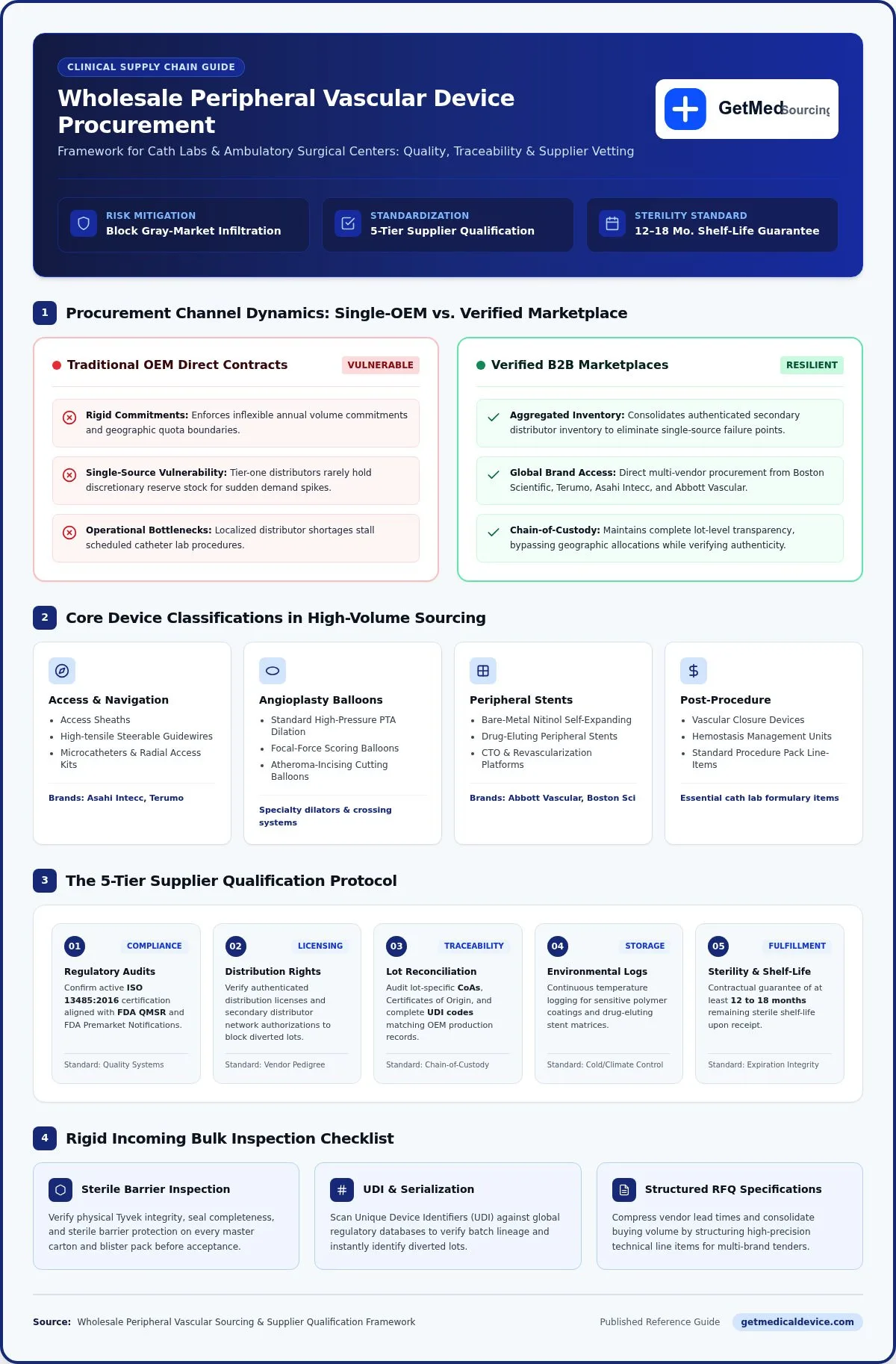
Catheterization labs and ambulatory surgical centers face acute operational bottlenecks when sourcing critical endovascular hardware. Inventory runs lean. Standard procedure packs require precise combinations of access sheaths, high-tensile steerable guidewires, angioplasty balloons, peripheral stents, and post-procedure vascular closure devices. When single-distributor stock allocations fail, clinical procedure schedules immediately stall.
Core Device Classifications in High-Volume Sourcing
Endovascular inventories demand exact procedural mapping. For complex revascularization and chronic total occlusion (CTO) cases, procurement officers balance standard bare-metal self-expanding nitinol stents against specialized drug-eluting peripheral stents engineered to limit restenosis. Angioplasty requirements diverge just as sharply between routine high-pressure PTA dilation balloons, focal-force scoring balloons, and atheroma-incising cutting balloons. Clinical buyers reference structured peripheral intervention categories to standardize technical line items across diverse hospital formularies and ensure continuous stock availability.
Procurement Channels: OEM Direct Contracts vs. Verified Marketplaces
Traditional sourcing relies on direct manufacturer contracts. These agreements impose rigid annual volume commitments, strict geographic territory restrictions, and inflexible allocation caps that leave cath labs vulnerable during localized shortages. When unexpected demand spikes occur, tier-one distributors rarely hold discretionary reserve stock.
Procuring wholesale peripheral vascular devices through verified B2B digital marketplaces removes these single-source failure points. Rather than relying on a solitary regional supply chain, digital platforms aggregate qualified secondary distributor inventory. Buyers can source authentic equipment from premier manufacturers like Boston Scientific, Terumo, Asahi Intecc, and Abbott Vascular, bypassing geographic quotas while maintaining complete lot-level transparency.
How to Evaluate and Select Wholesale Peripheral Vascular Suppliers
Procuring endovascular equipment requires a systematic qualification protocol. Clinical buyers cannot rely on vendor claims alone; every supplier must undergo a rigorous five-step vetting process covering regulatory standing, distribution authorization, lot traceability, warehouse controls, and fulfillment history. Implementing these formal criteria protects cath lab inventories from stockouts and substandard hardware.
Auditing Vendor Pedigree and Regulatory Traceability
Documentation audits form the operational foundation of supplier vetting. Before issuing purchase orders for wholesale peripheral vascular devices, buyers must confirm that facilities maintain active ISO 13485:2016 quality management certifications aligned with the FDA QMSR. In parallel, teams should consult formal technical references like the FDA Premarket Notification Guidance to evaluate device classifications and performance standards. Every inbound batch must include lot-specific Certificates of Analysis (CoA), original Certificates of Origin, and complete Unique Device Identification (UDI) codes that reconcile directly with manufacturer production records.
Assessing Multi-Brand Inventory Access and Lead Reliability
A reliable supplier must demonstrate access to major global manufacturers while maintaining verifiable shelf-life thresholds, typically guaranteeing at least 12 to 18 months of remaining sterility. Procurement teams should audit multi-vendor capabilities across core lines:
- Asahi Intecc and Terumo: Hydrophilic guidewires, microcatheters, and radial access kits.
- Abbott Vascular and Boston Scientific: Peripheral stent platforms, crossing systems, and specialty balloon dilators.
- Storage verification: Continuous environmental logging for temperature-sensitive polymer coatings and drug-eluting matrices.
Clinical procurement teams can consult the comprehensive medical device catalog to review pre-vetted distributor networks and compare specifications across authenticated product lines without the administrative burden of unvetted vendor setup.
Mitigating Counterfeit Risks and Quality Hazards in Bulk Device Orders
Gray-market distribution routes introduce severe clinical liabilities into catheterization laboratories. Diverted lots often suffer uncontrolled temperature excursions, moisture exposure, or rough handling during secondary transshipment. When purchasing wholesale peripheral vascular devices outside closed hospital networks, facilities require systematic receiving controls that verify physical sterile integrity and authenticate provenance before hardware enters clinical circulation.
Physical Inspection Protocols for Sterile Interventional Devices
Receiving departments must inspect every master carton against clear physical criteria:
- Sterile barrier inspection: Examine Tyvek heat seals under directional lighting to detect micro-punctures, stress cracks, or channel voids.
- Process indicators: Confirm that chemical sterilization indicators on individual unit boxes reflect complete, uniform exposure.
- Accessory alignment: Scan 2D DataMatrix barcodes to cross-check lot codes and expiration dates across high-demand interventional radiology categories and critical introducers in our vascular access categories.
Contractual Safeguards and Supplier Accountability
Procurement agreements must hold secondary suppliers to strict quality covenants. Institutional purchase orders should include explicit indemnification clauses covering latent manufacturer defects, unauthorized serial substitutions, and immediate reimbursement during field safety notices or recalls. Contracts must also enforce mandatory return clauses for any shipment arriving with fewer than 12 months of validated shelf life or damaged outer packaging.
To eliminate these compliance liabilities, submit your procurement requirements through GetMedicalDevice's verified sourcing platform to access authenticated suppliers that adhere to transparent quality and distribution agreements.
Optimizing Bulk Procurement: RFQ Processes and Digital Sourcing Platforms
Manual procurement through fragmented supplier networks introduces costly friction into hospital cath labs. Sourcing managers frequently waste days reconciling quotes across regional reps who may lack real-time stock access. Transitioning to a structured digital framework compresses purchasing cycles, improves volume pricing, and secures uninterrupted access to authentic wholesale peripheral vascular devices.
Constructing Precise Technical RFQs for Endovascular Consumables
Incomplete technical specifications cause avoidable fulfillment delays. Every purchase request for vascular hardware must articulate exact clinical operating thresholds:
- Guidewires: Specify outer diameter (e.g., 0.014", 0.018", 0.035"), core alloy composition, tip load stiffness in grams, and hydrophilic polymer coating chemistry.
- PTA and cutting balloons: Define nominal inflation size, guide sheath compatibility, working length, and minimum rated burst pressure (RBP) atmospheres.
- Brand-specific alternates: Detail acceptable OEM substitutions across Asahi Intecc, Terumo, Abbott Vascular, and Boston Scientific lines to preserve cross-procedural interchangeability.
Accelerating Procurement via GetMedicalDevice Verified B2B Marketplace
Direct manual outreach leaves purchasing teams vulnerable to isolated supply chain shocks. Digital marketplaces eliminate this vulnerability by centralizing verified distributors into a unified transactional interface.
GetMedicalDevice connects clinical procurement teams with an international network of pre-vetted medical device suppliers. Rather than managing disparate vendor audits independently, institutional buyers can leverage a structured RFQ system to broadcast precise bill-of-materials requirements to certified distributors simultaneously. Sourcing teams can review transparent vendor credentials, aggregate orders across complementary endovascular lines, and review current wholesale stock directly via all product listings to streamline institutional supply pipelines.
Streamline Your Vascular Sourcing Infrastructure
Securing resilient inventory for high-volume catheterization labs requires moving past single-distributor reliance. Systematic intake checks, rigid lot traceability under ISO 13485 standards, and multi-vendor qualification protocols safeguard clinical workflows against counterfeit gray-market entries and sudden operational delays. By standardizing technical RFQs and consolidating line items across proven platforms, procurement leaders eliminate operational friction while protecting patient safety.
Maintaining an uninterrupted supply of authentic wholesale peripheral vascular devices doesn't have to be an administrative bottleneck. Partnering with a verified platform ensures direct access to authenticated hardware from industry benchmarks like Boston Scientific, Terumo, Asahi Intecc, and Abbott Vascular. Take control of your clinical pipeline today and Source Verified Wholesale Peripheral Vascular Devices on GetMedicalDevice through our pre-qualified global distributor network. Build a dependable, compliant supply chain that keeps your procedural suites fully prepared.
Frequently Asked Questions
What regulatory certifications are required when purchasing wholesale peripheral vascular devices?
Procuring wholesale peripheral vascular devices requires verifying ISO 13485:2016 quality management certification alongside destination-specific market authorizations, such as FDA 510(k) clearance or European Union Medical Device Regulation (EU MDR) compliance. Distributors must maintain valid medical device establishment registrations and authorized trade licenses. Every shipment should accompany manufacturer Certificates of Analysis (CoA) and Certificates of Origin to confirm that devices satisfy regional statutory standards before customs clearance.
How do buyers verify that wholesale peripheral vascular products are authentic and not gray-market goods?
Buyers verify authenticity by cross-referencing package Unique Device Identification (UDI) DataMatrix barcodes and batch numbers directly against OEM production databases. Receiving teams must inspect intact Tyvek seals, examine chemical sterilization indicators, and review documented chain-of-custody records tracking back to authorized distribution hubs. Sourcing through platforms that audit vendor credentials provides verified proof of provenance, ensuring that devices haven't been diverted through unregulated secondary channels.
What is the standard shelf life required for bulk interventional vascular inventory?
Standard bulk procurement contracts require a minimum remaining shelf life of 12 to 18 months upon delivery. Interventional equipment like drug-eluting balloons and hydrophilic guidewires features delicate chemical coatings and polymer jackets vulnerable to age-related degradation. Clinical facilities should establish strict intake thresholds and contractually mandate supplier returns for any delivery arriving below agreed sterilization expiration windows to prevent procedure-day inventory write-offs.
Can healthcare facilities source mixed-brand wholesale orders through B2B medical platforms?
Yes, digital B2B marketplaces allow healthcare institutions to consolidate mixed-brand orders within a single procurement framework. Purchasing departments can source complementary hardware-such as Abbott Vascular stents, Asahi Intecc guidewires, and Boston Scientific catheters-across pre-vetted distributors simultaneously. This model aggregates institutional purchasing volume, reduces the administrative burden of onboarding multiple isolated suppliers, and helps cath labs source critical alternates when specific brand allocations run short.
How does an RFQ platform improve procurement speed for bulk vascular devices?
A structured RFQ platform accelerates sourcing by broadcasting comprehensive technical specifications to pre-qualified distributors simultaneously, eliminating slow manual email negotiations with regional representatives. Buyers upload exact parameters, including French sizes, balloon diameters, and coating profiles. Verified suppliers leverage credit-based response systems to deliver rapid, competitive bids, compressing procurement timelines from weeks to hours while securing authentic wholesale peripheral vascular devices without operational delays.
