

What if the lowest surgical equipment quote becomes the costliest offer to own? Purchase price is easy to compare, but it may not include operating costs, service support, accessories, training, or the impact of unplanned downtime. A useful total cost of ownership for surgical equipment comparison starts by aligning what each offer covers, including configuration, quantity, and documentation.
This guide explains how to define lifecycle costs over a stated evaluation period, set consistent assumptions, and record the basis for each comparison. It also shows how a structured RFQ can capture product, quantity, destination, timing, and documentation requirements so supplier responses are easier to assess. Your organization retains control of procurement decisions and must independently verify supplier legitimacy, documentation, regulatory compliance, and clinical suitability before purchase. The goal is a transparent comparison that looks beyond the initial quote without treating any one response as a final decision.
Key Takeaways
- Use a defined evaluation period and equipment scope to make total cost of ownership for surgical equipment relevant to your procurement decision.
- Classify costs as one-time, recurring, usage-dependent, or contingent so assumptions are easier to review.
- Compare equivalent configurations and quantities, and record exclusions so differences between supplier offers remain visible.
- Use structured RFQ details to organize supplier responses, then independently verify supplier legitimacy, documentation, regulatory compliance, and clinical suitability before purchase.
Table of Contents
- What Total Cost of Ownership Means for Surgical Equipment Procurement
- Which Lifecycle Costs Belong in a Surgical Equipment TCO Model?
- How to Compare Surgical Equipment Offers Using TCO
- How Structured RFQs Support a Better Surgical Equipment TCO Review
What Total Cost of Ownership Means for Surgical Equipment Procurement
Total cost of ownership is the documented cost of acquiring, preparing, using, supporting, and retiring equipment over a defined evaluation period, not simply its quoted purchase price. This lifecycle view helps procurement teams compare the resources required to keep a surgical asset available for its intended use. The Total Cost of Ownership (TCO) Definition offers a foundational overview of direct and indirect costs across a product’s lifecycle. For surgical equipment, the calculation is meaningful only when the equipment scope and time horizon are stated.
Why the quoted purchase price is an incomplete comparison
Supplier quotes can cover different configurations, quantities, accessories, setup requirements, and support arrangements. One offer may include components another lists separately, while training or service assumptions may differ. A lower initial price therefore does not establish a lower lifecycle cost. Before ranking offers, check what each price includes, note what is excluded, and identify any assumptions that affect the comparison. Otherwise, unlike packages may appear equivalent and the resources needed after purchase may be understated.
Set the scope before calculating surgical equipment TCO
Define the configuration, expected use, and evaluation period before calculating costs. Specify the system and included components, the anticipated pattern of use, and the period over which costs will be recorded. Assign input responsibilities across procurement, clinical teams, facilities or biomedical engineering, and finance. Each group can document the costs and operating assumptions it is best placed to assess.
Keep the boundary focused on ownership of the equipment. Include costs directly associated with acquiring, preparing, operating, supporting, and retiring the defined asset. Keep broader facility projects or clinical program expenses separate unless the analysis explicitly includes them. This makes the total cost of ownership for surgical equipment easier to interpret and compare. The buying organization remains responsible for assessing clinical suitability, verifying supplier and documentation details, and making final procurement decisions.
Which Lifecycle Costs Belong in a Surgical Equipment TCO Model?
A practical model groups costs by lifecycle stage, then labels each as one-time, recurring, usage-dependent, or contingent. Core TCO categories may include acquisition, installation and setup, training, accessories and consumables, service and support, and end-of-life costs, depending on the equipment and evaluation scope. This classification distinguishes a setup expense from a repeated operating cost without assuming every category applies to every purchase.
- One-time: acquisition, installation, initial setup, and introductory training, where applicable.
- Recurring or usage-dependent: service, supplies, accessories that require replacement, and additional training tied to staff changes or use.
- Contingent: repairs, upgrades, or other costs that depend on equipment condition, use, or supplier terms.
Record downtime and staff time as operational impacts. Quantify them only with buyer-specific evidence, such as internal labor records or documented equipment availability assumptions. Avoid assigning estimated financial values without a clear method and reliable local inputs.
Account for accessories, consumables, and training
List compatible accessories and recurring supplies within the assessed configuration. Note which items the quote includes and which may require separate procurement or replacement. For training, document the stated requirements, intended attendees, and whether it is included or quoted separately. These details expose scope differences without assuming a standard training format or usage level.
Capture service, downtime, and end-of-life assumptions
Record maintenance, repair, upgrades, technical support, and any warranty terms exactly as stated in each supplier response. Keep projected service life and disposal assumptions visible as estimates, not guarantees. If a cost depends on future use or a particular event, mark it as contingent and show the basis for including it. Buyers can use structured medical device sourcing requests to organize supplier information for this review. Responses are inputs to the buyer’s own analysis.
How to Compare Surgical Equipment Offers Using TCO
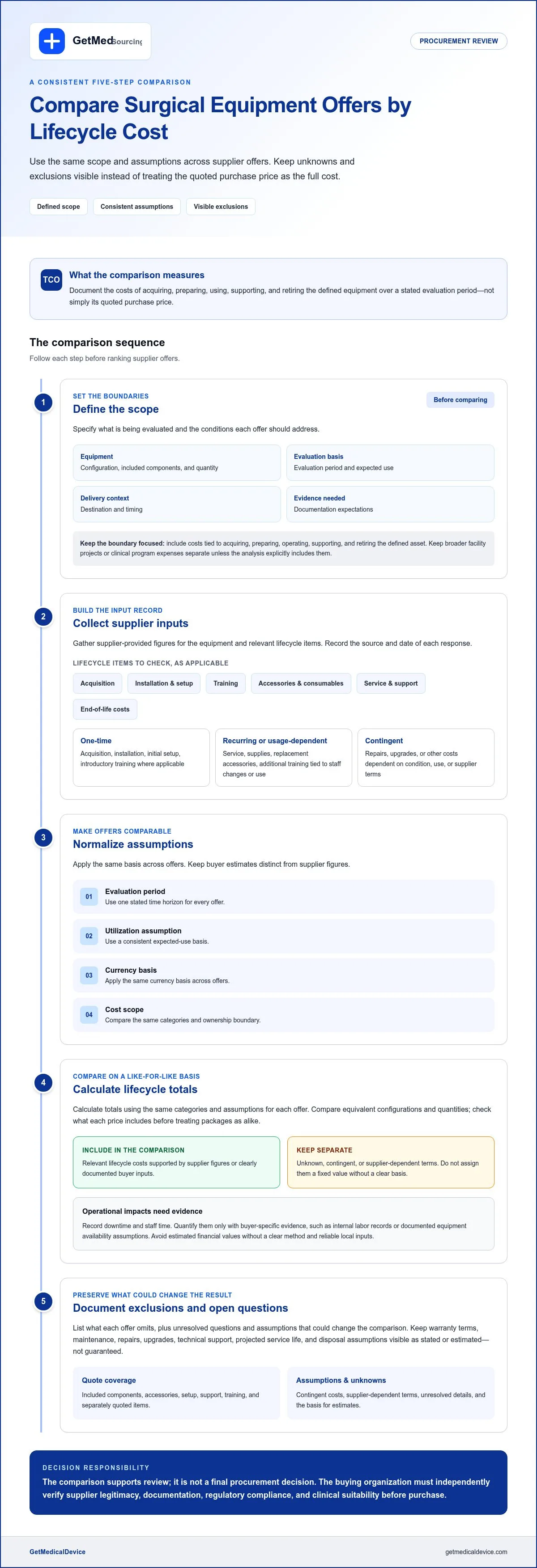
A defensible comparison depends on consistent inputs, not more decimal places. Use this sequence to assess total cost of ownership for surgical equipment while keeping differences and unknowns visible:
- Define the scope. Set the equipment configuration, quantity, evaluation period, expected use, destination, timing, and documentation expectations.
- Collect inputs. Gather supplier-provided figures for included equipment, setup, accessories, service, and other relevant lifecycle items. Record the source and date of each response.
- Normalize assumptions. Apply one evaluation period, utilization assumption, currency basis, and cost scope across offers. Keep buyer estimates distinct from supplier figures.
- Compare lifecycle totals. Calculate totals using the same categories and assumptions. Keep unknown, contingent, or supplier-dependent terms in a separate field instead of assigning them a fixed value.
- Document exclusions. List what each offer omits, along with unresolved questions and assumptions that could change the comparison.
Normalize quotes without creating false precision
Compare equivalent configurations and quantities using a common destination and timing basis. If one offer includes an accessory and another excludes it, show that difference instead of silently adjusting the figures. Label each input as supplier-provided, buyer-estimated, or unknown. If currency conversion is needed, record the chosen basis and date so reviewers can see how the comparison was prepared.
Turn the comparison into a procurement record
Use a side-by-side table with columns for included items, recurring inputs, exclusions, assumptions, and open questions. Broader sourcing considerations are addressed in the Global Medical Device Sourcing and Procurement guide. Before purchase, the buying organization must independently verify supplier legitimacy, documentation, regulatory compliance, and clinical suitability. GetMedicalDevice’s structured RFQ workflow helps organize supplier responses for review. Submit a structured sourcing request to begin gathering comparable information. Responses inform your analysis but do not make the procurement decision.
How Structured RFQs Support a Better Surgical Equipment TCO Review
A structured request for quotation (RFQ) gives suppliers a common set of details to respond to, helping buyers use supplier information as inputs to their own total cost of ownership for surgical equipment analysis. It can reduce avoidable ambiguity, but it does not guarantee faster responses, complete information, or savings.
What to include in an RFQ for a meaningful cost comparison
Specify the brand, product family, REF/UPN code where applicable, required configuration, quantity, destination country, timing, and documentation expectations. State the evaluation scope clearly so responses can be reviewed against the same requirements. Identify relevant records to request, such as certificates, declarations of conformity, instructions for use (IFUs), technical sheets, and supplier authorization documents. Which documents apply depends on the device and purchasing context.
GetMedicalDevice uses an RFQ-first workflow to capture structured request details and match requests with verified supplier options. Suppliers handle sales and commercial commitments. Structured fields make it easier to spot differences between responses, but they cannot establish that information is complete or resolve every open question.
From supplier responses to buyer-controlled decisions
Compare each response against the requested configuration and quantity. Record missing documents, deviations, assumptions, and supplier-dependent terms separately from stated costs. This creates a traceable basis for updating the lifecycle comparison without treating unknowns as fixed figures.
The buying organization retains control of the decision. Before purchase, independently verify supplier legitimacy, documentation, regulatory compliance, and clinical suitability. A platform match or supplier response does not replace those checks, and an RFQ alone does not create a purchase agreement. Explore the surgical products category when defining product scope, or use GetMedicalDevice to submit a structured sourcing request and compare supplier responses.
Make the Next Procurement Step More Comparable
A lifecycle comparison is most useful when it becomes a working procurement record, not a one-time calculation. Preserve the assumptions behind each offer and revisit them if requirements, expected use, or supplier terms change. This gives the buying team a consistent basis for review while keeping the total cost of ownership for surgical equipment tied to its actual operating context.
A structured request can help organize supplier information for that review. GetMedicalDevice captures product and purchasing requirements and matches requests with supplier options from its international network. A match does not guarantee supplier approval or a transaction outcome. Before purchase, independently verify supplier legitimacy, documentation, regulatory compliance, and clinical suitability. Your organization retains control of the final decision, and any purchase agreement must be made separately with the supplier.
Set out your requirements and begin gathering responses with Submit a structured surgical equipment RFQ. Start your comparison with a clear, consistent record of what you need.
Frequently Asked Questions
Is total cost of ownership the same as the purchase price?
No. The purchase price is one transaction figure, while TCO is a broader decision record for assessing an asset over a chosen period. Two quotations may show similar prices but differ in setup scope or supplies needed for the planned procedure mix. Keep each quoted amount identifiable, then evaluate it alongside other cost inputs rather than treating it as the final comparison.
How should procurement teams compare equipment with different expected service lives?
Compare options over a common decision horizon, then show service-life differences separately. If one asset may remain in use beyond the review period, record its expected remaining use or replacement timing rather than assuming both assets reach end of life together. A second view across each option’s expected service life can add context, provided assumptions are labeled. Clinical and biomedical engineering teams can inform these estimates.
Should accessories and consumables be included in surgical equipment TCO?
Yes. Include items required for the defined configuration and planned use, while distinguishing what is included from what may need replacement or separate procurement. A reusable accessory and a per-procedure supply have different usage patterns, so document the basis for each separately. Clinical and supply teams can identify workflow requirements. A broad catalogue list should not be treated as a forecast of actual consumption.
Does a lower-priced surgical equipment offer always have a lower TCO?
No. A lower quote may leave required accessories, setup, or support outside its stated scope, while another offer may include some of these items. Add only documented or buyer-estimated inputs, and label their sources. If a material term remains unknown, present a scenario or range based on stated assumptions instead of declaring one offer the lower-TCO choice.
Can an RFQ provide every figure needed to calculate surgical equipment TCO?
No. An RFQ can organize supplier inputs, but it cannot provide every internal or future estimate. Expected utilization, staff time, downtime impact, and local operating assumptions may require records from the buying organization. Treat supplier responses as inputs, identify gaps, and independently verify supplier legitimacy, documentation, regulatory compliance, and clinical suitability before purchase. An RFQ is a sourcing request, not a purchase contract.