

A device that fits the budget but not the clinical workflow is not a sound procurement choice. A surgical equipment procurement platform can help teams compare specifications, intended use, system interfaces, vendor documentation, and total ownership considerations in one process. Compatibility depends on matching those requirements to the equipment and the clinical systems it must work with.
A product listing alone cannot establish clinical fit. This article explains how to assess compatibility and integration, organize supplier information, compare costs with budget constraints, and involve clinical stakeholders. It also shows how a procurement platform can structure sourcing while leaving the hospital responsible for evaluating products against its own technical, clinical, and operational requirements.
Key Takeaways
- Bring vendor records and compliance documents into a structured view so teams can compare suppliers using consistent information.
- Assess performance against delivery quality, timeliness, and criteria tailored to clinical and operational needs.
- Compare total procurement requirements with budget limits, weighing clinical fit and supply continuity alongside purchase cost.
- Map equipment specifications and system interfaces to clinical workflows before selecting a product or advancing an RFQ.
Table of Contents
- 1. Centralized vendor information and compliance data
- 2. Healthcare procurement platforms
- 3. Procurement costs and budget constraints
- 4. Clinical and surgical equipment procurement
- GetMedicalDevice: Verified Supplier Membership
1. Centralized vendor information and compliance data
A central supplier record gives procurement, clinical engineering, and finance teams a shared reference point. Keep the supplier’s legal name, product categories, product details, contact information, documentation, and contract status together. Consistent fields make comparisons easier and reduce repeated requests for the same files. They also help staff find current records while controlling access to sensitive purchasing information.
Supplier reliability depends on documented performance, not a product listing alone. Record delivery quality, communication, and any supply interruptions against each vendor. Automating routine vendor-management tasks can reduce manual errors and make review steps more consistent. Consolidated vendor records can also simplify communication and support stronger negotiations. Use quarterly meetings to review relevant data with vendors and document follow-up actions.
Separate compliance evidence by product, vendor, and market. For orthopedic products in the United States, regulatory approval requirements include the FDA, according to the U.S. Food and Drug Administration. For surgical instrument vendors, include relevant registration and certification records in the assessment; ISO 13485 is one certification buyers may evaluate. Track document owners and review dates so staff can identify records requiring attention.
Assess platform security alongside supplier data quality. Restrict access by role, set approval permissions, and maintain an audit trail of record changes and purchasing actions. These controls help limit unauthorized access, accidental disclosure, and untraceable edits. Before adopting a platform, map which staff can view supplier files, change product details, and approve purchasing steps.
Look for approval workflows that connect purchasing authority to documented controls. A useful record includes contract terms, renewal dates, approved products, purchase limits, and the person authorizing each transaction. Route requests to the relevant clinical, procurement, and finance reviewers. This creates a traceable decision path from product evaluation to purchase order.
Traceability should connect the vendor, instrument, order, and supporting records. Keep product identifiers and manufacturer details aligned across purchasing and inventory records. Healthcare vendors and purchasers share responsibility for requirements covering medical-device and implant storage, handling, and documentation. A structured record helps teams locate those details when reviewing a delivery, investigating a discrepancy, or reconciling contract terms.
2. Healthcare procurement platforms
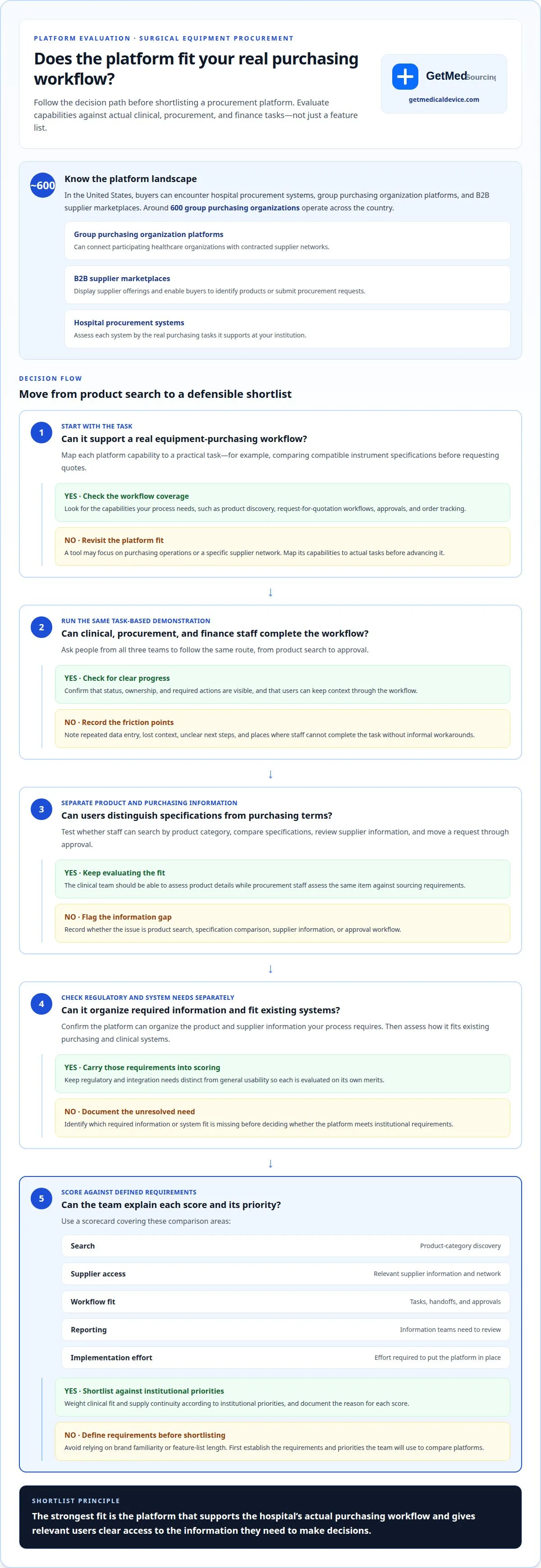
Compare platforms by workflow coverage, supplier reach, product data, and usability. A surgical equipment procurement platform may support product discovery, request-for-quotation workflows, approvals, and order tracking. Another tool may focus on purchasing operations or a specific supplier network. Map each capability to a real task, such as comparing compatible instrument specifications before requesting quotes.
In the United States, buyers can encounter hospital procurement systems, group purchasing organization platforms, and B2B supplier marketplaces. Around 600 group purchasing organizations operate across the country. Their platforms can connect participating healthcare organizations with contracted supplier networks. Marketplace platforms serve a different purpose by displaying supplier offerings and enabling buyers to identify products or submit procurement requests.
Feature comparison should reflect clinical and operational needs, not the length of a feature list. Test whether staff can search by product category, compare specifications, review supplier information, and move a request through the required approval steps. For example, a clinical team evaluating an instrument should be able to distinguish product details from purchasing terms. Procurement staff can then assess the same item against sourcing requirements.
Assess ease of use with a task-based demonstration. Ask people from clinical, procurement, and finance teams to complete the same workflow, from product search to approval. Note where they repeat data entry, lose context, or cannot identify the next step. A clear interface makes status, ownership, and required actions visible without relying on informal workarounds.
Assess regulatory and integration needs separately from general usability. Confirm that the platform can organize the product and supplier information your process requires, then determine how it fits your existing purchasing and clinical systems. Use a scorecard to compare search, supplier access, workflow fit, reporting, and implementation effort. Weight clinical fit and supply continuity according to institutional priorities, and document the reason for each score.
Shortlist platforms against defined requirements rather than brand familiarity. The strongest fit is the one that supports the hospital’s actual purchasing workflow and gives relevant users clear access to the information they need to make decisions.
In the United States, buyers can choose among hospital procurement systems, group purchasing organization platforms, and B2B supplier marketplaces.
3. Procurement costs and budget constraints
Medical equipment and devices account for 11-13% of healthcare expenditures. This makes purchasing a material budget category, especially when surgery schedules depend on reliable supply. A budget review should separate purchase price from operating expenses such as storage, maintenance, training, and replacement planning.
Compare equivalent products against the same requirements before evaluating quotes. For example, assess whether each product meets the intended clinical use, fits existing workflows, and includes the documentation buyers need. Then compare quoted prices alongside contract terms, ordering conditions, and ongoing support requirements. This helps teams identify cost differences without treating the lowest initial quote as the lowest overall expense.
Procurement platforms can reduce costs by making product and quote comparisons more structured. They can help teams identify purchasing patterns and consolidate suitable demand, which supports more informed negotiations. Predictive analytics can forecast demand for specific implants and help hospitals anticipate stockouts. Both methods depend on accurate purchasing and inventory records.
For stock control, compare expected use with available quantities and upcoming procedures. Vendor-managed inventory lets vendors oversee hospital stock and support timely replenishment. This approach can reduce avoidable shortages, but it also gives vendors access to inventory data. Hospitals should define data access and replenishment responsibilities within the workflow.
Budget limits should not lead to excessive cuts in supply resilience. Consolidating purchases may simplify ordering, but relying on fewer suppliers can increase dependency and disruption risk. Compare potential savings with the clinical consequences of delayed supply. A missed delivery of a required device can postpone surgery and affect patient care.
Use a consistent review process: identify clinical requirements, compare suitable products, estimate full operating expenses, and assess supply continuity. A seamless workflow links those decisions to inventory planning and purchasing approvals. Review actual use against forecasts after purchasing, then adjust future order quantities when demand patterns change. This keeps budget decisions tied to operational evidence rather than assumptions.
4. Clinical and surgical equipment procurement
Clinical fit starts with the procedure, patient population, and equipment already in use at the hospital. A multidisciplinary value analysis committee can assess clinical needs, costs, supply-chain flexibility, and institutional objectives. Include surgeons, nurses, procurement staff, and clinical engineering so the review reflects practical use. For a surgical instrument, compare its intended function and specifications with the procedure requirements.
Implants require particular attention because anatomical and clinical requirements can limit substitution. A familiar model is not automatically the right match as product options and clinical needs change. Evaluate current product information alongside the intended use and patient requirements. A mismatch can affect patient care and complicate procedure planning.
Set clinical requirements before requesting or comparing offers. Record the intended procedure, necessary features, compatible systems, and evidence reviewers will use. A structured RFQ platform can organize these criteria alongside product information, making differences easier to review. Keep clinical priorities distinct from purchasing preferences, then document how each product meets the requirements.
Timing matters: a U.S. hospital purchasing cycle takes an average of 6 to 12 months. Build clinical review, product comparison, approvals, and implementation planning into that sequence. Group purchasing also shapes decisions: 97% of U.S. hospitals use group purchasing organizations, which account for 75% of hospital purchases. Teams should align product evaluation with applicable purchasing workflows.
Traceability supports safe operational use after selection. Surgical instruments should carry markings that identify the manufacturer, instrument size, and catalog number. Match those details across product and purchasing records so staff can identify the item during receipt and inventory review. Before final approval, assign reviewers to assess clinical fit, system compatibility, and ongoing supply needs. Select equipment against documented clinical requirements, not price or familiarity alone.
GetMedicalDevice: Verified Supplier Membership
GetMedicalDevice connects medical device buyers and suppliers through a B2B platform focused on medical devices. For suppliers seeking to present products to a buyer network, Verified Supplier Membership and Premium Product Listings provide options for supplier and product visibility. RFQ Response Credits support suppliers participating in procurement requests from hospitals, clinics, and international distributors.
GetMedicalDevice helps professional buyers organize product searches and supplier options through a structured RFQ workflow. Capture the product, brand, model or reference code, quantity, destination country, and any acceptable alternatives or documentation needs. Compare supplier responses against the clinical, compatibility, and budget criteria established during your evaluation. Your organization retains control of purchasing, compliance, and product suitability decisions.
Explore GetMedicalDevice to submit a structured RFQ and compare responses from relevant suppliers.
Set a clear path from evaluation to sourcing
Before opening the next sourcing cycle, turn the evaluation into a decision record teams can use beyond the initial purchase. Assign an internal owner to each requirement, define how substitutions will be reviewed, and set a point to assess performance after implementation. This supports continuity when staff, demand, or product options change.
A surgical equipment procurement platform can support a repeatable process rather than a one-time comparison. Keep the rationale accessible to clinical, procurement, and finance stakeholders, and record the conditions that would trigger reassessment. A documented pathway helps future sourcing decisions stay aligned with operational priorities without treating previous selections as permanent.
When your team is ready to discuss procurement opportunities, contact GetMedicalDevice to discuss procurement. A clearly assigned next step gives your team a practical foundation for its next sourcing decision.
Frequently Asked Questions
How do you ensure equipment compatibility and integration?
Start by matching the product’s specifications to the procedure, existing equipment, and clinical workflow. For example, compare connection types, dimensions, software requirements, and intended use with the hospital’s documented setup. Have clinical engineering and relevant care teams review the comparison before purchase. Record accepted alternatives and constraints so receiving staff can identify mismatches before equipment enters service.
What is a surgical equipment procurement platform and how does it work?
A surgical equipment procurement platform helps healthcare buyers organize product discovery and sourcing. Buyers can define a requirement, identify supplier options, review product information, and manage quote responses. GetMedicalDevice uses a structured RFQ workflow: capture the request, match supplier options, compare responses, and proceed with control. Submitting an RFQ does not create a purchase contract; the buyer and supplier must agree separately on terms.
What are the pricing models and typical costs for surgical equipment procurement platforms?
GetMedicalDevice offers Verified Supplier Membership, premium product listings, and RFQ response credits for suppliers. Buyers using the platform can submit structured RFQs and compare supplier responses. Final pricing, invoices, delivery terms, and other commercial commitments are handled by the relevant supplier. Keep those terms separate from your assessment of equipment purchase and operating expenses.
What types of surgical equipment and supplies can hospitals procure through these platforms?
Product categories vary across platforms and supplier networks. Define the clinical category first, then search using the product family, manufacturer, reference code, or model identifier. For an implant request, include relevant sizing and any acceptable alternatives. The buyer remains responsible for assessing product suitability before use.
How do procurement platforms integrate with hospital ERP, EHR, and inventory systems?
Integration depends on the platform and the hospital’s existing systems. Map which records need to move, such as item identifiers, supplier details, purchase orders, and stock updates. Assess available technical routes with the hospital’s IT team, then test a sample transaction and reconcile the resulting records before relying on an automated workflow.
What U.S. regulations and standards apply to purchasing surgical equipment online?
Applicable requirements depend on the device and product category; buying online does not remove the buyer’s compliance responsibilities. For orthopedic products in the United States, regulatory approval requirements include the FDA, according to the U.S. Food and Drug Administration. Buyers should assess the applicable regulatory documentation and product records for the specific item, then retain those records with purchasing and receiving documentation.