

Procurement delays often start before an order is placed. Fragmented supplier communication, manually managed RFQs, and disconnected inventory records make it harder to compare offers and track decisions. For hospital teams, streamlining hospital procurement process workflows means reducing these administrative bottlenecks while maintaining clear product requirements and sourcing records.
When teams have limited visibility into purchasing activity, reactive buying is difficult to manage. A centralized sourcing workflow can make supplier responses easier to organize and compare. GetMedicalDevice’s B2B platform connects buyers with verified suppliers offering interventional, vascular, and surgical devices from brands including Boston Scientific, Terumo, Asahi Intecc, and Abbott Vascular.
This framework covers practical steps for mapping purchasing workflows, standardizing device requirements, structuring RFQs, and using supplier verification as one part of procurement review. Digital sourcing can help teams organize supplier discovery and communications, while clinical and procurement staff remain responsible for evaluating products against their requirements.
Key Takeaways
- Map each purchasing step to find manual handoffs, duplicate work, and decentralized decisions.
- Use a Value Analysis Committee to align device selection with clinical requirements and consistent purchasing criteria.
- Audit supplier lists and standardize RFQ fields so responses can be reviewed on a like-for-like basis.
- Use B2B marketplaces to discover verified suppliers and organize sourcing requests for essential equipment.
Table of Contents
- Identifying Inefficiencies in the Modern Hospital Procurement Process
- Standardizing High-Value Inventories: The Interventional Niche
- Implementing a Digital Sourcing and Verification Framework
- Future-Proofing Hospital Supply Chains with B2B Marketplaces
Identifying Inefficiencies in the Modern Hospital Procurement Process
Hospital procurement can become fragmented when departments maintain separate supplier relationships, submit requests through different channels, and track inventory in disconnected systems. Procurement includes defined activities from identifying a need to acquiring goods. The procurement process offers a useful framework for tracing those steps and locating delays. To find practical opportunities for improvement, record who requests, approves, sources, and receives each device category, then note where information is re-entered or approvals stall.
Decentralized purchasing can obscure price differences, lead to duplicate orders, and leave slow-moving stock alongside shortages of essential devices. This can be difficult to spot in specialized departments, where purchases may be spread across teams or handled outside standard workflows. Review spend by department, device category, and supplier, and compare purchase records with inventory data. For example, mapping interventional radiology purchases by category can show where sourcing and replenishment practices differ and where a common process may help.
The Impact of Manual RFQs on Administrative Overhead
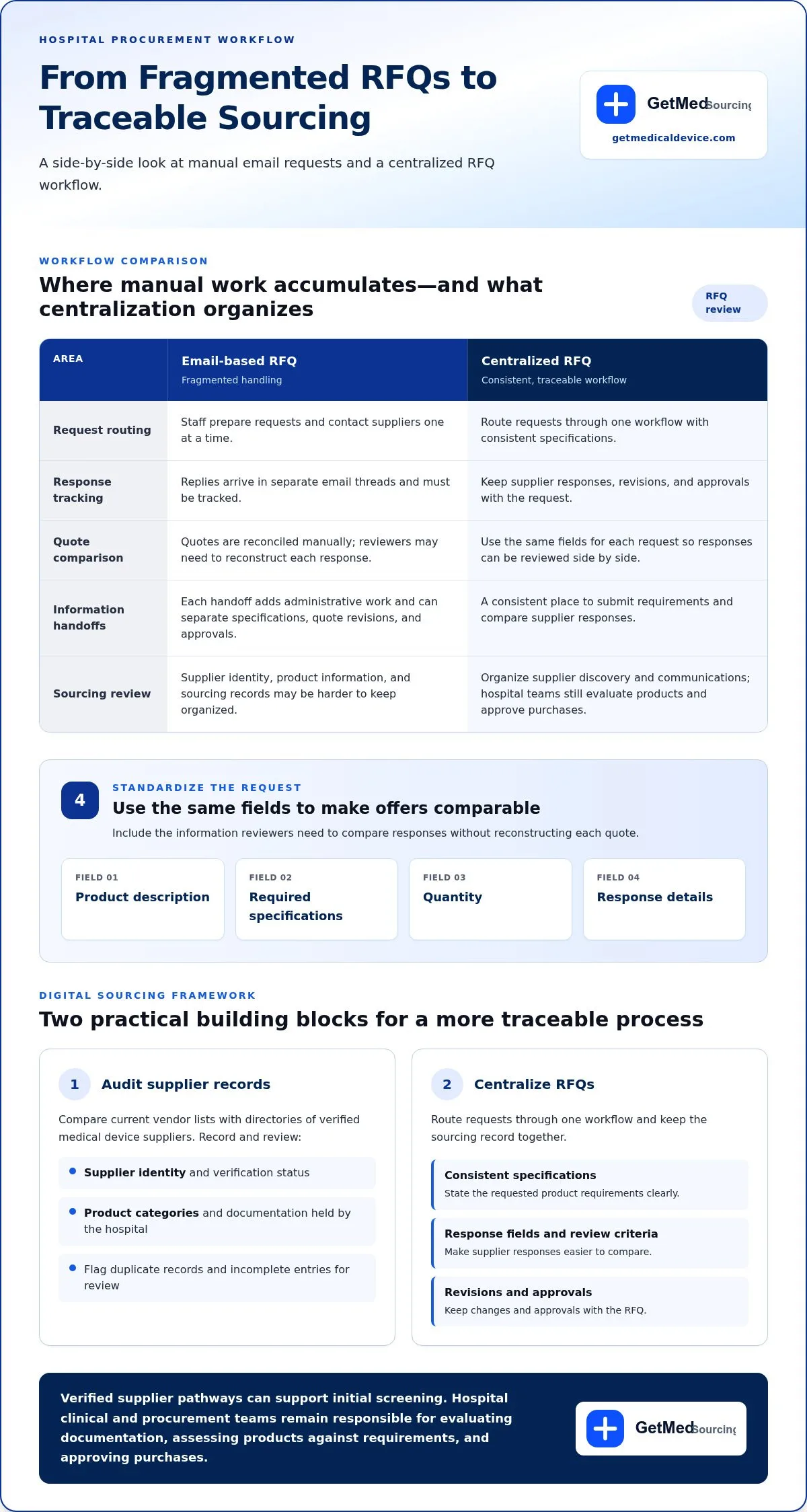
Email-based RFQs require staff to prepare requests, contact suppliers one at a time, track replies, and reconcile quotes manually. Every handoff adds work, and the time to fulfillment depends on the request and supplier response. Separate email threads can also make it harder to keep specifications, quote revisions, approvals, and supplier communications together. A centralized RFQ workflow gives teams a consistent place to submit requirements and compare responses. Use the same fields for each request, such as product description, required specifications, quantity, and response details, so reviewers can identify differences without reconstructing each quote.
Supply Chain Resilience and Global Sourcing Risks
A global medical device sourcing strategy can widen supplier visibility when local options are constrained. A broader search is useful only when buyers also review supplier identity, product information, and sourcing records. Before making a decision, document what information has been reviewed and how each response meets the request. Verified supplier pathways can support initial screening, while hospital teams retain responsibility for evaluating documentation and approving purchases.
Standardizing High-Value Inventories: The Interventional Niche
Standardization should reduce unnecessary variation without overriding clinical judgment. A Value Analysis Committee (VAC) can bring clinicians, supply chain staff, and finance teams together to evaluate device selection against clinical requirements, purchasing patterns, and replenishment needs. For interventional inventories, group products by category, such as coronary intervention, vascular access, and neurovascular devices. Then define which options are core, procedure-specific, or alternatives, and record the clinical rationale for those decisions.
SKU reduction works best when it targets duplication rather than clinically meaningful choice. A VAC can compare specifications and usage across departments, document approved options, and identify where a more focused set of supplier portfolios could simplify purchasing. A University of Arkansas data-driven optimization model offers one lens for evaluating vendor contracts and purchasing tiers. For sourcing, GetMedicalDevice connects buyers with verified suppliers and branded portfolios, including Abbott Vascular and Boston Scientific. Reviewing coronary intervention devices as a defined category can help teams organize requirements and compare relevant supplier responses.
Optimizing Neurovascular and Cardiovascular Sourcing
For neurovascular devices, procurement teams should assess supplier portfolios for relevant product information and a clear RFQ response process. Avoid treating a broad catalogue as proof that a specific item is available. Instead, state the required product specifications in the RFQ and compare each response against them. The same approach applies when reviewing a Boston Scientific medical device supplier: consider supplier status, the relevant product range, and how clearly the response addresses the hospital’s requirements.
The Clinical Advantage of Brand Standardization
Consistent use of brands such as Terumo or Asahi Intecc may support staff familiarity, but clinical teams should decide whether standardization fits their procedures. Review the full procedural sequence, from guidewires to stents, and assess product compatibility rather than assuming it. This disciplined review can support the streamlining hospital procurement process while preserving clinically appropriate choice. GetMedicalDevice’s verified supplier marketplace helps buyers organize supplier discovery and RFQ communication.
Implementing a Digital Sourcing and Verification Framework
A digital framework brings supplier review, RFQs, documentation, and inventory information into a more traceable workflow. To improve the streamlining hospital procurement process, implement it in stages and define who owns each review step:
- Audit supplier records. Compare current vendor lists with directories of verified medical device suppliers. Record supplier identity, verification status, product categories, and the documentation held by the hospital. Flag duplicate records and incomplete entries for review.
- Centralize RFQs. Route requests through one workflow with consistent specifications, response fields, and review criteria. Include the information needed to compare offers, and keep revisions and approvals with the request. Consolidated requests make supplier responses easier to review side by side.
- Set documentation checks. Define required ISO and regulatory documents by product and market, assign responsibility for review, and track document status and expiry dates. Automated reminders can flag records for follow-up, but they do not replace review by qualified hospital personnel.
- Connect inventory data. Where systems support it, integrate marketplace data with inventory tools through APIs. Validate product identifiers and update frequency before using connected data to inform replenishment decisions.
The Role of Verified Supplier Memberships
For international sourcing, verified status is a useful screening measure, not a substitute for hospital due diligence. A platform’s supplier verification layer can help Value Analysis Committees organize an initial review. Procurement teams should still assess product documentation, sourcing records, and fit with hospital requirements. GetMedicalDevice’s Verified Supplier Membership is part of its B2B sourcing framework, helping verified suppliers present their inventories to buyers.
Leveraging RFQ Credits for Competitive Bidding
A credit-based RFQ model gives suppliers a way to respond to structured requests from buyers. Specify product requirements and response fields so bids can be compared consistently. Review responses for price patterns or market benchmarks only when products, specifications, and purchasing conditions are comparable. GetMedicalDevice’s RFQ Response Credits support supplier participation in active procurement requests. Explore GetMedicalDevice’s sourcing platform to organize supplier discovery and RFQ activity.
Future-Proofing Hospital Supply Chains with B2B Marketplaces
Specialized B2B medical device marketplaces give hospitals a digital route to discover suppliers and submit structured requests for essential equipment. Their value is not limited to price comparison. For interventional, vascular, and surgical devices, procurement teams also need relevant product information, supplier screening, and a documented path from request to decision.
Marketplace sourcing can help hospitals broaden supplier discovery, including distributors with portfolios from brands such as Terumo, Asahi Intecc, and Abbott Vascular. A wider network can help teams consider alternatives when local sourcing is constrained, but it does not guarantee shorter lead times or product availability. Build a repeatable process for supplier interactions: share clear requirements, review RFQ responses against the same criteria, and retain sourcing records to inform future requests.
Integrating Specialized Surgical and Laboratory Sourcing
Centralizing surgical and laboratory purchasing through one verified interface can reduce the need for separate supplier discovery and request workflows across categories. For organizations seeking reliable vendor options for everyday clinical and surgical provisions, check out USA Medical and Surgical Supplies. For a pilot, select a defined product group, set approval and documentation criteria, and record how suppliers respond. Compare the results with the existing process, including the completeness of responses and the effort required to review them. This gives procurement and clinical teams a practical basis for deciding how the workflow should be used.
The Long-Term ROI of Procurement Digitalization
Measure results rather than assume savings. Compare administrative time per RFQ, quote completeness, order discrepancies, and cost per procedure before and during a pilot. To calculate cost per procedure, use device spend associated with the procedure and a consistent volume measure. Include relevant purchasing and inventory costs where data is available. Track whether required devices are available for planned care, but do not assume digital sourcing alone ensures availability.
Start with a focused category, set baseline measures, route requests through a verified digital portal, and review results with clinical and procurement stakeholders. This makes the impact of streamlining hospital procurement process improvements easier to assess. Explore GetMedicalDevice’s sourcing platform for supplier discovery and RFQ workflows.
Build a More Resilient Procurement Workflow
Streamlining hospital procurement process workflows starts with reducing fragmented purchasing, making high-value inventory decisions consistently, and moving supplier communication into structured digital channels. These steps can reduce administrative friction and give teams clearer records of sourcing decisions and supplier responses. For facilities expanding their vendor networks for essential personal protective equipment and office management items, check out NextGen Trading F.Z.E. | B2B Supplier UAE to establish dependable B2B supply lines.
For interventional and other specialized devices, price is only one consideration. Supplier verification, relevant product portfolios, and consistent documentation help procurement and clinical teams make informed decisions. A structured RFQ process also supports clearer bidding and more useful comparisons across supplier responses.
GetMedicalDevice connects buyers with verified suppliers and products from brands including Boston Scientific, Terumo, and Abbott Vascular. Its RFQ system supports structured hospital-to-supplier interactions, helping teams organize sourcing requirements through a centralized marketplace.
Take the next step toward a more coordinated sourcing workflow. Access GetMedicalDevice’s global network of verified medical device suppliers to organize supplier discovery and RFQ activity.
Frequently Asked Questions
What are the primary challenges in the hospital procurement process?
Common challenges include fragmented purchasing, manual RFQs, limited inventory visibility, and inconsistent supplier responses. These issues can create duplicate work, make quote comparisons difficult, and leave excess stock in one department while another faces a shortage. To improve the workflow, map who requests, approves, sources, and tracks each device category, then identify where communication or documentation breaks down.
How does a B2B medical device marketplace improve hospital efficiency?
A B2B medical device marketplace can centralize supplier discovery and RFQ communication, giving procurement teams a consistent way to submit requirements and compare responses. For specialized devices, buyers can search by category and review supplier information alongside offers. GetMedicalDevice connects healthcare buyers with verified suppliers and supports structured RFQ activity for interventional, vascular, and surgical equipment.
Why is supplier verification essential for hospital supply chains?
Supplier verification helps hospitals assess who they are sourcing from and supports a more traceable procurement record. This matters in global sourcing, where supplier identity and product documentation are relevant to purchasing review and patient-safety processes. Verified status is a screening layer, but it does not replace a hospital’s review of product documentation, sourcing requirements, and applicable internal controls.
Can digital procurement platforms help reduce the total cost of care?
Digital procurement platforms can support cost control by making RFQ responses easier to compare, reducing manual administration, and improving visibility into purchasing patterns. They do not guarantee lower costs or a reduced total cost of care. Measure outcomes against a baseline, including administrative effort, purchasing spend per procedure, duplicate orders, and inventory waste. Compare like-for-like products and specifications to make the analysis useful.
What is the role of a Value Analysis Committee (VAC) in procurement?
A Value Analysis Committee brings clinical and procurement perspectives into device selection. It can assess products against clinical requirements, procedural needs, purchasing patterns, and standardization opportunities. For interventional devices, the VAC can help define core and procedure-specific options and document the rationale for its decisions. This supports consistent purchasing without treating the lowest quote as the only measure of value.
