

Could a broad product search make sourcing hard-to-find surgical instruments more difficult? When a listing leaves out dimensions, materials, model identifiers, or configuration details, a familiar product name may not identify an exact match. Start with a clear specification, not an assumption that similar descriptions refer to interchangeable items. Confirm availability, lead time, and supporting documentation with the supplier.
Procurement teams may also encounter proposed alternatives that seem practical but cannot be treated as clinically equivalent without appropriate clinical and procurement review. This guide explains how to define the requirement, find potential sourcing channels, compare supplier responses, and clarify what to verify before moving a request forward. The result is a more structured inquiry and a clearer basis for deciding what can proceed.
Key Takeaways
- Distinguish a difficult search from confirmed scarcity or discontinuation before changing procurement plans.
- Organize known manufacturer, catalogue reference, variant, and quantity details to make supplier inquiries more precise.
- Assess supplier identity and product references alongside relevant supporting documents before advancing a response.
- Use direct outreach or a B2B marketplace for discovery, and treat platform verification as a starting point rather than item-level confirmation.
Table of Contents
- Why Are Some Surgical Instruments Hard to Source?
- Build a Precise Specification Before Searching for Surgical Instruments
- How to Find and Assess Potential Surgical Instrument Suppliers
- Use a Structured Sourcing Channel to Move the Request Forward
Why Are Some Surgical Instruments Hard to Source?
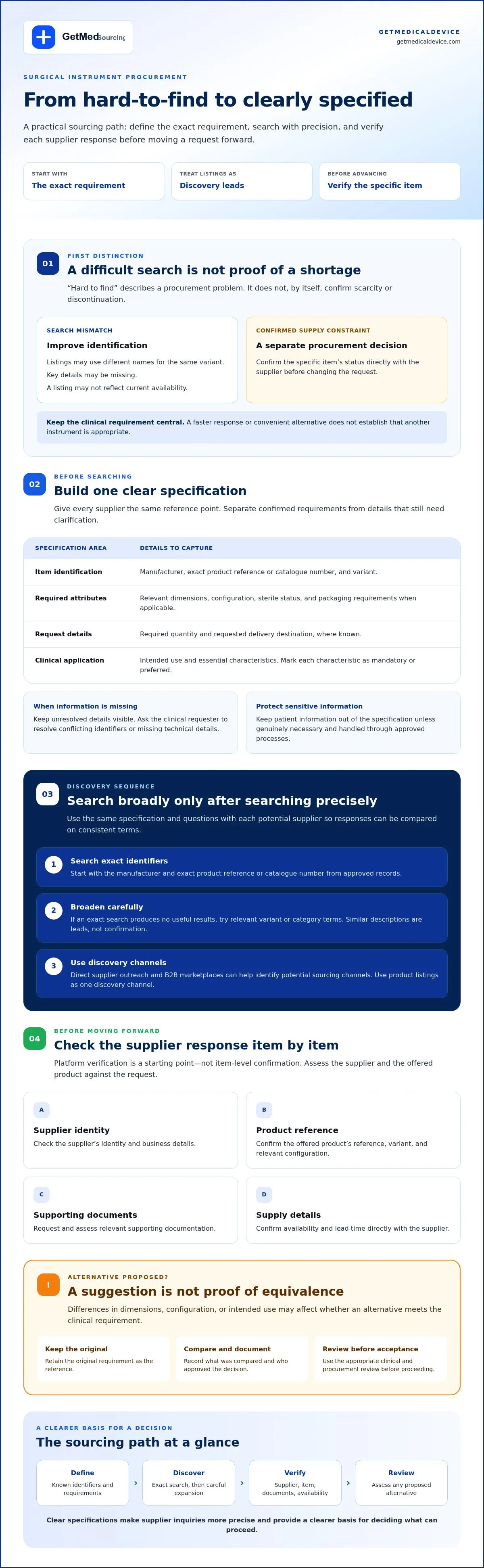
“Hard to find” describes a procurement problem, not a confirmed shortage or discontinued product. A search may stall because listings use different names for the same variant, key details are missing, or availability has changed since a listing was published. A delayed response or unclear stock status does not, by itself, establish a broader supply constraint. Confirm the specific item’s status directly with the supplier before changing the request.
The distinction matters: a search mismatch calls for better identification, while a confirmed supply constraint may require a separate procurement decision. Clinical requirements remain the priority. A convenient or faster response does not establish that another instrument is appropriate.
What makes an instrument difficult to identify?
Similar items can differ by model, dimensions, configuration, or intended use. A broad term such as “forceps” or an informal name may return instruments that look related but do not match the required variant. Check procurement records or product documentation for the terminology and identifying details to use. The Surgical instrument overview provides general context on instrument types, but it cannot confirm a particular item’s specifications.
A listing that names only a category, without an exact model or configuration, leaves important questions unanswered. Request clarification rather than treating the description as proof of a match.
When is an alternative not an automatic substitute?
A supplier-proposed alternative is a suggestion to assess, not proof of equivalence. Differences in dimensions, configuration, or intended use may affect whether it meets the clinical requirement. Send any proposed change through the appropriate clinical and procurement review before acceptance. Keep the original requirement visible and document what was compared and who approved the decision.
If the relevant decision-makers have not reviewed and accepted the alternative, do not treat it as interchangeable. Confirm its identity and supporting information before proceeding with procurement.
Build a Precise Specification Before Searching for Surgical Instruments
Prepare a concise specification before browsing listings or contacting suppliers. It gives every supplier the same reference point and separates confirmed requirements from details that still need clarification. Precise identifiers help direct searches and quotes toward the requested item, rather than products that share only a broad category name.
Which product identifiers should a procurement request include?
Use approved records to capture the manufacturer, exact product reference or catalogue number, variant, and required quantity, if known. Add relevant dimensions and configuration, along with sterile status and packaging requirements when applicable. State the requested delivery destination so suppliers can respond to the same request. If identifiers conflict or technical details are missing, ask the clinical requester to resolve them before treating a result as a match.
- Item identification: manufacturer, reference number, and variant.
- Required attributes: dimensions, configuration, sterile status, and packaging needs.
- Request details: quantity and requested destination, where known.
How should the intended use shape the specification?
Describe the clinical application and essential characteristics clearly enough for suppliers to assess the request. Keep patient information out of the specification unless it is genuinely necessary and handled through approved processes. Mark each characteristic as mandatory or preferred. This helps suppliers identify a possible match and shows which differences need further review.
Keep unresolved details visible rather than filling gaps with assumptions. State the known reference and variant, list unanswered questions, and ask the supplier to confirm the offered item against each requirement.
Once the specification is ready, use GetMedicalDevice’s product listings as one discovery channel. Confirm any relevant listing and current availability with the supplier.
How to Find and Assess Potential Surgical Instrument Suppliers
Move from precise identification to broader discovery, then to item-level checks. Use the same specification and questions with each supplier so you can compare responses on consistent terms.
- Search exact identifiers. Start with the manufacturer and exact product reference or catalogue number from approved records.
- Broaden carefully. If an exact search produces no useful results, try relevant variant or category terms. Treat similar descriptions as leads, not confirmation.
- Compare and verify responses. Check the supplier’s identity and business details, confirm product references, and request relevant supporting documents.
A platform listing is a discovery lead, not item-level verification. Before proceeding, confirm the specific instrument, current availability, condition, lead time, and applicable documentation directly with the supplier.
What should an RFQ ask a supplier to confirm?
Ask the supplier to confirm the offered item against the manufacturer and product reference in your request. Request relevant supporting documents and clarify whether the response covers the requested destination. Ask for a clear statement of current availability, product condition, and lead time. Do not treat an estimate or listing description as a confirmed commitment.
How can buyers compare supplier responses consistently?
Send each supplier the same specification and questions. Record the response date, availability statement, product reference, lead time, documents offered, and unanswered points. This makes differences visible and helps procurement teams identify gaps that need follow-up before selection.
Supplier verification status can support an initial assessment of trust, but it does not replace checks on the specific item and transaction. Use GetMedicalDevice’s RFQ channel to submit a defined request and compare supplier responses, then confirm item-level details with the supplier.
Use a Structured Sourcing Channel to Move the Request Forward
Direct supplier outreach lets buyers choose who receives a request and tailor follow-up questions. B2B marketplace discovery can broaden access to suppliers and provide a structured route for submitting procurement requests. Use direct contact for targeted follow-up and marketplace listings to identify potential sources. Neither method confirms that a particular instrument is available or suitable.
When can a B2B medical device platform help?
A platform such as GetMedicalDevice can support supplier discovery and RFQs. Its offerings include Verified Supplier Membership, Premium Product Listings, and RFQ Response Credits. Membership status can support an initial supplier assessment, but it does not replace item-level verification. Buyers must confirm the specific product’s availability, documentation, and suitability directly with the supplier. Browse the surgical products category as one discovery step, then check any relevant listing with the supplier.
What information should accompany the next sourcing request?
Send a complete specification, including the quantity, requested destination, requested timing, and questions about available documentation. Identify mandatory requirements separately from preferences, and ask suppliers to state clearly when they cannot confirm a detail. Keep responses together so outstanding questions can be resolved before procurement advances.
For additional context, consult a guide to global medical device sourcing and procurement. Once your request is defined, GetMedicalDevice’s platform is one sourcing channel. Review supplier responses and verify the specific item before making a procurement decision.
Move Your Surgical Instrument Request Forward
Sourcing hard-to-find surgical instruments is more manageable when procurement starts with a defined requirement and consistent checks. Exact references and clear variants help suppliers respond to the right request. Comparing availability, lead times, product details, and supporting documents makes gaps easier to identify before procurement advances. Any proposed alternative still requires appropriate clinical and procurement review.
GetMedicalDevice provides a structured platform for supplier listings and RFQ responses, connecting medical device buyers and suppliers across a global network. It can be one channel for discovery, but supplier responses and item-level details still need to be confirmed directly.
Before submitting a request, prepare the specification, quantity, destination, requested timing, and questions about supporting documents. Submit a surgical instrument sourcing request through GetMedicalDevice to move your inquiry forward. A clear request gives suppliers a useful basis for responding and your team a stronger starting point for review.
Frequently Asked Questions
What is the best way to find a hard-to-find surgical instrument?
Start with the exact manufacturer reference or catalogue number, then confirm the required variant, quantity, and destination. If an identifier is missing or details conflict, ask the clinical requester to clarify the essential characteristics. Broaden the search only after checking those requirements. Send the same specification to each potential supplier so you can compare product matches, availability statements, lead times, and documentation responses.
How can I verify a supplier for surgical instruments?
Confirm the supplier’s legal identity and business details, then request product-specific information for the exact instrument. Ask the supplier to confirm the manufacturer reference, current availability, product condition, and relevant documentation. If the supplier cites a verification process, check what it covers rather than assuming it applies to every item. Assess the information against your organization’s procurement procedures and the requirements applicable to the destination market.
Can I use a substitute if the exact surgical instrument is unavailable?
Do not assume a similar description or supplier recommendation means the alternative is equivalent. Have the appropriate clinical and procurement stakeholders assess the proposed instrument against the required use and specifications before accepting a change. Record the review and decision. Before proceeding, confirm the alternative’s identity and supporting information with the supplier. If the required review has not established acceptability, do not treat the proposed substitute as interchangeable with the requested instrument.
What information should an RFQ for a surgical instrument include?
Include the manufacturer and product reference when known, the required variant, quantity, destination, and requested timing. Describe essential technical characteristics and list questions about supporting documentation. Separate mandatory requirements from preferences so suppliers can identify where their response matches or needs clarification. Share only the procurement information needed for an accurate response, and avoid including patient-identifying information in the RFQ.
Can a medical device marketplace guarantee an instrument is available?
No. A marketplace listing can help identify a potential sourcing route, but it does not confirm current stock, delivery timing, product condition, or suitability. Ask the responding supplier to confirm these details for the exact requested reference and destination. Then review the relevant documentation through your organization’s procurement process before placing an order. Treat a listing as a discovery lead, not confirmation that the item is ready to procure.