
Sourcing neurovascular intervention devices starts with matching the clinical application to the device category, then assessing supplier fit, product performance, compliance, and operational risk. The global neurovascular devices market was valued at USD 5.17 billion in 2025, but market scale alone doesn’t determine which products suit a procurement requirement.
Buyers know device selection depends on more than a catalogue description. The practical challenge is matching thrombectomy, embolization, flow-diversion, stenting, and access products to their intended applications while accounting for supplier profiles and regional market conditions. Clot characteristics and vessel tortuosity also shape thrombectomy choices. This guide explains device categories and their clinical roles, outlines procurement factors to consider, and profiles companies active in the market. It also covers changes influencing demand and supply, giving buyers a clearer framework for comparing devices and identifying relevant suppliers across markets.
Key Takeaways
- Match device categories to their clinical applications, from thrombectomy systems to embolization and flow-diversion technologies.
- Compare company profiles by product focus and market presence, and distinguish U.S. regulatory status from broader supplier availability.
- Assess procurement decisions across performance, total cost, supplier capability, integration, compliance, and operational risk.
- Use market and regional conditions to identify which sourcing factors may matter most for your organization’s requirements.
Table of Contents
- Competitive landscape and device company profiles
- Product categories, including embolization, stenting, thrombectomy, and support devices
- Which FDA-cleared neurovascular device manufacturers and suppliers serve the U.S?
- Procurement, distribution, and regulatory considerations
- GetMedicalDevice: Verified Supplier Membership
Competitive landscape and device company profiles
The competitive field spans more than 40 significant neuro-interventional device manufacturers across North America, Europe, Asia-Pacific, and Latin America. Market analysis covers manufacturers accounting for 75-80% of global market share in 2024 and includes a 2025 market-share analysis. This breadth makes regional presence and product-category fit useful starting points for supplier comparisons.
Build a profile around the device categories a company serves, its target region, and the evidence available for the intended application. Boston Scientific, Terumo, Asahi Intecc, and Abbott Vascular are examples of established names buyers may encounter in medical-device sourcing. Compare each company’s relevant technologies and product documentation rather than treating a broad vascular portfolio as proof of fit for every neurovascular treatment. A neurovascular device category view can help organize the search by application when sourcing neurovascular intervention devices.
Guidewires require a separate, specification-level review. Conventional guidewires may support general catheter navigation, while neurovascular procedures place particular emphasis on controlled navigation through delicate anatomy. Compare the intended procedure, imaging compatibility, guidewire dimensions, tip control, and compatibility with the selected catheter. These criteria help buyers distinguish products by intended use, not just by name.
Clinical context also matters beyond product selection. Compartment syndrome is a surgical emergency, and pain disproportionate to injury is its first and most reliable sign, according to the Royal Children’s Hospital Melbourne. The same guideline identifies capillary refill longer than 3 seconds as an indicator of inadequate limb perfusion. It recommends neurovascular observations every hour for the first 24 hours after injury, surgery, or cast application, followed by observations every four hours for a further 48 hours, unless the treating medical team specifies otherwise. If compromise or deterioration is suspected, immediately contact the medical team. These response steps concern patient safety, not supplier selection, but they show why accurate device-use context matters.
Product categories, including embolization, stenting, thrombectomy, and support devices
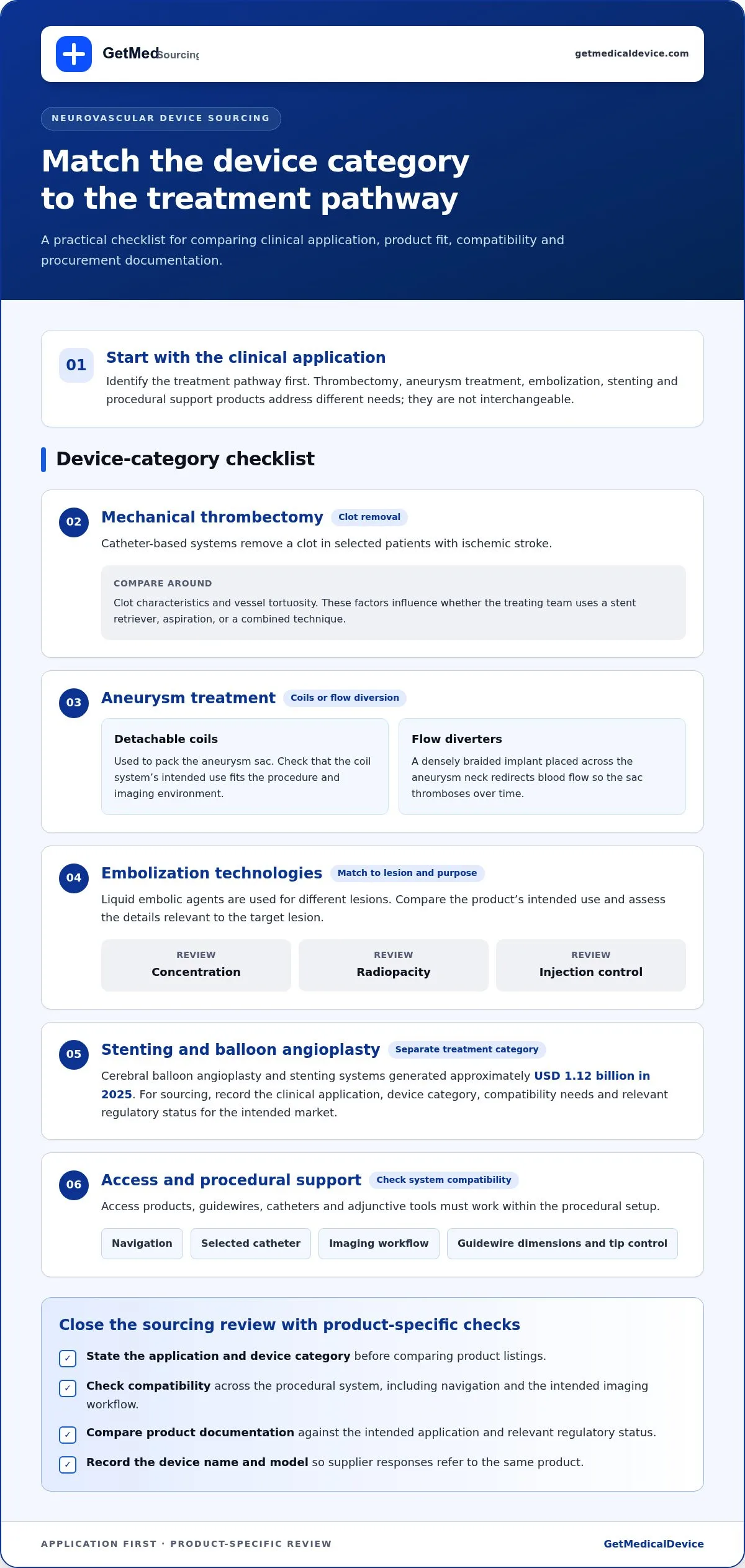
Start with the treatment pathway, then match each medical device category to its intended use. Mechanical thrombectomy uses a catheter-based system to remove a clot in selected patients with ischemic stroke. Aneurysm treatment may use detachable coils to pack the sac or a flow diverter to redirect blood across its neck. These minimally invasive approaches address different vascular problems and are not interchangeable.
For aneurysm coil embolization, compare the coil system’s intended use with the procedure and imaging environment. Flow diversion uses a densely braided implant across the aneurysm neck, changing blood flow so the sac thromboses over time. Liquid embolic agents are used for different lesions. Their selection and use require attention to concentration, radiopacity, and injection control for the target lesion. These distinctions separate embolization technologies by treatment purpose, not simply by product label.
Thrombectomy selection depends on clot characteristics and vessel tortuosity. These factors influence whether the treating team uses a stent retriever, aspiration, or a combined technique. Support products matter too: access products, guidewires, catheters, and adjunctive tools must work within the procedural setup. Assess compatibility across the system, including how each component supports navigation and the intended imaging workflow.
Stenting and balloon angioplasty address another category of need. Cerebral balloon angioplasty and stenting systems generated approximately USD 1.12 billion in 2025. For sourcing, record the clinical application, device category, compatibility needs, and relevant regulatory status for the intended market. Then compare product documentation against those criteria. A useful next step is to organize requirements against the neurovascular device category, separating thrombectomy, aneurysm, stenting, and support-device needs before reviewing listings.
Which FDA-cleared neurovascular device manufacturers and suppliers serve the U.S?
In the United States, assess regulatory status for each device, not by manufacturer name alone. A company may supply several neurovascular technologies, but that does not establish the status or intended use of every product in its portfolio. Match the exact device, application, and product documentation to the U.S. procurement requirement before comparing suppliers.
Boston Scientific, Terumo, Asahi Intecc, and Abbott Vascular are established medical-device names buyers may encounter in international sourcing. Their presence in a supplier search is a starting point, not evidence that every listed product is FDA-cleared for neurovascular use. Compare product-specific documentation, intended application, and supplier information. Record the device name and model so teams assess the same item across supplier responses.
Distinguish the manufacturer from the supplier. A manufacturer develops or markets a device, while a supplier may list or distribute products from one or more manufacturers. For each candidate, organize the review around these steps:
- Identify the specific device category, such as thrombectomy, aneurysm treatment, or vascular access.
- Match the product’s stated intended use to the clinical application under consideration.
- Review U.S. regulatory documentation for that specific device and model.
- Compare supplier details, product information, and response to the procurement request.
This approach also helps distinguish U.S. availability from global market presence. Neurovascular device availability and regulatory status vary by country, so a product found through an international listing should not automatically be treated as suitable for U.S. procurement. Keep a separate record for each market and device.
For a practical comparison, list companies in rows and product categories in columns. Include fields for device identification, intended application, regulatory documentation, supplier role, and procurement response. This structure helps teams spot gaps without treating a brand profile as a product-level assessment. It also makes sourcing decisions more consistent across clinical, purchasing, and compliance reviewers.
Boston Scientific, Terumo, Asahi Intecc, and Abbott Vascular are established medical-device names buyers may encounter when sourcing internationally. Confirm FDA clearance for neurovascular use for the specific product and model.
Procurement, distribution, and regulatory considerations
U.S. buyers often prioritize measurable return on investment, deployment speed, service coverage, supply resilience, and scalability. Compare these factors alongside product performance, total cost, reliability, integration, compliance, supplier capability, and operational risk. Even a device suited to the clinical application needs a workable implementation plan and a supply pathway that fits the facility.
Structure supplier evaluations around operational requirements, not product features alone. Record who owns implementation, what support is needed, how the device fits existing workflows, and whether the supplier can scale beyond a pilot. Transparent commercial terms, onboarding, documentation, technical support, and distributor enablement also inform procurement decisions. These criteria help teams compare supplier capability consistently across product categories.
Regulatory status and availability vary by country, so assess each target market separately. In the European Economic Area, cerebrovascular intervention devices sold there must complete Class III re-certification by the EU MDR transition deadline in December 2028. Average review delays for EU medical-device recertification can reach 18 months because of notified-body capacity limitations. These timelines make regulatory documentation and market-specific planning material sourcing considerations.
Distribution planning also needs to account for local requirements, supplier resilience, and end-user workflows. European strategies may need adjustments by country or market cluster, including localization, sustainability, cross-border standardization, and supplier transparency. In 2026, geopolitical disruptions and ESG reporting mandates are encouraging manufacturers to diversify sourcing and use circular-economy packaging. Specialty polymers, platinum-tungsten alloys, and precision micro-manufacturing also shape supply-chain dependencies.
Build a procurement matrix covering application, market, regulatory documentation, implementation ownership, support needs, and supply risks. Then use the neurovascular device category to align product discovery with the matrix requirements.
GetMedicalDevice: Verified Supplier Membership
GetMedicalDevice connects medical-device buyers and suppliers through a B2B platform for product discovery and procurement requests. For teams that have defined a neurovascular requirement, it provides a next step for finding listed medical devices and engaging with suppliers.
Suppliers can use Verified Supplier Membership and Premium Product Listings to present their inventory to buyers. RFQ Response Credits let suppliers respond to procurement requests from hospitals, clinics, and international distributors. These platform features support buyers comparing product listings or preparing an RFQ, rather than seeking clinical advice or regulatory consulting.
Use your device category and procurement requirements to guide your search and request. Visit getmedicaldevice.com to explore the platform or discuss supplier participation.
Turn Sourcing Requirements Into a Clear Next Step
As procurement plans evolve, teams can make future reviews more consistent by recording the clinical application, product requirements, target market, and decision criteria. This gives purchasing, clinical, and compliance stakeholders a shared set of requirements when sourcing neurovascular intervention devices. It also gives supplier discussions a clear purpose: aligning relevant listings and responses with the procurement need.
GetMedicalDevice offers Verified Supplier Membership and Premium Product Listings for suppliers presenting inventory to buyers. RFQ Response Credits support supplier responses to procurement requests. These options help organizations seeking supplier visibility or looking to engage with procurement requests.
Bring your sourcing requirements into the next discussion. Contact GetMedicalDevice about sourcing and take the next step with a clear procurement brief.
Frequently Asked Questions
What neurovascular intervention devices are commonly sourced?
Commonly sourced devices include thrombectomy systems, aneurysm coils, flow diverters, cerebral balloon angioplasty and stenting systems, catheters, guidewires, and access products. Build the request around the procedure and required components. For example, specify the system type and compatible access products in a thrombectomy request; for an aneurysm request, distinguish coils from flow-diversion devices. This level of detail supports more relevant supplier responses.
What are the prices and purchasing costs for neurovascular intervention devices?
Pricing is provided after a quote request and depends on factors such as device configuration, quantity, destination country, timing, documentation expectations, and supplier terms. Compare quotations using the same specifications so differences reflect the offers rather than mismatched requirements. Before purchasing, also review the supplier’s commercial terms, including payment and delivery arrangements.
How do neurovascular device suppliers compare on quality, availability, and service?
Compare suppliers using product-specific documentation, inventory information, response completeness, and the support described for the offered device. To source neurovascular intervention devices systematically, send each supplier the same product family, REF or UPN code, quantity, destination, and timing. Availability, lead time, and terms vary by supplier, country, stock status, and market conditions, so assess each response against your organization’s requirements.
What FDA regulations and approvals apply to sourcing neurovascular devices in the United States?
U.S. buyers should establish the applicable FDA status for the specific device and intended use before procurement. A manufacturer’s name or product listing alone does not establish that status. Match the device identification and labeling to the clinical application under consideration, then review the corresponding regulatory documentation. Assess each product individually, since a supplier’s broader portfolio does not establish the status of every device.
What certifications and documentation should buyers verify when sourcing neurovascular devices?
Request documentation tied to the exact product and supplier, including certificates, declarations of conformity, instructions for use, technical sheets, quality documents, labeling details, registration information, and supplier authorization documents. Compare product identifiers across the documents and quotation. Before purchase, buyers must independently verify supplier legitimacy, documentation, regulatory compliance, and clinical suitability. A supplier response or listing does not replace these checks.
How can hospitals and clinics evaluate and qualify neurovascular device suppliers?
Hospitals and clinics can qualify suppliers by documenting their needs, issuing a consistent RFQ, and assessing each response against procurement requirements. When sourcing neurovascular intervention devices, include the brand, product family, REF or UPN code, quantity, destination, timing, and documentation expectations. Then review supplier legitimacy, product records, commercial terms, and operational fit with relevant internal teams. The buyer retains final procurement, compliance, and product-suitability decisions.