

Hospitals can source interventional medical devices online through medical-device suppliers and B2B purchasing platforms, comparing listings against clinical specifications, order requirements, and delivery needs. Sourcing interventional medical devices online works best when the purchase is matched to the required device configuration and the supplier’s fulfillment details, not just the listing title.
That comparison matters because the World Health Organization estimates that the global market includes 2 million different kinds of medical devices, grouped into more than 7000 generic device groups. A product category alone may not be enough to confirm a match for a hospital’s requirements.
This guide explains how to compare options for sourcing interventional medical devices online, align product specifications with the intended use, and assess delivery and order details. It also covers the procurement information hospitals need to evaluate a request before purchase, helping teams make decisions based on defined requirements rather than assumptions.
Key Takeaways
- Compare online purchasing options by reviewing product details, supplier information, ordering workflow, and fulfillment criteria together.
- Assess delivery expectations and order accuracy by matching the requested device and quantity against the order documentation.
- Translate clinical requirements into a clear specification checklist, including device configuration and supporting documentation.
- Use GetMedicalDevice’s Verified Supplier Membership and Premium Product Listings to explore supplier and product information, or RFQ Response Credits to respond to procurement requests.
Table of Contents
- Delivery speed and order accuracy
- Online purchasing tools and comparison sites
- Interventional medical device solutions
- Medical-device procurement and technical specifications
- GetMedicalDevice: Verified Supplier Membership
Delivery speed and order accuracy
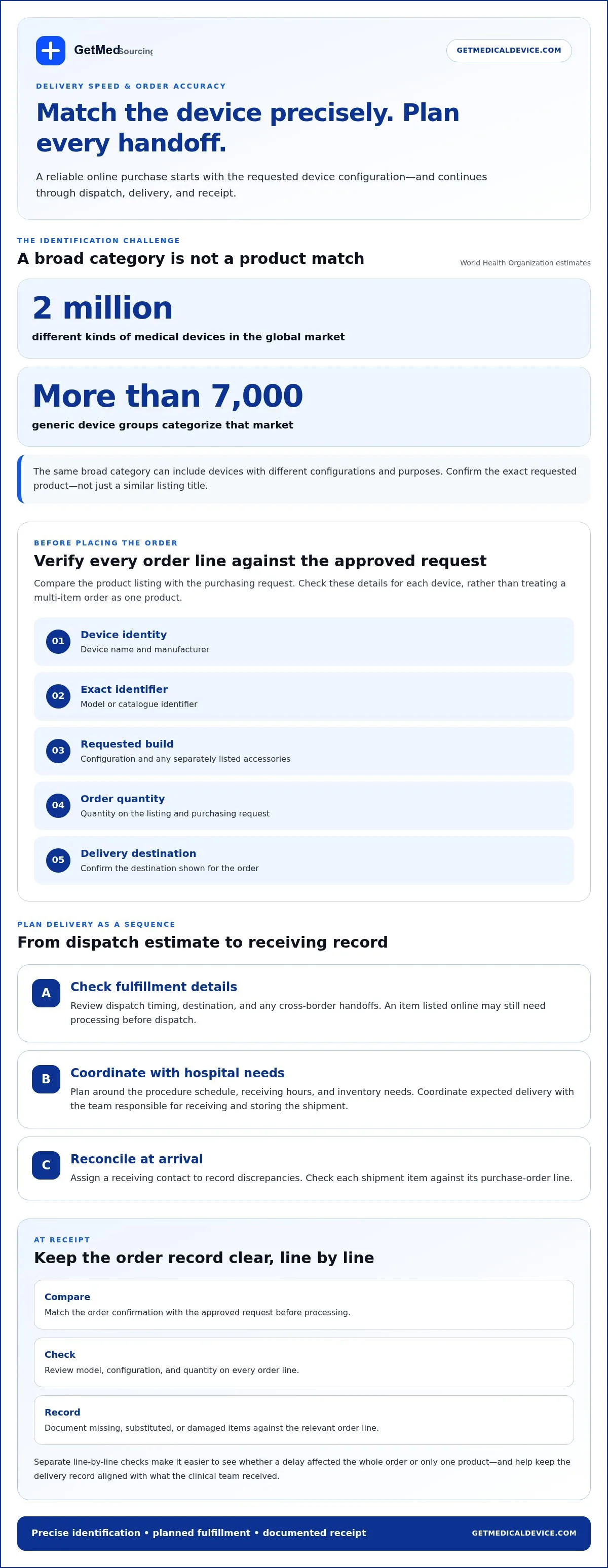
For hospitals, delivery planning starts with the procedure schedule and the device’s intended use. According to the World Health Organization, the world market contains an estimated 2 million different kinds of medical devices. The World Health Organization also categorizes the world market’s medical devices into more than 7000 generic device groups. That range makes precise identification essential: a broad category may include devices with different configurations and purposes.
Before placing an order, compare each product listing with the purchasing request. Check the device name, manufacturer, model or catalogue identifier, configuration, and quantity. For example, distinguish the requested interventional device model from other products in the same portfolio. List accessories separately, so the receiving team can check each shipment item against the purchase order.
Assess delivery timing as a sequence of steps, not a single estimate. Review dispatch timing, destination, and any cross-border handoffs. An item listed online may still require processing before dispatch. Plan around the hospital’s procedure schedule, receiving hours, and inventory needs. For diagnostic or interventional supplies, coordinate the expected delivery with the team responsible for receiving and storing the shipment.
- Compare the order confirmation with the approved request before processing.
- Check each line for model, configuration, quantity, and destination.
- Assign a receiving contact who can record discrepancies at arrival.
- Document missing, substituted, or damaged items against the relevant order line.
These steps create a record from product selection through receipt. If an order includes several device types, review each line separately rather than treating the shipment as a single item. That makes it easier to identify whether a delay affected the whole order or just one product. Clear records also support follow-up and help prevent an inaccurate delivery log from obscuring what the clinical team received.
Online purchasing tools and comparison sites
Online tools help procurement teams compare listings, supplier details, and purchasing workflows. Counterfeit, expired, recalled, or improperly stored devices can pose patient-safety and clinical-use risks, so assess product identity and condition before ordering.
Online Purchasing Tools
Supplier catalogs, B2B marketplaces, search filters, and request-for-quotation tools support different stages of online selection. Use filters to narrow by device category or manufacturer, then compare listing details and supplier information side by side. An RFQ can help communicate a hospital’s requested specifications and quantities. Save the product page and correspondence with the purchase record, so the clinical team can review the exact selection.
Device Authenticity and Condition Risks
A listing alone may not confirm whether a device is authentic, within its usable date, unaffected by a recall, or stored appropriately. Compare the manufacturer and model identifiers with the purchase requirements, and review available labeling and condition details. For example, resolve concerns about damaged package seals or an unclear expiration date before clinical use. Retain listing and order records for traceability.
Comparison sites can help with initial screening, but listings may use different naming conventions or provide different levels of detail. Compare equivalent information: manufacturer, device type, configuration, intended application, and included components. If one listing describes a broad category and another names a specific model, do not assume they are equivalent. Record which details are essential for the procedure and which are preferences.
Use a consistent review sequence for each purchase:
- Search by the exact device name or manufacturer identifier.
- Compare product details, supplier identity, and distribution information.
- Review order terms, documentation, and the stated device condition.
- Retain the selected listing and purchase correspondence for internal review.
These steps make online selection easier to audit across procurement and clinical teams. For a focused product search, browse medical device product listings alongside the hospital’s documented requirements.
Interventional medical device solutions
Define the procedure need before comparing interventional medical supplies. Start with the clinical application, then specify the device category, required configuration, and compatible components. For example, a coronary intervention request may include a guidewire, catheter, and related accessories. Listing each item separately helps procurement teams compare complete requirements rather than isolated products.
When sourcing interventional medical devices online, begin with a clear procedure specification. Include the intended use, required device characteristics, compatible equipment, and handling requirements. Separate essential requirements from preferences, such as a particular configuration or packaging format. A structured request gives suppliers a clear basis for responding and helps the clinical team assess proposed products against the planned use.
- Map each requested device to a specific clinical step.
- Identify compatible components and any equipment dependencies.
- Record required documentation and packaging considerations.
- Keep alternatives distinct from the requested configuration.
Review a supplier’s product range to see whether its listings cover related needs for a procedure. Compare each item separately, then consider how the products fit together. For example, when sourcing access devices and intervention supplies, distinguish the primary device from accessories and consumables. Similarly, when devices require custom rigid components or specialized housings, custom manufacturers like Central Plastics offer precision injection molding to satisfy technical requirements. This supports a complete purchase plan and makes the request more precise.
Include training needs in the procurement plan when a device or workflow requires team orientation. Describe the intended users, relevant clinical workflow, and materials the team needs to understand. Include these requirements in the purchasing request so supplier responses can address the operational need. Training does not replace selecting appropriate equipment or assessing device compatibility.
Organize the request by procedure and replenishment need. When sourcing interventional medical devices online, separate planned case requirements from recurring supplies, then identify items that need coordinated purchasing. A structured request lets suppliers respond to clear categories and helps procurement, clinical, and inventory teams review the same requirements. Link each device to its role in care delivery.
Medical-device procurement and technical specifications
Hospital procurement should bring together clinical requirements, documentation, and handling conditions. Define these before comparing brands or submitting a request. When specialized equipment requires custom components, bespoke tooling, or rapid prototyping before finalized procurement, partnering with providers like FORMAQ Advanced Manufacturing for 3D scanning, CAD design, and 3D printing can help teams refine and validate technical specifications.
For U.S. purchases, FDA requirements depend on the device and transaction. Include the device’s applicable FDA status in the procurement review rather than assuming every listing follows the same pathway.
Shipping and storage requirements depend on the device and its labeling. Align handling instructions with the receiving facility, and include any relevant protective equipment or storage needs in the order plan.
Before ordering, compare applicable FDA recall information and available registration records with the device identity. Record identifiers, supplier details, and order documents so the hospital can trace the item from receipt through use.
Online Price Considerations
Prices vary by device type, configuration, quantity, and purchasing terms. Compare equivalent products, not broad categories, and account for shipping, documentation, and required accessories. A quote depends on the device specifications, quantity, and destination. A lower listed price alone does not establish equivalent clinical suitability.
Online Sourcing Steps
Hospitals and clinics can follow a repeatable process: define the therapy or procedure need, document technical specifications, and compare matching listings. Review supplier and product information, check recall and traceability records, and assess handling and delivery requirements. Route the proposed purchase through clinical and procurement review before ordering, and retain the approved specification with the purchase record.
- Separate essential specifications from preferences.
- Match product identifiers to the requested device.
- Document storage and receiving requirements.
- Retain records linking the order to the received item.
For a category-specific comparison, review coronary intervention device listings against the hospital’s technical requirements.
GetMedicalDevice: Verified Supplier Membership
GetMedicalDevice connects hospitals and other buyers with medical-device suppliers through a B2B platform. For procurement teams sourcing interventional devices, Premium Product Listings provide a way to review supplier inventory, while medical-device listings support product discovery across relevant categories.
Verified Supplier Membership and RFQ Response Credits are for suppliers participating in the platform. Buyers can use supplier and product information to identify options for a procurement request, then apply their own clinical specifications and purchasing criteria. GetMedicalDevice is useful when a hospital wants to move from a defined requirement to supplier discovery, rather than seeking freight forwarding or regulatory consulting.
Define the device category and key requirements before using listings to identify options. GetMedicalDevice’s request-a-quote workflow lets professional buyers submit structured procurement requests to the verified supplier network.
Set the Next Procurement Step
Turn your sourcing criteria into a clear procurement brief. Identify the clinical requirement, device category, and criteria your team will use to assess supplier responses. This gives procurement and clinical stakeholders a shared starting point for sourcing interventional medical devices online and keeps supplier discussions focused on the hospital’s needs.
GetMedicalDevice supports suppliers through Verified Supplier Membership, Premium Product Listings, and RFQ Response Credits. Hospitals can use the platform’s structured RFQ workflow to share purchasing requirements with the verified supplier network. A clear request helps focus supplier responses on your team’s priorities.
Prepare your device category and procurement requirements, then contact GetMedicalDevice to discuss sourcing. A structured next step can help your team move forward with greater clarity.
Frequently Asked Questions
Where Can I Buy Medical Supply Equipment?
Hospitals can source medical supply equipment through medical-device suppliers and professional B2B sourcing platforms. GetMedicalDevice supports product discovery and structured supplier communication through an RFQ workflow; the relevant supplier or seller handles any sale. For example, a procurement team can submit a request with its required product family, quantity, destination, and documentation expectations, then assess supplier responses internally.
What types of interventional medical devices can be sourced online?
Online searches may cover coronary intervention, neurovascular, peripheral intervention, interventional radiology, and vascular access categories. Products depend on supplier listings and the request. For example, a hospital planning a vascular procedure can specify the relevant product family and device identifiers in its RFQ. The clinical team can then assess whether a proposed item fits its intended application.
Which online suppliers sell interventional medical devices in the United States?
GetMedicalDevice connects professional buyers with medical-device suppliers, but does not sell the listed devices directly. Brands identified on the platform include Boston Scientific, Terumo, Asahi Intecc, and Abbott. These names help buyers find relevant product and supplier information; they do not imply endorsement or guarantee availability. The individual supplier or seller handles sales and commercial terms.
How can buyers verify an online medical device supplier is legitimate and FDA compliant?
Independently assess supplier identity and device documentation before purchase. Compare the supplier’s business details with its authorization records, and match the manufacturer, model, and product identifiers across available documents. Review relevant FDA records for the specific device and its U.S. regulatory status. GetMedicalDevice supports sourcing communication, while buyers remain responsible for verifying supplier legitimacy, documentation, regulatory compliance, and product suitability.
Can individuals buy interventional medical devices online, or must purchases be made by licensed healthcare providers?
Purchase access depends on the seller’s terms and the product, so an online listing alone doesn’t establish that an item is available for consumer purchase. GetMedicalDevice is a professional B2B sourcing platform for organizations such as hospitals, clinics, laboratories, and distributors. Individuals should distinguish product discovery from a completed sale and consider the intended user and clinical setting before pursuing a purchase.
How do online suppliers compare on product availability, pricing, shipping, and support?
Compare supplier responses using the same device specification, quantity, destination, and requested timing. Availability, pricing, lead time, shipping options, minimum order quantities, and other terms vary by supplier, country, stock status, and market conditions. For a useful comparison, assess each response against the same RFQ fields, including product match, documentation, and commercial terms.

