
In 2026, the operational distance between a successful interventional procedure and a regulatory failure is determined by the integrity of your Abbott Vascular device distributor rather than the technology itself. Procurement officers recognize that securing critical inventory like the Volt pulsed field ablation system or the CardioMEMS HERO requires more than a simple purchase order. You're likely managing the complexities of the new FDA Quality Management System Regulation (QMSR) while mitigating the persistent risks of counterfeit or grey-market devices that threaten patient safety and institutional compliance.
We provide a professional framework designed to help you identify, verify, and engage with reliable global suppliers with clinical precision. This guide delivers a systematic approach to establish a secure supply chain, reduce RFQ turnaround times, and ensure full adherence to international standards. You'll learn how to evaluate distributor documentation against the latest ISO 13485:2016 alignments and manage the financial implications of recent international tax revisions, such as the September 2025 Indian GST updates for vascular closure systems.
Key Takeaways
- Define the ecosystem of authorized channel partners to understand why specialized dealers are essential for maintaining high-stakes vascular inventory.
- Identify core product requirements across coronary and structural heart categories, including XIENCE stents and MitraClip solutions, to align sourcing with clinical needs.
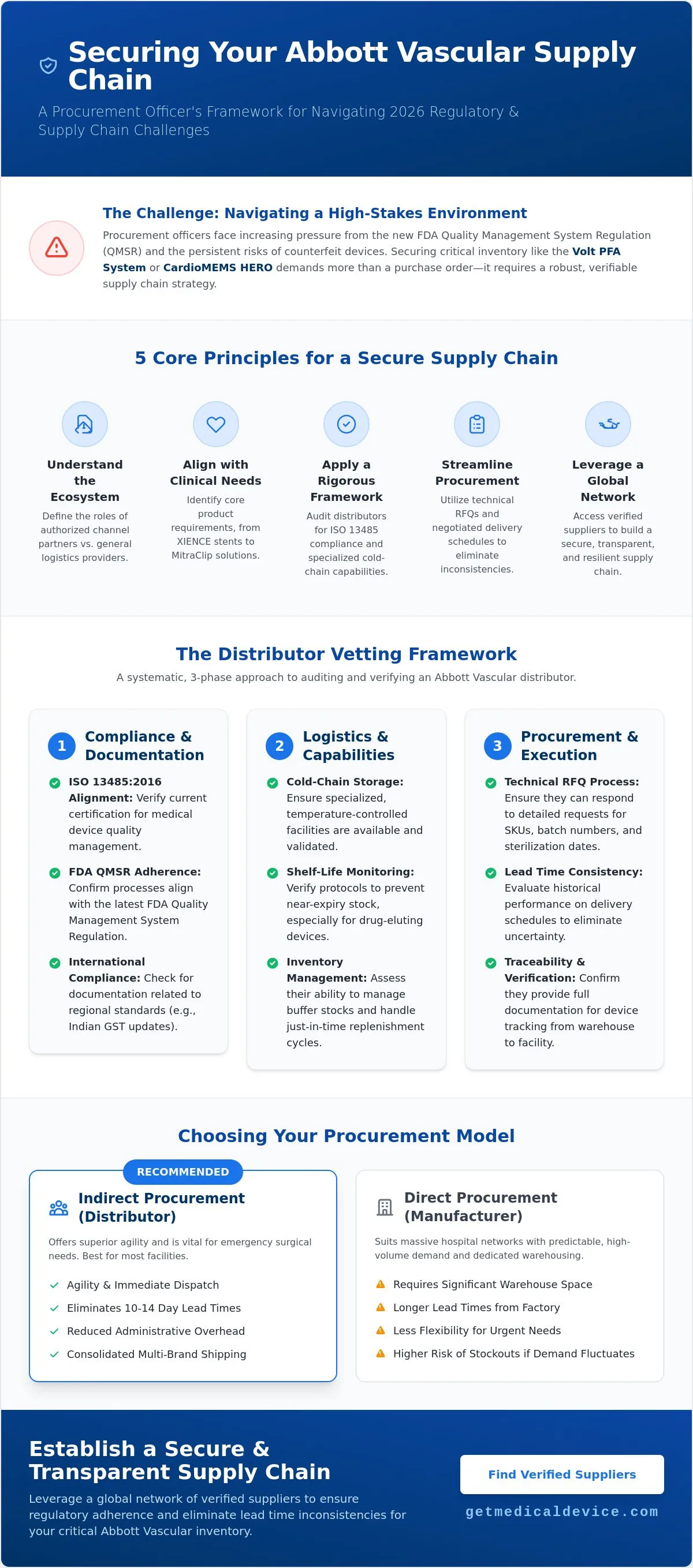
- Apply a rigorous verification framework to audit an Abbott Vascular device distributor for ISO 13485 compliance and specialized cold-chain storage capabilities.
- Execute a structured procurement workflow that utilizes technical RFQs and negotiated delivery schedules to eliminate lead time inconsistencies.
- Leverage a global network of verified suppliers to establish a secure, transparent supply chain that meets 2026 regulatory standards.
Table of Contents
- The Role of Abbott Vascular Distributors in the Global Supply Chain
- Key Product Categories in the Abbott Vascular Portfolio
- Vetting an Abbott Vascular Device Distributor: A Compliance Framework
- The Procurement Workflow: From RFQ to Final Delivery
- Leveraging GetMedicalDevice for Verified Abbott Sourcing
The Role of Abbott Vascular Distributors in the Global Supply Chain
The global distribution of advanced interventional tools requires a multi-tiered infrastructure to maintain clinical standards. Abbott Laboratories maintains a complex network of authorized dealers and channel partners to manage the delivery of specialized hardware. A professional Abbott Vascular device distributor acts as the critical link between high-volume manufacturing facilities and the sterile processing departments of global cardiac centers. These entities don't just move boxes. They provide the logistical stability required for life-critical procedures by managing the flow of inventory through regional hubs.
Hospitals and clinics rely on specialized distributors because the technical requirements for vascular inventory exceed the capabilities of general logistics providers. Specialized partners understand the shelf-life constraints and handling protocols for drug-coated technologies. While regional exclusive distributors often provide dedicated "feet on the ground" for specific territories, global B2B marketplaces offer a broader procurement reach. These marketplaces facilitate access to verified suppliers across different jurisdictions, allowing procurement officers to compare availability without the limitations of a single local contract.
Supply Chain Dynamics for Interventional Cardiology
Interventional cardiology departments operate on a strict just-in-time inventory model. High-turnover items, such as coronary stents and balloon catheters, require precise replenishment cycles to avoid stockouts during emergency cases. A qualified Abbott Vascular device distributor manages these cycles by forecasting clinical demand and maintaining buffer stocks within regional proximity. They also navigate the impact of global logistics shifts, ensuring that regional supply chains remain resilient against shipping delays. Beyond physical transport, these partners manage local regulatory registrations for imported devices. This documentation is essential for ensuring that every catheter or guidewire enters the facility with full legal and clinical clearance.
Direct vs. Indirect Procurement Models
Procurement officers must analyze when to source directly from the manufacturer versus using a verified third-party supplier. Direct models typically suit massive hospital networks with predictable, high-volume demand and dedicated warehouse space. However, the indirect model through a distributor offers superior agility for most facilities. Distributors maintain local stock that is ready for immediate dispatch, which is vital for emergency surgical needs. This local availability eliminates the 10 to 14-day lead times often associated with direct factory shipments. Additionally, sourcing through a multi-brand supplier allows for consolidated shipping and reduced administrative overhead. This approach simplifies the reconciliation of multiple product lines within a single procurement event, improving overall cost-efficiency.
Key Product Categories in the Abbott Vascular Portfolio
The Abbott Vascular portfolio is categorized by clinical application, ranging from routine coronary interventions to complex structural heart repairs. For a procurement officer, understanding these categories is the first step in establishing a technical dialogue with an Abbott Vascular device distributor. Each category requires specific storage conditions and documentation to remain compliant with FDA medical device regulations. Managing these diverse product lines involves coordinating with suppliers who can provide technical data sheets and verification of sterilization dates for every SKU.
High-Demand Coronary Stent Systems
Coronary interventions rely heavily on the XIENCE family, particularly the XIENCE Sierra and XIENCE Skypoint drug-eluting stents (DES). Procurement teams must manage an extensive range of diameters and lengths to ensure procedural readiness for varying vessel anatomies. Distributors must strictly monitor shelf-life standards, as the drug-polymer coating has a defined expiration window that impacts clinical efficacy. Utilizing a verified medical device supplier allows facilities to maintain these high-turnover SKUs without the risk of receiving near-expiry stock or unverified grey-market inventory.
Structural Heart and Occlusion Devices
Sourcing structural heart solutions involves higher logistical complexity. The MitraClip G4 system and the Amplatzer family of PFO and ASD occluders aren't simple off-the-shelf items. They often require specialized training and clinical support from the distributor. For example, the Amplatzer TorqVue delivery systems require rigorous inspection following the March 2025 recall updates to ensure all current inventory meets the latest safety benchmarks. Newer entries like the Volt pulsed field ablation (PFA) system, which received approval in January 2026, represent the latest shift toward non-thermal cardiac mapping and ablation technologies that require specialized sourcing channels.
Peripheral vascular interventions utilize stent grafts and specialized balloons designed for endovascular procedures. Vessel closure remains a high-volume category, led by the StarClose and Perclose ProGlide systems. In certain regions, procurement costs for these devices have shifted due to regulatory changes. For instance, the GST rate on the Perclose ProGlide in India was reduced from 12% to 5% in September 2025, which directly impacts the landed cost of these units. An experienced Abbott Vascular device distributor will reflect these regional tax and regulatory adjustments in their quotation structures, ensuring that procurement budgets are optimized according to current international trade laws.
Vetting an Abbott Vascular Device Distributor: A Compliance Framework
Vetting requires a systematic audit of quality management systems to ensure patient safety and institutional security. Since the FDA's Quality Management System Regulation (QMSR) became effective on February 2, 2026, alignment with ISO 13485:2016 is mandatory for any reputable Abbott Vascular device distributor. This regulatory shift emphasizes risk-based management over prescriptive checklists. Procurement officers must verify that their chosen partner maintains active certification and documented procedures for handling high-sensitivity devices within this new framework.
Auditing storage capabilities is essential for maintaining product integrity. Many vascular technologies, particularly drug-eluting stents like the XIENCE series, require climate-controlled environments to prevent polymer degradation. Traceability must be maintained through the Unique Device Identification (UDI) system. This allows for rapid response during safety events, such as the December 2025 recall of FreeStyle Libre 3 sensors or the April 2025 Class I recall of HeartMate power units. A distributor's ability to track specific lot numbers through international customs is a primary indicator of their operational maturity and compliance with FDA and EMA standards.
The 4-Point Supplier Verification Checklist
A standardized verification process reduces the risk of supply chain disruptions. Follow these four steps before finalizing any procurement agreement:
- Step 1: Document Authentication: Request and verify Certificates of Origin (COO), Certificates of Analysis (COA), and current CE certificates to ensure regulatory alignment with international trade laws.
- Step 2: Facility Inspection: Conduct a physical or virtual audit of the distributor's warehouse. Focus on environmental controls and sterile storage zones.
- Step 3: Financial Stability: Review the distributor's financial health to ensure they can sustain large-scale, long-term supply contracts without interruption.
- Step 4: Client References: Obtain feedback from existing hospital or clinical clients to verify the distributor's historical lead time accuracy and service reliability.
Avoiding Counterfeit and Grey-Market Risks
Grey-market devices often bypass the essential climate controls and sterile handling protocols required for vascular hardware. A primary red flag is pricing that deviates significantly from established market averages. While cost-saving is a priority, extreme discounts often indicate compromised supply chains or near-expiry stock. Non-sterile or tampered packaging presents a direct threat to patient outcomes in the cath lab. Utilizing a verified Abbott Vascular device distributor through an established marketplace provides a layer of security. These platforms conduct background checks and document verification to ensure every listed supplier operates within the legal framework of the medical device industry.
The Procurement Workflow: From RFQ to Final Delivery
The transition from clinical requirement to physical delivery involves a series of structured logistical steps. Procurement officers must define technical parameters within the Request for Quotation (RFQ) to ensure compatibility across complex vascular kits. A reliable Abbott Vascular device distributor facilitates this process by providing detailed technical specifications and logistical data. This workflow extends beyond price negotiation, encompassing international shipping terms and post-market surveillance protocols. It's essential to establish a protocol that accounts for the high-stakes nature of interventional cardiology supplies.
Optimizing the RFQ Process
Precision in the RFQ stage prevents downstream errors in the cath lab. Clear documentation ensures that the hardware received matches the specific procedural needs of the facility.
- SKU Specification: Explicitly list product codes for stents, balloons, and guidewires. This ensures that accessories are compatible with primary devices like the XIENCE Skypoint system.
- Shelf-Life Requirements: Define a minimum remaining shelf-life, typically 80% of the total duration or higher, to prevent inventory expiration and waste.
- Bidding Efficiency: Use structured platforms to reach verified suppliers. You can purchase RFQ response credits to engage with multiple distributors simultaneously, ensuring competitive market pricing.
Logistics and Cold-Chain Management
Vascular devices often require specific environmental controls during transit. While coronary stents are stable at room temperature, certain accessories and drug-coated technologies demand climate-controlled shipping to maintain polymer integrity. Ensuring sterile barrier integrity is non-negotiable. International shipments must utilize Incoterms that clearly define the point of risk transfer, such as Delivered at Place (DAP) or Cost, Insurance, and Freight (CIF). Effective customs clearance strategies are necessary for time-critical technologies, such as the Volt pulsed field ablation system approved in January 2026, where delays can disrupt scheduled clinical programs.
An experienced Abbott Vascular device distributor also serves as a vital node in post-market surveillance. They are responsible for reporting adverse events and coordinating with the manufacturer during safety alerts. This role was highlighted during the 2025 Class I recalls for HeartMate power units, where distributors managed the identification and recovery of affected components. By maintaining a methodical procurement workflow, facilities ensure that their supply chain is both efficient and compliant with the latest global safety standards. This systematic approach reduces the administrative burden on hospital staff while securing the necessary tools for patient care.
Leveraging GetMedicalDevice for Verified Abbott Sourcing
GetMedicalDevice operates as a specialized intermediary designed to streamline the identification of a reliable Abbott Vascular device distributor. The platform provides a structured environment where procurement officers can bypass the logistical friction of unverified global sourcing. By consolidating international suppliers into a single framework, the system ensures that every interaction is grounded in professional verification and documented compliance. This centralized approach addresses the fragmentation of the medical supply chain, allowing for a more clinical and precise procurement process.
The platform functions as a knowledgeable bridge between complex global entities. It offers a suite of tools that prioritize efficiency and clarity, ensuring that hospitals and surgical centers can secure high-stakes vascular technology without unnecessary delays. By utilizing this infrastructure, procurement professionals can focus on clinical outcomes rather than the administrative burden of supplier vetting.
Benefits for Global Buyers and Hospitals
The centralized dashboard serves as a command center for managing complex procurement requirements across multiple product lines. Trust signals are integrated directly into the interface; for instance, the "Verified Supplier" badge indicates that a dealer has successfully passed a rigorous audit of their ISO 13485 certifications and climate-controlled storage facilities. This system reduces the administrative burden on hospital procurement teams, often moving the sourcing cycle from several weeks to a few business days. Procurement officers can utilize RFQ response credits to broadcast their requirements to multiple authorized distributors simultaneously. This ensures that bids are received only from suppliers who possess the documented capacity to meet the specific technical demands of the interventional cardiology department.
Joining the Verified Supplier Network
For the medical device supplier, the platform offers a professional pathway to showcase specialized inventory to a targeted global audience. An Abbott Vascular device distributor can utilize a Verified Supplier Membership to establish immediate credibility within the marketplace. This membership provides the necessary infrastructure to manage high-value inquiries and maintain a reputable presence in international trade. Premium product listings further ensure that critical technologies, such as the XIENCE Skypoint stent or the Perclose ProGlide system, remain visible to facilities currently optimizing their supply chains. This visibility is essential for suppliers looking to align their operations with the 2026 FDA QMSR updates, which demand higher levels of transparency and risk-based quality management across the entire distribution network.
Securing Your Vascular Supply Chain for 2026
Establishing a resilient procurement strategy requires more than just identifying inventory. It demands a systematic verification of every Abbott Vascular device distributor against the latest QMSR and ISO 13485:2016 standards. By prioritizing documented traceability and rigorous storage audits, procurement officers can eliminate the risks associated with grey-market devices and inconsistent lead times. A structured workflow ensures that your interventional cardiology department remains fully operational and compliant with international regulations.
GetMedicalDevice provides the global B2B network necessary to facilitate these complex transactions. You gain immediate access to top brands, including Abbott, Boston Scientific, and Terumo, through a verified supplier vetting process that prioritizes transparency and efficiency. This infrastructure allows you to manage multiple RFQs from a single, professional interface, reducing the time required to secure critical medical hardware.
Browse Verified Abbott Vascular Suppliers on GetMedicalDevice
Standardizing your sourcing protocols today ensures a stable and secure supply chain for the future of patient care.
Frequently Asked Questions
How can I verify if an Abbott Vascular distributor is authorized?
You should request an official letter of authorization from the manufacturer or consult their global dealer directory. It's also necessary to verify the distributor's status on the FDA Establishment Registration database. Ensure the supplier provides documentation showing alignment with ISO 13485:2016 standards, which is a requirement under the Quality Management System Regulation (QMSR) effective as of February 2, 2026.
What are the most commonly sourced Abbott Vascular devices for interventional cardiology?
The primary product requirements include the XIENCE Skypoint and XIENCE Sierra drug-eluting stents, alongside Trek and Mini-Trek coronary dilatation catheters. Procurement offices also frequently source the Perclose ProGlide suture-mediated closure system. Following their 2026 approvals, the Volt pulsed field ablation (PFA) system and the CardioMEMS HERO pulmonary artery pressure reader have become high-demand items for advanced cardiac centers.
Does Abbott Vascular sell directly to hospitals or only through distributors?
Abbott utilizes a hybrid model that combines direct sales to large hospital networks with an Abbott Vascular device distributor network for regional and international markets. Distributors are often the preferred choice for smaller clinics because they maintain local buffer stocks. This allows for immediate dispatch during emergency surgical needs, which direct manufacturer channels might not support with the same speed.
What documentation should I request from a new Abbott device supplier?
You must require a Certificate of Analysis (COA), Certificate of Origin (COO), and the device's specific FDA 510(k) clearance or CE certificate. It's essential to obtain evidence of the supplier's adherence to the February 2026 FDA QMSR guidelines. This includes their internal risk-management protocols and documented procedures for handling recalls, such as those issued for HeartMate power units or FreeStyle Libre 3 sensors in 2025.
How long is the typical lead time for Abbott Vascular stents in international markets?
Lead times depend on the supplier's proximity and stock levels, but they typically range from 3 to 10 business days for regional distributors. Direct factory orders often require 14 to 21 days for production and international transit. Utilizing a distributor with local warehouse capabilities is the most effective way to reduce these timelines and ensure procedural readiness in high-volume cath labs.
Can I source Abbott structural heart devices like MitraClip through a B2B marketplace?
Yes, you can identify a verified Abbott Vascular device distributor for structural heart solutions like the MitraClip G4 or Amplatzer occluders through professional marketplaces. These platforms vet suppliers specifically for their ability to manage complex device logistics. This includes verifying that the distributor can provide the necessary technical training and clinical support bundled with these high-complexity occlusion technologies.
What is the role of a verified supplier membership in medical device procurement?
A verified supplier membership acts as a filter to ensure that only dealers with audited quality systems enter the procurement pipeline. It provides a layer of security for buyers by confirming that the supplier has passed rigorous background checks. This system helps procurement officers avoid the risks of counterfeit hardware and ensures that every listed product meets current international regulatory requirements.
Are there specific storage requirements for Abbott Vascular catheters?
Catheters and guidewires must be stored in a climate-controlled environment, typically between 15°C and 30°C, to maintain the integrity of their sterile barriers and polymer coatings. Excessive humidity or temperature fluctuations can degrade the materials, leading to device failure during a procedure. Suppliers must provide logs of their climate-controlled storage to prove that the devices have been handled according to manufacturer specifications.
