
Over 20 million patients globally have received implants from the XIENCE family, yet procurement teams in 2026 still face significant hurdles when securing authentic Abbott Vascular coronary stents. You're likely aware that while the clinical superiority of the XIENCE Skypoint is well-established, the global secondary market remains fraught with counterfeit risks and persistent supply chain delays. Managing these high-stakes logistics requires more than just a list of vendors; it demands a verified, systematic approach to inventory acquisition.
This guide provides the professional precision necessary to verify supplier credentials and align your 2026 procurement strategy with the latest regulatory approvals. We'll examine the technical specifications of the XIENCE Alpine, Sierra, and Skypoint models to ensure your inventory matches specific clinical requirements. You'll also learn how to streamline the RFQ process and utilize credit-based B2B sourcing to secure a reliable supply of these essential medical devices without compromising on patient safety or organizational efficiency.
Key Takeaways
- Identify the technical distinctions of the XIENCE family, focusing on how the cobalt-chromium platform and fluorinated copolymer coating influence clinical performance.
- Analyze long-term safety data and deliverability metrics to justify procurement expenditures and optimize hospital cost-efficiency.
- Establish a secure procurement pathway for Abbott Vascular coronary stents by implementing a rigorous verification framework for suppliers and channel partners.
- Standardize the 2026 RFQ management workflow to ensure consistent inventory availability for high-demand interventional procedures.
- Mitigate global supply chain volatility by aligning procurement strategies with verified ISO-certified sources and documented regulatory standards.
Table of Contents
- The Abbott Vascular Coronary Stent Portfolio (XIENCE Family)
- Clinical Performance Indicators for Interventional Procurement
- Evaluating Abbott Vascular Stent Suppliers and Channel Partners
- Global Procurement Logistics and RFQ Management in 2026
The Abbott Vascular Coronary Stent Portfolio (XIENCE Family)
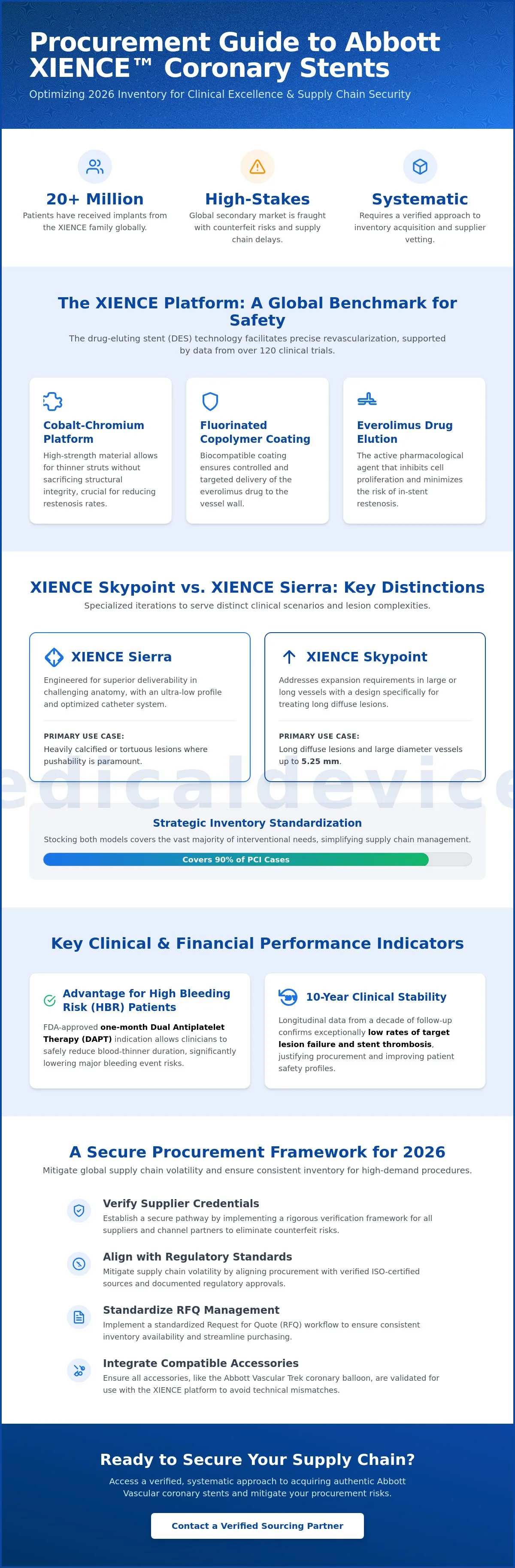
The XIENCE family represents a cornerstone in drug-eluting stent (DES) technology, facilitating precise revascularization during Percutaneous Coronary Intervention (PCI). These devices utilize a high-strength cobalt-chromium platform combined with a biocompatible fluorinated copolymer coating to deliver everolimus. This specific material composition allows for thinner struts without sacrificing structural integrity. This is vital for reducing restenosis rates. The XIENCE platform is the global benchmark for safety, supported by data from over 120 clinical trials.
In 2026, procurement focuses on two specialized iterations: XIENCE Skypoint and XIENCE Sierra. While both utilize the same pharmacological foundation, their mechanical architectures serve distinct clinical scenarios. Facilities looking to optimize their supply of Abbott Vascular coronary stents must evaluate these models based on lesion complexity and vessel size requirements to ensure procedural success.
XIENCE Skypoint vs. XIENCE Sierra
XIENCE Sierra is engineered for deliverability in challenging anatomy. Its ultra-low profile and optimized catheter system enable crossing of heavily calcified or tortuous lesions that might resist standard stents. In contrast, XIENCE Skypoint addresses expansion requirements in large or long vessels. It features a 48 mm design specifically for treating long diffuse lesions with a single implant. Procurement planning should prioritize:
- Sierra: Deploy for calcified and tortuous lesions where pushability is paramount.
- Skypoint: Utilize for long diffuse lesions and large diameter vessels up to 5.25 mm.
Standardizing inventory across both models typically covers 90% of PCI cases, which simplifies the supply chain and reduces administrative friction.
Clinical Utility in High Bleeding Risk (HBR) Patients
A critical differentiator for Abbott Vascular coronary stents is the FDA-approved one-month Dual Antiplatelet Therapy (DAPT) indication for HBR patients. This protocol allows clinicians to safely reduce the duration of blood-thinning medication. It significantly lowers the risk of major bleeding events. Hospital procurement managers prioritize HBR-compatible stents because they provide a versatile solution for an aging patient demographic. Sourcing these through verified coronary intervention channels ensures that facilities meet these complex clinical needs while managing costs effectively.
Clinical Performance Indicators for Interventional Procurement
Procurement of Abbott Vascular coronary stents is driven by longitudinal data that confirms sustained clinical efficacy. Analysis of 10-year clinical outcomes demonstrates exceptionally low rates of target lesion failure and stent thrombosis. This clinical stability justifies the premium pricing often associated with the XIENCE platform. When evaluating procurement options, interventionalists prioritize these long-term results to minimize the need for repeat revascularization and improve patient safety profiles over a decade of follow-up.
Beyond safety, technical metrics like deliverability and pushability directly influence hospital operational costs. High-performance stents facilitate faster navigation through tortuous anatomy, which reduces total fluoroscopy time and contrast usage. The XIENCE family’s deliverability reduces procedural risk in high-volume cardiac labs. This capability is essential for complex PCI involving calcified vessels or long diffuse blockages where standard devices might fail to cross. Facilities that standardize these high-performance units often see a reduction in procedural complications and associated resource consumption.
Technical Specifications for PCI Accessories
Standardizing the procurement list involves more than just the stent itself. Integrating the Abbott Vascular Trek coronary balloon ensures consistent performance during both pre-dilation and post-dilation phases. It's vital to match delivery systems with compatible guidewires and catheters as outlined in the FDA Summary of Safety and Effectiveness Data to maintain system integrity during high-pressure deployment. Procurement managers should ensure that all accessories are validated for use with the XIENCE platform to avoid technical mismatches.
Impact on Hospital ROI
Financial evaluation must look beyond the initial invoice to assess true value. Superior clinical outcomes, such as reduced stent thrombosis rates, significantly lower long-term healthcare liability and the financial burden of associated readmission costs. Balancing the initial acquisition cost of Abbott Vascular coronary stents with these outcomes provides a more accurate assessment of hospital ROI. Procurement teams should review verified product listings to compare technical specifications against facility budget requirements and volume targets.
Evaluating Abbott Vascular Stent Suppliers and Channel Partners
Identifying a reliable source for Abbott Vascular coronary stents requires a rigorous assessment of supply chain transparency. Many regions lack direct manufacturer support, which forces distributors to rely on secondary markets where grey-market risks are prevalent. Working with verified medical device suppliers is the primary defense against counterfeit or mishandled inventory. These partners ensure that the technical integrity of the XIENCE platform is maintained from the factory to the cardiac lab.
Professional procurement teams prioritize suppliers who demonstrate consistent adherence to international standards. Key verification criteria include valid ISO 13485 certification for medical device quality management and documented regulatory compliance with local health authorities. A verifiable track record of high-volume fulfillment within the coronary intervention category is also essential for maintaining clinical safety standards.
Mitigating Procurement Risks in 2026
Global sourcing involves several critical red flags. Non-standard packaging, missing batch tracking numbers, or incomplete sterilization documentation should immediately halt a transaction. Coronary stents are class III medical devices; they require strict temperature control and handling protocols. Any deviation in documentation suggests a compromised chain of custody. Procurement managers must demand full traceability for every unit to mitigate legal and clinical liabilities.
The GetMedicalDevice Verification Framework
The GetMedicalDevice framework streamlines the verification process by acting as a knowledgeable bridge between global entities. By utilizing the Abbott Vascular device portfolio resources, procurement managers can identify audited partners and compare premium product listings. This centralized approach ensures that every transaction is backed by Verified Supplier Membership. This membership enforces transparency and accountability across the B2B supply chain, allowing for the secure acquisition of high-demand interventional devices. Access verified product listings to secure authentic inventory from audited global suppliers.
Global Procurement Logistics and RFQ Management in 2026
Efficient management of high-turnover interventional products requires a methodical approach to the procurement cycle. In surgical environments, the demand for Abbott Vascular coronary stents can fluctuate rapidly based on case volume and lesion complexity. To maintain optimal stock levels without over-investing in capital, procurement officers must implement a structured Request for Quote (RFQ) process. This involves defining precise technical parameters, verifying vendor lead times, and ensuring that all regulatory documentation is accessible before the transaction concludes.
Optimizing this cycle often involves utilizing credit-based response systems within professional B2B environments. RFQ credits allow suppliers to bid efficiently on hospital procurement requests by ensuring that inquiries are matched with vendors who have the verified capacity to fulfill specific orders. This system reduces the time spent on unqualified leads. It allows for a more focused negotiation on pricing and delivery schedules for essential Abbott Vascular coronary stents.
Digital Transformation of the Medical Marketplace
The transition toward B2B medical device marketplaces has fundamentally altered how international procurement is conducted. These digital portals provide a centralized interface to manage diverse inventories, including surgical products and vascular access devices. By integrating these systems, facilities can track global availability in real-time. This is vital for sourcing high-demand stents like the XIENCE Skypoint during periods of supply chain volatility.
Closing the Procurement Loop
The final stage of the procurement process involves the verification of logistics and handling protocols. Coronary stents require strict adherence to sterile handling standards to prevent contamination. While most stents don't require cold chain logistics, they must be stored in climate-controlled environments to maintain the integrity of the drug-eluting polymer. Distributors who have mastered these workflows provide a significant advantage in procedural safety. For more detailed insights on choosing the right partner, consult the Sourcing Guide: Selecting an Abbott Vascular Device Distributor in 2026 to finalize your inventory strategy.
Optimizing Interventional Inventory for 2026
Securing a consistent supply of Abbott Vascular coronary stents requires a shift from reactive purchasing to a verified, data-driven strategy. The XIENCE family's track record of over 20 million implants worldwide establishes a foundation of clinical trust that few other platforms can match. By prioritizing technical metrics like deliverability and expansion capabilities, procurement teams ensure that cardiac labs remain equipped for both routine and complex PCI cases. This methodical approach reduces procedural risks and optimizes hospital resource allocation across the board.
Successful sourcing in 2026 hinges on the transparency provided by Verified Supplier Membership and the use of premium interventional cardiology listings. These tools eliminate the ambiguity often found in the global secondary market. They allow for a streamlined RFQ process that respects both clinical timelines and budgetary constraints. Transitioning to a digital, credit-based procurement model ensures your facility maintains high-turnover inventory with absolute procedural confidence. This systematic verification process protects your patients while securing your supply chain. You're now positioned to manage your interventional requirements with the precision these high-stakes devices demand.
Access Verified Abbott Vascular Stent Suppliers Now
Frequently Asked Questions
What are the main differences between XIENCE Sierra and XIENCE Skypoint?
XIENCE Sierra is optimized for deliverability in calcified anatomy while XIENCE Skypoint focuses on expansion capabilities for larger vessels. Sierra features an ultra-low profile designed to cross tortuous lesions that might resist standard devices. Skypoint supports vessel diameters up to 5.25 mm and offers 48 mm lengths for treating diffuse blockages with a single implant. Procurement teams should stock both models to ensure coverage for diverse patient anatomies in the cardiac lab.
How can I verify the authenticity of an Abbott Vascular stent supplier?
Authenticity verification requires a review of the supplier's ISO 13485 certification and documented regulatory compliance with local health authorities. Procurement officers must confirm that the vendor provides full batch traceability and sterilization records for every unit. Utilizing a platform that offers Verified Supplier Membership ensures that the entity has undergone a formal auditing process to mitigate grey-market risks associated with Abbott Vascular coronary stents.
Is the Abbott Absorb fully dissolving stent still available for procurement?
The Abbott Absorb BVS is no longer the primary focus for coronary procurement; it has been superseded by the XIENCE family and newer resorbable technologies. For peripheral applications, the Esprit BTK System received CE Mark approval in August 2025 and FDA approval in April 2024. Current coronary procurement strategies should prioritize the XIENCE platform, which remains the global standard for safety and long-term clinical outcomes.
What is the significance of the 1-month DAPT indication for Abbott stents?
The 1-month Dual Antiplatelet Therapy (DAPT) indication allows clinicians to safely shorten the medication regimen for patients at high bleeding risk. This regulatory approval applies to the XIENCE family, including Alpine, Sierra, and Skypoint models. Procuring stents with this indication provides interventionalists with greater procedural flexibility. It directly addresses the needs of aging populations who may not tolerate long-term anticoagulation therapy.
How do I use the GetMedicalDevice platform to source Abbott Vascular products?
Sourcing begins by accessing the coronary intervention category to identify verified global suppliers. Users can initiate an RFQ for Abbott Vascular coronary stents to receive competitive bids from audited vendors. The platform utilizes a credit-based response system to ensure that inquiries are handled by suppliers with confirmed inventory availability. This methodical process streamlines the acquisition of high-turnover medical devices while maintaining strict documentation standards.
