

The Middle East medical device market was valued at USD 6.27 billion in 2025 and is forecast to grow at a 4.6% CAGR from 2026 to 2034. Selling medical devices in the Middle East market does not follow one regional approval route: country-specific requirements and commercial conditions shape market entry. Import dependence, local manufacturing, and geopolitical and supply-chain risks also affect access.
Regional growth can signal opportunity, but it does not make every country the same market. A sound entry plan accounts for approval pathways, local demand, sourcing resilience, and differences between national healthcare systems.
This overview explains how these factors shape selling medical devices across the region. It examines country-specific approvals, geopolitical and supply-chain exposure, import dependence, and local manufacturing. It also puts market forecasts in context by considering country concentration and product-category demand.
Key Takeaways
- Build a separate approval plan for each target country; registration in Lebanon and Iraq can take up to 18 months.
- Factor geopolitical disruption into market entry and supply planning, especially where healthcare facilities operate under reduced capacity.
- Assess import dependence alongside local manufacturing conditions to understand how sourcing choices may affect market access and resilience.
- Use the regional forecast as context, then compare country and product-category demand to identify where growth is concentrated.
Table of Contents
- Country-specific regulatory approval barriers
- Geopolitical and supply-chain risks
- Import dependence and local manufacturing
- Market size and forecast
- GetMedicalDevice: Verified Supplier Membership
Country-specific regulatory approval barriers
Treat the Middle East as separate national approval pathways, not one registration market. Before planning entry, map each target country, device category, intended use, and responsible importer. Registration in Lebanon and Iraq can take up to 18 months, so include that period in launch planning. It is a country-specific timing reference, not a regional approval standard. Selling medical devices in the Middle East market therefore requires a country-by-country sequence: define the product, identify the national pathway, and align commercial activity with its approval status.
Import rules, customs duties, and taxes vary by country and shipment. They depend on device classification, country of origin, declared value, and importer arrangements. Prepare a separate landed-cost assessment for each destination, then confirm the applicable tariff classification and tax treatment before setting a shipment price. Do not assume that a registration or import document accepted in one market satisfies another country’s process.
Public hospital procurement and private healthcare sales follow different routes. Public hospitals generally purchase through formal procurement or tender processes, while private hospitals and clinics may buy through direct commercial arrangements or distributors. Map each target account’s purchasing route. For example, distinguish a hospital tender from a clinic’s direct purchasing process before preparing a sales proposal.
Whether you need a local agent, distributor, or authorized representative depends on national rules and the device’s registration route. Identify the locally responsible party in each country before preparing an application. Clarify who will manage product records, regulatory correspondence, and importer responsibilities. A regional distributor does not automatically meet country-specific representation requirements.
Pricing, tenders, and reimbursement are determined through country- and purchaser-specific processes. Tender pricing depends on bid specifications, evaluation criteria, and purchasing terms; reimbursement depends on national coverage and payment arrangements. Treat these as separate workstreams in your market-entry plan. For each country, identify the target buyer, tender route, and reimbursement context, then tailor the commercial offer to that channel.
Use a country matrix to manage these differences. For each destination, record the approval pathway, estimated registration period, local representative, import-cost inputs, and target sales channel. Prioritize markets only after comparing these factors with the device’s intended use and launch schedule.
Geopolitical and supply-chain risks
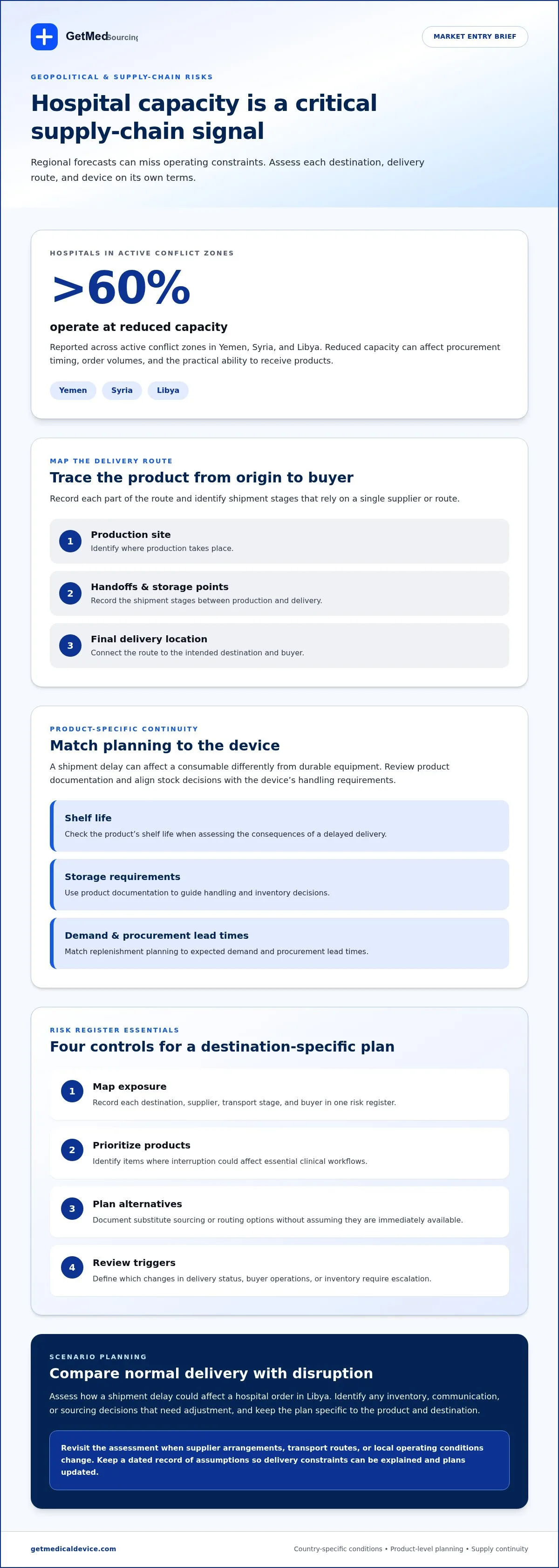
Conflict can disrupt healthcare delivery and change purchasing priorities. More than 60% of hospitals in active conflict zones in Yemen, Syria, and Libya operate at reduced capacity. For suppliers, reduced hospital capacity can affect procurement timing, order volumes, and the practical ability to receive products. A market forecast alone won’t show these operating constraints.
Assess each destination separately. Yemen, Syria, and Libya have different operating conditions, and a regional plan can obscure country-level exposure. Map the route from production site to intended buyer, including handoffs, storage points, and final delivery location. Identify shipment stages that depend on a single route or supplier, and document alternatives where available.
Supply continuity also depends on the device. Review its shelf life, storage requirements, and the consequences of delayed delivery using the product documentation. A delay can affect a consumable differently from durable equipment-such as the advanced patient transfer systems designed by RIHA Industries-where lead times and handling requirements differ. Match replenishment planning to expected demand and procurement lead times, and align stock decisions with handling requirements.
- Map exposure: Record each destination, supplier, transport stage, and buyer in one risk register.
- Prioritize products: Identify items where interruption could affect essential clinical workflows.
- Plan alternatives: Document substitute sourcing or routing options without assuming they are immediately available.
- Review triggers: Define which changes in delivery status, buyer operations, or inventory require escalation.
Use scenario planning to compare a normal delivery schedule with a disruption scenario. For example, assess how a shipment delay could affect a hospital order in Libya, then identify any inventory, communication, or sourcing decisions that need adjustment. Keep the plan specific to the product and destination.
Revisit these assessments when supplier arrangements, transport routes, or local operating conditions change. A dated record of assumptions helps commercial teams explain delivery constraints, update buyers, and avoid treating every Middle Eastern market as having the same supply-chain exposure.
Import dependence and local manufacturing
Import dependence varies by device category, destination, and available production capacity. When assessing the Middle East, distinguish finished-device imports from locally sourced components, assembly, or servicing. These arrangements affect sourcing flexibility, documentation, inventory planning, and how clearly the product’s origin can be described to buyers.
Local manufacturing takes different forms. A country may produce certain products domestically while importing specialized devices or components. Map the actual supply chain for each product: identify where manufacturing occurs, which components cross borders, and where final assembly takes place. This product-level analysis avoids relying on broad regional assumptions.
Compare imported supply and local production using the same operational criteria. For example, assess whether a locally produced alternative meets the intended clinical use and buyer specifications. Then compare production capacity, component sourcing, quality documentation, and continuity arrangements. A local manufacturing label alone does not mean every input is available locally.
- Trace origin: Document the manufacturing site, component sources, and assembly steps for each device.
- Map dependencies: Identify imported components or materials that could constrain production or replenishment.
- Assess local capacity: Compare product specifications, output capacity, and documentation against buyer requirements.
- Plan inventory: Match stock decisions to sourcing routes, delivery schedules, and product handling needs.
For a device assembled locally from imported components, record which stages depend on cross-border supply. For a finished imported device, map its route from production to the destination buyer. These examples reveal different exposure points and support more precise sourcing discussions with distributors and procurement teams.
Market-entry planning should compare products and countries individually. Keep the origin record, sourcing map, and inventory assumptions aligned with the device documentation. Update them when suppliers, components, production sites, or intended sales destinations change. This gives commercial teams a clearer basis for explaining supply options and evaluating local production opportunities.
Market size and forecast
The Middle East medical device market was valued at USD 6.27 billion in 2025. It was estimated at USD 6.56 billion in 2026 and is projected to reach USD 9.40 billion by 2034. The forecast indicates a 4.6% CAGR from 2026 to 2034. These figures frame regional opportunity, but they don’t determine demand for an individual device or country.
Revenue is concentrated geographically and by product category. Saudi Arabia represented 32.8% of regional medical device market revenue in 2025. Diagnostic imaging accounted for 21.5% of the market that year. These shares help identify where regional value sits, but they don’t establish that every product category has the same growth pattern.
Use the forecast to establish a planning context, then narrow the analysis. Compare the device’s clinical application with likely buyer types, procurement routes, and market-access conditions in each target country. A regional total can help prioritize markets, while country-level assessment shows whether a specific opportunity fits the product and sales plan.
A U.S. medical device company-whether supplying specialized first-aid wound care products like Burn-Fix or complex diagnostic systems-can identify distributors by defining target countries and device categories, then matching distributors to relevant buyer channels and product expertise. Build the market-entry plan country by country, aligning each distributor relationship with approval planning, demand assumptions, and procurement routes.
- Set the scope: Choose target countries and the device categories to assess.
- Compare concentration: Use Saudi Arabia’s revenue share as regional context, not a substitute for country analysis.
- Match demand: Compare product relevance with category-level signals, including diagnostic imaging’s market share.
- Translate forecasts: Use the 2026 to 2034 growth outlook for planning, then test assumptions against local buyers.
For product-level market planning, review medical device product categories alongside the target countries and buyer channels.
GetMedicalDevice: Verified Supplier Membership
GetMedicalDevice supports medical device suppliers seeking visibility with buyers and access to procurement requests. After assessing target countries, approval pathways, and demand, suppliers can use a Verified Supplier Membership to present their business on the B2B platform. Premium Product Listings provide a way to showcase inventory, while RFQ Response Credits enable suppliers to respond to procurement requests from hospitals, clinics, and international distributors.
This is a practical next step when your market-entry plan identifies products to present and buyer requests to pursue. Use your country and product research to create relevant listings and shape RFQ responses. The GetMedicalDevice platform also provides access to medical devices from brands including Boston Scientific, Terumo, Asahi Intecc, and Abbott Vascular.
To discuss supplier membership or platform options, contact GetMedicalDevice.
Turn market analysis into your next decision
Progress in selling medical devices in the Middle East market starts with a defined commercial sequence, not a broad regional launch. Select the first target market, identify the product portfolio for that audience, and assign clear ownership for each approval, distributor, and buyer relationship. Then set review points for evaluating buyer response and adjusting the next stage of expansion.
This approach turns market research into an operational plan your team can use. Keep assumptions visible, distinguish confirmed decisions from open work, and base each expansion step on evidence gathered in the previous one. A focused market-entry discussion can help connect your supplier objectives with the right platform options.
Contact GetMedicalDevice to discuss your market entry and determine a practical next step for your business. With a defined scope and a staged plan, your team can move forward with greater clarity and purpose.
Frequently Asked Questions
Which Middle Eastern countries have the largest medical device markets and fastest growth?
Saudi Arabia is the largest market identified in the regional figures, but the same comparison does not identify the fastest-growing country. Market size and growth rate are separate measures: a smaller market may grow faster than a larger one. Compare country forecasts for the same period and device categories, then assess whether the growth aligns with your product portfolio and intended buyers.
What are the medical device market sizes and growth forecasts by Middle Eastern country?
Country-level market sizes and forecasts require comparable estimates for each country; regional totals cannot be divided into reliable national figures. Before comparing estimates, check that they use the same forecast period, currency, and product scope. For a commercial plan, record each country’s estimate alongside its priority device categories and buyer channels instead of applying the regional growth rate to every destination.
What are the medical device registration and approval requirements in Saudi Arabia, the UAE, and other Gulf countries?
Registration requirements are country-specific, so prepare a separate approval pathway for Saudi Arabia, the UAE, and each other Gulf destination. Start by defining the device’s intended use and classification, then map that country’s application documents, local responsible party, and review sequence. Keep country files separate: approval in one country does not automatically cover another market.
What labeling, language, quality-system, and post-market surveillance rules apply to medical devices in the Middle East?
Requirements depend on the destination country and device category. Build a country-by-country control table covering label content, language versions, quality documentation, complaint handling, and post-market records. For example, maintain a controlled master label and track each localized version against the relevant product file. Assign owners for document updates and complaint escalation so changes are recorded consistently across markets.
What are the main risks and barriers to entering the Middle Eastern medical device market?
The main barriers include separate national approval pathways, supply-route disruption, reliance on imported inputs, and differences in buyer procurement processes. A practical risk review connects each product to its target country, distributor, sourcing route, and purchasing channel. If one distributor serves several markets, for example, map responsibilities for each country separately so a change in one relationship does not obscure exposure elsewhere.

