

Inventory software can’t prevent a stockout when the only supplier is out of stock. Preventing medical device stockouts in hospitals requires both accurate inventory data and a reliable alternative sourcing route. Unpredictable lead times for specialized catheters and stents, manual tracking errors, and costly emergency orders can leave procurement teams reacting instead of planning.
Hospitals need critical devices available without tying up resources in excess inventory. This framework outlines how to use demand and stock data to improve replenishment, reduce expiry and tracking risks, and identify verified suppliers before a local shortage becomes urgent. It also explains how a global B2B sourcing network can provide another route to seek specialized coronary intervention and neurovascular devices, including products from established brands.
Use the steps below to strengthen inventory controls, diversify procurement channels, and prepare for supplier requests before a shortage occurs. The aim is a more resilient supply process that supports access to critical devices while limiting avoidable inventory costs.
Key Takeaways
- Assess how device shortages affect procedure planning and procurement, then identify where emergency ordering creates avoidable pressure.
- Use automated data capture and RFID-enabled tracking to improve visibility into high-value devices.
- Preventing medical device stockouts in hospitals calls for inventory controls paired with a verified supplier network for alternate sourcing.
- Use digital RFQs and global marketplace access to seek sourcing options when local supply is constrained.
Table of Contents
- The High Stakes of Medical Device Stockouts in 2026
- 5 Technological Pillars for Real-Time Inventory Management
- Diversifying Supply Chains through Verified B2B Marketplaces
- Integrating Global Connectivity into Hospital Procurement
The High Stakes of Medical Device Stockouts in 2026
A missing device can disrupt more than an inventory count. If a specialized catheter, stent, or access device isn’t available, an interventional radiology or cardiology team may need to delay or reschedule a procedure while staff assess alternatives. That creates clinical and operational pressure, particularly when a device is selected for a specific patient or technique.
Emergency procurement can add cost and leave less time to verify supplier credentials, product identity, and documentation. Build contingency options before a shortage occurs rather than bypassing standard review when a need becomes urgent. Strong supply chain management principles pair demand planning with supplier and inventory controls.
Clinical Risks in Specialized Departments
Neurovascular and vascular access devices can be difficult to replace with a product that only appears similar. Clinical equivalence isn’t automatic: dimensions, compatibility, intended use, and instructions for use may differ. Clinicians should assess any proposed substitute through established clinical and procurement review processes before it is selected for patient care.
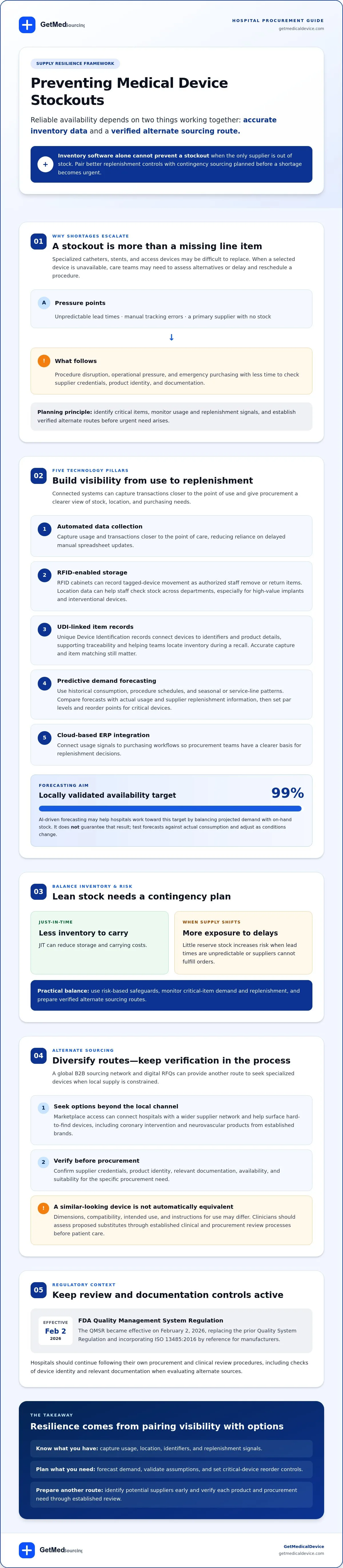
Just-in-Time (JIT) inventory can reduce storage and carrying costs, but keeping little reserve stock increases exposure when lead times become unpredictable or a supplier cannot fulfill an order. In 2026, preventing medical device stockouts in hospitals means balancing lean inventory with risk-based safeguards. Identify critical items, monitor usage and replenishment signals, and establish verified alternate sourcing routes.
Regulatory compliance also informs shortage response. The FDA’s Quality Management System Regulation became effective on February 2, 2026, replacing the prior Quality System Regulation and incorporating ISO 13485:2016 by reference for manufacturers. Hospitals should continue applying their own procurement and clinical review procedures, including checking device identity and relevant documentation when evaluating alternate sources. A verified B2B marketplace can provide another sourcing route, but availability and suitability must be confirmed for each procurement need.
5 Technological Pillars for Real-Time Inventory Management
Preventing medical device stockouts in hospitals starts with reliable inventory data. Manual spreadsheets rely on staff to enter and reconcile information, which can delay visibility into usage, location, and replenishment needs. A connected system can capture transactions closer to the point of use and feed them into procurement workflows.
Build the system around five capabilities: automated data collection, RFID-enabled storage, UDI-linked item records, predictive demand forecasting, and cloud-based ERP integration. Together, they can help teams see what was used, where remaining stock is located, and when purchasing action may be needed. Technology supports these controls; it doesn’t replace routine validation or clinical oversight.
Harnessing RFID and UDI Tracking
RFID-enabled cabinets can record the movement of tagged devices as authorized staff remove or return them, reducing reliance on manual counts for high-value implants and interventional devices. Location data can help staff check stock across departments instead of searching one area at a time. Unique Device Identification (UDI) records associate a device with its identifier and related product details, supporting traceability and helping teams locate affected inventory during a recall. Data quality still matters: confirm that identifiers are captured accurately and linked to the correct item records.
Predictive Analytics for Procurement
Use historical consumption, procedure schedules, and seasonal or service-line patterns to estimate demand. Compare forecasts with actual usage and supplier replenishment information, then set par levels and reorder points for each critical device. Cloud-based ERP integration can connect usage signals to purchasing workflows, giving procurement teams a clearer basis for replenishment decisions.
AI-driven forecasting can balance projected demand with on-hand stock to reduce overordering and help hospitals work toward a locally validated 99% availability target, but it cannot guarantee that result. Test forecasts against actual consumption and adjust assumptions when clinical demand or supply conditions change. For teams reviewing device categories and listings as part of inventory planning, browse medical device products.
Diversifying Supply Chains through Verified B2B Marketplaces
Inventory visibility cannot solve a shortage if a primary supplier has no stock. A diversified sourcing plan gives procurement teams another route to investigate before a local gap disrupts scheduled care. B2B marketplaces can connect hospitals with a wider supplier network and help surface hard-to-find devices, including coronary intervention equipment.
For critical brands such as Boston Scientific and Terumo, avoid relying on a single purchasing channel. Identify alternate suppliers in advance, document the specifications and records that require review, and confirm availability when a need arises. An RFQ process lets hospitals submit requirements and seek responses from a global supplier network. It supports comparison and sourcing, but every offer still requires procurement and clinical review.
Mitigating Risks in Global Sourcing
Supplier verification is an important control in international procurement. Membership-based verification can support a more trust-based process and help reduce exposure to unreliable sources, but it doesn’t replace the hospital’s own checks. Before purchasing, confirm the supplier’s identity and review product identifiers, traceability, condition, and supporting documentation according to institutional procedures. Apply the same scrutiny to secondary-distributor offers for Abbott Vascular or Asahi Intecc devices. For additional context, see this framework for global medical device sourcing and procurement.
Use a verified marketplace as a Plan B to complement, not replace, routine inventory planning. This is a practical part of preventing medical device stockouts in hospitals: keep alternate sourcing options visible, define the information required to assess an offer, and begin supplier review before an urgent purchase is needed. Hospitals evaluating marketplace sourcing can explore medical device supplier listings and use RFQs to seek responses from the network.
Integrating Global Connectivity into Hospital Procurement
Digital procurement can make supplier communication and inventory requests more structured, but it shouldn’t be treated as a guaranteed shortcut. Rather than relying on a general claim about shorter lead times, hospitals should measure results against their own baseline. Track request-to-response and order-processing intervals to see whether a portal improves the workflow.
A “Digital Supply Twin” can be understood as a connected view of supply information across stages, from sourcing through hospital receipt and use. In practice, visibility depends on the data suppliers and internal systems provide. GetMedicalDevice’s B2B marketplace uses Verified Supplier Membership and RFQ Response Credits to help hospitals seek inventory from a global supplier network, including when local channels are constrained. For background on supplier verification, see this guide to verified medical device suppliers.
Practical Implementation Steps
Start by auditing the vendor list. Flag critical devices with only one sourcing route, then document an alternate sourcing protocol. Specify who can issue an RFQ, which product identifiers and documents are required, and which clinical and procurement checks must be completed before purchase. Include relevant categories such as surgical products.
- Set a trigger for activating secondary sourcing, such as a confirmed supplier backorder or stock below the hospital’s approved threshold.
- Prepare RFQ details in advance, including the device description, required quantity, and documentation to review.
- Use available RFQ credits to submit requests during a local shortage, then evaluate supplier responses through established review procedures.
This workflow makes preventing medical device stockouts in hospitals a repeatable procurement process rather than an improvised response. To assess marketplace sourcing options, explore GetMedicalDevice.
Build a More Resilient Procurement Plan
Preventing medical device stockouts in hospitals requires more than accurate counts. Real-time inventory data helps teams identify replenishment needs, while demand planning supports more appropriate stock levels. A pre-assessed secondary sourcing route gives procurement teams another option when a primary supplier cannot meet demand.
Make the approach actionable by reviewing inventory controls, identifying single-source risks, and defining the information and approvals required to evaluate alternate offers. A digital RFQ process can help hospitals seek responses from a global procurement network, but each offer still requires review for suitability and documentation.
GetMedicalDevice provides marketplace access to products from brands including Boston Scientific, Terumo, and Abbott Vascular. Its Verified Supplier Membership and structured RFQ system can support hospitals exploring additional sourcing options. Availability and product suitability should be confirmed for each procurement need.
Explore the Verified Supplier Network and assess whether it can support your hospital’s procurement plan. With clear inventory controls and alternate sourcing pathways in place, teams can take practical steps toward a more resilient supply chain.
Frequently Asked Questions
How does RFID technology help in preventing medical device stockouts?
RFID can help prevent stockouts by recording tagged device movement and making inventory status easier to update than manual counts alone. In an RFID-enabled cabinet, a hospital can track when items are removed or returned and check stock across departments. Linking device records to identifiers and location data can also help staff find items and review affected stock during a recall. Accurate setup and routine checks remain essential.
What are the most common causes of hospital supply chain disruptions in 2026?
Common disruption risks include unpredictable supplier lead times, product shortages, dependence on a single sourcing route, and unexpected increases in demand. Regulatory changes can also affect product availability when manufacturers adjust their portfolios; for example, some manufacturers have withdrawn products from the EU market amid MDR requirements. Hospitals can reduce exposure by monitoring critical items, reviewing supplier dependencies, and identifying alternate sourcing options before urgent needs arise.
Can B2B marketplaces really provide authentic devices from brands like Boston Scientific?
B2B marketplaces can provide access to listings for products from brands such as Boston Scientific, but hospitals should verify each offer before purchase. GetMedicalDevice connects buyers with medical device suppliers through a marketplace that uses Verified Supplier Membership. That process supports trust, but it doesn’t replace hospital checks. Confirm the supplier, product identity, traceability, condition, and relevant documentation, and follow internal procurement and clinical review procedures.
What is the difference between a verified supplier and a standard medical distributor?
A verified supplier has completed a platform’s supplier verification process, while “standard medical distributor” is a broad business description and doesn’t by itself indicate what checks have been completed. Verification can provide an additional trust signal, but it isn’t a substitute for a hospital’s due diligence. Confirm the supplier’s identity, review the device details and documentation, and assess whether the offer meets institutional procurement and clinical requirements.
How can hospitals reduce inventory waste while preventing stockouts?
Hospitals can reduce waste by setting replenishment levels based on actual usage, procedure schedules, and supplier information, then reviewing those levels as demand changes. Track device location and expiry information, and use stock rotation procedures to help staff identify items that need attention first. Preventing medical device stockouts in hospitals requires balancing lean inventory with appropriate safeguards for critical devices, rather than eliminating reserve stock across the board.