
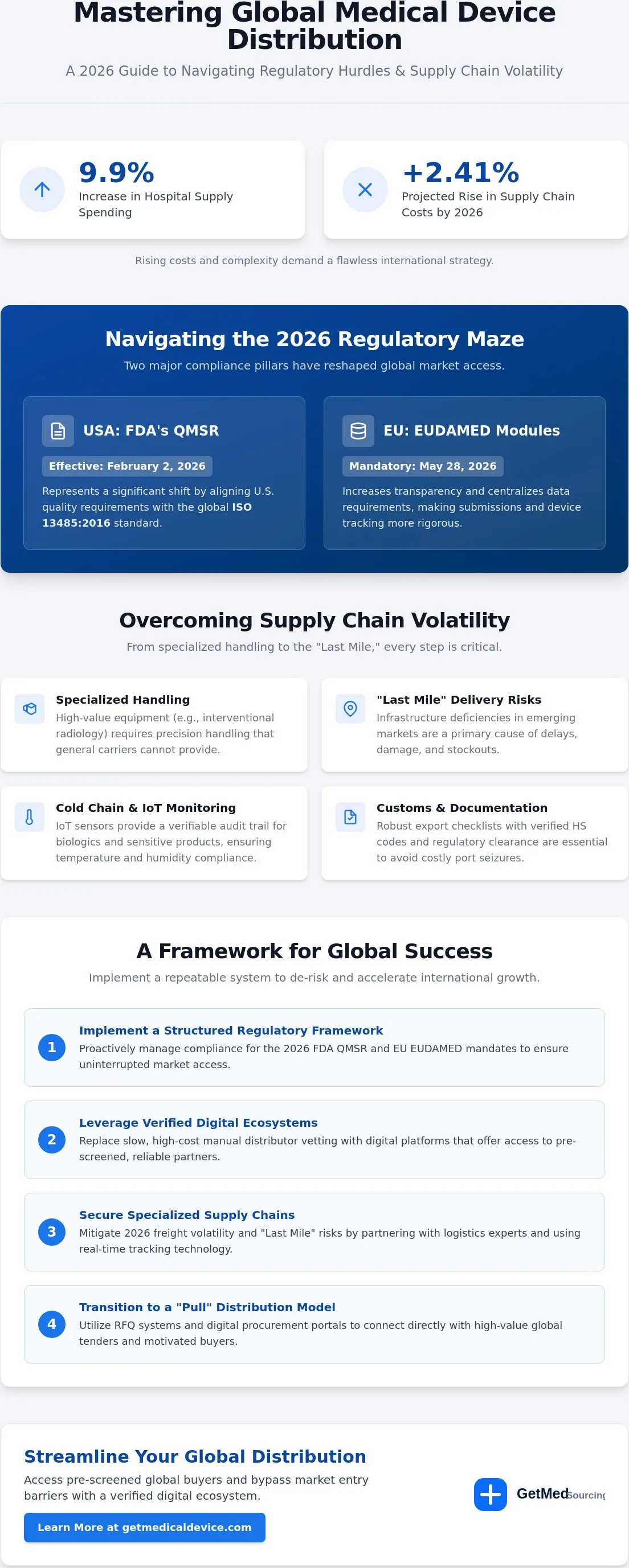
With hospital supply spending having increased by 9.9% and medical supply chain costs projected to rise by another 2.41% throughout 2026, the margin for error in global trade has effectively vanished. You likely recognize that the challenges of selling medical devices internationally have shifted from simple logistics to high-stakes regulatory navigation. Between the FDA's new Quality Management System Regulation (QMSR) that became effective on February 2, 2026, and the mandatory EUDAMED modules in the EU as of May 28, the administrative burden on your team is likely at an all-time high. Opaque requirements in emerging markets and the high cost of manual distributor vetting only compound these operational frictions.
This guide provides a systematic approach to mastering these complexities, ensuring your specialized surgical and interventional radiology equipment reaches global markets without the typical delays associated with unverified partners. By implementing a repeatable framework for regulatory compliance and logistics, you can stabilize your distribution pipeline against geopolitical volatility. We'll examine how to leverage verified digital ecosystems to bypass traditional market entry barriers, gain access to pre-screened global buyers, and significantly reduce lead times for critical medical technology.
Key Takeaways
- Implement a structured framework to navigate the 2026 regulatory landscape, including the FDA’s Quality Management System Regulation and mandatory EU EUDAMED modules.
- Mitigate the challenges of selling medical devices internationally by replacing manual vetting processes with verified digital ecosystems to ensure partner reliability.
- Secure specialized medical supply chains against 2026 freight volatility and "Last Mile" delivery risks within developing healthcare infrastructures.
- Transition to a "pull" model of distribution by leveraging RFQ systems and digital procurement portals to access high-value global tenders.
Table of Contents
- Navigating Global Regulatory Compliance and Market Access Barriers
- Managing Supply Chain Volatility and Logistical Bottlenecks
- Vetting International Partners for Quality Assurance and Risk Mitigation
- Leveraging Digital Marketplaces to Streamline Global Distribution
Navigating Global Regulatory Compliance and Market Access Barriers
International medical device distribution isn't a simple logistical handoff. It's a multi-layered compliance journey. Each market requires interaction with distinct local and global bodies, making the challenges of selling medical devices internationally a matter of documentation as much as delivery. In 2026, the landscape has solidified around two major pillars: the EU Medical Device Regulation (MDR) and the U.S. FDA’s Quality Management System Regulation (QMSR).
The FDA's QMSR, which became effective on February 2, 2026, represents a significant shift by aligning U.S. quality requirements with ISO 13485:2016. Simultaneously, the EU’s mandatory use of EUDAMED modules since May 28, 2026, has increased transparency and data requirements. For small-to-midsize manufacturers, entering APAC and EMEA regions often feels like navigating a "Regulatory Black Box" due to opaque local requirements. You must localize all documentation and ensure it's audit-ready before you even begin identifying buyers. Understanding global medical device regulations is the prerequisite for any cross-border trade. This is especially critical for high-risk equipment found in interventional radiology or surgical products categories.
Harmonizing International Standards (ISO 13485)
ISO 13485 serves as the universal language for Quality Management Systems (QMS). Maintaining a unified technical file is essential for passing global audits across multiple jurisdictions. This structural alignment reduces redundant documentation when expanding from North America into European or Asian markets. It ensures your QMS meets the baseline expectations of most major regulatory bodies.
Managing Post-Market Surveillance (PMS) Across Borders
Tracking device performance after it leaves the domestic market is a difficult logistical hurdle. Jurisdictions have specific, often conflicting, reporting timelines for adverse events. You'll need a systematic workflow to capture field data and report it to the relevant authorities. Failure to maintain this feedback loop can result in immediate market suspension and heavy financial penalties.
Managing Supply Chain Volatility and Logistical Bottlenecks
The 2026 freight landscape is defined by volatility. Medical supply chain costs are projected to increase by 2.41% this year, making logistics a primary factor in the challenges of selling medical devices internationally. Standard shipping protocols are insufficient for high-value interventional radiology equipment. These devices require specialized handling to maintain calibration and structural integrity during transit. You can't rely on general freight carriers to manage the precision required for such sensitive clinical technology.
In emerging healthcare sectors, the "Last Mile" remains the most vulnerable segment of the distribution chain. Infrastructure deficiencies often lead to delayed deliveries or damaged goods. The NIH identifies these logistical hurdles as significant barriers to medical device innovation and accessibility. Maintaining end-to-end inventory transparency is critical to prevent stockouts of critical equipment. Without real-time data, your ability to respond to procurement requests in developing regions is severely compromised.
Cold Chain and Specialized Handling Requirements
Biologics and sensitive surgical products require strict adherence to cold chain protocols. Modern distribution relies on IoT sensors to provide real-time environmental data. These devices monitor temperature and humidity, providing a verifiable audit trail for quality assurance. This data-driven approach ensures that products remain within specified parameters throughout the entire journey, preventing the loss of high-value stock.
Mitigating Customs Delays and Import Duties
Customs delays often stem from documentation inconsistencies. A robust export checklist must include verified HS codes, commercial invoices, and proof of regulatory clearance. Fluctuating tariffs in 2026 significantly influence the final landed cost of medical devices. To minimize these risks, you may choose to list your inventory through a verified supplier membership to ensure your documentation meets international buyer standards and avoids port seizures.
Vetting International Partners for Quality Assurance and Risk Mitigation
Manual vetting processes represent a significant bottleneck in 2026. The "Trust Deficit" in international B2B trade has expanded as regulatory scrutiny intensifies. Manufacturers can't rely on self-reported data from potential distributors. You must evaluate a partner’s local market penetration and their ability to provide clinical support for complex equipment. Opaque pricing and missing certificates of free sale are immediate red flags that signal high risk.
The Global Regulatory Challenges for Medical Devices review highlights how divergent standards in the EU, USA, and Japan require partners who possess deep technical knowledge. One of the primary challenges of selling medical devices internationally is ensuring your distributor understands these nuances to avoid compliance failures. Sourcing from verified suppliers for established brands like Boston Scientific or Terumo ensures that the chain of custody remains intact. To mitigate these risks, utilizing a medical device supplier platform with pre-verified entities is the most efficient path forward.
The Role of Verified Supplier Status
Third-party verification significantly reduces the due diligence burden on hospital procurement teams. A verified status confirms that the supplier has undergone rigorous documentation checks, ensuring they meet the standards required for cross-border trade. For a detailed breakdown of these requirements, consult our Verified Medical Device Suppliers: A Global Procurement and Verification Guide for 2026.
Sourcing Specialized Interventional Products
Vetting requirements become more stringent for coronary intervention and neurovascular devices. These high-risk products demand distributors with specialized clinical training. Official distributor status is mandatory for equipment from manufacturers like Abbott Vascular to guarantee patient safety and technical support. Securing these items through a verified supplier membership ensures all partners meet high-stakes clinical requirements.
Leveraging Digital Marketplaces to Streamline Global Distribution
Traditional distribution models often rely on aggressive, manual "hunting" for buyers, which can't keep pace with modern demand. This reliance on legacy methods often amplifies the challenges of selling medical devices internationally. In 2026, industry leaders are transitioning toward a "pull" model. By utilizing digital medical device sourcing and procurement portals, you position your inventory where active buyers are already searching. This shift centralizes your presence, allowing global entities to find your offerings through a structured, transparent interface rather than fragmented offline networks.
Digital transformation is the final step in resolving the distribution hurdles discussed in previous sections. Centralized listings are particularly effective for high-demand sectors like cardiac rhythm management and endoscopy. These platforms use Request for Quote (RFQ) systems to democratize access to global tenders. Instead of navigating closed procurement circles, you gain direct entry to active requests from international clinics and governmental healthcare bodies. This systemic approach ensures that the challenges of selling medical devices internationally are mitigated through data-driven visibility.
Maximizing Reach with Premium Product Listings
Structured data is the foundation of high-quality digital listings. By providing technical specifications and regulatory certifications in a standardized format, you attract international distributors who require immediate verification. Managing these global inquiries through a single verified dashboard eliminates the friction of multi-channel communication. It creates a linear workflow from the initial inquiry to the final procurement agreement, ensuring no technical detail is overlooked during the evaluation phase.
Efficiency in Procurement via RFQ Response Credits
Bidding on active procurement requests requires a focus on high-intent buyers. Credit-based bidding systems allow you to allocate resources toward specific tenders that align with your inventory, such as surgical products or diagnostic tools. This prevents the resource drain associated with chasing cold leads. You can bid on active requests from hospitals with the confidence that the buyer's intent is already verified, streamlining the transition from quote to contract without unnecessary delays.
Optimizing Global Distribution for 2026 and Beyond
The transition toward digitalized procurement is no longer optional for manufacturers seeking sustainable growth. Success in the current landscape requires a dual focus on harmonized regulatory documentation and the abandonment of manual vetting processes. By integrating your inventory into a verified digital ecosystem, you effectively bypass the most persistent challenges of selling medical devices internationally. This shift ensures that your specialized interventional and surgical products remain visible to high-intent procurement teams without the friction of legacy distribution models.
Leveraging a centralized platform provides immediate access to a global RFQ system, delivering real-time procurement leads directly to your dashboard. This infrastructure facilitates verified connections with established brands such as Abbott Vascular and Asahi Intecc, ensuring your supply chain remains resilient against volatility. Become a Verified Supplier and access our global network of medical device buyers today. Establishing a structured, data-driven presence is the most reliable method for securing your position in the international healthcare market.
Frequently Asked Questions
What are the most common regulatory challenges in international medical device distribution?
The most frequent hurdles involve the misalignment of international standards and the mandatory implementation of the EU Medical Device Regulation (MDR). These challenges of selling medical devices internationally are compounded by the FDA’s transition to the Quality Management System Regulation (QMSR) as of February 2, 2026. Manufacturers must navigate varying clinical evidence requirements and post-market surveillance protocols across different jurisdictions to maintain market access.
How can I verify the authenticity of a global medical device supplier?
Verification of a global medical device supplier requires a systematic audit of their regulatory documentation and clinical support capabilities. You should prioritize suppliers with third party verification status and official authorization for high stakes brands such as Abbott Vascular or Terumo. Manual vetting is increasingly insufficient; therefore, digital platforms with pre-screened memberships are the standard for ensuring partner reliability and quality assurance in 2026.
What documentation is required for exporting interventional cardiology devices?
Exporting interventional cardiology devices requires a comprehensive technical file including ISO 13485 certification and proof of regulatory clearance such as CE marking or FDA 510(k). You must also provide a Certificate of Free Sale (CFS), accurate HS codes for customs classification, and a detailed commercial invoice. These documents ensure that high risk equipment meets the safety standards of the destination jurisdiction and avoids port seizures.
Can a B2B marketplace help overcome customs and logistical delays?
A digital B2B marketplace overcomes logistical delays by centralizing documentation and utilizing RFQ systems to connect suppliers with high intent buyers. These platforms streamline the challenges of selling medical devices internationally by providing a transparent workflow for managing global inquiries. By using a single dashboard for communication and document exchange, you reduce the administrative friction that typically leads to customs bottlenecks and extended lead times.
Is EU MDR compliance required for distribution outside of Europe?
EU MDR compliance is strictly mandatory only for devices sold within the European Economic Area. However, many international markets in the APAC and EMEA regions accept CE marking as primary evidence of safety and performance. Maintaining MDR compliance serves as a strategic advantage, allowing for faster market entry in jurisdictions that recognize European regulatory standards as a benchmark for global quality.