

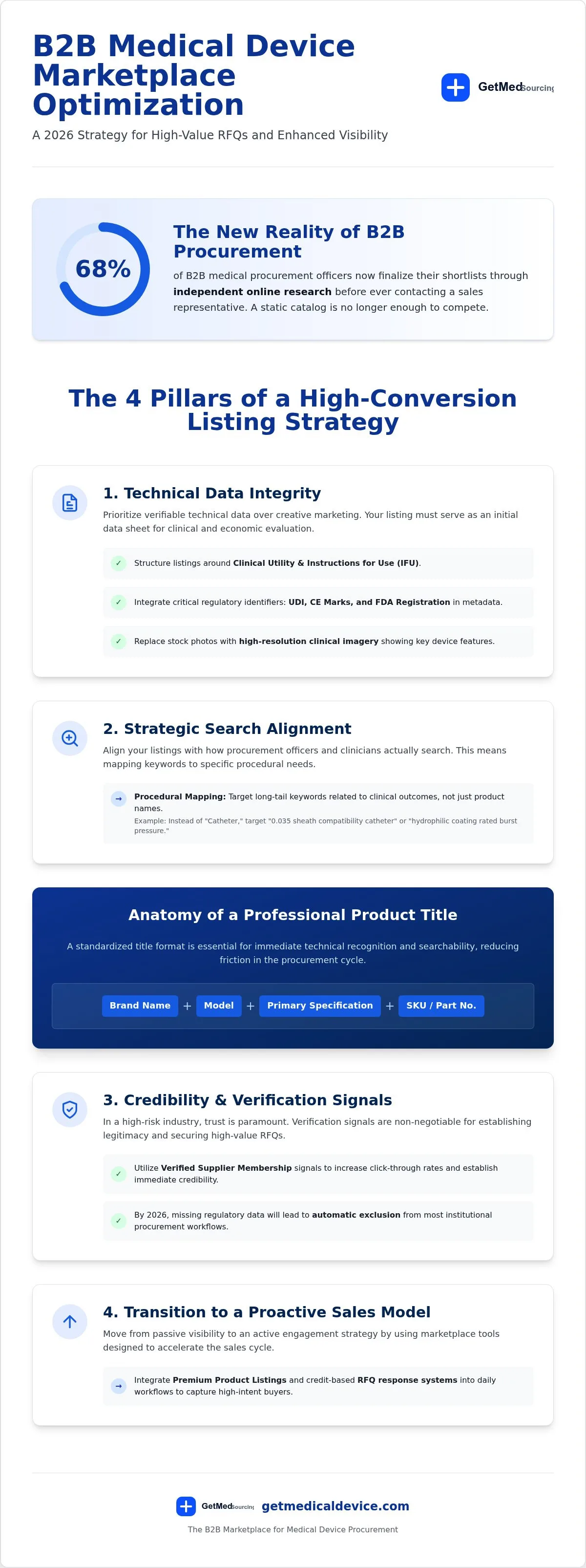
68% of B2B medical procurement officers now finalize their shortlists through independent online research before ever contacting a sales representative. This shift toward self-directed digital sourcing means a static catalog is no longer sufficient to maintain a competitive advantage in a global market. You've likely experienced the frustration of low visibility despite maintaining high-quality inventory, or the burden of managing a high volume of unqualified leads that don't match your technical specifications.
Mastering the technical and strategic parameters for optimizing product listings on a B2B marketplace is essential for converting this research-heavy buyer behavior into high-value RFQs. This article provides a comprehensive 2026 strategy for medical device suppliers to enhance visibility and convey technical superiority within standardized digital frameworks. We'll analyze the impact of the new FDA Quality Management System Regulation (QMSR) on listing documentation, examine the influence of AI-driven search parameters, and demonstrate how Verified Supplier Membership acts as a foundational layer for streamlined procurement communication.
Key Takeaways
- Prioritize technical data integrity by structuring product information around clinical utility and Instructions for Use (IFU) rather than standard retail marketing tactics.
- Implement a systematic framework for optimizing product listings on a B2B marketplace by aligning long-tail keywords with specific clinical procedural outcomes.
- Establish immediate credibility with hospital procurement officers by utilizing Verified Supplier Membership signals to increase click-through rates and trust.
- Transition from passive visibility to a proactive sales model by integrating Premium Product Listings and credit-based RFQ response systems into your daily workflow.
Table of Contents
- The Strategic Importance of Marketplace Optimization in B2B Medical Procurement
- Building High-Conversion Listings: Technical Specifications and Content Integrity
- Strategic Visibility: Leveraging Keywords, RFQs, and Verification Signals
- Scaling Sales through Verified Membership and Premium Listings
The Strategic Importance of Marketplace Optimization in B2B Medical Procurement
B2B Marketplace Optimization (MPO) is the systematic improvement of product visibility and data integrity within professional trade environments. It involves the precise alignment of technical specifications with buyer search intent. Unlike retail e-commerce, which targets consumer desire, medical procurement focuses strictly on clinical utility and regulatory compliance. Precision matters in this context. On B2B online marketplaces, the digital listing functions as the initial point of contact during the hospital's shortlisting phase. If the data is incomplete, the product is effectively invisible to the procurement team.
The industry is moving toward a verified-only sourcing model. This is especially true for high-risk categories like neurovascular where procedural success depends on exact specifications. The practice of optimizing product listings on a B2B marketplace requires more than just keywords; it demands a commitment to data transparency. Procurement officers use these listings to verify that a device meets specific procedural requirements before they commit to a Request for Quote (RFQ). A well-optimized listing reduces communication friction and accelerates the procurement cycle.
Why Generic SEO Tactics Fail in Medical Device Sales
Generic digital marketing strategies often fail because they emphasize creative headlines over technical accuracy. In medical sales, buyer intent is functional rather than emotional. Procurement teams don't have time for vague descriptions. Standardized nomenclature, specifically the brand, model, and technical specification, outperforms creative copy in every professional search scenario. High-performing listings must also integrate regulatory identifiers such as UDI, CE marks, and FDA registration within the metadata. These aren't just details; they are the primary verification signals used to validate a supplier's legitimacy. By 2026, missing regulatory data will lead to automatic exclusion from most institutional procurement workflows.
Building High-Conversion Listings: Technical Specifications and Content Integrity
High-conversion listings in the MedTech sector depend on the immediate accessibility of verifiable technical data. Technical data sheets and Instructions for Use (IFU) serve as your primary content assets. They provide the objective evidence required for clinical and economic evaluation. According to Harvard B2B Marketing Principles, organizational buying decisions are driven by rational, performance-based criteria rather than emotional appeal. This is why optimizing product listings on a B2B marketplace requires a strict hierarchical data structure. You must categorize by Brand, Category, Primary Indication, and Material Composition to remain compatible with sophisticated hospital procurement filters.
Replace generic stock photography with high-resolution clinical imagery that demonstrates device architecture. Visuals must showcase specific features like distal tip radiopacity or hydrophilic coating thickness. Visuals inform procurement decisions. For complex devices in coronary intervention, these granular details directly influence procedural selection. If you're looking to enhance your catalog's performance, you can view premium product listings to see these standards in practice. Every data point should serve a functional purpose in the buyer's decision-making matrix.
The Anatomy of a Professional Medical Product Title
Standardized titles follow a Brand + Model + Primary Specification format to facilitate immediate technical recognition. Including the SKU and manufacturer part number within the title string is essential for searchability. This allows procurement officers to locate exact replacements quickly, bypassing the friction of manual catalog cross-referencing.
Optimizing for Clinical Search Intent
Procedural mapping involves aligning keywords with specific medical procedures rather than simple product names. Interventionalists frequently search for specific performance parameters like "sheath compatibility" or "rated burst pressure" when planning cases. Aligning your metadata with these procedural requirements ensures your inventory appears when clinicians are addressing specific anatomical or technical challenges.
Strategic Visibility: Leveraging Keywords, RFQs, and Verification Signals
Visibility in a professional marketplace requires aligning inventory with specific clinical challenges. Instead of focusing solely on product names, implement long-tail keyword strategies based on procedural outcomes. For example, terms like "radial access site management" target the actual clinical application, ensuring your devices appear when procurement teams search for solutions to specific procedural hurdles. This approach is a core component of optimizing product listings on a B2B marketplace, as it prioritizes the buyer's operational needs over generic catalog terms.
A direct correlation exists between "Verified Supplier" status and listing click-through rates (CTR). In high-stakes medical procurement, verification acts as a primary trust signal that mitigates risk. By utilizing the Global Medical Device Sourcing and Procurement Framework standards, suppliers ensure their data integrity matches international expectations. Beyond passive search, you should utilize RFQ response credits to engage with active procurement requests. This proactive bidding allows you to identify emerging market demands and adjust your inventory strategy accordingly. To begin this process, you can access Verified Supplier Membership signals to enhance your listing authority.
The Role of Verification in Shortening the Sales Cycle
Verified status serves as an essential pre-qualification filter for hospital legal and procurement departments. It confirms that the supplier has passed rigorous background checks and maintains documented associations with industry leaders like Abbott Vascular or Terumo. This transparency removes the initial layer of due diligence typically required in the 6 to 18 month MedTech buying cycle. When a supplier is pre-verified, procurement teams can move directly to technical evaluation and price negotiation, significantly reducing the time from initial contact to final contract execution.
Scaling Sales through Verified Membership and Premium Listings
Scaling sales requires moving beyond organic visibility to a model of guaranteed placement. Premium Product Listings ensure top-of-category positioning, which allows suppliers to bypass standard algorithm fluctuations that often disrupt search rankings. This stability is critical for maintaining consistent lead flow in high-demand sectors. By optimizing product listings on a B2B marketplace through premium tiering, you ensure your inventory remains the primary option for procurement officers during urgent sourcing cycles. This strategic positioning acts as a hedge against the volatility of general search indexing.
Data integrity allows for more precise inventory planning. By analyzing listing performance metrics, such as specification-to-click ratios, you can refine your procurement focus toward growth-heavy segments like interventional radiology. This data-driven approach aligns with the 2026 roadmap outlined in The Evolution of the B2B Medical Device Marketplace, where systematic workflows replace speculative inventory management. Accurate data allows you to predict which SKUs will generate the highest RFQ volume based on historical buyer behavior.
Maximizing ROI with RFQ Response Credits
RFQ Response Credits transform a passive storefront into a proactive sales engine. Strategic bidding involves prioritizing RFQs that align with your existing premium listings to maximize conversion rates. It's not about volume; it's about technical alignment. When your bid matches the buyer's exact specifications, you create opportunities to convert one-time marketplace inquiries into long-term distribution partnerships. This systematic use of credits ensures that your sales team focuses on verified buyers with immediate clinical needs, streamlining the path from inquiry to procurement. These interactions serve as the foundation for multi-year supply agreements that stabilize revenue.
Advancing Your Digital Procurement Strategy for 2026
Transitioning to a data-driven sales model isn't optional for MedTech suppliers. The integration of technical specifications and verified trust signals provides the foundation for high-value procurement interactions. By optimizing product listings on a B2B marketplace, suppliers ensure their inventory meets the rigorous documentation standards required by international hospital networks. This systematic approach reduces communication friction and positions your products directly in the path of verified decision-makers.
Specialized inventory management and documented associations with industry leaders like Boston Scientific and Terumo are essential for establishing immediate credibility. Accessing a global network of verified procurement officers allows you to scale operations with clinical precision. Apply for Verified Supplier Membership to optimize your global visibility and secure your position in the 2026 medical trade landscape. Establishing these professional benchmarks today ensures long-term stability in a competitive global market.
Frequently Asked Questions
How do I improve the search ranking of my medical devices on a B2B marketplace?
Improving search ranking requires a combination of technical precision and platform-specific trust signals. You must align your metadata with procedural outcomes like radial access site management rather than just generic product names. Maintaining a Verified Supplier Membership ensures your inventory passes initial trust filters. High-resolution clinical imagery and standardized nomenclature including Brand, Model, and Specification further enhance the algorithm's ability to rank your devices for relevant procurement queries.
What technical specifications are mandatory for a professional medical product listing?
Professional listings must include regulatory identifiers such as UDI, CE marks, and FDA registration numbers to ensure institutional compliance. Technical parameters like material composition, sheath compatibility, and rated burst pressure are essential for clinical evaluation. You should also provide searchable SKU and manufacturer part numbers within the title string. Including downloadable Instructions for Use (IFU) and technical data sheets provides the objective evidence required by procurement teams to finalize shortlists.
How does Verified Supplier Membership impact my sales conversion rate?
Verified Supplier Membership increases conversion rates by acting as a pre-qualification filter for hospital legal and procurement departments. It builds immediate trust through documented associations with established brands like Abbott Vascular or Terumo. This status reduces the friction of the long MedTech buying cycle by removing the initial layer of due diligence. When buyers see a verified badge, they move faster from technical evaluation to final contract execution.
Can I optimize my listings for specific international markets like the EU or North America?
Optimization must account for regional regulatory frameworks such as the EU Medical Device Regulation (MDR) or the FDA Quality Management System Regulation (QMSR). You should tailor your technical documentation to match the specific compliance standards of your target region. EU-bound listings must prioritize EUDAMED registration data. Optimizing product listings on a B2B marketplace for specific territories involves aligning metadata with localized procedural terminology and regional procurement preferences used by international distributors.
What is the difference between standard and Premium Product Listings in 2026?
Standard listings rely on organic search performance and algorithm indexing, which can fluctuate based on marketplace updates. In contrast, Premium Product Listings guarantee top-of-category placement and bypass standard search friction. This ensures consistent visibility for high-priority SKUs regardless of algorithm changes. Premium tiering allows your inventory to remain the primary option for procurement officers during urgent sourcing cycles, providing a stable lead flow that standard listings cannot maintain.

