
What if a detailed RFQ still leaves the most important supply questions unanswered? International medical device supply agreements need to define more than the product and price. Buyers and suppliers also need to agree on documentation, delivery responsibilities, and destination-market requirements before making a commercial commitment. A supplier response can inform procurement review, but it is not a purchase contract.
Comparisons become harder when RFQs omit product identifiers, quantities, destinations, timing, or documentation expectations. This practical 2026 guide explains how procurement teams can prepare a useful RFQ, review proposed agreement terms, and keep final purchasing, compliance, and product-suitability decisions under buyer control. It covers the information to capture, the terms to agree with the supplier, and how to use supplier responses in a separate procurement process. A structured RFQ can prepare the negotiation; only terms agreed separately by the buyer and supplier create a commercial commitment.
Key Takeaways
- Define the products, parties, destination, documentation expectations, and delivery responsibilities so the agreement’s scope is clear.
- Review international medical device supply agreements across product and ordering scope, commercial terms, delivery, and documentation, and make sure the buyer and supplier agree on each.
- Include brand, product family, REF/UPN code, quantity, destination country, timing, and documentation expectations in the RFQ to support meaningful response comparisons.
- Use GetMedicalDevice’s sourcing process to capture requests, match supplier options, compare responses, and proceed with control. Supplier verification does not replace buyer due diligence or decisions.
Table of Contents
- Why international medical device supply agreements need clear scope
- What to define in an international medical device supply agreement
- How procurement teams can move from RFQ to agreement review
- How GetMedicalDevice supports sourcing without replacing the agreement
Why international medical device supply agreements need clear scope
International medical device supply agreements are arrangements between a buyer and supplier that record the commercial terms they have agreed to. A clear scope links a sourcing request to a defined transaction: which products are covered, which entities are buying and selling, where the products are intended to go, who handles each responsibility, and what documentation is expected. Without those details, a quote may not describe the transaction the buyer intends to approve.
Sourcing discovery and RFQ responses help buyers identify options and compare supplier terms. They inform negotiation but do not replace a formal agreement. Submitting an RFQ alone does not create a purchase contract. A contract exists only after the buyer and supplier separately agree on the commercial terms.
Which parties and transactions does the agreement cover?
Name the buyer and supplier or seller, and identify any ordering entities that may issue purchase orders. Whether working with specialized manufacturers or established distributors like USA Medical and Surgical Supplies, define the product families in enough detail to distinguish the requested devices, including the brand, product family, and REF/UPN code. Specify the intended destination country or countries rather than relying on a general phrase such as “international delivery.”
Separate standing terms from order-specific details. An agreement may set terms for repeat orders, while each order confirms the products, quantity, destination, timing, and applicable supplier response. This gives both parties a consistent framework without treating an earlier quote as confirmation of a later order.
Why cross-border sourcing requires explicit assumptions
Destination, documentation expectations, stock status, and supplier terms can vary by request and supplier. A response that identifies a product does not, by itself, establish whether its documentation meets the buyer’s requirements or whether the product is suitable for the intended use and market. Record what the supplier has offered and identify any open questions the parties need to resolve before committing.
The Regulation of medical devices overview provides background on how regulatory frameworks differ across markets. Use the destination details to guide the buyer’s own review. An RFQ or sourcing platform does not determine legal applicability, product suitability, or procurement outcomes. Those decisions remain with the buyer.
What to define in an international medical device supply agreement
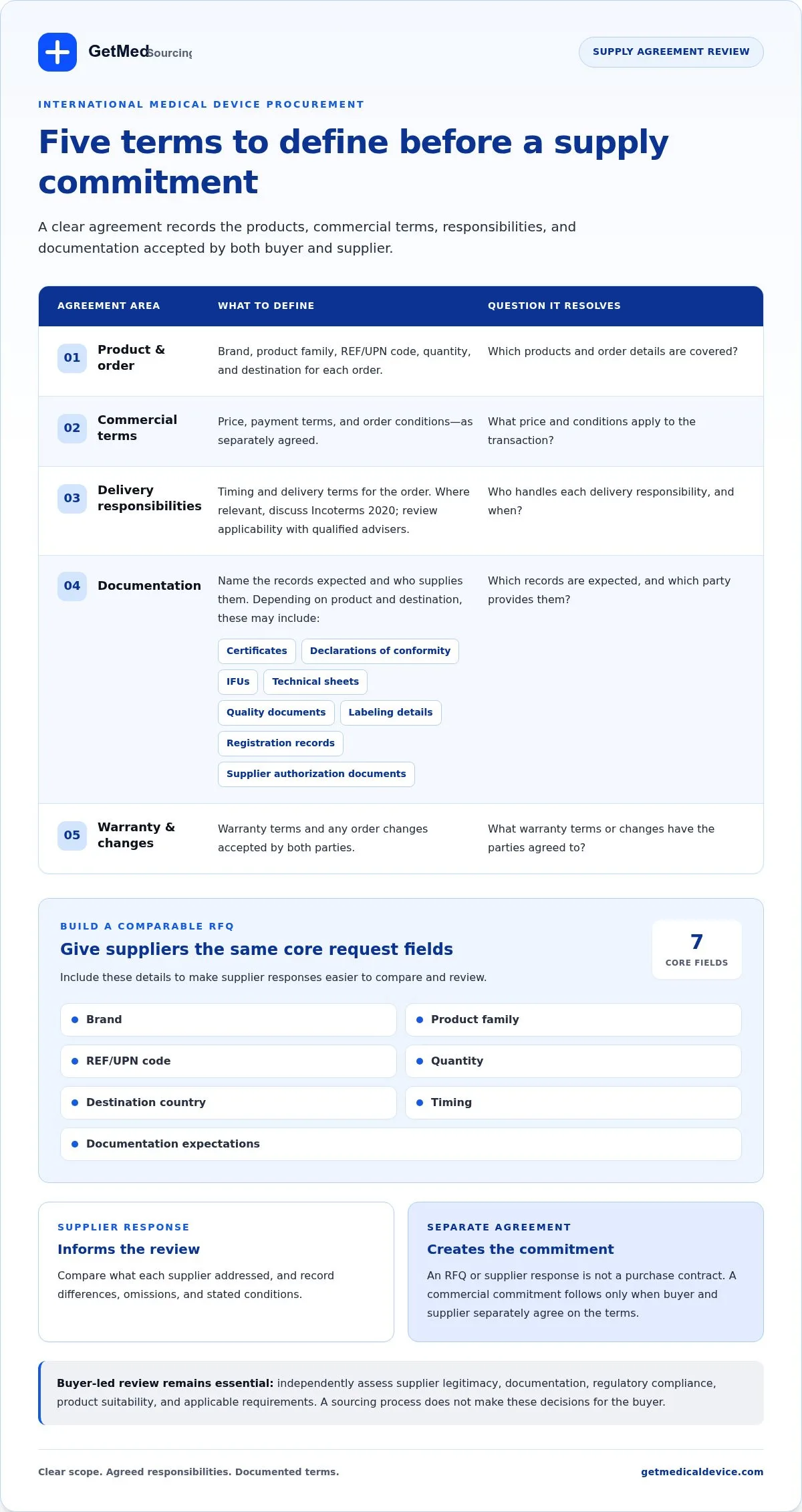
Set out the product and ordering scope, commercial terms, delivery responsibilities, and documentation requirements. International medical device supply agreements should assign each obligation to the buyer or supplier instead of leaving important assumptions buried in an RFQ or informal correspondence.
| Term | Question it resolves | Who must agree |
|---|---|---|
| Product and order | Which brand, product family, REF/UPN code, quantity, and destination are covered? | Buyer and supplier |
| Commercial terms | What price, payment terms, and order conditions apply? | Buyer and supplier |
| Delivery responsibilities | What timing and delivery terms apply to this order? | Buyer and supplier |
| Documentation | Which records are expected, and who supplies them? | Buyer and supplier |
| Warranty and changes | What warranty terms or order changes have the parties accepted? | Buyer and supplier |
Product identification, quantity, and documentation
Specify the brand, product family, REF/UPN code, quantity, and destination for each order. Then state which records the supplier is expected to provide. For example, when sourcing advanced aesthetic or ophthalmic equipment from providers like Jett Medical Canada, contracts often detail specialized device specifications and clinical user guidelines alongside standard commercial terms. Depending on the product and destination, the buyer may request certificates, declarations of conformity, instructions for use (IFUs), technical sheets, quality documents, labeling details, registration records, or supplier authorization documents. The buyer must independently review these materials and assess product suitability and applicable requirements.
Commercial and delivery terms to agree separately
Record price, payment, timing, warranty, and order-specific conditions only as agreed by the buyer and supplier. Where relevant, the parties can discuss Incoterms 2020 to clarify delivery responsibilities, with applicability reviewed by qualified advisers. Applicable laws and standards also require independent review; a sourcing platform does not determine compliance.
Use supplier responses to inform that review, then document the terms both parties accept. A structured medical device sourcing request can help organize product and destination details before negotiation, but it does not replace the agreement.
How procurement teams can move from RFQ to agreement review
A disciplined RFQ process gives buyers a consistent basis for comparing supplier responses and preparing to review international medical device supply agreements. Treat it as a sequence, not a commitment:
- Define the need. Identify the product, required quantity, destination country, timing, and documentation expectations.
- Structure the RFQ. Provide the same core fields to each supplier: brand, product family, REF/UPN code, quantity, destination country, timing, and requested documentation.
- Compare responses. Check whether each response addresses the requested fields, then record differences, omissions, and stated conditions.
- Conduct buyer-led review. Independently assess supplier legitimacy, documentation, regulatory compliance, and clinical suitability before deciding whether to proceed. Negotiate and document commercial terms separately with the supplier.
This sequence fits into the wider global sourcing and procurement framework, where request preparation, supplier options, comparison, and buyer control all inform the procurement process.
Prepare a complete, comparable medical device RFQ
Separate required identifiers from preferences. Brand, product family, REF/UPN code, and quantity define what is being requested; preferred timing and other conditions can be stated separately. Specify the destination country and list the documentation expectations for the request. Using the same fields for each supplier makes side-by-side comparison easier and helps reveal different assumptions or unanswered questions.
Supplier responses describe the information provided by the supplier. They do not guarantee availability, price, lead time, or terms. Record what each response actually states before beginning negotiations.
Keep independent verification within buyer review
Supplier verification is a useful sourcing input, not a substitute for buyer checks. Independently verify supplier legitimacy and documentation, and assess applicable regulatory requirements and clinical suitability. The verified supplier procurement guide provides additional context for that review.
To organize product and destination details for supplier comparison, start a structured medical device RFQ.
How GetMedicalDevice supports sourcing without replacing the agreement
GetMedicalDevice supports sourcing by organizing buyer requests and supplier responses. Its workflow has four steps:
- Capture the request: Record the product and destination details supplied by the buyer.
- Match supplier options: Connect the request with options from a verified supplier network that includes suppliers from 80+ countries.
- Compare responses: Review supplier-provided information against the request and note gaps or differences.
- Proceed with control: Use the responses to inform a separate, buyer-led procurement review.
This process supports discovery and comparison. It does not decide which product is suitable, whether documentation meets destination requirements, or whether a buyer should proceed with a supplier. Those decisions remain with the buyer.
What the platform does, and does not decide
Structured RFQ capture helps buyers communicate product identifiers, quantity, destination, timing, and documentation expectations. Supplier verification is a sourcing input, not a guarantee of approval and not a substitute for independently checking supplier legitimacy, documents, regulatory compliance, and clinical suitability. GetMedicalDevice does not make legal, regulatory, import-clearance, or clinical decisions.
The platform also does not replace the commercial relationship. Sellers handle sales, invoices, delivery terms, and commercial commitments directly. An RFQ response can inform negotiation, but it does not establish the terms of international medical device supply agreements.
Prepare the next step with a structured request
Before submitting a request, assemble the brand, product family, REF/UPN code, quantity, destination country, timing, and documentation expectations. Clear inputs give suppliers a defined basis for responding and help buyers compare the information received. Then conduct due diligence and agree on any purchase terms directly with the supplier. A contract exists only after the buyer and supplier separately agree on the commercial terms.
Start a structured medical device sourcing request with the details available for your requirement.
Make the next sourcing decision traceable
For the next cross-border purchase, set a review gate before making a commitment. Record who owns each open question, which supplier response or document addresses it, and what still needs buyer review. If the product, destination, or requested documentation changes, reconcile those details with the proposed terms before approval. This creates a clear record for procurement teams and keeps final purchasing, compliance, and product-suitability decisions with the buyer.
A structured RFQ can establish that record from the outset. Include the brand, product family, REF/UPN code, quantity, destination, timing, and documentation expectations. GetMedicalDevice connects buyers with a verified supplier network that provides access to suppliers from 80+ countries. Supplier verification supports sourcing, but buyers must still independently assess supplier legitimacy, documentation, regulatory compliance, and clinical suitability. Only an agreement between buyer and supplier creates the commercial commitment in international medical device supply agreements.
Prepare the request with the information available and use supplier responses as inputs to your own review. Start a structured sourcing request and move the next procurement decision forward with clear inputs and buyer control.
Frequently Asked Questions
What is the difference between a supply agreement and a purchase order?
A supply agreement typically sets standing terms for the buyer-supplier relationship, while a purchase order identifies a specific order under those terms. For example, the agreement may describe payment procedures and how changes are handled; a purchase order can specify the product identifier, quantity, destination, and requested timing for one transaction. The parties should state how the documents interact and which terms prevail if they conflict.
Can one international medical device supply agreement cover multiple destination countries?
Yes, one agreement can cover multiple destination countries if it clearly identifies each market and the relevant ordering entities. Country-specific schedules or order terms can capture differences in documentation expectations, delivery arrangements, and other applicable conditions. Buyers should assess requirements separately for each destination rather than assume one market’s review applies to another. Qualified advisers can review jurisdiction-specific contract language before execution.
How should a supply agreement address currency and exchange-rate changes?
Set the invoice currency and exchange-rate treatment in writing. The parties can specify whether the agreed price is fixed in that currency or converted, the reference rate and conversion date if conversion applies, and which party bears bank or conversion charges. If rates move, define any review or price-adjustment process, including notice and written agreement. These are negotiated commercial terms, so obtain qualified advice for the transaction.
What happens if product specifications change after a supply agreement is signed?
Use a written change-control process. It should describe the proposed change, identify affected product codes and documents, assess open orders, and require approval of revised terms before implementation. A specification or labeling change may affect more than the product description, so the buyer should independently review documentation, destination requirements, and clinical suitability. The supplier should separately state any effect on price, timing, or order conditions.