
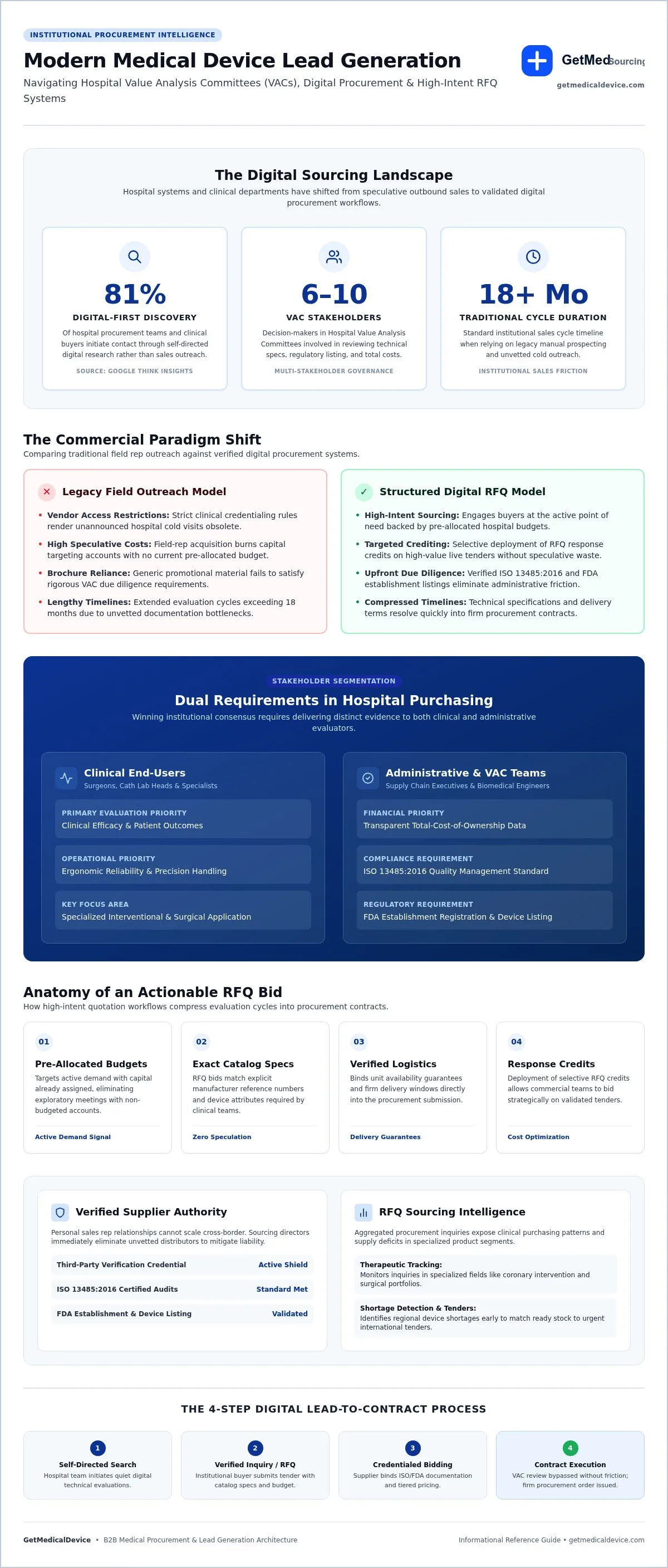
Over 81% of hospital procurement teams and clinical buyers now initiate vendor contact through self-directed digital research rather than outbound sales outreach, according to data from Google Think Insights. For commercial leaders reassessing how to generate leads for medical device sales, traditional field visits and unvetted cold calls can no longer support a predictable revenue pipeline.
Gaining access to clinical decision-makers has never been harder. Hospital Value Analysis Committees involve six to ten stakeholders, regulatory requirements add friction, and sales cycles often stretch past 18 months, making field-rep acquisition unsustainably expensive. You don't need more speculative meetings; you need high-intent buyers seeking specific device specifications. Mastering the shift from manual prospecting to structured digital procurement positions your organization directly in front of ready-to-buy sourcing teams. This guide delivers a repeatable blueprint to capture targeted RFQs, increase market visibility for premium interventional and surgical portfolios, and compress complex institutional sales timelines.
Key Takeaways
- Transition to a digital procurement model to understand how to generate leads for medical device sales across multi-stakeholder hospital purchasing committees.
- Target verified Request for Quotation (RFQ) pipelines to engage clinical buyers at the active point of need rather than relying on speculative outbound outreach.
- Utilize third-party supplier verification to establish institutional authority and reduce the administrative due diligence burden on hospital evaluation teams.
- Leverage dedicated B2B medical marketplaces to deploy RFQ response credits strategically and expand global visibility for specialized surgical and interventional product lines.
Table of Contents
- The Evolution of Medical Device Lead Generation in 2026
- High-Intent Lead Acquisition Through RFQ Systems
- Building Authority with Verified Supplier Status
- Strategic Lead Scaling with GetMedicalDevice
The Evolution of Medical Device Lead Generation in 2026
Lead generation in the medical sector is no longer an exercise in cold outreach or booth presence at annual conferences. Sourcing specialized hospital equipment functions as an institutional, multi-stakeholder procurement process. Modern commercial teams assessing how to generate leads for medical device sales must align their acquisition architecture with verified digital workflows rather than legacy field tactics.
Understanding the Digital Procurement Shift
Strict clinical credentialing rules and vendor access restrictions have made cold hospital visits obsolete. Today, clinical departments and hospital systems rely directly on healthcare procurement platforms to identify validated distributors. Buyers conduct technical evaluations quietly before contacting suppliers. When sourcing teams initiate contact, they typically leverage a structured request for quotation (RFQ) process to verify regulatory clearance, unit availability, and delivery guarantees.
Targeting the Right Healthcare Stakeholders
Modern hospital purchasing decisions require consensus across distinct administrative and clinical groups. Effective lead generation separates these profiles to address their competing requirements directly:
- Clinical End-Users: Surgeons, catheterization laboratory heads, and interventional specialists prioritize clinical efficacy, ergonomic reliability, and patient outcomes.
- Administrative Procurement & VACs: Value Analysis Committees, supply chain executives, and biomedical engineers demand transparent total-cost-of-ownership data, ISO 13485:2016 verification, and strict regulatory compliance.
To master how to generate leads for medical device sales in this environment, suppliers cannot rely on generic sales brochures. Trust serves as the primary currency in 2026 transactions. Presenting validated regulatory listings and technical documentation upfront allows vendors to satisfy VAC due diligence rapidly, moving qualified institutional leads into firm procurement contracts without friction.
High-Intent Lead Acquisition Through RFQ Systems
Passive lead generation relies on unprompted web forms, while territory-based field sales burns capital on accounts with zero current budget. Request for Quotation (RFQ) pipelines eliminate this inefficiency. An RFQ represents active institutional demand backed by pre-allocated budgets, defined catalog reference numbers, and specific delivery windows. Sourcing teams don't submit requests casually; they need verified stock immediately. Targeting active quotation requests shifts your commercial model from chasing cold prospects to supplying verified institutional buyers.
How to Respond to Medical RFQs for Maximum Conversion
Speed and data precision determine conversion rates. Procurement committees disqualify bids lacking necessary technical credentials or clear regulatory validation, including current FDA establishment registration and device listing records. An RFQ response functions as a formal tactical bid that binds technical specifications, verifiable compliance data, and tiered pricing into an actionable procurement contract. By deploying dedicated RFQ response credits, suppliers bid selectively on verified hospital tenders without incurring speculative acquisition costs.
Leveraging RFQ Data for Market Intelligence
Aggregated sourcing feeds provide actionable intelligence on clinical purchasing patterns. Tracking procurement inquiries in therapeutic segments like coronary intervention allows distributors to spot regional supply shortages early. This visibility shows suppliers how to generate leads for medical device sales by matching ready inventory directly to urgent international tenders. To connect with clinical buyers submitting live equipment tenders, participating in the GetMedicalDevice B2B marketplace provides immediate visibility into high-value procurement requests.
Building Authority with Verified Supplier Status
Personal rep relationships cannot scale across cross-border healthcare markets. Modern hospital supply networks demand verifiable infrastructure before considering new commercial partnerships. Sourcing directors eliminate unvetted distributors immediately to mitigate clinical and institutional liability. In this digital environment, third-party vetting transforms your profile into an active lead magnet. Demonstrating institutional readiness is the most reliable strategy when determining how to generate leads for medical device sales across international hospital networks.
The Anatomy of a High-Converting Medical Listing
Hospital purchasing committees demand comprehensive technical documentation before initiating dialogue. High-converting entries in specialized segments like interventional radiology or neurovascular therapies must include complete manufacturer catalog numbers, shelf-life specifications, sterilization modalities, and batch traceability protocols. Integrating valid FDA Device Registration and Listing documentation directly within your product pages confirms market clearance. Clear data eliminates clinical ambiguity, allowing surgical teams to approve device evaluations without administrative delays.
Reducing Procurement Friction through Verification
Institutional due diligence creates significant administrative friction during onboarding. Sourcing teams spend weeks validating corporate legitimacy, quality certifications, and operational compliance. Working with verified medical device suppliers allows procurement departments to bypass preliminary vetting checks entirely:
- Accelerated Evaluation: A verified badge authenticates vendor integrity instantly, removing regulatory bottlenecks.
- Cross-Border Confidence: International buyers order complex equipment with confidence when supplier credentials meet standardized verification criteria.
- Enhanced Visibility: Premium listings ensure maximum placement when institutional buyers search by precise OEM part numbers.
Suppliers learning how to generate leads for medical device sales must minimize buyer friction upfront. Apply for a Verified Supplier Membership to validate your institutional catalog and secure inbound hospital orders.
Strategic Lead Scaling with GetMedicalDevice
Outsourced telemarketing agencies rarely possess the technical vocabulary required for specialized medical negotiations. Hospital sourcing leads immediately detect generic scripts. GetMedicalDevice functions as an industry-dedicated infrastructure designed to solve how to generate leads for medical device sales through structured, data-first discovery. By indexing inventory by reference codes and verified manufacturer specifications, the platform connects suppliers directly to clinical purchasing networks actively seeking specialized lines.
Accessing Global Interventional and Surgical Markets
Hospital purchasing teams evaluate international vendors based on product authenticity and operational compliance. GetMedicalDevice routes pre-qualified procurement requests for critical devices, enabling distributors to reach clinics across eighty countries. Sourcing directors regularly evaluate supply lines for established OEM brands, including:
- Cardiovascular and Endovascular Portfolios: Boston Scientific, Abbott Vascular, and Asahi Intecc interventional lines.
- Access and Diagnostic Equipment: Terumo catheter assemblies and dedicated vascular access systems.
- Surgical and Specialty Hardware: Critical consumables serving neurovascular, endoscopy, and peripheral clinics.
Optimizing ROI with Premium Supplier Tools
Traditional digital marketing for healthcare carries low conversion efficiency because institutional buyers ignore consumer advertising. In contrast, B2B marketplace memberships deliver lower cost-per-lead by replacing speculative clicks with active commercial requests. Through a Verified Supplier Membership, distributors secure institutional authority, deploy RFQ Response Credits to quote on high-margin hospital tenders, and leverage Premium Product Listings for top visibility. Integrating this specialized marketplace framework refines how to generate leads for medical device sales, transforming passive inventory into high-converting institutional contracts.
Modernize Your Institutional Medical Sales Pipeline
Securing sustainable commercial growth in healthcare procurement requires moving past legacy territory rep models. Establishing third-party credentials and capturing active, budgeted tenders represents the most efficient strategy for how to generate leads for medical device sales in 2026. Direct access to hospital procurement RFQs allows commercial teams to bid on live clinical requirements, satisfy Value Analysis Committee standards early, and shorten lengthy institutional buying cycles.
Achieving verified status establishes immediate institutional trust with international hospital networks and clinics seeking specialized portfolios from respected manufacturers like Terumo and Asahi Intecc. Aligning your catalog with structured B2B procurement platforms eliminates speculative outbound acquisition costs while connecting you directly with high-intent purchasing directors. Take control of your commercial distribution: Become a Verified Supplier and access active RFQs today to expand your global reach and deliver consistent, measurable revenue growth.
Frequently Asked Questions
What is the most effective way to generate B2B medical device leads in 2026?
The most effective method is positioning inventory inside specialized B2B medical procurement marketplaces that capture active Request for Quotation (RFQ) pipelines. Hospital buyers rarely respond to speculative outbound prospecting. Mastering how to generate leads for medical device sales requires meeting clinical sourcing teams at their point of need, using technical catalog indexing by OEM part numbers to capture pre-budgeted tenders directly from hospital networks.
How do RFQ response credits help in medical equipment sales?
RFQ response credits give medical device suppliers a disciplined, unit-economic approach to institutional bidding. Rather than maintaining expensive retainer agreements or speculative ad campaigns, suppliers allocate credits selectively to bid on verified procurement requests matching their specific stock. This credit-based structure ensures your capital targets high-margin opportunities with active hospital purchasing committees, maximizing sales conversion efficiency without upfront wasted spend.
Why is supplier verification important for hospitals and clinics?
Supplier verification serves as a critical risk-mitigation filter for hospital Value Analysis Committees and purchasing directors. Vetted credentials confirm operational legitimacy, standard quality system alignment, and genuine manufacturer supply lines. This third-party validation eliminates weeks of preliminary administrative due diligence, allowing clinical healthcare providers to execute urgent procurement contracts with confidence while minimizing regulatory and liability risks across cross-border distribution networks.
Can digital lead generation replace traditional field sales in medical devices?
Digital lead generation doesn't eliminate clinical specialists, but it completely replaces speculative field prospecting. Modern hospital credentialing protocols prevent uninvited sales representatives from accessing surgical suites or purchasing directors. Digital platforms capture initial institutional interest and qualify technical requirements upfront. This operational shift allows commercial teams to redirect clinical field specialists toward procedural support, trial evaluations, and account expansion rather than cold customer acquisition.
What information should be included in a premium medical product listing?
A high-converting premium listing must contain granular technical and compliance specifications to satisfy clinical reviewers. Include precise OEM catalog reference numbers, cleared regulatory documentation, device sterilization methods, shelf-life data, and batch traceability protocols. For complex surgical equipment, providing clear dimensional data and compatibility parameters removes evaluation friction, giving hospital procurement departments everything required to approve an immediate equipment requisition.