

What if the first warning that a medical device is nearing expiry comes from a shelf check rather than a reliable inventory record? Managing expiring medical device stock means tracking dates at item, lot, and location level, including when stock moves between sites or is held on consignment. When those details are fragmented, teams may find short-dated stock too late to review, redistribute, or account for in replenishment plans.
Expiry control works when clear date visibility leads to timely, documented action. This guide explains how to identify at-risk inventory, assign follow-up ownership, and use consistent review and rotation procedures across locations. It covers FEFO, which prioritizes stock with the earliest expiry, and the information to capture in inventory records. When a review confirms a replenishment need, a structured RFQ can specify product identifiers, quantity, destination, timing, and documentation expectations. Buyers retain control of supplier selection and final procurement decisions.
Key Takeaways
- Managing expiring medical device stock starts with clear expiry-date records linked to each item, lot, and location.
- Use FEFO rather than FIFO to prioritize items with the earliest expiry, and maintain accurate records for rotation to work.
- Follow a consistent action sequence: identify at-risk stock, prioritize it, assign an owner, act under policy, and document the outcome.
- When inventory review confirms a replenishment need, use an RFQ to specify product identifiers, quantity, destination, timing, and documentation expectations.
Table of Contents
- Why managing expiring medical device stock requires early visibility
- How FEFO and reliable date records prevent avoidable expiry
- A practical action plan for stock approaching expiry
- Replenish medical device stock through a controlled sourcing workflow
Why managing expiring medical device stock requires early visibility
Expiring stock is inventory approaching its stated expiry date, not only goods that have already expired. Early visibility gives teams time to locate affected units, review them under organizational policy, and assign follow-up before the date passes. Managing expiring medical device stock is an expiry-control process. Broader inventory management also covers demand, replenishment, and availability.
A total unit count cannot show which lots are approaching expiry or where they are held. A useful inventory record identifies the specific stock that needs review, rather than relying on a general impression that a product is available.
Where expiry exposure builds up
Expiry exposure can build wherever stock is held or changes hands. A warehouse may have several lots of the same item, even if routine checks focus only on total quantity. Hospital stock may be split among departments, consignment areas, and loaner sets, each with different review routines. A report limited to central stores can miss units held elsewhere.
Distributor inventory may be spread across depots, while field stock can sit with representatives or in vehicles. Transfers add another handoff: expiry-date and lot details need to travel with the inventory record so the receiving location can identify what arrived and prioritize its review. Define who updates the record at dispatch and who confirms it at receipt.
What an expiry-ready inventory record contains
For each stock line, capture the product identifier, lot or batch, expiry date, quantity, and current location. These fields connect the date to the actual inventory and show where follow-up is needed. Record consignment, loaner, and field-stock locations distinctly instead of grouping them under a broad site label.
- Product identifier: distinguishes the device or item.
- Lot or batch and expiry date: identifies which units need review and when.
- Quantity and current location: supports a focused count and ties the stock to a place.
Item-level records provide a clearer view than aggregate counts. If a report shows only total units, staff cannot tell whether one lot is short-dated while another has a later expiry. Linking each lot to its location makes review, transfer follow-up, and reconciliation more precise.
How FEFO and reliable date records prevent avoidable expiry
FEFO means First Expired, First Out: allocate eligible stock with the earliest expiry date before later-dated stock. FIFO, or First In, First Out, prioritizes the item received first, which may not be the item that expires first. If a newer delivery has a shorter expiry than stock already on the shelf, FIFO alone can leave the earlier-expiring lot unused.
Accurate item-level records make FEFO actionable by showing which lot expires first and where it is held. If a date is missing, inconsistent, or unreadable, flag the affected stock for review rather than guessing or allowing it to pass through routine allocation. This makes managing expiring medical device stock a controlled process, not simply a shelf-ordering convention.
Apply FEFO without confusing it with product suitability
At picking, check the recorded expiry for each lot and prioritize the earliest-dated eligible units. When replenishing shelves, place later-dated stock behind earlier-dated stock where the storage setup permits, and maintain lot separation so staff can identify what they are selecting. Rotation determines sequence only. It does not establish clinical suitability or override organizational procedures. Keep expired or questionable stock out of routine allocation while the responsible team reviews it under policy.
Make expiry tracking work across locations
Use one unambiguous date format and a consistent location naming convention across stores, departments, consignment areas, and field stock. Assign responsibility for updating records when stock is received, moved, counted, or otherwise handled. Reconcile system records against physical stock at intervals set by the organization, and investigate mismatches instead of silently adjusting totals.
For every transfer, carry the same product identifier, lot or batch, expiry date, and quantity into the receiving record. If the date is unreadable or conflicts with the system entry, flag the discrepancy and pause normal rotation until it is reviewed. Consistent records let staff apply FEFO across locations, not only within a single storeroom.
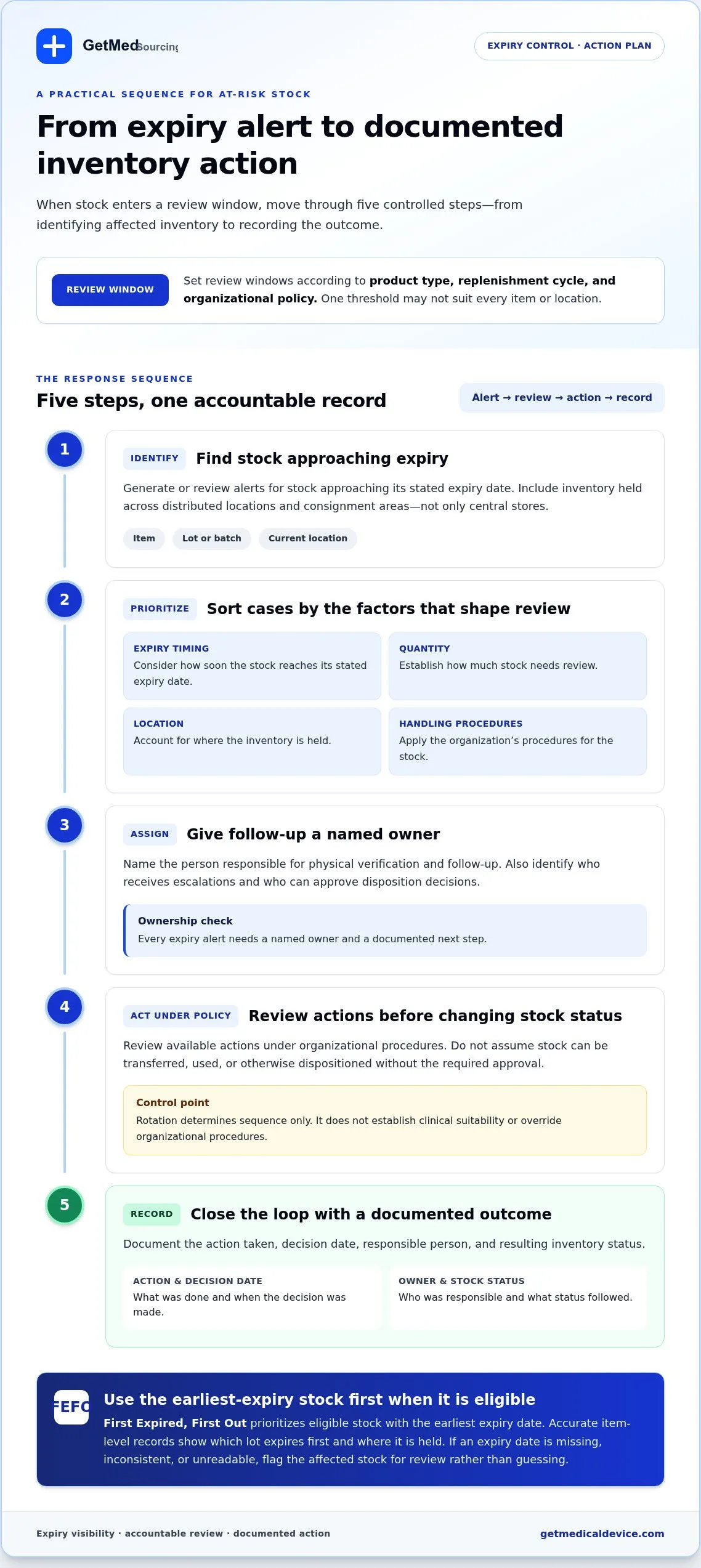
A practical action plan for stock approaching expiry
An alert needs to trigger a defined response, not simply add a line to a report. Set review windows according to product type, replenishment cycle, and organizational policy. A single threshold may not suit every item or location. In managing expiring medical device stock, use this sequence whenever stock enters a review window:
- Identify: Generate or review alerts for stock approaching its stated expiry date, including inventory at distributed and consignment locations.
- Prioritize: Rank cases by expiry timing, quantity, location, and the organization’s handling procedures.
- Assign: Name the person responsible for physical verification and follow-up. Identify who receives escalations and who can approve disposition decisions.
- Act under policy: Review available actions under organizational procedures. Do not assume stock can be transferred, used, or otherwise dispositioned without the required approval.
- Record: Document the action, decision date, responsible person, and resulting inventory status.
Every expiry alert needs a named owner and a documented next step. This keeps a flagged item from remaining unresolved between review cycles.
Set windows, responsibilities, and review measures
Define alert windows internally, taking product type and replenishment cycle into account. Establish who reviews alerts, who verifies stock physically, and who approves disposition. After each review, record the decision and update the inventory status so the next reviewer can see what remains open.
Track quantities flagged, actions completed, and stock that reaches expiry. Review recurring cases for causes such as over-ordering, low utilization, delayed transfers, or inaccurate records. Use those findings to adjust forecasts, replenishment parameters, ownership, or review cadence. If the review identifies a replenishment requirement, use a structured sourcing request to provide product details and timing for supplier matching.
Replenish medical device stock through a controlled sourcing workflow
Expiry control and sourcing are separate steps. First, review inventory and apply organizational policy to determine whether a replenishment need remains. This prevents a short-dated item from automatically triggering an order when usable stock is available elsewhere or the requirement has changed. In managing expiring medical device stock, sourcing begins only after that review establishes what needs replacing.
Prepare an RFQ with usable product and delivery requirements
Build the request around details that help suppliers understand the requirement. Identify the brand and product family. A medical device product directory can help with category identification. Include the REF/UPN code or other relevant product identifier, requested quantity, destination country, timing, and documentation expectations. For specialized testing kits and rapid detection supplies such as those from druglab118.com, specifying minimum remaining shelf life upfront helps ensure incoming inventory meets operational needs. Complete fields make responses easier to compare, but do not guarantee a match, availability, or a particular response time.
GetMedicalDevice’s RFQ-first workflow captures these details and matches requests with supplier options. Supplier responses and terms vary by request and market. Assess pricing, lead time, minimum quantities, and stock availability from the information provided for each request rather than assuming them in advance.
Compare responses while retaining procurement control
Review each response against the original requirement. Compare supplier-provided product details, documentation, stated availability, and commercial terms. Buyers must independently assess supplier legitimacy, documentation, regulatory compliance, and product suitability before purchase. GetMedicalDevice supports request capture, supplier matching, and response comparison, while final procurement and compliance decisions remain with the buyer.
Connect expiry planning to wider purchasing controls by defining who reviews responses and who authorizes the next step. An RFQ is a request for information and a quotation, not a purchase contract. The buyer and supplier must agree separately before a purchase is made. This keeps replenishment decisions documented and buyer-controlled, while distinguishing supplier communication from inventory management.
Make expiry reviews part of a stronger procurement cycle
Use each review to improve the next purchasing decision. When your team identifies a replenishment need, capture the requirement clearly and keep sourcing separate from stock disposition. This makes managing expiring medical device stock part of a deliberate procurement cycle, with decisions documented and responsibility retained by the buyer.
A structured RFQ can record the brand, product family, REF/UPN code, quantity, destination, timing, and documentation expectations. GetMedicalDevice connects buyers with supplier options from 80+ countries. Responses and terms vary by request. Buyers remain responsible for assessing supplier legitimacy, documentation, compliance, and product suitability, then agreeing any purchase terms directly with the supplier.
Ready to define a replenishment requirement?Submit a structured medical device sourcing request with the details your procurement team needs to compare supplier responses. Your team remains in control of the decision.
Frequently Asked Questions
How do you manage medical device stock that is close to expiry?
Start with an item-level record that identifies the product and each affected lot. For example, if a consignment location holds two batches with different dates, review them separately rather than treating the product as one stock line. Set internal alert windows, assign a reviewer, and document the next action. Apply FEFO where appropriate, while following organizational procedures for stock status, disposition, and suitability decisions. This makes managing expiring medical device stock traceable and actionable.
What does FEFO mean in medical device inventory management?
FEFO means First Expired, First Out: prioritize eligible stock with the nearest expiry date, not simply the earliest receipt. If a recently received lot expires before an older lot already on hand, FEFO selects based on expiry order. FIFO instead follows receipt order. Accurate date records and consistent picking are prerequisites. FEFO organizes inventory rotation only; it does not establish whether a device is clinically suitable or authorize its use.
How often should medical device expiry dates be checked?
Set the checking cadence under your organization’s policy, using stock volume, site count, expiry profiles, and replenishment cycles as inputs. Pair scheduled record reviews with physical checks at receiving and after transfers so movement does not leave a stale location entry. Document the selected interval and the role responsible for escalating missed checks or date discrepancies. There is no single suitable schedule for every inventory network.
What information should be recorded for expiring medical device stock?
Record the product identifier, lot or batch, expiry date, quantity, and location, plus a status such as available for review or held pending assessment. Add the review date, responsible owner, and action taken to create an audit trail. For example, a transfer record should show the quantity sent and received so a difference can be investigated. Use consistent field formats across sites and reconcile records with physical stock. Before procurement, independently verify supplier legitimacy and relevant documentation.
Can a supplier or sourcing platform decide whether near-expiry medical devices are suitable to use?
No. The buyer’s organization retains responsibility for product suitability, compliance, and procurement decisions. A sourcing platform can structure product and supplier communication, but it cannot replace the organization’s review or determine whether a device is suitable for use. Follow internal procedures and involve the appropriate responsible personnel. Before purchasing, buyers must independently assess supplier legitimacy, relevant documentation, applicable compliance requirements, and product suitability.

