

A Request for Quotation in the medical sector is a critical risk-mitigation document that dictates the integrity of your entire supply chain. Procurement professionals frequently encounter the frustration of vague responses and the persistent threat of non-compliant or counterfeit hardware. Learning how to write an effective medical device RFQ is essential for any organization that requires precision and regulatory adherence. By refining your documentation, you eliminate the ambiguity that often leads to procurement failures and safety risks.
This guide details the technical and regulatory requirements needed to draft an RFQ that attracts high-quality, verified suppliers. You'll learn to align your requests with the FDA's Quality Management System Regulation (QMSR) and mandatory EUDAMED registration standards. We provide a structured framework to reduce procurement risk and secure transparent pricing from established global brands. This article outlines a repeatable process for verifying supplier legitimacy and ensuring full compliance with current international standards. Following these protocols ensures your sourcing remains efficient and legally sound.
Key Takeaways
- Distinguish between RFIs, RFPs, and RFQs to ensure you utilize the correct procurement instrument for your specific sourcing requirements.
- Master how to write an effective medical device RFQ by incorporating mandatory regulatory certifications and precise material biocompatibility standards.
- Eliminate pricing and logistical ambiguity by providing clear volume projections and standardized Incoterms within your request documentation.
- Streamline the procurement lifecycle by utilizing verified B2B marketplaces to connect with a pre-vetted network of global medical device suppliers.
Table of Contents
- Defining the Strategic Role of a Medical Device RFQ
- Essential Technical and Regulatory Components
- Structuring the RFQ for Maximum Supplier Engagement
- Streamlining Procurement via Verified Marketplaces
Defining the Strategic Role of a Medical Device RFQ
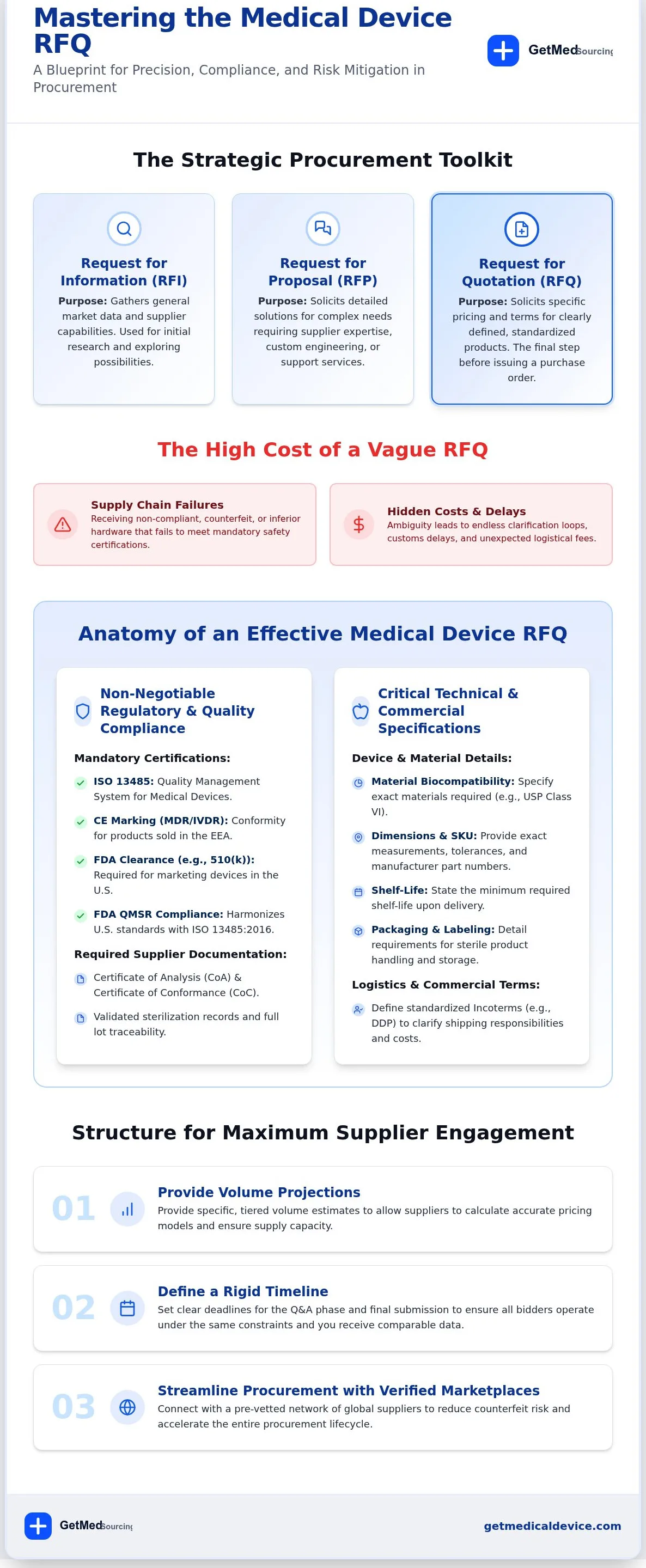
A Request for Quotation (RFQ) acts as a formal procurement instrument used to solicit specific pricing and contractual terms from vendors for clearly defined medical equipment. In the MedTech sector, this document is more than a price check; it's a strategic tool for risk management. Understanding how to write an effective medical device RFQ allows procurement managers to filter out unreliable entities and move toward a single, verified procurement partner. Unlike general commodities, medical devices require extreme precision. Any ambiguity in the request directly impacts patient safety and increases regulatory liability for the purchasing institution. Systematic documentation ensures that every technical parameter is met before a purchase order is issued.
RFQ vs. RFP: When to Use Each in MedTech
The choice between procurement documents depends on the complexity of the requirement. An RFQ is appropriate for standardized products with established specifications, such as coronary intervention catheters or surgical sutures. Conversely, a Request for Proposal (RFP) is necessary when the solution requires supplier expertise, custom engineering, or clinical trial support. While a Request for Information (RFI) gathers general market data, the RFQ focuses on the final execution phase of the sourcing process. It's the bridge between identifying a need and securing a contract.
The Cost of a Poorly Written RFQ
Vague specifications in an RFQ create significant financial and operational friction. Incomplete data leads to hidden costs in logistics, customs delays, and post-market compliance audits. If technical parameters are not explicitly detailed, suppliers may quote based on inferior materials that don't meet hospital standards. This lack of clarity forces procurement teams into endless clarification loops, delaying critical supply chains. An incomplete RFQ increases the risk of receiving non-compliant or counterfeit devices that fail to meet mandatory safety certifications. Precision is your primary defense against supply chain volatility, and mastering how to write an effective medical device RFQ is the first step toward clinical reliability.
Essential Technical and Regulatory Components
Integrating clinical compliance is the foundation of how to write an effective medical device RFQ. Mandatory certifications such as ISO 13485, CE Marking under MDR/IVDR, and FDA 510(k) clearances must be treated as non-negotiable prerequisites. Aligning these requirements with value-based procurement strategies ensures that the sourcing process accounts for long-term patient safety and regulatory stability. Your RFQ should define a formal "Quality Agreement" to hold suppliers accountable for product deviations, especially when managing complex international shipments.
Regulatory Documentation Requirements
Suppliers must submit a comprehensive documentation package for verification. This includes Certificates of Analysis (CoA), Certificates of Conformance (CoC), and validated sterilization records. Within the vascular access supply chain, rigorous traceability is essential for maintaining safety standards. It's critical to ensure that suppliers comply with the FDA’s new Quality Management System Regulation (QMSR), which harmonizes U.S. standards with ISO 13485:2016. Every device must be traceable to its specific production lot to manage potential recalls or audits effectively.
Technical Specification Checklist
Technical accuracy is required at the individual SKU level to avoid procurement errors. When requesting quotes for high-precision items like Asahi Intecc guidewires or components from Abbott Vascular, you must specify material biocompatibility, exact dimensions, and minimum shelf-life. Detail your requirements for packaging and labeling of sterile surgical products to prevent contamination during transit or storage. Accessing a verified marketplace ensures these technical parameters are met by legitimate, pre-vetted entities, reducing the risk of counterfeit procurement.
Structuring the RFQ for Maximum Supplier Engagement
High-quality suppliers prioritize detailed requests over vague inquiries. Learning how to write an effective medical device RFQ involves presenting a clear commercial roadmap that respects the supplier's time and resources. You should provide specific volume projections to allow vendors to calculate tiered pricing models accurately. Define a rigid timeline for the Q&A phase and final submission to ensure all participants operate under the same constraints. Precision in these early stages prevents logistical bottlenecks and ensures that you receive comparable data sets from all bidders.
Logistics and Commercial Terms
Specifying Incoterms like DDP (Delivered Duty Paid) or EXW (Ex Works) is critical for international medical device sourcing and procurement. This clarity eliminates freight ambiguity and ensures total landed cost visibility before a contract is signed. Organizations must also define preferred payment terms, such as Letters of Credit for high-value cross-border transactions or Net 30 for established domestic relationships. Utilizing technical procurement and prioritization methods allows you to align these commercial terms with institutional risk tolerance and lifecycle management.
The Evaluation Matrix
Evaluation criteria must extend beyond the unit price to encompass total value. A robust scoring framework weights regulatory compliance, lead times, and historical reliability alongside cost. Assigning a heavy weight to the "Verified" status of a supplier ensures that only entities with validated credentials and legitimate trade histories reach the final selection phase. Establishing these metrics is a core component of how to write an effective medical device RFQ that yields actionable results. This systematic approach reduces the likelihood of sourcing non-compliant hardware or encountering fraudulent operators. To simplify this process, you can submit your RFQ through a verified B2B marketplace to ensure immediate engagement from pre-vetted global brands.
Streamlining Procurement via Verified Marketplaces
Digital platforms like GetMedicalDevice significantly reduce the friction inherent in manual procurement cycles. Once you understand how to write an effective medical device RFQ, deploying that document within a structured marketplace ensures it reaches the most relevant audience. These platforms act as a bridge to premium global brands, including Terumo and Boston Scientific, by utilizing a credit-based response system. This model requires suppliers to use RFQ credits to bid, which filters out low-intent inquiries and guarantees that responses come from professional, capable entities. It transforms the procurement process from a reactive task into a systematic, data-driven workflow.
The Value of Supplier Verification
The verification process serves as a critical first-line defense against supply chain volatility. By engaging with verified medical device suppliers, procurement teams eliminate the burden of independent legitimacy audits. This streamlined access is particularly valuable when sourcing specialized components for neurovascular procedures or interventional radiology. The platform ensures that every participating vendor maintains the necessary certifications and financial stability required for high-stakes medical trade, providing a secure environment for cross-border transactions.
Closing the Deal: From Quote to Delivery
Finalizing the procurement process requires a methodical transition from the accepted quote to the formal purchase order (PO). Once a bid is selected, the PO must mirror the exact technical and regulatory specifications defined in your original RFQ. Before accepting delivery, use a standardized checklist to verify:
- SKU numbers match the technical specifications exactly.
- Sterilization records and CoA/CoC are present, valid, and match the production lot.
- Packaging integrity is maintained according to the specified Incoterms.
- Unique Device Identification (UDI) details are registered in EUDAMED for EU-bound goods as of the May 2026 mandatory deadline.
Optimizing Your Medical Device Procurement Pipeline
Mastering the technical and regulatory nuances of a Request for Quotation ensures that your supply chain remains resilient against non-compliance and counterfeit risks. By integrating precise technical specifications with clear commercial terms, you create a document that attracts high-quality, professional vendors. Understanding how to write an effective medical device RFQ is the definitive first step toward securing transparent pricing and reliable delivery timelines.
Send your next medical device RFQ to our network of verified suppliers today to gain direct access to premium brands such as Asahi Intecc, Terumo, and Boston Scientific. Our global network of pre-verified B2B suppliers is equipped to handle specialized requirements in interventional and surgical categories with clinical precision. Establishing a standardized, repeatable RFQ process doesn't just save time; it significantly reduces your procurement friction and enhances overall operational stability.
Frequently Asked Questions
What is the difference between an RFP and an RFQ in medical device sourcing?
An RFQ focuses strictly on price and commercial terms for standardized medical hardware with established technical specifications. In contrast, a Request for Proposal (RFP) is utilized when the procurement objective requires supplier expertise, custom engineering, or complex service solutions. Understanding this distinction is a fundamental step in how to write an effective medical device RFQ that yields comparable and actionable data sets.
Which regulatory documents should I always request in a medical RFQ?
Mandatory documentation includes ISO 13485 certification, CE Marking (MDR/IVDR), and FDA 510(k) clearances where applicable. You must also request lot-specific Certificates of Analysis (CoA) and Certificates of Conformance (CoC) to ensure full traceability. These records verify that the devices meet the FDA’s Quality Management System Regulation (QMSR) standards. Including these requirements is essential for maintaining a compliant and audited supply chain.
How do Incoterms affect the final price in a medical device quote?
Incoterms dictate the allocation of logistical costs and risks between the buyer and the vendor. For example, a quote based on DDP (Delivered Duty Paid) includes freight, insurance, and customs duties, resulting in a higher unit price but lower administrative burden. Conversely, EXW (Ex Works) quotes appear lower but require the buyer to manage all transportation. Specifying these terms eliminates pricing ambiguity during the evaluation phase.
Can I use an RFQ for customized medical equipment?
RFQs are typically reserved for finished goods with static technical specifications. If your equipment requires custom engineering or unique material modifications, a Request for Proposal (RFP) is the appropriate instrument to evaluate supplier capabilities. Once the custom design is finalized and SKUs are established, you may then issue an RFQ to lock in pricing. This methodical progression ensures that technical requirements are fully understood before financial commitments are made.
How do I verify the legitimacy of a supplier who responds to my RFQ?
Verification requires cross-referencing supplier certifications against official databases like EUDAMED or the FDA's registration portal. Utilizing a B2B marketplace like GetMedicalDevice simplifies this process by providing access to a pre-verified network of global suppliers. The platform’s verification protocols act as a primary defense against counterfeit procurement. Ensuring your chosen partner has a verified status reduces the risk of supply chain disruptions and ensures product authenticity.


