

What separates a complete RFQ response from another round of follow-up? Often, it is how clearly the offer maps to the buyer’s requirements. Knowing how to write a winning RFQ response for medical devices means addressing more than price. Missing product identifiers, unclear quantities, or undocumented assumptions can make an offer difficult to evaluate.
A strong response gives buyers a clear basis for comparison without promising what you can’t substantiate. Match your offer to the requested product, reference codes, quantity, destination, timing, and documentation expectations, then present any commercial terms clearly. State limitations and open points so buyers can distinguish confirmed details from items that still require agreement. A structured RFQ workflow helps organize the request and supplier responses, but final commercial commitments remain between buyer and seller. Use the steps below to prepare a complete, traceable response that supports a more efficient sourcing process.
Key Takeaways
- Distinguish an RFQ response from an RFP proposal by focusing on the specific product and commercial requirements the buyer has stated.
- Learn how to write a winning RFQ response for medical devices by extracting each requirement, mapping supporting evidence, identifying gaps, and reviewing terms before submission.
- Use a concise comparison table to connect requested items with your response, supporting documents, and relevant caveats.
- Understand how a structured RFQ workflow organizes supplier responses, while buyers and sellers agree on final commercial terms separately.
Table of Contents
- What Makes a Medical Device RFQ Response Stand Out?
- How to Match Every Medical Device RFQ Requirement
- How to Present Medical Device Documentation and Commercial Terms
- Submit and Manage a Medical Device RFQ Response Through a Structured Workflow
What Makes a Medical Device RFQ Response Stand Out?
A medical-device RFQ response is a supplier’s offer against the buyer’s stated product and commercial requirements. Accurate product identifiers make it easier for buyers to compare offers against the same request. Make clear which item you are offering, which requirements it addresses, and where a difference or limitation applies. Promotional language cannot replace specific, traceable information.
What is the difference between an RFQ and an RFQ response?
The RFQ is the buyer’s request; the response is the supplier’s offer against it. A Request for Quotation (RFQ) typically seeks offers for defined goods or services, while an RFP invites a broader proposal for meeting a need. In medical-device sourcing, the RFQ’s specifications determine what the response should cover. If it identifies a brand, product family, REF/UPN code, and quantity, address those details directly rather than substituting a general product pitch.
What does a winning response mean in medical-device sourcing?
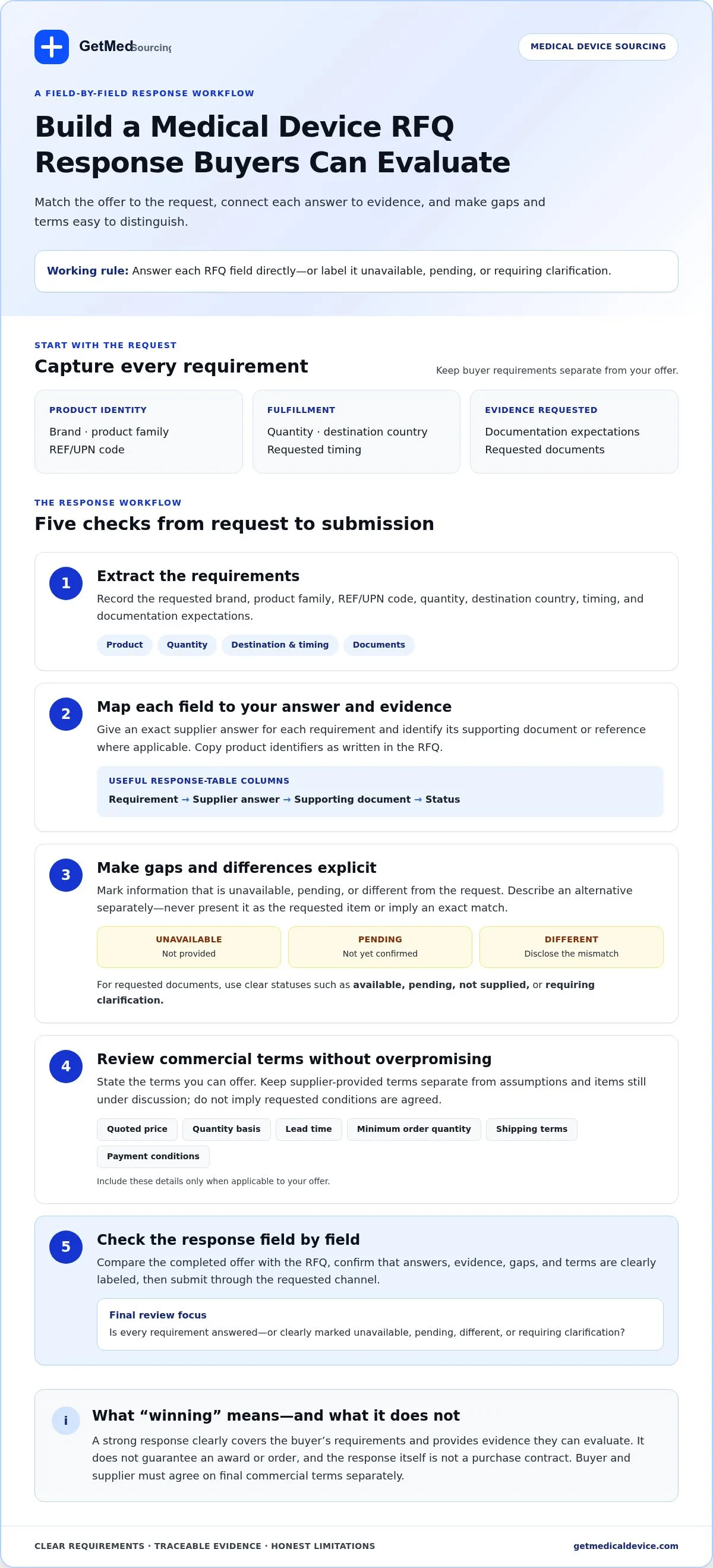
“Winning” means clearly covering the buyer’s requirements and providing evidence they can evaluate. It does not guarantee an award or order. The buyer makes the selection, and the RFQ response itself is not a purchase contract. Buyer and supplier must separately agree on commercial terms.
When considering how to write a winning RFQ response for medical devices, prioritize accuracy over claims such as “best in class” or “fully compliant.” Include claims only when they are supported and relevant to the request. Identify every mismatch, exclusion, or unanswered point directly. This helps the buyer distinguish confirmed offer details from limitations instead of assuming every requirement has been met. The result is a more useful offer, whether or not it is selected.
How to Match Every Medical Device RFQ Requirement
Use a requirement-by-requirement process to keep product details, documents, and commercial terms tied to the buyer’s request. A useful rule is: Answer each RFQ field directly, or label the information unavailable, pending, or requiring clarification. Don’t present an alternative product or an assumed supplier term as a match.
- Extract the requirements. Capture the requested brand, product family, REF/UPN code, quantity, destination country, timing, and documentation expectations.
- Map each field to evidence. Record your exact answer and identify the supporting document or reference, where applicable.
- Identify gaps. Mark fields that are unavailable, pending, or different from the request. Describe any alternative separately rather than presenting it as the requested item.
- Review commercial terms. State the terms you can offer, without assuming that requested timing, price, or other conditions are agreed.
- Check and submit. Compare the completed response with the RFQ field by field, then submit it through the requested channel.
Which product and shipment details should suppliers match?
Copy identifiers as written in the RFQ. If the buyer requests a specific brand, product family, REF/UPN code, and quantity, address each separately. For example, if the code for the item you offer differs from the requested code, disclose the difference instead of implying an exact match. For custom component manufacturing-such as plastic injection molding provided by Central Plastics-suppliers should also specify exact tooling details, resin certifications, and production limits. Record the destination country and requested timing as buyer requirements, then state your own terms separately. Do not imply that they align unless they do.
How should suppliers map answers to RFQ requirements?
Use a table with columns for requirement, supplier answer, supporting document, and status. Category language can help organize product identification: distinguish coronary intervention products from neurovascular devices, while leaving clinical suitability decisions to the buyer. For regulatory-related requests, identify the documents you are providing without making compliance decisions. The FDA overview of device regulation offers U.S. regulatory context.
This field-by-field method makes how to write a winning RFQ response for medical devices practical: build an offer that is traceable and straightforward to evaluate. Use medical device product listings as a sourcing reference when organizing product categories for a response.
How to Present Medical Device Documentation and Commercial Terms
Make documentation and commercial terms easy to assess separately. A compact response table can use four columns: requested item, supplier response, supporting document, and caveat. Include buyer-requested certificates, declarations of conformity, instructions for use (IFUs), technical sheets, quality documents, labeling, registration information, or supplier authorization documents when applicable. Identify each document by name and status instead of relying on broad statements such as “documentation available.”
How should a supplier handle missing documents or open questions?
Assign each requested document a clear status: available, pending, not supplied, or requiring clarification. If a document is pending, do not imply it is attached or already issued. Keep product descriptions and claims within the information and evidence you can provide. Documents support the buyer’s review; they do not by themselves establish regulatory compliance or clinical suitability. Buyers must independently assess the documentation and determine whether the product suits their requirements.
How can commercial terms remain clear without overpromising?
Separate supplier-provided terms from assumptions and items still under discussion. State the quoted price, quantity basis, lead time, minimum order quantity, shipping terms, and payment conditions only when applicable to your offer. Label estimates and dependencies clearly. Do not present requested timing or shipping arrangements as agreed facts. Availability, pricing, lead time, minimum order quantities, shipping options, and other supplier terms may vary by supplier, country, stock status, and market conditions. Buyer and supplier must separately agree on price, payment, delivery, and warranty terms.
When deciding how to write a winning RFQ response for medical devices, this distinction matters: an organized offer helps the buyer review evidence and commercial details without treating the response as a purchase contract. Flag exceptions beside the relevant requirement, not only in a general note that could be missed. Suppliers can use GetMedicalDevice’s RFQ workflow for medical device suppliers to respond to procurement requests through a structured sourcing process.
Submit and Manage a Medical Device RFQ Response Through a Structured Workflow
A structured platform can organize the sourcing exchange from request to supplier offer. In an RFQ-first workflow, the buyer submits details such as product identifiers, quantity, destination, timing, and documentation expectations. The platform matches the request with suppliers, who can submit offers through the workflow. Buyers can then compare responses and decide how to proceed.
What happens after a supplier submits an RFQ response?
Submission starts a review process; it does not guarantee a reply, selection, or sale. Buyers must independently assess supplier legitimacy, documentation, regulatory compliance, and clinical suitability for their needs. An RFQ response is not a purchase contract. Buyer and supplier must separately agree on commercial terms, including price, payment, and delivery. The relevant seller handles sales, invoicing, and delivery.
How does a structured platform support supplier responses?
Structured fields help organize requests and offers for comparison. Supplier matching connects requests with relevant suppliers, but does not guarantee routing or buyer access. GetMedicalDevice’s verified supplier network includes suppliers from 80+ countries. Suppliers can use RFQ response credits to respond to procurement requests, and Verified Supplier Membership is available through the platform. Neither guarantees leads, visibility, conversion, or an RFQ outcome. The platform facilitates sourcing communication; commercial commitments remain between buyer and seller.
Apply the same discipline to the process as to the offer itself: submit accurate information, distinguish confirmed terms from open points, and let the buyer control the next step. This is a practical way to apply how to write a winning RFQ response for medical devices without treating submission as a guaranteed award. Suppliers can review medical device product listings and respond to procurement requests through the platform’s RFQ workflow.
Put Your Next RFQ Response Into a Clear Sourcing Workflow
A strong response is a repeatable business process, not a one-off document. Apply the same discipline to each opportunity, then use a structured sourcing channel to organize buyer requirements and supplier offers. GetMedicalDevice captures product identifiers, quantity, destination, timing, and documentation expectations in structured RFQs within a verified supplier network that includes suppliers from 80+ countries.
This structure helps suppliers present offers in a format buyers can review, while leaving selection and final commercial agreements to the buyer and seller. Keep your response precise, distinguish confirmed terms from open points, and treat each RFQ as an opportunity to communicate your offer clearly, not as a guaranteed order. These are practical principles for how to write a winning RFQ response for medical devices.
Explore the GetMedicalDevice platform and its RFQ workflow to review Verified Supplier Membership, premium product listings, and RFQ response credits. Use the structured workflow to respond to procurement requests with a clear, requirement-by-requirement offer.
Frequently Asked Questions
What should a medical device supplier include in an RFQ response?
Include the requested brand, product family, REF/UPN code, quantity, destination country, timing, and documents. When considering how to write a winning RFQ response for medical devices, treat each requested line item as its own response record. Identify supporting documents by name and mark whether they are attached, pending, or unavailable. Separate confirmed supplier information from open details, and state commercial terms without presenting them as guaranteed.
How do you make RFQ responses comparable for medical devices?
Use the buyer’s fields and order, and answer each one directly. Keep product identifiers distinct from quantity, destination, document status, and commercial terms. For multiple line items, use a separate row for each so an offer for one product is not mistaken for another. This structure supports comparison, but buyers remain responsible for independently assessing supplier legitimacy, documentation, regulatory compliance, and clinical suitability.
Can a supplier change product specifications in an RFQ response?
A supplier should not silently substitute a requested product or identifier. State whether the offered item matches the requested brand, product family, and REF/UPN code. If proposing an alternative, label it separately and provide its identifying information and supporting documents. Do not imply that the alternative is clinically suitable or acceptable for procurement; the buyer must make those assessments for its requirements.
Does submitting an RFQ response guarantee a medical device order?
No. A response is an offer for the buyer to review, not a purchase contract or promise of selection. Availability, pricing, lead time, minimum order quantities, shipping options, and supplier terms may vary. If the buyer wants to proceed, buyer and supplier must separately agree on applicable commercial terms, such as price, payment, delivery, and warranty.
Which documents should accompany a medical device RFQ response?
Provide the documents requested by the buyer when available, such as certificates, declarations of conformity, IFUs, technical sheets, quality documents, labeling details, registration information, or supplier authorization documents. Make file names and document status easy to identify, and do not imply that a missing item is included. Buyers independently review documentation and determine applicable regulatory compliance; the response does not make that decision for them.
