
A supplier’s registration can be genuine without proving that a specific device is authorized for your market or that the proposed transaction is reliable. Knowing how to verify online medical device suppliers means checking three things separately: the supplier, the device, and the terms of the transaction.
Cross-border procurement can make those checks difficult. Registration, certification, and authorization are not interchangeable, and inconsistencies in company details, product records, or commercial terms can complicate an assessment. A structured review helps you identify what needs validation before procurement advances.
This guide provides a repeatable way to assess supplier credentials, review device-specific records, and compare transaction details. It also explains which documents to request, how to distinguish common regulatory terms, and how to organize requirements for clearer supplier comparisons. Structured RFQs that specify the product, quantity, destination, timing, and documentation expectations can make supplier communication more consistent. Final supplier, compliance, and product-suitability decisions remain the buyer’s responsibility.
Key Takeaways
- Learn how to verify online medical device suppliers by reviewing business identity, supplier authority, and device records separately.
- Assess what a platform badge or certificate actually supports by checking its authenticity, scope, and current validity.
- Follow a practical review sequence to identify the records and destination-market requirements to examine before making a procurement decision.
- Structure RFQ details to compare supplier responses consistently, while keeping commercial agreements and final decisions under buyer control.
Table of Contents
- How to Verify an Online Medical Device Supplier: Start with Three Separate Checks
- Does an Online Supplier Badge Prove a Medical Device Is Safe to Buy?
- How to Verify a Medical Device Supplier Online: A Practical Review Sequence
- How GetMedicalDevice Supports Supplier Discovery Without Replacing Due Diligence
How to Verify an Online Medical Device Supplier: Start with Three Separate Checks
A practical answer to how to verify online medical device suppliers begins with evidence, not a badge, certificate, or directory entry. Review the supplier’s identity and authority, the exact device and its documentation, and the transaction terms as separate questions. Requirements vary by device and destination market, so consult official sources relevant to the market rather than assuming one checklist applies everywhere.
Supplier identity, product status, and transaction terms are different questions
First, compare the supplier’s legal name, address, and contact details across business records, correspondence, and sales documents. Then assess evidence for its role in the supply chain, such as its authority to offer the device. For the product, match the documentation to the exact model, REF or UPN, and destination market. A general company credential cannot establish the status of a specific device. A Medical device definition and regulation overview can help frame the product category, but confirm applicable requirements through official sources for the destination.
Next, examine the commercial offer independently. Confirm that the quote identifies the product and quantity you requested, then review the stated price, availability, delivery terms, and other commitments with the seller. Availability and terms can vary by supplier and country.
What a verification claim does, and does not, establish
Business registration shows that an entity is recorded in a business or regulatory system. It does not, by itself, prove that the entity is authorized to sell a particular device. A certificate or logo also needs to be assessed for authenticity, scope, validity, and relevance to the product and market.
For example, the U.S. FDA’s establishment registration database can help check whether an establishment is registered. The FDA states that registration does not mean the establishment or its products are approved, cleared, or certified. Buyers must independently verify supplier legitimacy, documentation, regulatory compliance, and clinical suitability before purchase.
Supplier verification is a multi-layer buyer review of the seller, the specific device, and the proposed transaction using evidence relevant to the destination market.
Does an Online Supplier Badge Prove a Medical Device Is Safe to Buy?
No. A platform badge is a supplier-verification signal, not purchase approval or proof that a device is safe or suitable for your requirements. A badge alone does not establish what was checked, when it was checked, or whether the review applies to the specific product and destination market. When considering how to verify online medical device suppliers, treat every claim as a starting point for an evidence review.
Review certificates, declarations, and product records critically
Request documents relevant to the device and the supplier’s claimed role. These may include certificates, declarations of conformity, instructions for use (IFUs), technical sheets, and quality documents. A manufacturer’s quality document, a distributor’s business record, and a product-specific declaration serve different purposes. None should be treated as proof of everything.
- Compare legal entity names and addresses across records.
- Match the product family and identifiers, including the REF or UPN, to the offer.
- Review dates, document scope, and destination-market details.
A logo or document title does not establish authenticity, current validity, or applicability. If details conflict or a claim lacks supporting evidence, pause and seek clarification or further records. An inconsistency warrants review, but is not by itself proof of wrongdoing.
Check authorization and traceability for the specific offer
If a seller claims to act as an authorized distributor or representative, request evidence relevant to that role and compare it with the named legal entity. Then trace the quoted REF or UPN to the product records and confirm they relate to the same product family and intended market. Do not rely on a broad authorization statement to validate a different model or offer.
The FDA’s FDA Medical Device Regulation Overview explains the U.S. distinction between establishment registration, device listing, and product approval or clearance. Apply the same discipline to other credentials: assess what each record covers, not just the authority or logo it names. Supplier checks do not replace independent product and compliance review.
For sourcing discovery, explore verified medical device suppliers, then independently assess supplier legitimacy, device documentation, regulatory compliance, and clinical suitability before purchase.
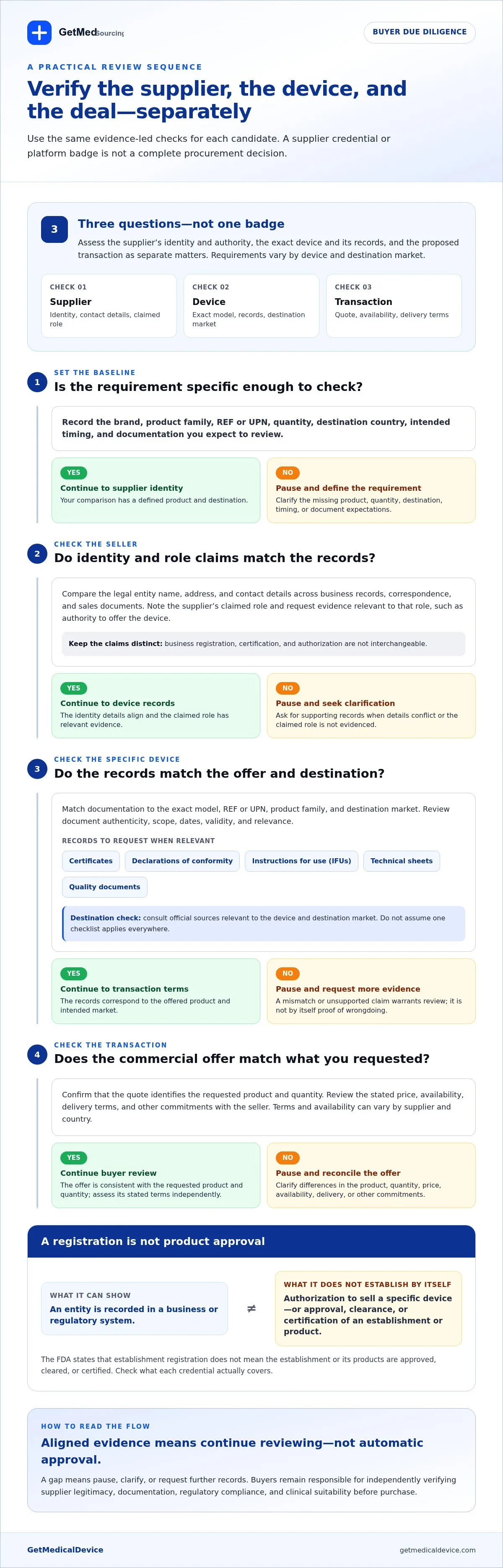
How to Verify a Medical Device Supplier Online: A Practical Review Sequence
Use the same documented sequence for each candidate supplier. A consistent process makes gaps easier to identify and offers easier to compare, without treating one credential as a complete procurement decision.
- Define the requirement. Record the brand, product family, REF or UPN, quantity, destination country, and intended timing. Specify the documentation you expect to review.
- Identify the supplier. Record the legal entity name and contact details, then compare them across business records, correspondence, and the offer. Note the role the supplier claims in the transaction.
- Check destination-market requirements. Consult official sources relevant to the product and destination. Record which sources you reviewed and route questions to the appropriate internal compliance or regulatory reviewer. Do not treat this review as a legal conclusion.
- Match product evidence. Request relevant instructions for use (IFUs), technical sheets, quality records, declarations, and registration information. Compare identifiers, entity names, dates, and market details with the exact offer.
- Document the decision. Log sources consulted, evidence received, discrepancies, and unresolved questions. Assign further review before advancing procurement, and record the buyer’s rationale and decision.
Build a product-specific verification file
Keep the request and supporting records together so each document can be traced to the relevant product and destination. If a record covers a product family but not the quoted REF or UPN, flag the gap rather than assuming it applies. Route unresolved documentation or compliance questions to the appropriate internal reviewer.
Assess the offer without assuming terms
Request written details for availability, lead time, minimum order quantity, shipping, and other commercial terms. Compare supplier responses using the same product identifiers, quantities, and destination details. Availability and terms can vary by supplier, country, stock status, and market conditions. Suppliers handle sales, invoices, delivery terms, and commercial commitments. An RFQ is not a purchase contract. The buyer retains final procurement, compliance, and clinical suitability decisions.
Use global medical device sourcing and procurement workflows to structure requirements and compare supplier responses. Include consistent product, quantity, destination, timing, and documentation details in an RFQ to support the process.
How GetMedicalDevice Supports Supplier Discovery Without Replacing Due Diligence
GetMedicalDevice supports B2B sourcing through a four-step process: capture the request, match supplier options, compare responses, and proceed with buyer control. Its verified supplier network provides access to suppliers from 80+ countries, supporting discovery across markets. This is a sourcing resource, not a guarantee of supplier approval, product suitability, availability, or a successful offer.
Use structured RFQs to organize supplier communication
A clear RFQ gives suppliers a consistent basis for responding. Include the details that identify the requirement and destination, so responses can be reviewed against the same specifications rather than interpreted from incomplete descriptions.
- Brand and product family
- REF or UPN and quantity
- Destination and intended timing
- Documentation expectations
Complete fields can reduce avoidable clarification exchanges, though suppliers may still need additional information. Responses can then be compared with the stated request. Availability, pricing, lead time, minimum order quantities, shipping options, and supplier terms vary by supplier, country, stock status, and market conditions. Submitting an RFQ does not guarantee an offer or create a purchase contract. Suppliers or sellers handle sales, invoices, delivery terms, and commercial commitments, which require separate agreement.
Keep final procurement decisions with the buyer
Use the platform to organize sourcing communication, not to replace due diligence. Before purchase, independently verify supplier legitimacy, documentation, regulatory compliance for the destination market, and clinical suitability. The buyer retains final procurement and compliance decisions. GetMedicalDevice describes buyer information handling as secure and confidential; this is not a legal certification.
To organize a product-specific request for supplier responses, submit a structured medical device RFQ.
Make Due Diligence Part of Every Procurement Decision
Supplier review is most effective as a documented procurement control, not a one-off check performed only when a concern appears. Establish who owns each review, what evidence must be retained, and which unresolved issues pause procurement. Revisit the records when the supplier, device, destination, or commercial offer changes. This creates a consistent basis for decisions across sourcing cycles.
Apply the same disciplined approach to how to verify online medical device suppliers, even when purchasing timelines are tight. Discovery can organize options, but it does not transfer the buyer’s responsibility to assess supplier legitimacy, documentation, regulatory compliance, and clinical suitability. Treat each response as input for review, and advance only when your organization has completed its checks and separately agreed commercial terms with the supplier.
Prepare your procurement requirements and use them to begin supplier conversations through GetMedicalDevice. Submit a structured medical device RFQ to give your team a clear, controlled next step.
Frequently Asked Questions
Does an FDA registration certificate prove that a medical device is approved?
No. The FDA does not issue establishment registration certificates, and establishment registration and device listing do not by themselves mean a device is approved, cleared, or authorized. If a seller provides a registration record, treat it as evidence about the establishment, not proof of the device’s status. Identify the exact device and consult official sources appropriate to its intended market. Record what you checked and when.
Does a verified supplier badge prove that an online medical device supplier is legitimate?
No. A badge can help with supplier discovery, but it does not settle whether an offer is appropriate for your procurement needs. When considering how to verify online medical device suppliers, distinguish the platform’s description of its review from your own assessment. Note what the badge claims to cover, then compare the supplier’s legal identity and role with the documents and product details for the specific offer.
What documents should I request from an online medical device supplier?
Request records relevant to the device, supplier role, and destination, such as applicable certificates, declarations of conformity, instructions for use, technical sheets, quality documents, labeling details, registration information, or supplier authorization documents. Ask for complete, legible copies. Check issue or revision details where shown, and note whether the records identify the same product and entity as the quote. Your organization must assess whether the evidence meets its requirements.
How can I check whether a medical device supplier is authorized to sell a product?
Start by identifying the supplier’s claimed role and the exact device, including the brand, product family, and REF or UPN where available. Request authorization evidence relevant to that role, product, and territory. Compare the named entity with the seller on the offer, and use official destination-market sources where appropriate. A marketplace profile or general company record alone does not establish product-specific authorization.
Does submitting a medical device RFQ commit me to buying?
No. An RFQ communicates a requirement and can support supplier responses, but it is not a purchase contract. The buyer and supplier must separately agree on commercial terms, including price, payment, delivery, and warranty. Keep the RFQ and any revised offers together so your team can track what was requested and proposed. Availability, lead time, minimum order quantities, shipping options, and terms vary.