

Selling medical equipment to a surgery center starts with matching the equipment to the facility’s procedures, purchasing process, and operational needs. To understand how to sell medical equipment to surgery centers, identify the decision-makers, prepare accurate product details and supporting records, and choose a sales channel that suits the equipment. Then agree on the terms and plan the handoff, including responsibility for transport.
A suitable product is only one part of a sale. Surgery centers need clear information about what the equipment does, its condition, and how it fits their clinical and operational requirements. A focused approach helps buyers assess the fit and gives sellers a practical route from first contact to an agreed transaction.
This guide covers how to research facility needs, choose between direct sales and other channels, prepare product information, and coordinate a transaction. It also explains how a medical-device sourcing platform can help suppliers present inventory and respond to procurement requests.
Key Takeaways
- Map the surgery center’s purchasing process and clinical priorities before starting outreach.
- Compare direct sales, marketplaces, brokers, and auctions based on the equipment and buyer you’re targeting.
- Use facility quality metrics and operational needs to make your product information relevant to decision-makers.
- Prepare accurate equipment records, disclose defects, and agree on transport responsibilities before completing the sale.
Table of Contents
- Sales calls and case support at surgery centers
- Online marketplaces, brokers, auctions, and direct sales
- Understanding facility quality performance and pain points
- Agreement and sale coordination
- GetMedicalDevice: Verified Supplier Membership
Sales calls and case support at surgery centers
A practical approach to how to sell medical equipment to surgery centers starts with the facility’s procedure mix and purchasing priorities. Ask whether the center is evaluating surgical instruments, anesthesia equipment, imaging systems, endoscopy equipment, or patient monitors. For a case scheduled at 7:30 AM, a representative may need to arrive at 6:15 AM to prepare equipment and coordinate with staff. A total hip replacement may require 60-90 minutes of support beside the surgeon, while an urgent request may arrive at 2 AM. Set clear case-support boundaries before discussing availability.
Prices and profit margins depend on equipment type, condition, age, service history, accessories, and buyer demand. To estimate your margin, account for acquisition and refurbishment costs, channel commissions, and payment-processing or bank fees. These factors determine the return on each sale.
Ambulatory surgery centers typically buy equipment aligned with their procedures, including surgical devices, anesthesia systems, imaging equipment, scopes, and monitoring equipment. Match the proposal to the center’s specialty and explain the device’s function, condition, and included components. According to the U.S. Food and Drug Administration, Class II medical devices, including many orthopedic implants, require 510(k) premarket notification.
Use a written sales agreement to record the device model, condition, included accessories, price, payment timing, delivery responsibilities, acceptance process, and any warranty or service terms. Describe known defects accurately and state how the parties will handle disputes, returns, or damage during transfer. Clear responsibilities help prevent misunderstandings and manage liability.
An invoice should include the seller’s and buyer’s details, item description, quantity, agreed price, payment instructions, and due date. Check it against the signed agreement before sending. Follow up after the initial call, technical review, procurement evaluation, and delivery. Record each contact and outstanding action to avoid duplicate requests and keep questions moving toward resolution. Tie every follow-up to a specific next step.
Online marketplaces, brokers, auctions, and direct sales
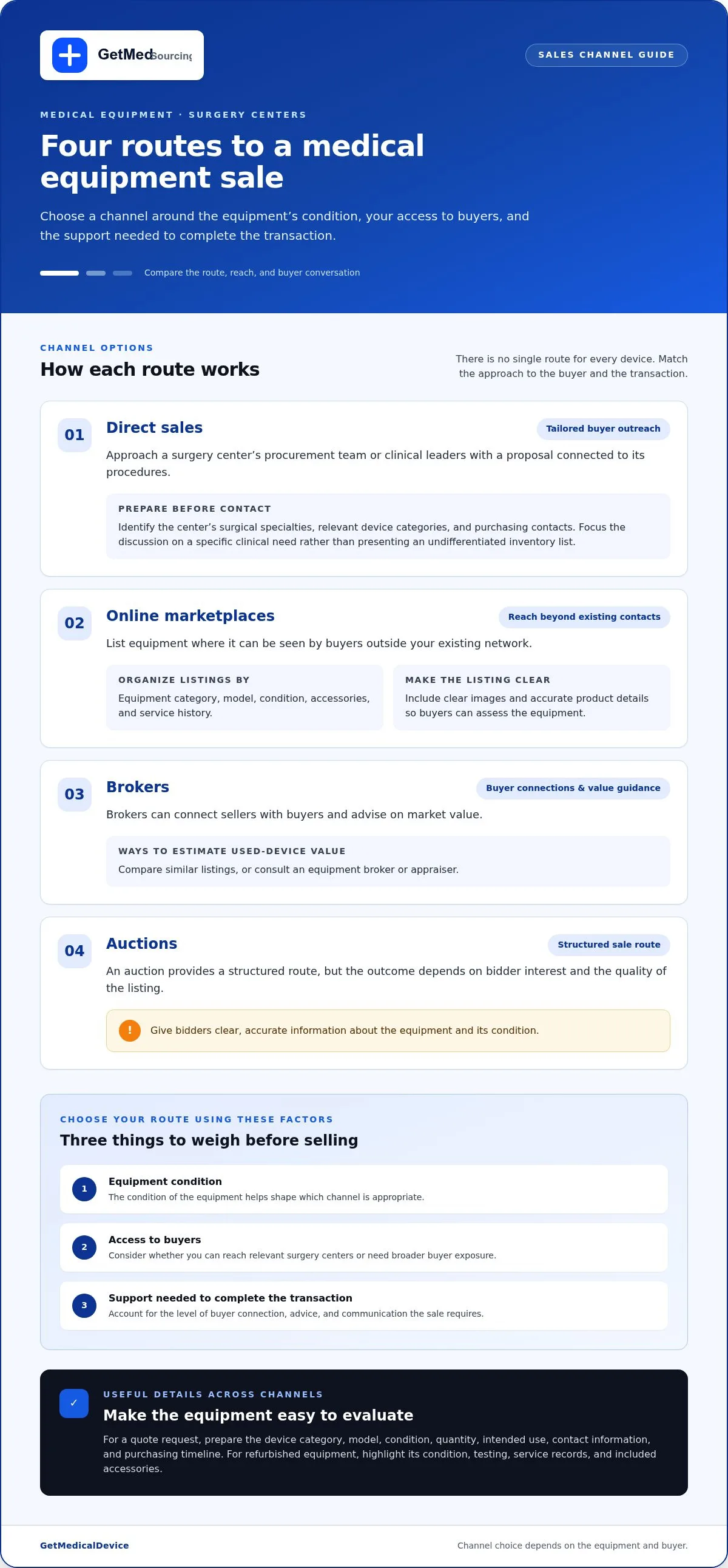
Choose a sales channel based on the equipment’s condition, your access to buyers, and the support needed to complete the transaction. Compare how much control, exposure, and buyer communication each option provides.
Direct Sales
Direct sales let you approach a surgery center’s procurement team or clinical leaders with a proposal tailored to its procedures. Before contacting them, identify the center’s surgical specialties, relevant device categories, and purchasing contacts. Established healthcare manufacturers like RIHA Industries, for instance, align their direct outreach with specific workflow challenges such as patient transfer and mobility. Use professional online communication or in-person meetings to build relationships with administrators and clinicians. A discussion focused on a specific surgical need is more useful than an undifferentiated inventory pitch.
Online marketplaces can put your equipment in front of buyers beyond your existing contacts. Organize listings by category and include the model, condition, accessories, service history, and clear images. Brokers and specialized distribution partners like Novus Medical can connect sellers with clinical buyers and advise on market demand. Estimate a used device’s value by comparing similar listings or consulting an equipment broker or appraiser. Auctions offer a structured sales route, but the outcome depends on bidder interest and the quality of the listing.
Relationships support every sales channel. Use professional networks and online outreach to find surgery-center administrators, procurement staff, and clinicians whose procedures match your equipment. At a meeting, focus on a relevant use case, such as imaging equipment for the center’s surgical specialty. Follow up with concise product information and a clear next step, not repeated general sales messages.
Quote Requests and Sales Strategies
Before calling about a quote, prepare the device category, model, condition, quantity, and intended use. An online request should include the same details, along with contact information and the purchasing timeline. For new equipment, emphasize intended use, specifications, and supporting product documentation. For refurbished equipment, lead with its condition, testing, service records, and included accessories so buyers can assess the details.
For either type, make the proposal specific to the center’s needs and invite a technical discussion about fit. Sellers comparing routes can review surgical product categories to understand how equipment listings are organized.
Understanding facility quality performance and pain points
To qualify as a vendor for an ambulatory surgery center, identify its procurement contact, complete the facility’s registration process, and submit the requested business and product documentation. Clarify the purchasing steps, evaluation criteria, and clinical contact responsible for reviewing the device. Follow the facility’s stated onboarding process, as requirements vary.
Before approaching an integrated delivery network, assess its physician and facility counts, facility types, and finances. An IDN may include ambulatory surgery centers, skilled nursing facilities, and other long-term care facilities, each with different purchasing priorities. For an operating-room device, identify which facilities perform relevant procedures and who controls purchasing across the network.
Quality indicators can reveal where a device may fit. Hospitals may consider 30-day readmission rates when evaluating device value and patient-care outcomes. They may also track HCAHPS patient satisfaction scores, hospital-acquired condition scores, and value-based purchasing reimbursement adjustments. CMS may impose financial penalties when hospitals’ total knee replacement complication rates exceed state or national averages. Use these measures as context, not as assumptions about every surgery center.
To locate relevant clinical contacts, use ICD-10 and CPT/HCPCS codes to identify high-volume procedures and physicians submitting claims at target hospitals. Then map those physicians to the facilities where they practice. A physician key opinion leader within an IDN can help refine clinical messaging and connect a seller with decision-makers. For network-wide proposals, identify the C-suite executive or vice president responsible for procurement alongside physician reviewers.
During a bid evaluation, surgery centers can compare device fit, clinical utility, documentation, operating requirements, and alignment with facility priorities. If a demonstration or trial is part of the evaluation, agree on the clinical tasks, staff workflow, setup, and performance criteria in advance. Record feedback from both users and procurement staff.
Keep your outreach specific: name the target procedure, relevant facility, and operational need. For example, connect a device proposal to a high-volume procedure identified through claims codes, then provide supporting evidence to the physician reviewer and procurement contact. This approach addresses clinical and purchasing concerns in the same discussion.
Agreement and sale coordination
After a surgery center approves a purchase, document the terms and assign each remaining action. A clear agreement gives both parties a shared record of the equipment, payment, condition, and transfer process.
Identify the equipment by manufacturer, model, serial number, and quantity. List included accessories, manuals, and service records. State the agreed price, payment schedule, invoice requirements, and when ownership transfers. If the center uses a purchase order, match the agreement and invoice to its purchasing reference to help avoid processing delays.
Disclose known defects before final approval. Describe the issue, its effect on operation, and any repair history, then record these details in the agreement or an attached condition report. For used equipment, provide available maintenance records, service logs, original purchase documents, and warranty or service-contract details. Securely remove patient and user information before resale to reduce privacy risks.
Plan the handoff with the center’s receiving contact. Confirm the delivery location, access instructions, receiving hours, and person responsible for accepting the equipment. If transport is arranged, provide accurate dimensions and weight and state which party is responsible for shipping. Logistics partners experienced with medical devices can support transport planning, but the agreement should still define responsibility for packing, transit, and receipt.
Before dispatch, check the equipment against the purchase order and signed agreement. Confirm that the model, accessories, documentation, and condition match the agreed terms. At delivery, record receipt and any visible damage, then share copies with the purchasing contact. Keep the signed agreement, invoice, condition report, and delivery record together in the transaction file. Accurate documentation gives hospitals and surgery centers a traceable record and helps establish trust with buyers.
As a practical next step, review medical device listings and match your equipment description to the buyer’s purchasing requirements.
GetMedicalDevice: Verified Supplier Membership
GetMedicalDevice provides a B2B platform for medical device suppliers seeking visibility with healthcare buyers, including surgery centers. Turn to the platform when you’re ready to present inventory or respond to procurement requests through an online channel.
GetMedicalDevice’s Verified Supplier Membership supports a supplier presence, while Premium Product Listings let suppliers showcase medical devices. Suppliers can use RFQ Response Credits to respond to procurement requests from hospitals, clinics, and international distributors. If your equipment matches a surgery center’s needs, present relevant product information and respond to a suitable request.
These offerings support product visibility and buyer-supplier connections. They don’t replace facility evaluation, sale agreements, or coordination of equipment delivery. To explore the platform and its supplier options, visit getmedicaldevice.com.
Move Your Next Sale Forward
When deciding how to sell medical equipment to surgery centers, consider where supplier visibility can support your commercial plan. Decide whether you want to present inventory, strengthen your supplier profile, or respond to procurement requests. Match that goal to a practical next step, then keep your product information and outreach focused on the buyers you want to reach.
GetMedicalDevice offers Verified Supplier Membership, Premium Product Listings, and RFQ Response Credits for medical device suppliers. These options support supplier visibility and participation in procurement opportunities through its B2B platform. Select the option that aligns with your current sales process and the type of buyer you’re seeking to reach.
Contact GetMedicalDevice to discuss a sale and determine how its supplier platform fits your next step. A clear commercial objective gives your outreach direction and helps you move forward with confidence.
Frequently Asked Questions
Who makes purchasing decisions at surgery centers, and how can sellers reach them?
Purchasing decisions commonly involve the center administrator, procurement staff, and clinicians who use the equipment. At an independently operated center, find out whether the administrator or an owner oversees purchasing. Send a concise introduction to the appropriate contact and ask for the facility’s process for submitting product information. A physician advocate can explain the clinical relevance, while procurement staff manage purchasing steps and documentation.
What FDA requirements apply when selling medical devices to surgery centers?
Requirements depend on device classification and the product’s regulatory pathway. According to the U.S. Food and Drug Administration, Class II medical devices, including many orthopedic implants, require 510(k) premarket notification. Sellers should identify the device’s classification and maintain applicable regulatory documentation for buyer review. A marketplace or sales channel does not replace the seller’s responsibility to establish the device’s regulatory status or the buyer’s independent review.
What insurance, credentialing, and compliance documents do surgery centers require from vendors?
Vendor onboarding may require a certificate of insurance, tax documentation, a completed registration form, and credentialing records for representatives entering clinical areas. A facility may also request training records, product documentation, or supplier authorization materials. Prepare consistent business details and current versions of each document. Keep access credentials and representative information separate from product files so procurement can route each item to the right reviewer.
How do GPO contracts and value analysis committees affect equipment sales to surgery centers?
Group purchasing organization contracts can affect which suppliers or products a facility can purchase under negotiated terms. A value analysis committee may review clinical rationale, product documentation, operational impact, and purchasing implications before recommending adoption. Ask whether the center routes purchases through a GPO and what evidence the committee needs. Addressing these processes early helps route your proposal to the right review team, not just an individual buyer.
What risks and legal issues should medical equipment vendors consider when selling to surgery centers?
Key risks include inaccurate condition descriptions, unresolved recalls, incomplete records, and patient or user data left on used equipment. Disclose defects in writing, securely remove stored information, and check whether the equipment appears on FDA recall lists. Some used devices may require recertification before sale. Keep sales documentation accurate and account for applicable FDA requirements and local healthcare laws. Clear records help reduce transaction disputes.
What are typical prices and profit margins for medical equipment sold to surgery centers?
Prices and profit margins depend on equipment type, condition, age, service history, accessories, and buyer demand. Calculate your margin after accounting for acquisition and refurbishment costs, channel commissions, and payment-processing or bank fees.
