

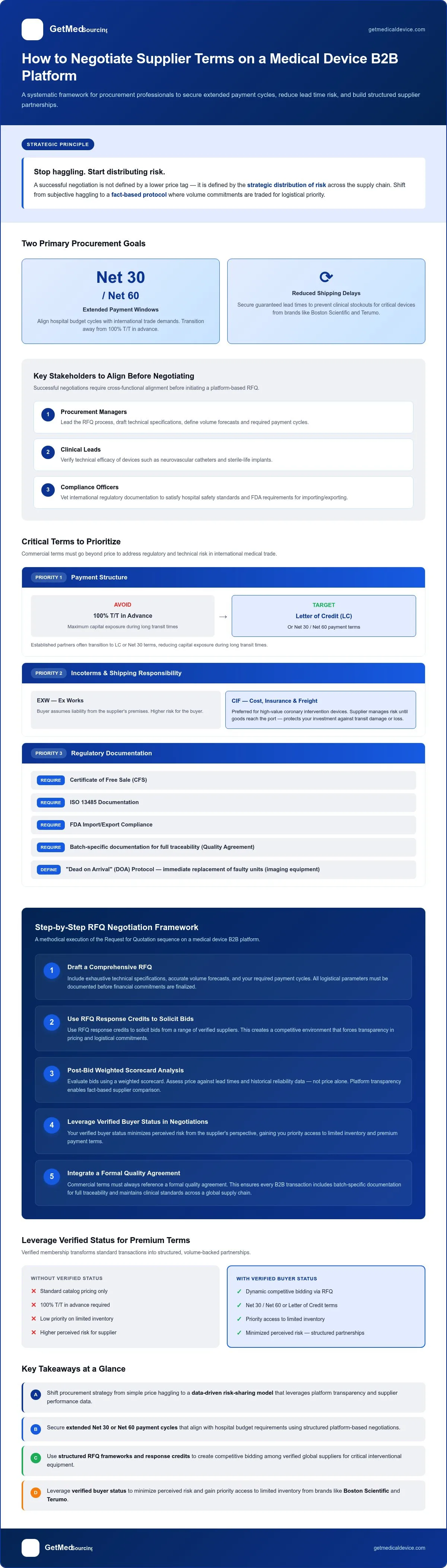
In the high-stakes sector of interventional radiology and surgical equipment, a successful negotiation isn't defined by a lower price tag; it's defined by the strategic distribution of risk across the supply chain. Understanding how to negotiate supplier terms on a medical device B2B platform is essential for procurement professionals who face the friction of aligning rigid hospital budget cycles with the immediate financial demands of international trade. You likely understand the pressure of securing critical supplies from brands like Boston Scientific or Terumo while managing significant capital exposure and lead time uncertainty.
This guide provides a systematic framework for mastering these negotiations to achieve Net 30 or Net 60 payment windows and reduced shipping delays. We'll examine how to leverage credit-based RFQ systems and verified memberships to transform standard transactions into structured, volume-backed partnerships. By following these logistical protocols, you can secure the authenticity and efficiency required for high-value medical device procurement.
Key Takeaways
- Shift your procurement strategy from simple price haggling to a data-driven risk-sharing model that leverages platform transparency and supplier performance data.
- Learn how to negotiate supplier terms on a medical device B2B platform to secure extended Net 30 or Net 60 payment cycles that align with hospital budget requirements.
- Utilize structured RFQ frameworks and response credits to create a competitive bidding environment among verified global suppliers for critical interventional equipment.
- Leverage your verified buyer status to minimize perceived risk and gain priority access to limited inventory from leading brands like Boston Scientific and Terumo.
Table of Contents
- Understanding the Architecture of Medical B2B Negotiations
- Critical Terms to Prioritize in International Medical Trade
- A Step-by-Step Framework for Negotiating via RFQ Platforms
- Leveraging Verified Status to Secure Premium Terms
Understanding the Architecture of Medical B2B Negotiations
Supplier terms in medical B2B environments represent a technical matrix of payment schedules, lead times, regulatory documentation, and Incoterms. While legacy procurement relied on opaque relationships, learning how to negotiate supplier terms on a medical device B2B platform allows for the utilization of verified performance data to drive specific outcomes. This transparency transforms negotiation from subjective haggling into a fact-based protocol where volume commitments are traded for logistical priority. Before beginning, procurement teams should explore our range of surgical products to identify the precise technical specifications required for an accurate bid.
The Request for Quotation (RFQ) process serves as the primary mechanism for this transition. It moves the interaction from static catalog pricing toward dynamic bidding for high-value interventional cardiology or surgical inventory. This systematic approach ensures that all logistical parameters are documented before financial commitments are finalized.
The High Stakes of Medical Procurement
High-value devices such as neurovascular catheters or sterile-life implants demand more rigorous oversight than general commodities. These products require strict adherence to the Global Medical Device Sourcing and Procurement framework to ensure regulatory alignment. Securing specific lead time guarantees for these items is critical, as delays directly impact clinical outcomes in interventional settings.
Key Stakeholders in the Negotiation Process
Successful negotiations require cross-functional alignment before initiating a platform-based RFQ. Procurement managers must coordinate with clinical leads to verify technical efficacy and compliance officers to vet international regulatory documentation. Aligning these internal entities ensures that once a team masters how to negotiate supplier terms on a medical device B2B platform, the resulting contract satisfies both hospital budget cycles and safety standards.
Critical Terms to Prioritize in International Medical Trade
In international medical procurement, commercial terms must go beyond price to address regulatory and technical risk. When determining how to negotiate supplier terms on a medical device B2B platform, payment structure is the primary lever. While many suppliers request 100% T/T in advance, established partners often transition to Letters of Credit (LC) or Net 30 terms. This shift reduces your capital exposure during long transit times. You can review verified supplier profiles to identify partners capable of supporting these professional payment frameworks.
Logistical commitments are equally vital. Negotiating guaranteed lead times for inventory from brands like Boston Scientific prevents clinical stockouts. Precise terms must explicitly require the provision of Certificates of Free Sale (CFS) and ISO 13485 documentation. Compliance with FDA regulatory requirements for importing and exporting medical devices ensures that equipment isn't detained at customs. For sensitive imaging equipment, define "Dead on Arrival" (DOA) protocols to mandate immediate replacement of faulty units.
Incoterms and Shipping Responsibilities
Choosing between EXW (Ex Works) and CIF (Cost, Insurance, and Freight) determines where your liability begins. For high-value coronary intervention devices, CIF is often preferred because the supplier manages the risk until the goods reach the port. This protects your investment against transit damage or loss.
Quality Agreement Integration
Commercial terms should always reference a formal quality agreement. This ensures that every B2B transaction includes batch-specific documentation for full traceability. Negotiating these technical requirements upfront is a key part of how to negotiate supplier terms on a medical device B2B platform effectively. It's the only way to maintain clinical standards across a global supply chain.
A Step-by-Step Framework for Negotiating via RFQ Platforms
Mastering how to negotiate supplier terms on a medical device B2B platform requires a methodical execution of the Request for Quotation (RFQ) sequence. The process begins with documentation. You must draft an RFQ that includes exhaustive technical specifications, accurate volume forecasts, and your required payment cycles. Once the requirements are defined, use RFQ response credits to solicit bids from a range of verified suppliers. This creates a competitive environment that forces transparency in pricing and logistical commitments.
Post-bid analysis is the next critical phase. Utilize a weighted scorecard to evaluate price against lead times and historical reliability data. If the initial responses don't meet your budgetary or clinical constraints, consider a bundling strategy. Linking high-volume vascular access consumables with complex interventional radiology tools often provides the leverage needed to secure extended Net 45 or Net 60 payment windows.
Leveraging Volume for Better Pricing
Annual volume commitments are a primary tool for reducing costs. Implementing a "Blanket Order" strategy allows you to commit to a large quantity while negotiating staggered delivery schedules. This approach secures lower unit pricing while ensuring that payments are only triggered upon the dispatch of specific batches, aligning the procurement cycle with actual clinical consumption.
Managing the Dialogue on B2B Portals
Digital negotiation requires clinical precision. Maintain a professional audit trail by keeping all discussions within the platform’s messaging infrastructure. Avoid ambiguity in your counter-offers. A professional example of a utilitarian counter-offer is: "We will authorize a 12-month volume commitment of 2,500 catheters provided the lead time is guaranteed at 14 days and the payment terms are Net 30."
Start your professional RFQ today to connect with verified suppliers and optimize your procurement terms.
Leveraging Verified Status to Secure Premium Terms
Negotiation power on a digital marketplace is fundamentally tied to the credibility of the participants. Understanding how to negotiate supplier terms on a medical device B2B platform requires recognizing that suppliers offer their most favorable terms to buyers they perceive as low-risk entities. The Verified Medical Device Suppliers status serves as a professional credential that reduces friction during the initial onboarding process. When a supplier identifies a verified badge, they're more likely to bypass standard 100% advance payment requirements in favor of flexible credit terms that support your hospital's budget cycle.
Risk Mitigation Through Platform Verification
The platform’s verification process functions as a pre-negotiation due diligence phase. It validates the commercial legitimacy and regulatory standing of both parties before a single message is exchanged. This verification is often the deciding factor in securing open-account payment terms. Suppliers are willing to extend Net 30 or Net 60 windows because the platform has already mitigated the primary risks of identity or financial fraud, creating a stable environment for high-value trade.
Accessing Premium Inventory Listings
Verified status yields a "Trust Dividend," granting priority access to limited stock from manufacturers like Terumo. High-demand interventional tools are often reserved for buyers with high platform ratings and a consistent response history. These premium listings frequently come with pre-negotiated baseline terms. Identifying "Verified" badges should be your first step in supplier selection to ensure you're engaging with partners who value systematic workflows and clinical accuracy.
Using your historical fulfillment data as leverage is a critical final step in how to negotiate supplier terms on a medical device B2B platform. A documented history of prompt payments and clear communication allows you to demand faster lead times and lower unit costs. Secure your competitive advantage by applying for Verified Supplier Membership today.
Optimizing Your Procurement Infrastructure for Scalable Growth
Effective procurement in the medical sector requires moving beyond transactional price points toward a structured risk-sharing model. By mastering how to negotiate supplier terms on a medical device B2B platform, you transform procurement from a logistical hurdle into a strategic competitive advantage. You've learned to prioritize Net 30 or Net 60 payment terms, integrate formal quality agreements, and utilize the "Trust Dividend" provided by platform verification. These protocols ensure that your supply chain remains resilient even during periods of high clinical demand or global inventory fluctuations.
Implementing these strategies requires a digital infrastructure built on transparency and verified data. GetMedicalDevice provides the necessary framework to execute high-stakes negotiations with confidence. You can Access Premium Medical Device Listings and Verified Suppliers to secure direct access to inventory from industry leaders like Boston Scientific, Terumo, and Abbott Vascular. Our Verified Supplier Membership ensures supply chain integrity, allowing you to focus on clinical excellence rather than logistical uncertainty. Professionalizing your negotiation framework is the most reliable path to securing the favorable terms your organization requires.
Frequently Asked Questions
What are the most common payment terms for international medical device trade?
Common payment terms in international medical trade range from 100% T/T (Telegraphic Transfer) in advance for initial transactions to Net 30 or Net 60 days for established partnerships. Secure platforms facilitate these transitions by providing verified history. Understanding how to negotiate supplier terms on a medical device B2B platform involves leveraging your platform status to move away from upfront payments toward credit-based cycles that align with hospital reimbursement schedules.
How can I verify if a medical device supplier on a B2B platform is legitimate?
Verification of a supplier’s legitimacy is achieved by reviewing their platform-specific credentials and regulatory certifications. On GetMedicalDevice, look for the Verified Supplier Membership badge, which indicates a professional vetting process has been completed. You should also request current ISO 13485 documentation and verify their response history through the credit-based RFQ system. Consistent platform activity and transparent documentation are primary indicators of a reliable and authentic medical device supplier.
Can I negotiate lead times for high-demand products like coronary stents?
Negotiating lead times for high-demand inventory like coronary stents is possible through annual volume commitments or blanket orders. Suppliers prioritize verified buyers who provide clear forecasting data. Providing a predictable procurement schedule reduces the supplier's inventory risk, often resulting in guaranteed dispatch windows. Mastering how to negotiate supplier terms on a medical device B2B platform requires trading this predictability for reduced shipping delays and priority stock access from leading global brands.
What should be included in a medical device B2B Request for Quote (RFQ)?
A professional medical device RFQ must include exhaustive technical specifications, target volumes, and desired payment schedules. You should explicitly list required regulatory documents, such as Certificates of Free Sale or FDA clearances. Including specific Incoterms and packaging requirements for sterile-life products ensures that all logistical costs are accounted for in the initial bid. This structured approach allows suppliers to provide precise, binding quotes through the platform’s credit-based bidding system.
How do I handle shipping and Incoterms when buying medical devices online?
Handling shipping involves selecting the appropriate Incoterm to define the point of risk transfer between the buyer and supplier. For high-value interventional equipment, CIF (Cost, Insurance, and Freight) is often preferred as the supplier manages transit risk until the goods reach your port. Alternatively, EXW (Ex Works) provides you with full control over the logistics chain. Ensure these terms are clearly documented within the platform's messaging system to maintain a professional audit trail.


