
A reliable medical device forecast starts with actual demand, then adjusts for the factors that can change future use. To understand how to forecast medical device demand, combine historical sales or usage with procedure volumes, customer inventory, product changes, and expected purchasing activity. The method should match the data available and the planning horizon.
Past orders provide a useful baseline, but they can misrepresent demand when customers have accumulated inventory, purchasing patterns have shifted, or a product is newly introduced. Separate underlying use from one-off orders to build a forecast that better supports procurement and inventory decisions.
This article explains how to choose a forecasting method, organize inputs, and test assumptions against different demand scenarios. It also covers updating forecasts as sales and market information changes, so planning reflects current conditions rather than a single historical trend.
Key Takeaways
- Choose a forecasting method that matches your product’s sales history, demand pattern, and planning horizon.
- Separate repeat demand from unusual orders to build a more dependable baseline for procurement decisions.
- Combine usage and purchasing signals, then revise assumptions as customer activity and market conditions change.
- Verified Supplier Membership, Premium Product Listings, and RFQ Response Credits support suppliers seeking visibility and procurement opportunities.
Table of Contents
How to forecast medical device demand
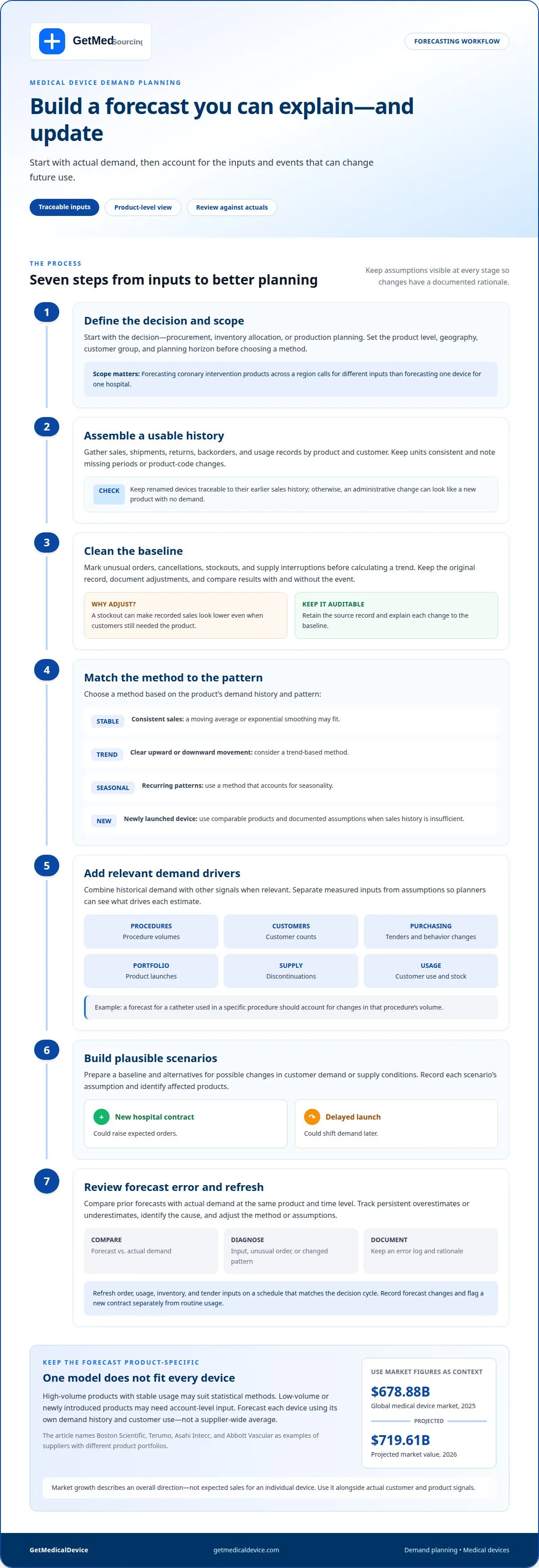
Start with a defined decision, such as procurement, inventory allocation, or production planning. Set the product level, geography, customer group, and planning horizon before choosing a method. Forecasting coronary intervention products across a region requires different inputs from forecasting one device for one hospital. A consistent scope also makes later comparisons meaningful.
Where possible, use actual consumption rather than treating every shipment as final demand. Distributor orders may reflect inventory build-up, delayed purchasing, or a one-time contract. Compare orders with customer usage and available stock to distinguish recurring demand from a temporary purchasing event, and avoid carrying a one-off spike into future estimates.
- Assemble a usable history. Gather sales, shipments, returns, backorders, and usage records by product and customer. Keep units consistent, and note missing periods or product-code changes. A device renamed after a catalogue update should remain traceable to its earlier sales history. Otherwise, the forecast may treat an administrative change as a new product with no demand.
- Clean the baseline. Mark unusual orders, cancellations, stockouts, and supply interruptions before calculating a trend. A stockout can make recorded sales look like demand fell, even when customers still needed the product. Keep the original record, document the adjustment, and compare results with and without the event. This creates an auditable basis for planning decisions.
- Match the method to the pattern. A stable product with consistent sales may suit a moving average or exponential smoothing. A product with a clear upward or downward trend may need a trend-based method. Seasonal products require a method that accounts for recurring patterns. For a newly launched device, historical sales may be insufficient, so use comparable products and documented assumptions-whether planning clinical instruments or emerging consumer wellness devices such as those from meetpureone.com.
- Add causal inputs. Historical demand is only one input. Include procedure volumes, customer counts, tenders, product launches, discontinuations, and changes in purchasing behavior when relevant. For example, a forecast for a catheter used in a specific procedure should account for changes in that procedure’s volume. Separate measured inputs from assumptions so planners can see what drives each estimate.
- Build scenarios. Prepare a baseline forecast and alternatives for plausible changes in customer demand or supply conditions. A new hospital contract could raise expected orders, while a delayed launch could shift demand later. Record the assumption behind each scenario and identify which products would be affected. Scenario planning shows where procurement decisions depend on uncertain inputs.
- Review forecast error. Compare prior forecasts with actual demand at the same product and time level. Track consistent overestimates and underestimates, then identify whether the cause was a poor input, an unusual order, or a changed demand pattern. Use the findings to adjust the method or assumptions. Keep an error log so revisions have a documented rationale.
Segment products instead of applying one model to every device. High-volume products with stable usage may suit statistical methods, while low-volume or newly introduced products may require account-level input. Boston Scientific, Terumo, Asahi Intecc, and Abbott Vascular have different product portfolios; forecast each device using its own demand history and customer use rather than a supplier-wide average.
Market growth can provide context, but it cannot replace product-level evidence. The global medical device market was valued at $678.88 billion in 2025 and is projected to reach $719.61 billion in 2026. These market figures describe an overall direction, not the expected sales of an individual device. Use them as context alongside actual customer and product signals.
Set a review schedule that matches the decision cycle. At each review, refresh order, usage, inventory, and tender inputs, then record forecast changes. A procurement team, for example, can flag a new contract separately from routine usage. This keeps the baseline clear and helps planners respond to new evidence instead of revising estimates without a stated reason.
A practical process for how to forecast medical device demand uses traceable inputs: define the scope, establish a clean baseline, select a suitable method, add relevant drivers, and compare estimates with actuals. Keep assumptions visible at each stage. This helps procurement teams distinguish a market shift from a one-off order and focus planning on the products most affected.
GetMedicalDevice: Verified Supplier Membership
GetMedicalDevice connects medical device suppliers with buyers through its B2B platform. After translating a demand forecast into inventory and sales priorities, suppliers can use a Verified Supplier Membership to present their business to a global buyer network. Premium Product Listings provide a way to showcase available medical devices, while RFQ Response Credits let suppliers respond to procurement requests from hospitals, clinics, and international distributors.
For suppliers aligning product visibility and RFQ activity with forecast demand, GetMedicalDevice provides a platform to present products and engage with procurement requests. A forecast remains an internal planning tool; the platform offers a channel for supplier listings and buyer enquiries. Explore GetMedicalDevice’s supplier membership, product listings, and RFQ response options.
Turn Your Forecast Into a Planning Routine
Make the forecast useful by connecting it to specific decisions. Assign responsibility for updating inputs, set triggers to review material changes, and record the reason for each adjustment. A major order or shift in customer purchasing, for example, can prompt a review before the next scheduled planning cycle. This keeps the forecast tied to operational decisions rather than leaving it as a static estimate.
Teams refining how to forecast medical device demand can include supplier visibility and buyer enquiries in commercial planning. GetMedicalDevice gives suppliers a platform to present medical devices and respond to procurement requests. When your next step is reaching buyers, explore Verified Supplier Membership, premium product listings, and RFQ response credits.
Contact GetMedicalDevice today to explore the platform as you put your demand plan into action.