
The implementation of the FDA Quality Management System Regulation (QMSR) on February 2, 2026, has fundamentally altered the compliance landscape for every Boston Scientific medical device distributor. Procurement teams now face a more rigorous verification environment where the harmonization with ISO 13485:2016 standards is no longer optional but a critical operational requirement. You likely recognize that the complexity of global supply chains often obscures the path to verified equipment, leading to high-stakes risks regarding supplier authenticity and regulatory alignment. This guide provides a definitive roadmap to navigate these networks and secure authentic interventional and surgical equipment with clinical precision. We will examine the specific protocols for supplier verification, the impact of the new 138 million dollar Indiana distribution facility, and how to utilize B2B marketplaces to maintain inventory agility. This systematic approach ensures your facility meets the latest regulatory standards while avoiding the logistical friction common in high-value medical procurement. By following this framework, you'll gain access to a global network of verified inventory through a structured and reliable procurement workflow.
Key Takeaways
- Identify specific therapeutic infrastructure requirements to ensure clinical alignment with regional distribution hubs across cardiology and endoscopy sectors.
- Confirm the authenticity of any Boston Scientific medical device distributor by following a systematic cross-referencing protocol between official manufacturer directories and local regulatory bodies.
- Establish selection criteria based on objective data points, including current ISO 13485 compliance and the supplier's ability to maintain a consistent stock of high-stakes consumables.
- Streamline the procurement process by implementing a standardized Request for Quote (RFQ) workflow that accounts for the technical complexities of interventional devices.
- Utilize verified supplier memberships to establish a reliable and transparent bridge between procurement departments and authorized global distribution networks.
Table of Contents
- Understanding the Boston Scientific Global Distribution Infrastructure
- How to Identify and Verify Official Boston Scientific Channels
- Key Selection Criteria for Interventional Device Suppliers
- Managing the Procurement Lifecycle for Specialized Medical Equipment
- Optimizing Your Supply Chain with GetMedicalDevice Verified Memberships
Understanding the Boston Scientific Global Distribution Infrastructure
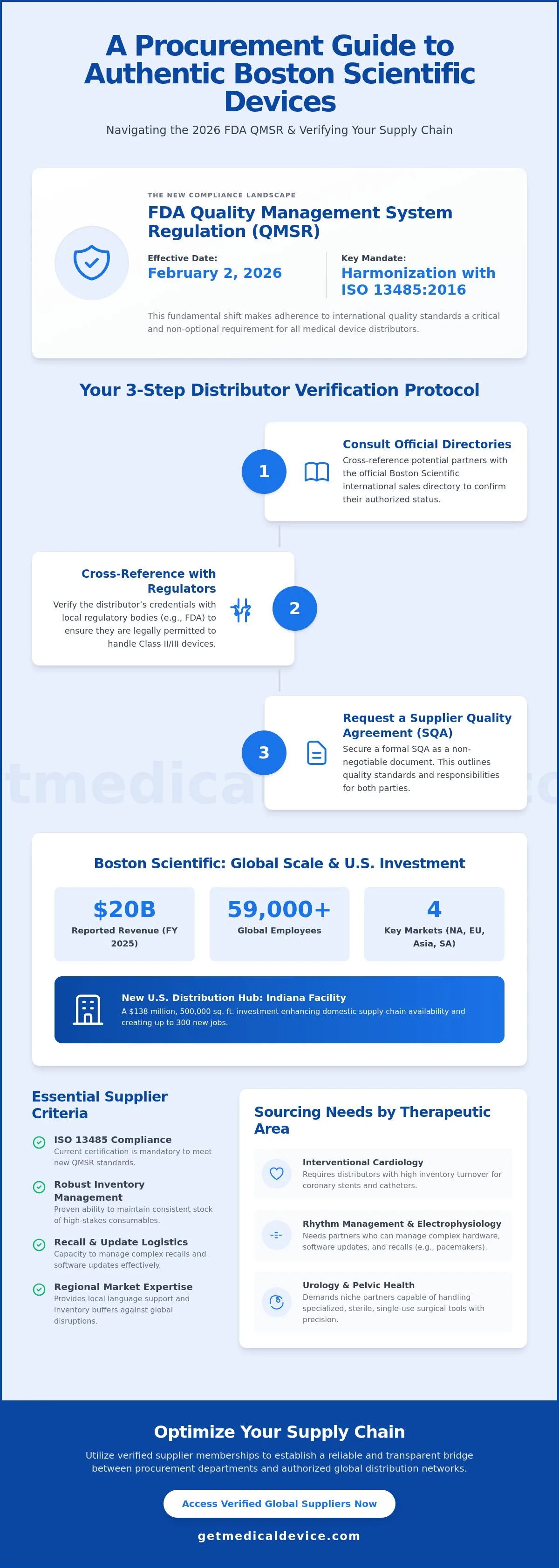
The global infrastructure of Boston Scientific represents a multi-faceted logistical network designed to support high-stakes medical interventions. With reported revenues reaching $20 billion in fiscal year 2025, the organization relies on a workforce of over 59,000 employees to maintain its market position across North America, Europe, Asia, and South America. For a detailed Boston Scientific corporate overview, one can examine their history of expansion into complex therapeutic sectors. A specialized Boston Scientific medical device distributor acts as the primary conduit between this massive manufacturing entity and localized healthcare facilities.
Direct procurement from the manufacturer is often reserved for high-volume hospital systems. Smaller clinics and providers in emerging markets frequently encounter barriers such as minimum order requirements and complex credit terms. Authorized distributors bridge this gap by offering flexible procurement cycles and localized logistics. In 2026, the company's commitment to U.S. distribution is evidenced by the groundbreaking of a $138 million, 500,000-square-foot facility in Indiana. This site enhances the availability of interventional and surgical equipment across the domestic supply chain while creating up to 300 new jobs.
Core Therapeutic Portfolios and Distribution Needs
Sourcing requirements vary significantly across therapeutic areas. Interventional Cardiology requires a consistent supply of coronary stents and catheters, necessitating a distributor with high inventory turnover. Rhythm Management and Electrophysiology involve more complex hardware, such as pacemakers. Recent 2026 Class I recalls for ACCOLADE pacemakers highlight the need for a Boston Scientific medical device distributor that can manage software updates and recall logistics effectively. Urology and pelvic health portfolios require niche partners capable of handling specialized surgical tools and sterile single-use devices with precision.
The Importance of Regional Market Expertise
Local distributors are essential for navigating the regulatory shifts of 2026. The FDA's adoption of the Quality Management System Regulation (QMSR) on February 2, 2026, aligns U.S. standards with ISO 13485:2016. A regional partner ensures that all imported devices meet these harmonized requirements. Beyond compliance, these partners provide technical support in the local language, which is vital for the correct implementation of complex devices. They also maintain inventory buffers that protect healthcare providers from global supply chain disruptions or shipping delays that might otherwise compromise patient care.
How to Identify and Verify Official Boston Scientific Channels
Verification isn't a mere administrative hurdle; it's a critical safety protocol. Identifying a legitimate Boston Scientific medical device distributor requires a multi-layered validation process to ensure the integrity of the clinical supply chain. Organizations must move beyond surface-level searches and adopt a structured approach to supplier qualification. Integrating these steps into your procurement workflow promotes Smarter Healthcare Supply Chain Management, reducing the risk of logistical failures and patient safety incidents.
The following systematic steps establish a reliable verification framework:
- Consult the Official Directory: Start by cross-referencing any potential partner with the Boston Scientific international sales directory. This confirms the supplier's standing within the manufacturer's authorized network.
- Regulatory Cross-Referencing: Verify that the distributor's credentials align with local healthcare regulatory bodies, such as the FDA or relevant national health ministries. This ensures the partner is legally permitted to handle Class II and Class III medical devices.
- Request a Supplier Quality Agreement (SQA): A formal SQA outlines the quality standards and responsibilities of both parties. It's a non-negotiable document for high-stakes procurement.
- Confirm Product-Specific Authorization: Authorization is often segmented. A distributor might be authorized for coronary stents but not for the Watchman device. Always request proof of authorization for the specific product lines required by your facility.
Red Flags in Medical Device Sourcing
Procurement officers must remain vigilant for anomalies that indicate substandard or counterfeit operations. Incomplete regulatory documentation or expired ISO 13485 certifications are primary indicators of risk. Pricing that falls significantly below global market averages for high-precision devices often suggests gray-market sourcing or compromised equipment. Additionally, a lack of transparency regarding the device's pedigree, or its documented chain of custody, should result in immediate disqualification of the supplier.
Utilizing Digital Verification Tools
Modern B2B marketplaces have streamlined the vetting process by providing pre-qualified data on global suppliers. Utilizing a Verified Supplier Membership allows procurement officers to bypass initial vetting stages by accessing a database of partners who have already cleared rigorous documentation checks. These platforms provide RFQ response data that helps teams gauge a supplier's technical knowledge and responsiveness. Premium product listings further enhance efficiency by confirming real-time inventory availability, ensuring that critical interventional tools are accessible when clinical timelines are tight.
Key Selection Criteria for Interventional Device Suppliers
Selecting a Boston Scientific medical device distributor requires a rigorous evaluation of technical and operational benchmarks. Beyond basic authorization, the distributor's ability to maintain clinical continuity is paramount. This selection process should prioritize partners who demonstrate a deep understanding of the regulatory landscape, especially following the FDA's transition to the Quality Management System Regulation (QMSR) on February 2, 2026. This change emphasizes the integration of ISO 13485:2016 standards across the entire supply chain, making the distributor's compliance history a primary indicator of reliability.
Key criteria for selection of a Boston Scientific medical device distributor include:
- Inventory Depth: A distributor must prove their capacity to maintain a consistent stock of interventional cardiology consumables, such as coronary stents and catheters, to avoid clinical backorders.
- Technical Support: The availability of certified clinical specialists is essential for device training and troubleshooting during complex procedures, ensuring medical staff can utilize equipment with precision.
- Logistical Efficiency: Specialized surgical products often require sophisticated cold chain capabilities to maintain sterile integrity and temperature stability during transit.
- Financial Stability: A verified track record in global B2B medical trade ensures the supplier can handle high-value transactions and maintain steady operations without liquidity disruptions.
Regulatory and Quality Documentation
A reliable partner must provide transparent access to FDA 510(k) Premarket Notification Clearances for every device in their portfolio. This documentation confirms the regulatory status of devices intended for the U.S. market and serves as the baseline for quality assurance. Additionally, the distributor's Quality Management System (QMS) must align with global standards, including the California Transparency in Supply Chain Act and similar international frameworks. This level of documentation mitigates the risk of non-compliance during internal or external facility audits, protecting the institution from legal and clinical liabilities.
Service Level Agreements (SLAs) for Procurement
SLAs must define precise lead times for critical equipment to prevent delays in surgical schedules. Given that Boston Scientific is investing 138 million dollars in a new Indiana distribution facility in 2026, domestic lead times are expected to stabilize. However, your agreement should still specify return policies for non-conforming goods and establish clear protocols for post-market surveillance. Efficient recall management coordination is vital, particularly when addressing software updates for devices like pacemakers. A structured SLA ensures that the distributor remains accountable for the device's performance and safety throughout its lifecycle.
Managing the Procurement Lifecycle for Specialized Medical Equipment
Efficient procurement of specialized interventional tools requires a systematic transition from technical identification to commercial acquisition. A procurement officer must distinguish between high-volume consumables, such as coronary stents, and complex implants like the Watchman device. Each category demands specific logistical and clinical support from a Boston Scientific medical device distributor. Precision at this stage prevents the acquisition of non-conforming equipment and ensures that clinical timelines remain intact.
When evaluating potential partners, price should not be the sole determining factor. Total Cost of Ownership (TCO) provides a more accurate financial metric for high-stakes medical devices. This calculation includes the unit price, shipping costs under Incoterms 2026, and the overhead associated with regulatory documentation. It also accounts for the technical support provided by the supplier. High-stakes cardiovascular equipment requires a distributor capable of managing complex delivery schedules and providing proof of authenticity for every SKU. Finalizing a procurement contract involves establishing clear delivery milestones and verifying that the supplier's quality management system aligns with the latest FDA standards.
The RFQ Process: Best Practices for Procurement Officers
Writing a precise Request for Quote (RFQ) is the foundation of a successful procurement cycle. Every RFQ must include specific SKUs, exact quantities, and required certifications to minimize ambiguity. Procurement teams can utilize RFQ Response Credits to solicit bids from a pre-vetted pool of international medical device distributors. This approach allows for a direct comparison of response times and technical accuracy. A supplier's ability to provide detailed specifications and compliance data within the initial bid is a strong indicator of their operational competence.
Logistics and International Trade Parameters
Logistics for cardiovascular equipment involve more than simple transport. Understanding Incoterms 2026 is essential for defining the point where risk and responsibility transfer from the distributor to the buyer. Managing customs clearance for specialized equipment requires detailed documentation, including the device's pedigree and regulatory clearances. Tracking shipments in real-time is no longer an optional feature; it's a necessity for ensuring that surgical schedules are not disrupted by unforeseen delays. Regional partners often mitigate these risks by maintaining local inventory, which is particularly beneficial given the ongoing expansion of distribution hubs in 2026.
Optimizing Your Supply Chain with GetMedicalDevice Verified Memberships
The complexity of global medical trade requires a structured intermediary to ensure that procurement workflows remain efficient and compliant. GetMedicalDevice operates as a specialized bridge between high-volume buyers and any authorized Boston Scientific medical device distributor. By providing a centralized framework for transaction data and supplier credentials, the platform reduces the administrative burden typically associated with verifying international distributors. This systematic approach ensures that clinical facilities can secure critical interventional tools without the risks inherent in unverified sourcing channels.
Trust in the B2B marketplace is established through rigorous documentation and transparent processes. A Verified Supplier Membership serves as a primary filter, indicating that a distributor has cleared essential regulatory and operational checks. This status provides procurement officers with the confidence that the equipment, whether it's a coronary stent or a heart valve, follows a documented chain of custody. Accessing Premium Product Listings for major manufacturers like Asahi Intecc, Abbott Vascular, and Boston Scientific allows teams to view verified inventory levels in real-time, facilitating faster decision-making for time-sensitive surgical requirements.
The platform's credit-based RFQ system is designed to eliminate sourcing friction. Instead of manual outreach to multiple disparate entities, procurement teams use RFQ Response Credits to broadcast technical requirements to a pre-vetted pool of suppliers. This methodical process ensures that every bid received is technically accurate and backed by a legitimate Boston Scientific medical device distributor, allowing for a direct comparison of total cost of ownership and logistical capacity.
Leveraging the Verified Supplier Network
Verified status significantly increases the visibility of medical device inventories within a clinical-grade platform. Global buyers utilize this structured marketplace to identify suppliers capable of meeting specific therapeutic needs, such as urology or rhythm management. This centralized ecosystem allows for the efficient management of interventional and surgical equipment across borders, ensuring that regional supply chain disruptions don't compromise patient care. By standardizing the way inventory is presented and verified, the platform creates a stable environment for high-value medical procurement.
Next Steps for Medical Device Procurement
Beginning your sourcing journey requires the creation of a detailed buyer profile to establish your facility's specific requirements. This profile allows the platform to match your needs with the most relevant authorized distributors. To maximize ROI, procurement officers should utilize RFQ response credits for high-value tenders, ensuring that competitive bids are obtained from suppliers with a proven track record of regulatory compliance. This structured approach to procurement minimizes delays and guarantees the acquisition of authentic medical equipment. Access our network of verified Boston Scientific distributors today to secure your facility's interventional and surgical supply chain for 2026.
Standardizing Your Medical Procurement Strategy
Securing a reliable supply chain in 2026 requires systematic adherence to the FDA's Quality Management System Regulation and a dual-track verification protocol. Identifying an authorized Boston Scientific medical device distributor involves cross-referencing manufacturer directories with regional regulatory databases to ensure absolute clinical safety. By prioritizing partners who demonstrate inventory depth and technical support, you mitigate risks associated with counterfeit equipment and logistical delays. A centralized platform simplifies these complex requirements by offering a structured RFQ system and a global network of interventional and surgical equipment providers. You can access high-quality products from industry leaders like Boston Scientific, Terumo, and Abbott Vascular through a single, clinical-grade interface that prioritizes verified supplier status. Establishing a reliable supply chain shouldn't be an obstacle to patient care. It's a fundamental component of clinical excellence. Join GetMedicalDevice as a Verified Supplier or Buyer to streamline your sourcing journey and ensure your facility maintains its commitment to precision and safety.
Frequently Asked Questions
How do I find an official Boston Scientific distributor in my country?
Locating an official Boston Scientific medical device distributor requires consulting the manufacturer's international sales directory first. You should then verify these results by contacting your local ministry of health or national regulatory authority. This dual-track verification ensures the entity is authorized to distribute Class II and Class III devices in your specific jurisdiction and meets current 2026 compliance standards.
Can I buy Boston Scientific products directly from the manufacturer?
Direct procurement is typically limited to large-scale hospital networks or government health systems with high-volume requirements. Most clinical facilities and specialty centers utilize an authorized Boston Scientific medical device distributor to manage smaller order quantities and localized logistics. This arrangement provides greater procurement flexibility and technical support, which is especially vital for facilities operating in emerging markets.
What is the process for a company to become a Boston Scientific distributor?
Potential partners must submit a comprehensive supplier profile for review by Boston Scientific’s corporate quality department. The candidate must demonstrate strict adherence to the FDA's Quality Management System Regulation (QMSR) and maintain ISO 13485:2016 certification. The process involves rigorous audits of distribution facilities to ensure alignment with global safety standards and the ability to handle high-stakes medical inventory.
How can I verify if a medical device supplier is legitimate?
Verification involves auditing the supplier’s current ISO 13485 certification and confirming their registration with local health authorities. You should also request recent FDA 510(k) clearances for their specific inventory. Using a B2B platform with a verified membership structure streamlines this process by providing pre-vetted documentation for international suppliers, reducing the risk of sourcing from unverified or gray-market channels.
What are the most commonly sourced Boston Scientific interventional cardiology devices?
Interventional cardiology departments frequently source drug-eluting stents, balloon catheters, and specialized tools like the Watchman device. Other commonly procured items include guidewires and intravascular imaging equipment. These devices require a distributor capable of maintaining high inventory turnover and providing sterile, temperature-controlled logistics to ensure clinical efficacy during high-stakes procedures.
What should I include in an RFQ for Boston Scientific stents or catheters?
A precise RFQ must include exact SKUs, required quantities, and necessary regulatory documentation, such as CE Marks or FDA approvals. You should also specify the desired Incoterms 2026 for shipping and clear lead-time expectations. Including these technical details ensures that the bids you receive are accurate and comparable across different suppliers, facilitating a more efficient evaluation process.
Does GetMedicalDevice provide logistics services for medical device shipping?
GetMedicalDevice doesn't provide direct logistics, freight forwarding, or regulatory consulting services. The platform functions as an authoritative facilitator and intermediary, connecting buyers with a verified network of medical device suppliers. Logistics and shipping arrangements are handled directly between the buyer and the chosen distributor according to their agreed-upon contracts and specified international trade parameters.
Why is it important to use a verified marketplace for sourcing medical equipment?
Utilizing a verified marketplace reduces the operational risk of acquiring counterfeit or substandard equipment in a complex global market. These platforms provide a structured framework for supplier vetting, ensuring that all participants adhere to high-level professional standards. This transparency is essential for maintaining clinical precision and protecting patient safety during critical interventional and surgical procedures.
