

In the 2026 medical procurement landscape, traditional marketing materials and unverified claims no longer secure high-value contracts. You've likely experienced the mounting friction within the RFQ process, where proving compliance with MDR or FDA standards feels like an exhaustive hurdle when competing against unverified, low-cost alternatives. This guide details exactly how to demonstrate supplier credibility in healthcare by utilizing structured verification markers that satisfy institutional requirements.
You'll learn the precise frameworks required to build institutional trust and secure contracts with Tier-1 medical brands. We examine the role of Verified Supplier Membership, the strategic application of RFQ response credits, and the necessity of aligning with established entities like Boston Scientific or Abbott Vascular to shorten your sales cycle. By adopting these systematic markers, your organization can bypass standard trust barriers and transition directly into high-level procurement discussions.
Key Takeaways
- Identify the core pillars of 2026 credibility by balancing regulatory compliance with the transparency that's required by risk-averse hospital procurement officers.
- Leverage the "Halo Effect" by aligning your portfolio with industry leaders like Boston Scientific and Terumo to build immediate authority.
- Learn how to demonstrate supplier credibility in healthcare through third-party verification and "Verified" status on global B2B marketplaces.
- Shorten procurement cycles through high-precision RFQ responses that prioritize operational speed and technical accuracy.
Table of Contents
- The Core Pillars of Medical Supplier Credibility
- Leveraging Tier-1 Brand Alignment for Instant Authority
- Digital Verification: The Role of B2B Marketplaces
- Demonstrating Reliability through RFQ Performance
The Core Pillars of Medical Supplier Credibility
In 2026, understanding how to demonstrate supplier credibility in healthcare requires a dual focus on regulatory compliance and commercial transparency. Hospital procurement officers operate with a deep risk-aversion mindset. They prioritize operational reliability over aggressive pricing because the cost of a supply chain failure or a regulatory non-compliance event far outweighs marginal budget savings. A single unverified component can stall an entire surgical department, making reliability the primary currency in medical trade.
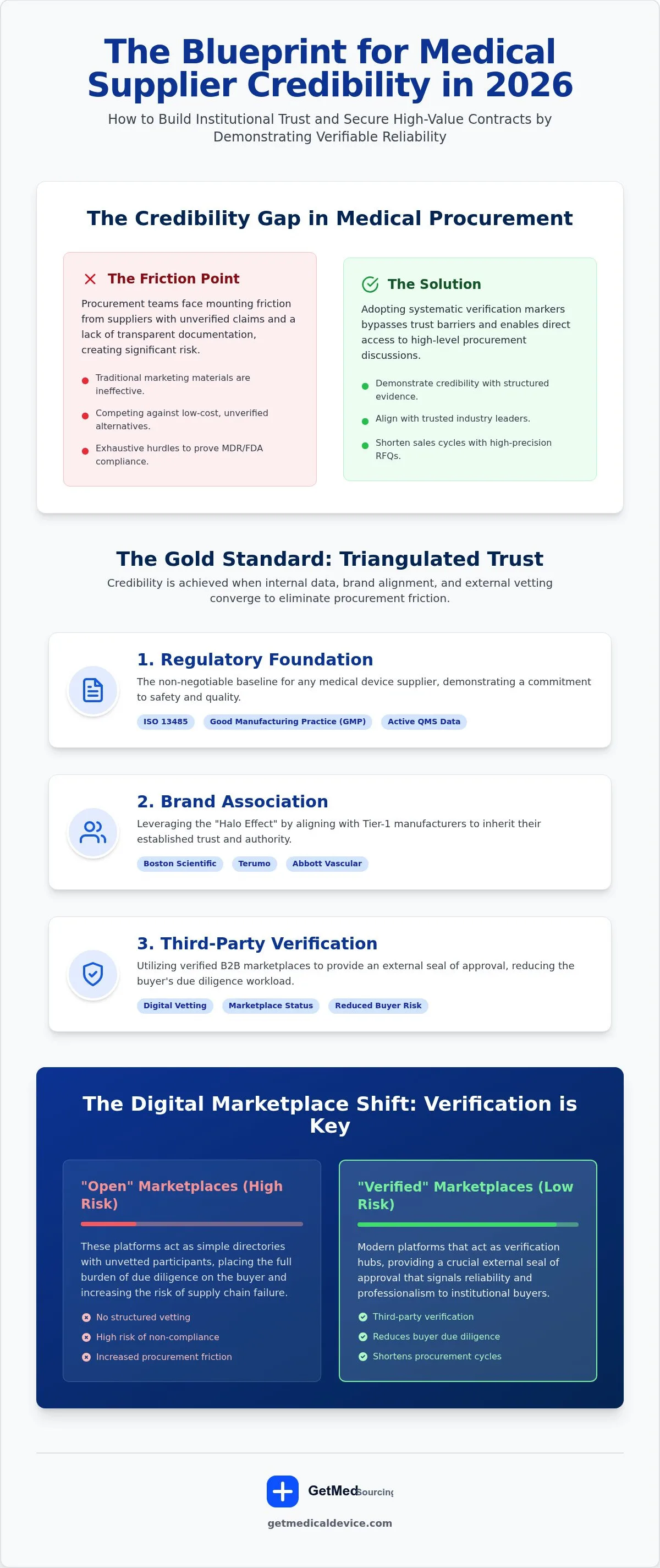
Credibility rests on three specific pillars: Regulatory Foundation, Brand Association, and Third-Party Verification. Triangulated Trust is the gold standard for modern medical B2B procurement, representing a state where internal data, brand alignment, and external vetting align to remove friction from the buying process.
Regulatory Foundations: ISO 13485 and Beyond
ISO 13485 stands as the non-negotiable baseline for any medical device supply chain. It's not just about holding a certificate; it's about maintaining an audit-ready Quality Management System (QMS). Suppliers must strictly adhere to Good Manufacturing Practice (GMP) to ensure every product meets stringent safety requirements consistently. In the current market, a "paper-only" QMS is insufficient. Procurement teams now look for active data tracking and documented evidence of continuous quality improvement.
Transparency in Documentation
Commercial transparency involves providing immediate, frictionless access to critical paperwork. Procurement teams expect valid Certificates of Free Sale (CFS) and Letters of Authorization (LoA) to be available upon request. When presenting technical data for complex items, such as vascular access devices, documentation must be structured for rapid technical review by clinical staff. Clear, indexed data sheets reduce the time required for institutional approval and signify a supplier's professional maturity.
Leveraging Tier-1 Brand Alignment for Instant Authority
The "Halo Effect" serves as a critical commercial shortcut in medical procurement. When a distributor maintains a portfolio featuring Tier-1 manufacturers like Boston Scientific, Terumo, or Abbott Vascular, the established trust of these brands transfers to the supplier. This alignment signals to procurement officers that the supplier has already passed the rigorous vetting processes required by global leaders. Understanding how to demonstrate supplier credibility in healthcare often begins with this strategic association.
Institutional buyers are legally bound by FDA 21 CFR 820.50 Purchasing Controls, which requires manufacturers and their partners to evaluate suppliers based on quality requirements. By highlighting official distribution status and adhering to trademark guidelines, suppliers fulfill the buyer's need for documented compliance. Listing high-demand items within premium product listings allows suppliers to capture immediate interest from serious procurement teams looking for specific, verified inventory. This approach reduces the friction typically found in the initial RFQ phase by providing immediate proof of commercial capability.
Building Authority through Specialized Portfolios
Distributors who specialize in high-stakes niches, such as coronary intervention or neurovascular equipment, command higher authority than generalists. Specialized expertise allows for more precise communication regarding technical specifications and clinical applications. This focus demonstrates a deeper commitment to the specific logistical and regulatory nuances of a medical sub-field, such as interventional radiology or cardiac rhythm management.
Verifying Product Authenticity
Credibility is maintained through the rigorous tracking of lot numbers and expiration dates. This data proves product integrity and ensures patient safety. For a detailed framework on sourcing and verifying Tier-1 equipment, refer to the Boston Scientific medical device supplier guide. Systematic verification remains the most effective method for confirming that inventory meets global standards for clinical use. It's a foundational step in how to demonstrate supplier credibility in healthcare when managing high-value surgical assets.
Digital Verification: The Role of B2B Marketplaces
Digital ecosystems in 2026 have shifted from simple directories toward complex verification hubs. Hospital procurement teams now distinguish between "Open" marketplaces, which carry high risk due to unvetted participants, and "Verified" marketplaces that offer structured vetting. Utilizing a platform's third-party verification acts as an external seal of approval, immediately reducing the buyer's due diligence workload. This structured vetting is a primary method for how to demonstrate supplier credibility in healthcare within a digital-first procurement environment. It allows suppliers to "skip the line" in the trust-building process by providing pre-validated credentials.
The Mechanics of a Verified Membership
A verified profile provides transparency that anonymous listings cannot replicate. Buyers see a history of compliance, verified documentation, and operational stability. This membership signals a long-term commitment to the industry, distinguishing established entities from temporary operations that lack permanent infrastructure. The psychological impact is measurable; a "Verified Supplier" status significantly increases RFQ conversion rates by removing initial trust barriers. It provides a level of commercial legitimacy that self-reported data simply cannot achieve.
Accessing Global RFQs with Credibility
Engaging with high-intent buyers requires a professional approach to lead acquisition. By using RFQ response credits, suppliers can directly target procurement requests that match their specific inventory and geographic capabilities. For a detailed analysis of international standards and frameworks, consult the Verified Medical Device Suppliers guide. This systematic access ensures that your bids are prioritized by institutional teams looking for pre-vetted partners. Understanding how to demonstrate supplier credibility in healthcare through these platforms is essential for competing in a global market. To scale your operations and access these exclusive procurement channels, apply for Verified Supplier Membership today.
Demonstrating Reliability through RFQ Performance
Responsiveness serves as a direct proxy for operational excellence in the medical supply chain. Hospital procurement teams often prioritize suppliers who respond within the first 24 hours of an RFQ being issued, as this speed indicates robust inventory management and administrative efficiency. A professional bid must be structured with absolute accuracy regarding lead times, specific Incoterms, and final pricing. Inconsistencies in these parameters signal potential logistical failures, which risk-averse buyers will avoid. Consistent RFQ behavior builds a reliability footprint that modern AI-driven procurement tools now track to rank suppliers automatically. This data-driven tracking is a fundamental component of how to demonstrate supplier credibility in healthcare for the 2026 market.
Optimizing the RFQ Response
Tailoring a bid involves addressing specific clinical and logistical requirements, such as sterilization standards or specialized packaging. For high-demand surgical products, providing technical documentation and compliance certificates within the initial response eliminates the need for follow-up inquiries. This proactive approach demonstrates a thorough understanding of the institutional workflow. It ensures your bid moves through the technical review phase without unnecessary delays.
Post-Sale Credibility: The Feedback Loop
Fulfillment performance is the final arbiter of trust. Successful deliveries lead to higher platform rankings and increased visibility within the marketplace. These metrics provide digital social proof, including transaction history and buyer ratings, which serve as verified evidence of competence. Encouraging buyers to leave detailed testimonials on your marketplace profile further solidifies your standing. This feedback loop is essential in how to demonstrate supplier credibility in healthcare, as it converts past performance into future contract opportunities. High rankings and positive feedback loops create a cycle of trust that shortens future procurement cycles.
Advancing Your Position in the 2026 Medical Supply Chain
Securing high-value contracts requires more than a standard product catalog. It demands a systematic integration of regulatory foundations, strategic brand alignment, and a verified digital presence. By focusing on rapid RFQ responsiveness and transparent documentation, organizations can effectively lower the risk profile perceived by hospital procurement teams. Implementing these frameworks is the most direct method for how to demonstrate supplier credibility in healthcare while navigating increasingly complex global standards.
It's essential for commercial growth to transition from an anonymous listing to a verified industry partner. You can apply for a Verified Supplier Membership on GetMedicalDevice to build instant trust with global buyers. This status provides a verified badge for your inventory, access to premium product listings for Tier-1 brands, and direct access to active RFQs from international hospitals. Maintaining a verifiable reliability footprint ensures your organization remains a preferred partner for Tier-1 medical brands as the industry continues to professionalize.
Frequently Asked Questions
What is the most important document for a medical supplier to have?
ISO 13485 certification remains the foundational document because it validates your Quality Management System (QMS). However, for distributors, a Letter of Authorization (LoA) from the manufacturer is equally critical. These documents confirm that your inventory is authentic and that you possess the legal right to distribute specialized equipment. Together, they provide the regulatory and commercial evidence required to satisfy institutional procurement audits and ensure patient safety.
How can a small distributor compete with large medical supply companies?
Small distributors compete by focusing on specialized niches and superior operational speed. While large companies have broad reach, they often suffer from bureaucratic delays. By maintaining a Verified Supplier Membership, a smaller entity can bypass initial trust hurdles and bid directly on RFQs with high-intent buyers. This strategy allows you to demonstrate expertise in specific categories, such as interventional radiology, where technical precision is more valuable than sheer volume.
Does a 'Verified' status on a B2B platform actually improve sales?
Verified status directly impacts sales by reducing the due diligence workload for procurement officers. It acts as an external seal of approval that signals your business has passed structured vetting. This status is a primary method for how to demonstrate supplier credibility in healthcare, leading to higher RFQ conversion rates. By utilizing a verified badge, you distinguish your inventory from unverified listings, making your organization a low-risk choice for global hospitals.
What are the common red flags that make buyers distrust a medical supplier?
Buyers identify several key red flags, including a lack of lot numbers, missing expiration tracking, and anonymous marketplace profiles. Inconsistent communication or delayed RFQ responses also suggest operational instability. If a supplier cannot provide a valid Letter of Authorization (LoA) or technical data sheets immediately, procurement teams will likely disqualify them. Transparency in documentation and rapid responsiveness are essential to avoid being flagged as a high-risk, unverified entity.
How do I demonstrate credibility when entering a new international market?
Entering a new international market requires alignment with global standards and established Tier-1 brands. Offering products from recognized names like Boston Scientific or Terumo provides immediate commercial legitimacy. Additionally, maintaining a verified status on a global B2B platform ensures your credentials are pre-validated for international buyers. This approach is essential for how to demonstrate supplier credibility in healthcare, as it provides a documented infrastructure that meets the regulatory requirements of diverse healthcare systems.