

What earns a hospital’s trust after the first supplier conversation? Learning how to build long-term relationships with hospitals starts with understanding how many teams may contribute to a purchasing decision. Clinical users, procurement, and supply-chain staff can each assess different parts of an offer. A single outreach rarely creates a dependable partnership. Suppliers need to stay relevant, provide consistent information, and make it easier for hospital teams to evaluate whether a product meets their stated needs.
This article explains how hospital stakeholders evaluate supplier relationships and how to create a repeatable process for engagement. You’ll learn how to tailor communication to purchasing priorities, follow through with accurate and useful information, and use relevant sourcing and RFQ channels to start qualified conversations. Platforms such as GetMedicalDevice can support supplier visibility and responses to active procurement requests. Ongoing account management helps carry those conversations forward.
Key Takeaways
- Distinguish a one-time sale from a hospital relationship by identifying where ongoing supplier communication can support procurement needs.
- Build credibility with accurate product information, realistic commitments, and follow-through that addresses the limits of generic outreach.
- Apply a repeatable process to research accounts, qualify relevance, document stakeholder needs, and plan next steps.
- Learn how to build long-term relationships with hospitals by combining account engagement with relevant product visibility and responsive RFQ participation.
Table of Contents
- Why long-term hospital relationships matter to medical device suppliers
- How suppliers earn hospital trust despite established procurement processes
- A repeatable process for building hospital relationships over time
- Use verified visibility and RFQs to support hospital relationships
Why long-term hospital relationships matter to medical device suppliers
Hospital evaluations can involve several review stages and stakeholders from clinical teams, procurement, and supply chain. Each group may assess a different part of an offer, so suppliers need dependable communication throughout the process, not only when an order is placed. Understanding how to build long-term relationships with hospitals starts with treating each interaction as part of an ongoing working relationship.
A transactional sale ends when an order is placed. A continuing relationship depends on whether the supplier remains relevant and useful as needs evolve. For example, a conversation about vascular or surgical equipment should stay focused on the hospital’s stated requirements. Share clear product information, answer the questions asked, and keep a record of any open points. Purchasing may also involve Group Purchasing Organizations (GPOs), which aggregate purchasing power for healthcare providers. Understand that these channels may shape a buying process, but don’t assume that one contact or successful RFQ will lead to a contract.
What hospitals need from a medical device supplier
Why trust takes repeated, useful interactions
Credibility develops through reliable follow-through: sending the information promised, answering relevant questions, and stating clearly when more detail is needed. Each interaction should reflect what the hospital has already shared. Frequent generic messages add little value; a concise update tied to a stated need is more useful. A durable relationship is an ongoing process of relevant communication and dependable execution, not a single meeting, sale, or successful RFQ.
How suppliers earn hospital trust despite established procurement processes
Established suppliers may already understand a hospital’s purchasing workflow, but generic outreach rarely gives a new supplier a reason to be considered. Demonstrate relevance against the organization’s stated needs, product category, and evaluation process. Requirements can differ between hospitals, so avoid assuming that one message, document set, or purchasing route applies everywhere. Before sending information, identify which requirement it addresses and who asked for it.
Trust is verifiable consistency across supplier interactions. It develops when product information is accurate, commitments are realistic, and follow-through matches what was agreed. If a detail is uncertain, identify it as an assumption rather than presenting it as fact. This makes an offer easier to assess and helps prevent confusion as a discussion moves between stakeholders.
Map the hospital stakeholders and decision criteria
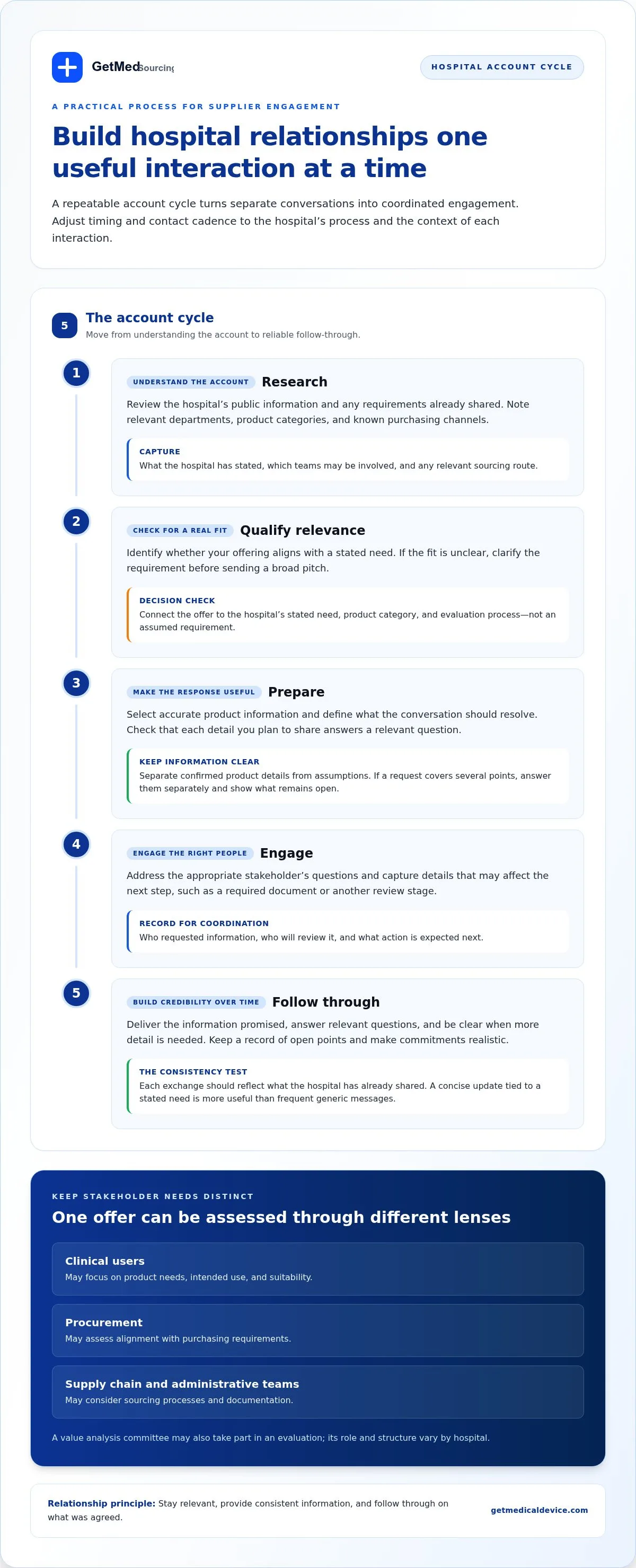
Clinical users may focus on product needs and fit for the intended use. Procurement may assess alignment with purchasing requirements, while supply-chain and administrative teams may consider sourcing processes and documentation. A value analysis committee may also take part in an evaluation, but its role and structure vary by hospital. Map the people involved and record the criteria each stakeholder has actually raised. Keep track of who requested information, who will review it, and what action is expected next.
Make each interaction specific and supportable
Before responding, connect the inquiry to the relevant product category and address the questions asked. For example, whether providing specialized medical equipment or laboratory supplies from manufacturers like RMR Reagents, conversations should focus on information relevant to that sourcing need rather than relying on a broad catalogue introduction. Separate confirmed product details from assumptions that require clarification. If a request calls for information you don’t have, state what remains unresolved and identify a practical next step.
This is a practical foundation for how to build long-term relationships with hospitals: make every exchange useful to the decision in front of the team. Use category-specific product information to keep supplier conversations focused, and let the hospital’s stated criteria guide what you share next.
A repeatable process for building hospital relationships over time
A consistent account cycle helps turn separate conversations into coordinated engagement. Use it to guide how to build long-term relationships with hospitals, while adjusting response timing and contact cadence to the hospital’s process and the context of each interaction.
- Research: Review the hospital’s public information and any requirements already shared. Note relevant departments, product categories, and known purchasing channels.
- Qualify relevance: Identify whether your offering aligns with a stated need. If the fit is unclear, clarify the requirement before sending a broad pitch.
- Prepare: Select accurate product information and define what the conversation should resolve. Check that each detail you plan to share answers a relevant question.
- Engage: Address the appropriate stakeholder’s questions and capture details that may affect the next step, such as a required document or another review stage.
- Follow through: Deliver agreed information or updates, and record outstanding questions and commitments.
- Review: Revisit account notes before the next interaction. Update stakeholder roles, needs, product discussions, and planned actions.
Prepare for a relevant first conversation
Match the hospital’s stated needs to relevant product categories rather than presenting an undifferentiated catalogue. For broader procurement context, consult this global medical device sourcing framework. Before outreach, note what is known, what remains an assumption, and which question would help clarify the fit. A focused opening can state the relevant category, explain why it may match the stated need, and invite the recipient to identify any missing information.
Follow up without creating unnecessary friction
Send a concise recap of agreed actions, requested information, and unresolved questions. Keep open RFQs and their response commitments separate from general relationship-development activity so urgent procurement tasks remain visible. Log the stakeholder involved, the date and context of the exchange, and the next action. Documented follow-through turns individual contacts into continuity across the hospital account.
Use GetMedicalDevice RFQ response credits to respond to active procurement requests, then carry that specific communication into subsequent account follow-up.
Use verified visibility and RFQs to support hospital relationships
Supplier visibility and account management serve different purposes. Listings help buyers discover relevant offerings, RFQs provide a route to respond to active procurement needs, and direct engagement supports follow-up within an account. Used together, these channels can support how to build long-term relationships with hospitals, but visibility alone doesn’t guarantee a hospital contract.
- Direct account engagement: Use conversations to understand a hospital’s stated needs, clarify questions, and maintain continuity. Let the account’s process and prior interactions guide timing.
- Product listings: Present relevant inventory to a global B2B buyer audience. Premium listings can support discovery when buyers are exploring a specific category.
- RFQ responses: Respond to active procurement requests when the requirements align with your offering. Keep the response specific to the request and clear about product scope.
When listings and RFQ responses can help
Focused category visibility makes it easier for buyers to find products relevant to their sourcing needs. For example, suppliers of neurovascular products can use a category-specific listing to present relevant inventory rather than relying only on broad outreach. A Verified Supplier Membership provides verified status and visibility to global buyers, while accurate listing details help buyers assess the supplier information presented.
Turn a sourcing request into a credible conversation
An RFQ response should address the requested product and information directly. State the scope clearly, avoid unsupported claims, and respond to the specific requirements rather than sending a general introduction. This creates a practical basis for follow-up without implying that a response will result in an award. For additional context, consult the verified supplier procurement guide.
To put these channels into practice, explore supplier membership and RFQ options and identify the product categories that align with your target buyers.
Put your next hospital conversation into motion
Choose one target account and define a practical next step: identify a relevant product category, clarify which buyer need it may address, and prepare information that supports a focused conversation. This creates a clear starting point for applying how to build long-term relationships with hospitals to your supplier outreach.
GetMedicalDevice supports supplier visibility through Verified Supplier Membership and premium product listings, and provides RFQ response credits for access to active procurement requests. The platform supports sourcing across interventional, vascular, and surgical equipment, helping suppliers align their presence with relevant categories. These tools can create opportunities for discovery or an RFQ response; account-level communication and follow-through remain essential to developing the relationship.
Explore supplier membership and RFQ options, then identify the categories that best match your target buyers. A focused, well-documented next step can help turn supplier visibility into a relevant conversation and build momentum over time.
Frequently Asked Questions
How long does it take to build a relationship with a hospital?
There’s no fixed timeline; progress depends on the hospital’s needs, evaluation stages, and purchasing schedule. A first exchange may establish relevance, while further steps can depend on internal reviews or a future sourcing cycle. Track milestones rather than assume a close date: a qualified contact, a request for information, an evaluation step, or a defined future follow-up. This makes how to build long-term relationships with hospitals a manageable account process.
Who is involved in a hospital’s medical device purchasing decisions?
The people involved vary by hospital and product. A clinical user may identify a need, while procurement coordinates purchasing requirements; supply-chain staff may assess sourcing considerations, and administrators may participate in approvals. A value analysis committee can also review an offering in some organizations. Ask who owns each next step, and distinguish the person requesting information from the person authorized to make or approve a purchasing decision.
What should a supplier do after a hospital does not respond?
Check whether the hospital provided a response window or requested a specific follow-up date, then use that guidance. If no timing was given, send one brief, relevant follow-up that refers to the earlier exchange and offers a clear next step, such as supplying a requested document. Avoid repeated messages without new information. If there’s still no response, pause and record the account status for a more appropriate future contact.
Can an online marketplace replace direct hospital relationship-building?
No. A marketplace can help buyers discover supplier information or connect a supplier with an active request, but it doesn’t manage the account relationship or determine a hospital’s purchasing decision. Treat each listing or RFQ response as an entry point. If a buyer engages, continue the conversation through the appropriate channel, respond to the actual inquiry, and keep the hospital’s process in view.
How can suppliers measure progress in hospital relationships?
Measure account movement, not just outreach volume. Track whether a target account has a confirmed need, an identified purchasing pathway, relevant stakeholders engaged, and agreed next steps completed. Record RFQ status separately from broader account development so a single request doesn’t overstate relationship progress. Periodic review can reveal stalled assumptions, missing contacts, or product information that needs updating before the next interaction.

