The World Health Organization estimates that 1 in 10 medical products in low- and middle-income countries is substandard or falsified. That figure covers more than devices, but it underscores why avoiding counterfeit medical devices takes more than checking a product listing. Packaging that appears to match established brands such as Abbott or Terumo is not proof of authenticity.
For procurement teams, the challenge is practical: international suppliers can be difficult to verify, while a substandard device can create clinical, operational, and legal risks. A verification-first process moves decisions beyond price and appearance to documented supplier checks and reliable sourcing channels.
This guide explains how to identify warning signs, verify suppliers, and build a repeatable process for investigating concerns before devices reach clinical use. You’ll learn which records and product details to review, how to structure supplier vetting, and how a platform with a Verified Supplier Membership system can connect buyers with sellers whose membership status has been reviewed.
Key Takeaways
- Understand why high-value interventional devices can attract counterfeiters and where supply-chain exposure may arise.
- Use unusually low offers and missing or inconsistent product records as prompts for closer supplier and device checks.
- Apply a repeatable approach to avoiding counterfeit medical devices by cross-checking supplier credentials and comparing product specifications.
- See how Verified Supplier Membership and structured RFQs can support organized sourcing and procurement records.
Avoiding Counterfeit Medical Devices: Table of Contents
- The Landscape of Counterfeit Medical Supply Chains in 2026
- Identifying Red Flags in Global B2B Procurement
- Implementing a Multi-Layered Verification Strategy
- Securing the Supply Chain with Verified B2B Marketplaces
The Landscape of Counterfeit Medical Supply Chains in 2026
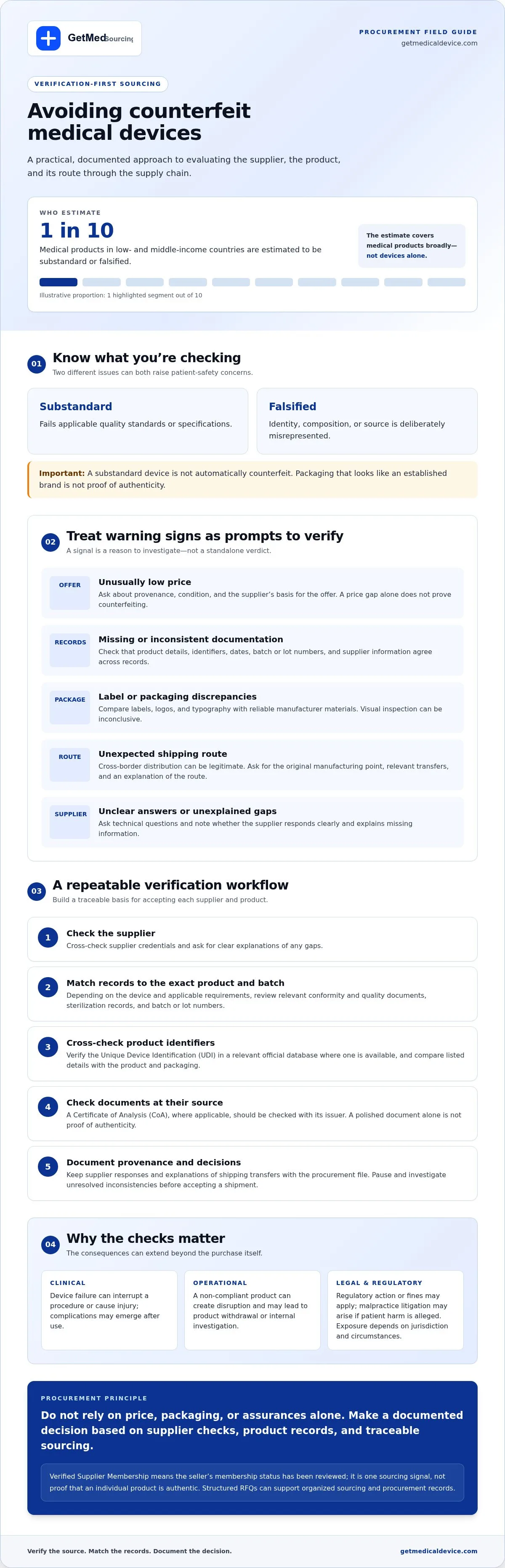
Counterfeit medical supply chains (CMSCs) are channels through which falsified or otherwise non-compliant medical products enter distribution and reach healthcare providers. They are not confined to lower-income markets. Products can move through complex cross-border networks and appear in established healthcare systems, making source verification relevant at every stage of procurement. The World Health Organization estimates that 1 in 10 medical products in low- and middle-income countries is substandard or falsified; this estimate covers medical products broadly, not devices alone. The global landscape of counterfeit medical products provides wider context for the risks.
WHO distinguishes substandard products, which fail applicable quality standards or specifications, from falsified products, whose identity, composition, or source is deliberately misrepresented. A substandard device is not automatically counterfeit, but either category can create patient-safety concerns. High-value interventional devices such as catheters and stents may attract counterfeiters because they are specialized products with clinical demand and features that can be difficult to assess from a listing or package alone. A device failure can interrupt a procedure or cause injury, and complications may also emerge after use.
The High Stakes of Interventional Radiology and Cardiology
Devices used in coronary intervention require close scrutiny because their performance can directly affect a time-sensitive procedure. Unverified vascular access products can also introduce risks in critical care, where dependable access and product integrity matter. Treat gaps in provenance as a potential clinical risk, not just a documentation issue.
Economic and Legal Liability for Procurement Officers
A procurement error may trigger an internal investigation, product withdrawal, regulatory action or fines where applicable, or malpractice litigation if patient harm is alleged. Exposure depends on jurisdiction and circumstances, so buyers should follow their organization’s policies and applicable requirements. Duty of Care: In 2026, a medical procurement officer’s duty of care is to take reasonable, documented steps to source products that meet applicable requirements and protect patient safety.
Avoiding counterfeit medical devices starts with accountable sourcing decisions and a traceable basis for accepting each supplier and product.
Identifying Red Flags in Global B2B Procurement
For high-value products such as Abbott Vascular or Terumo devices, an unusually low offer should trigger verification, not an immediate purchase. A price gap alone doesn’t prove a product is counterfeit, but it warrants questions about provenance, condition, and the supplier’s basis for the offer. WHO’s guidance on substandard and falsified medical products underscores why buyers need to assess the supply chain, not just the product description.
Match supporting records to the exact product and batch. Depending on the device and applicable requirements, request relevant conformity and quality documentation, sterilization records, and batch or lot numbers. Check that identifiers, dates, product details, and supplier information are consistent across records. A Certificate of Analysis (CoA), where applicable, should be checked with its issuer. A polished document is not proof of authenticity. Ask technical questions and note whether the supplier answers clearly and explains any gaps. For wider procurement planning, use medical device product listings as one point of reference for comparing product information.
Anomalies in Product Packaging and Labeling
Packaging deserves inspection, but modern printing can make visual checks inconclusive. Compare labels, logos, and typography with reliable manufacturer materials, then verify the Unique Device Identification (UDI) in the relevant official database where one is available. Confirm that the identifier and listed device details match the product and its packaging. Treat discrepancies as reasons to pause and investigate, not as a standalone verdict.
Inconsistent Lead Times and Shipping Logistics
An unexpected route, such as a US-branded device shipping from an unrelated third country, isn’t proof of counterfeiting. Legitimate distribution can cross borders, but an unfamiliar route raises a chain-of-custody question. Ask the supplier to document the original point of manufacture, relevant transfers, and the reason for the route. Keep the response with the procurement file. Avoiding counterfeit medical devices means resolving these inconsistencies before accepting a shipment, rather than relying on packaging or assurances alone.
Implementing a Multi-Layered Verification Strategy
Avoiding counterfeit medical devices requires checks at supplier, product, and transaction level. No single database entry, document, or platform badge proves authenticity. Use a documented sequence before approving a purchase:
- Check supplier credentials: Compare the supplier’s legal name, registration details, and claimed authorizations with relevant records from the FDA, EMA, or local regulatory authorities. Confirm that the records match the entity selling the device.
- Compare product details: Review model identifiers and specifications against manufacturer information and listings in a medical device product catalog. Investigate any mismatch before proceeding.
- Verify batch documents: Request records tied to the specific product and batch, then check them against the supplier’s details and the issuing source.
- Assess a limited order: Where appropriate and permitted, use a small order for documented, nonclinical inspection of packaging and records. Do not treat a trial shipment as proof of clinical safety, and do not use unverified devices on patients.
Vetting International Wholesalers and Distributors
When evaluating Boston Scientific medical device suppliers, ask who owns the inventory, where it was sourced, and whether the seller can provide traceable batch documentation. A B2B platform’s “Verified” status can serve as an initial filter, including when sourcing higher-risk neurovascular catheters, but it should not replace product-level checks. GetMedicalDevice’s Verified Supplier Membership is intended to support seller vetting. Buyers should still validate the details of each transaction.
The Role of Digital Verification Tools in 2026
Where implemented, blockchain-based records can support traceability by preserving transaction history, while AI tools may help identify inconsistencies in documents. Neither confirms authenticity on its own. Check the underlying records and their source. Automated RFQ systems can flag pricing outliers against comparable responses, prompting procurement teams to investigate unusually low offers before approval.
For broader procurement context, consult a strategic sourcing framework and apply the checks above to each transaction. Explore GetMedicalDevice’s supplier listings as one starting point for structured sourcing.
Securing the Supply Chain with Verified B2B Marketplaces
A specialized B2B marketplace can give buyers a structured way to identify suppliers, compare offers, and organize procurement records. GetMedicalDevice’s Verified Supplier Membership system supports seller vetting, so buyers can use verified status as an initial screening point. It doesn’t replace checks on the specific device, batch documentation, or transaction, but it can add structure to global sourcing.
How Verified Supplier Status Protects Buyers
Use verified status to narrow the supplier pool, then confirm the details that matter for each purchase: the seller’s identity, product provenance, and ability to provide relevant records. This can help when sourcing specialized or difficult-to-find surgical products, where urgency may make unverified offers more tempting. For interventional radiology needs, browse by product category to focus your search on the clinical area, then assess whether a supplier can respond to the specific requirement.
Leveraging RFQ Credits for Structured Sourcing
A credit-based RFQ system gives buyers a defined process for submitting requirements and receiving supplier responses. Make each request specific: identify the device and relevant specifications, ask for batch documentation, and request information about source and availability. Retain the request and responses with your procurement records to support a clearer audit trail. RFQ credits structure participation, but they are not proof that a response or product is authentic.
A centralized B2B marketplace can also make it easier to evaluate offers across brands such as Abbott Vascular, Terumo, and Asahi Intecc within one sourcing workflow. Listings and responses are starting points. Verify product-level details before approval. Avoiding counterfeit medical devices depends on pairing platform-level seller vetting with independent transaction checks. Review GetMedicalDevice’s verified supplier listings as one option for structured sourcing.
Make Verification Part of Every Procurement Decision
Avoiding counterfeit medical devices depends on consistent checks, not a single visual inspection or supplier claim. Verify the seller, review product- and batch-specific records, and investigate unexplained differences in pricing, documentation, or provenance before approving a purchase. These steps help procurement teams create a clearer, more accountable sourcing process.
A verified B2B marketplace can support that process by connecting buyers with sellers whose membership status has been reviewed. GetMedicalDevice’s Verified Supplier Membership system supports supplier vetting, while its structured, credit-based RFQ process helps organize procurement requests and responses. Buyers can also explore listings associated with Asahi Intecc, Abbott Vascular, and Boston Scientific through one marketplace. Continue to verify the specific supplier, device, and transaction before purchase.
Join GetMedicalDevice as a Verified Supplier or source medical devices through its global network to explore a structured sourcing option. A disciplined procurement process strengthens supply-chain oversight and supports more confident decisions for clinical settings.
Frequently Asked Questions
How can I verify if a medical device supplier is legitimate?
Verify the supplier’s identity and credentials independently before placing an order. Cross-check its legal name and relevant registration or authorization details with the applicable regulator, such as the FDA, EMA, or a local equivalent. Ask for product provenance, batch-specific records, and clear answers to technical questions. A marketplace’s verified status can be a useful first filter, but it doesn’t replace checks on the supplier and transaction.
What are the most common signs of a counterfeit medical device?
Potential warning signs include unusually low pricing, inconsistent product or batch details, missing or unverifiable documentation, and packaging that differs from reliable manufacturer information. Unclear sourcing or a supplier unwilling to explain provenance also warrants investigation. These indicators don’t prove a device is counterfeit, and polished packaging doesn’t prove it’s genuine. Pause procurement and verify the product and records with appropriate sources before accepting or using it.
Is it safe to buy medical devices from international B2B marketplaces?
It can be appropriate to source through an international B2B marketplace if buyers apply supplier and product checks to each transaction. Review how supplier status is established, confirm device provenance and batch documentation, and assess whether the seller’s details match relevant regulatory records. GetMedicalDevice’s Verified Supplier Membership provides a seller-vetting status as an initial screening point, not a guarantee of any specific product’s authenticity or suitability.
What should I do if I suspect a medical device is counterfeit?
Stop the procurement or use process and quarantine the device according to your organization’s procedures. Preserve the packaging, labels, shipment details, and supplier communications. Record batch and device identifiers without altering the product. Notify your organization’s quality or patient-safety lead and contact the manufacturer or relevant regulator for guidance. Follow applicable reporting procedures, and don’t return, distribute, or use the item until the concern has been assessed.
How does UDI (Unique Device Identification) help prevent counterfeiting?
A UDI provides an identifier that can help buyers and healthcare organizations match a device to associated product information and records. Where an official database is available, compare the identifier and device details against its entry, and check that the packaging and documentation are consistent. A valid-looking code alone doesn’t establish authenticity because identifiers may be copied or misused. Treat UDI verification as one layer of a broader sourcing review.