
With the global structural heart devices market projected to reach a valuation of up to USD 19.70 billion by late 2026, the traditional reliance on fragmented, direct-to-manufacturer procurement models is becoming an operational liability. Identifying reliable structural heart device suppliers requires more than clinical preference; it demands a rigorous verification process to mitigate the risks of unverified products and non-compliance with evolving international standards. You likely recognize that the lack of pricing transparency and the complexity of managing separate international contracts often lead to significant administrative friction and supply chain vulnerability.
This guide provides a structured framework to help you establish a secure supply chain for transcatheter devices while optimizing your RFQ process for cardiac interventions. You'll learn how to leverage verified supplier memberships to access premium product listings from major brands like Abbott Vascular and Boston Scientific through a single, transparent portal. We'll examine the shift toward centralized B2B marketplaces and provide actionable steps to ensure your procurement strategy aligns with the latest 2026 regulatory approvals and market trends.
Key Takeaways
- Define the clinical scope of transcatheter interventions by identifying structural heart device suppliers with specialized inventory in TAVI/TAVR and septal occluders.
- Evaluate the specific market strengths of global leaders, including Abbott's TEER dominance and Boston Scientific's leadership in LAAO technology.
- Implement a systematic risk framework to verify supplier credentials and assess lead times for critical cardiac procedures.
- Refine procurement workflows by standardizing technical specifications and establishing volume-based pricing within the RFQ process.
- Utilize verified B2B portals to access premium product listings and streamline cross-border procurement through a centralized professional hub.
Table of Contents
- What is a Structural Heart Device Supplier?
- Top Global Manufacturers and Their Distribution Models
- Evaluating Structural Heart Device Suppliers: A Risk Framework
- Optimizing the RFQ Process for Structural Heart Procurement
- GetMedicalDevice: Your Hub for Verified Structural Heart Sourcing
What is a Structural Heart Device Supplier?
Structural heart device suppliers are specialized entities, either manufacturers or authorized intermediaries, responsible for the distribution and lifecycle management of cardiac implants. Unlike general medical distributors, these organizations manage high-risk Class III devices that require specific technical support and rigorous handling protocols. They serve as the primary link between the engineering of complex transcatheter systems and the clinical environment where they are deployed.
The industry has transitioned from a localized model where hospital representatives managed inventory manually to a global digital procurement framework. This evolution allows healthcare providers to engage with structural heart device suppliers through centralized platforms, improving inventory visibility and reducing the administrative burden of manufacturer-direct relationships. Centralized sourcing through verified portals ensures that procurement teams can verify product authenticity and regulatory status before a purchase is finalized.
A critical operational requirement for any supplier in this space is maintaining the integrity of the sterile cold chain and specialized logistics. Many structural heart devices require precise temperature controls and specialized packaging to remain viable for clinical use. Effective structural heart device suppliers provide the documentation and logistical transparency necessary to prove that these conditions were met throughout the transit process.
Key Categories in Structural Heart Portfolios
Structural heart portfolios focus on treating non-coronary abnormalities within the heart's chambers and valves. These devices are essential for managing structural heart disease through minimally invasive techniques. Modern procurement lists typically include several specialized categories:
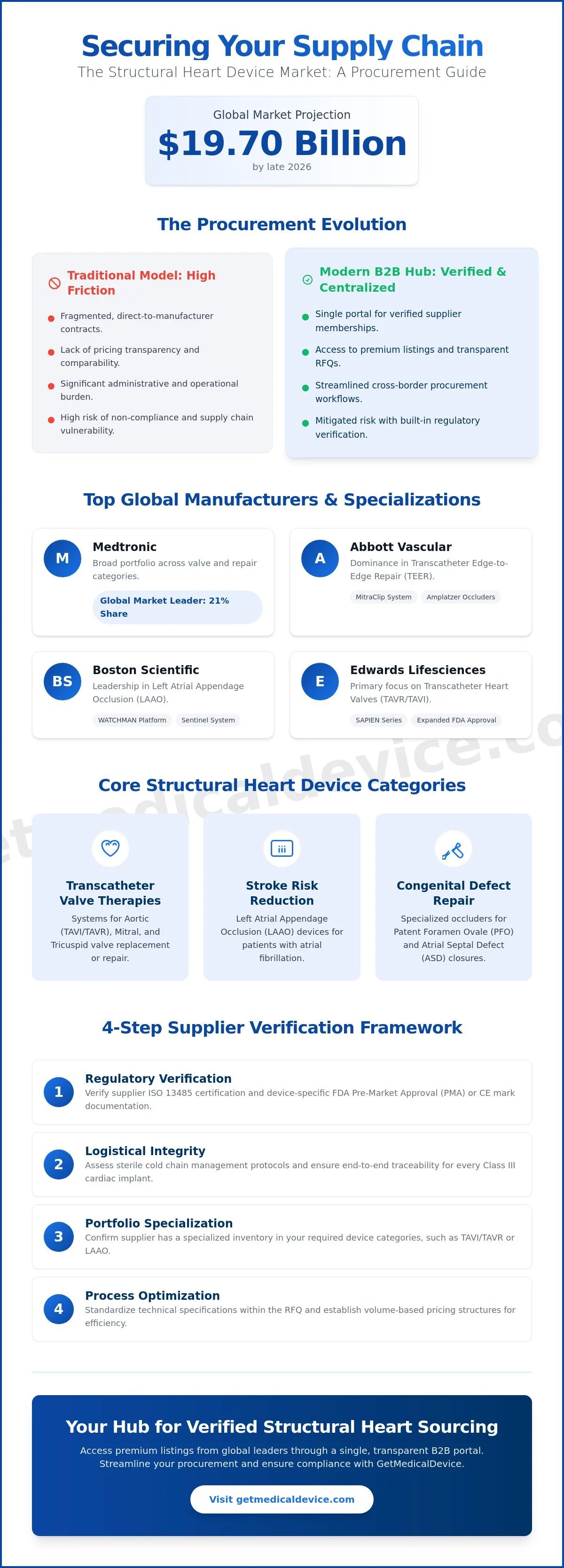
- Transcatheter Valve Therapies: Systems designed for Aortic (TAVI/TAVR), Mitral, and Tricuspid valve replacement or repair.
- Stroke Risk Reduction: Primarily Left Atrial Appendage Occlusion (LAAO) devices used for patients with atrial fibrillation.
- Congenital Defect Repair: Specialized occluders for Patent Foramen Ovale (PFO) and Atrial Septal Defect (ASD) closures.
The Regulatory Responsibility of the Supplier
Suppliers must adhere to strict international standards to ensure patient safety and legal compliance. This includes maintaining ISO 13485 certification for medical device quality management systems. Because structural heart devices are categorized as Class III cardiac implants, traceability is a non-negotiable requirement. Every unit must be tracked from the manufacturing floor to the specific patient implantation record.
Verification of FDA Pre-Market Approval (PMA) or CE mark documentation is mandatory before any device enters the supply chain. Suppliers act as a formal checkpoint; they ensure every unit meets the regional regulatory requirements for the specific healthcare market it serves. This verification process prevents the entry of counterfeit or unverified products into the sterile field, protecting both the patient and the institution's liability.
Top Global Manufacturers and Their Distribution Models
Strategic procurement requires a granular understanding of the dominant manufacturers and their specific clinical niches. Abbott Vascular maintains a significant position through its dominance in transcatheter edge-to-edge repair (TEER) with the MitraClip system and its extensive Amplatzer occluder portfolio. Boston Scientific leads the left atrial appendage occlusion (LAAO) segment with the WATCHMAN platform while also providing critical embolic protection through the Sentinel system. Edwards Lifesciences remains a primary focus for transcatheter heart valves, specifically the SAPIEN series, which received expanded FDA approval for asymptomatic patients in 2025.
While these manufacturers drive innovation, the role of structural heart device suppliers is to facilitate the complex movement of these Class III devices into the clinical setting. Medtronic currently holds the largest global market share at 21%, reflecting a broad portfolio that spans multiple valve and repair categories. These organizations typically utilize a direct sales model in major markets like North America, which accounted for 36.52% of the market in 2025, to provide the high-level clinical support required during complex implantations.
Manufacturer-Direct vs. Authorized Distribution Channels
Procurement teams must decide between sourcing directly from the original equipment manufacturer (OEM) or utilizing authorized regional distributors. Direct models offer the benefit of integrated clinical education and technical support. However, authorized distributors often provide superior localized logistics and consolidated invoicing for multiple brands. The emergence of global digital marketplaces allows facilities to view premium product listings from multiple structural heart device suppliers through a single interface, increasing transparency in lead times and inventory availability.
Support Devices: The Often Overlooked Procurement Need
Successful structural heart interventions depend on a secondary ecosystem of support devices that are as critical as the primary implants. Procurement teams don't just buy valves; they secure an entire ecosystem. High-performance guidewires, such as those from Asahi Intecc or the Boston Scientific Safari series, are essential for stable valve delivery. Vascular closure is another vital consideration; the Teleflex MANTA device is frequently specified for large-bore access management in TAVR procedures. Diagnostic catheters and dual-lumen systems from Terumo provide the necessary torque and trackability for navigating complex anatomy. Failing to secure a reliable supply of these support tools can delay procedures even when the primary valve or occluder is in stock.
Evaluating Structural Heart Device Suppliers: A Risk Framework
Procuring Class III cardiac implants necessitates a shift from clinical preference to institutional risk management. Establishing a secure procurement pipeline requires more than verifying the manufacturer's brand; it requires a systematic audit of the structural heart device suppliers themselves. This audit must prioritize operational continuity and regulatory adherence over simple price comparisons. Institutions should evaluate four primary pillars: credentialing, inventory resilience, technical support capacity, and financial stability.
Lead times for transcatheter interventions are non-negotiable variables. A reliable supplier must demonstrate consistent fulfillment rates, especially for high-stakes procedures like transcatheter aortic valve replacement (TAVR). Procurement officers should request historical data on lead time variance and assess the supplier's global shipping capabilities to ensure that cross-border logistics don't compromise procedure schedules. Furthermore, the presence of localized technical support is vital. You should verify if the supplier provides access to clinical specialists who can assist with device-specific troubleshooting during the perioperative phase.
The Dangers of Unverified Medical Supply Chains
Sourcing through unverified entities introduces systemic risk to the healthcare facility. Gray-market listings often lack the documentation necessary to prove continuous climate control or sterile integrity. Compromised packaging on a Class III device isn't just a logistical error; it's a direct threat to patient safety that can lead to endocarditis or mechanical failure. Beyond the clinical impact, hospitals face significant legal and insurance liabilities when using products from unverified structural heart device suppliers. These entities often bypass the rigorous traceability requirements mandated for high-risk cardiac implants.
Supplier Verification Standards (SVS)
Modern B2B medical marketplaces solve these issues by implementing Supplier Verification Standards (SVS). These platforms act as a formal intermediary, vetting the business licenses and medical distribution credentials of all participants before they're allowed to list inventory. By utilizing a membership-based portal, procurement teams can maintain a "Preferred Supplier" list that has already passed rigorous third-party verification. This centralized vetting process reduces the administrative burden on hospital legal departments while ensuring that all vendors meet high-level industry standards for documentation and ethical trade.
Optimizing the RFQ Process for Structural Heart Procurement
A structured Request for Quote (RFQ) process transforms medical procurement from a reactive administrative task into a precise strategic operation. For high-value cardiac interventions, generic inquiry forms are insufficient. You must implement a standardized RFQ framework that captures granular technical requirements and commercial parameters. This approach allows your institution to compare structural heart device suppliers on a like-for-like basis, ensuring that clinical requirements and budgetary constraints are both met without compromising the sterile supply chain.
Defining technical specifications is the first stage of this optimization. Your RFQ must specify the exact sheath compatibility (French size), delivery system profile, and material composition, such as Nitinol frames or bovine pericardium tissue. For occluder devices, you should define the required waist diameter and disc sizes to match specific patient anatomy. By providing these details upfront, you eliminate the back-and-forth communication that often delays the procurement cycle. Setting volume-based pricing tiers within the RFQ also allows you to establish long-term contract parameters that provide price stability despite market fluctuations.
Implementing a multi-bid strategy is essential for maintaining a competitive and resilient supply chain. Rather than relying on a single manufacturer-direct relationship, you should solicit bids from multiple verified structural heart device suppliers. This creates a transparent environment where vendors compete on lead times, support availability, and total cost of ownership. To facilitate this, you can utilize RFQ response credits to engage with specialized cardiovascular inventories through a centralized digital hub.
Critical Data Points for Cardiac RFQs
Your RFQ documentation must mandate specific data points to ensure regulatory and clinical compliance. Every response should include a guarantee of lot number traceability and a minimum shelf-life requirement for all sterile components. You must also request formal regulatory certificates, such as a Certificate of Free Sale (CFS), to verify the product's legal status in your region. Finally, clarify the shipping terms using standard Incoterms; specifying FCA (Free Carrier) or DDP (Delivered Duty Paid) ensures that insurance coverage and risk transfer for high-value cargo are clearly defined before the purchase order is issued.
Streamlining Procurement via Digital Hubs
Digital hubs reduce the bid-to-delivery cycle time by centralizing all supplier communications in a single, auditable portal. Instead of managing fragmented email chains, procurement teams can monitor the status of multiple RFQs simultaneously. This centralized data allows you to analyze response patterns and identify cost-saving opportunities across different brands, such as Terumo or Abbott Vascular. Systematic data collection through these portals provides the transparency needed to optimize inventory levels and prevent stockouts of critical structural heart devices.
GetMedicalDevice: Your Hub for Verified Structural Heart Sourcing
GetMedicalDevice operates as a specialized infrastructure designed to bridge the gap between global healthcare institutions and structural heart device suppliers. It functions as a centralized hub for interventional cardiovascular procurement, consolidating premium product listings from industry leaders such as Abbott Vascular, Terumo, and Boston Scientific. This platform addresses the fragmentation inherent in traditional manufacturer-direct models by providing a single, auditable portal for high-stakes medical trade. It's a tool for precision procurement in an industry where accuracy is the only acceptable standard.
The cornerstone of the platform's reliability is the Verified Supplier Membership. This framework requires a comprehensive audit of a supplier's credentials, ensuring they possess the necessary medical distribution licenses and adherence to ISO 13485 standards. Buyers utilize RFQ Response Credits to engage with these vetted entities, facilitating a direct line to authentic inventory holders. This systematic approach ensures that every transcatheter valve or occluder sourced through the marketplace maintains the required lot traceability and sterile integrity. It's a process-driven solution to the risks of counterfeit or unverified products.
In the 2026 market, where the Asia-Pacific region is identified as the fastest-growing sector, having a global digital reach is essential. GetMedicalDevice enables procurement teams to navigate this complex international landscape with clinical precision. It eliminates the opacity of pricing and the risks associated with unverified supply chains by enforcing a transparent, data-driven workflow for every transaction. This ensures that even as the market scales toward its projected USD 19.70 billion valuation, your supply chain remains stable and compliant.
Benefits for Global Medical Device Buyers
Sourcing interventional and surgical equipment requires high-level coordination across multiple departments. GetMedicalDevice offers a structured B2B marketplace that streamlines these interactions, delivering significant efficiency gains compared to manual procurement methods. You can manage technical specifications for various brands, including Asahi Intecc or Teleflex, within a single interface. Rigorous vetting protocols provide the confidence needed to secure Class III cardiac implants while minimizing the administrative burden on hospital legal and compliance teams.
Empowering Suppliers in the Cardiovascular Space
For structural heart device suppliers, the platform serves as a sophisticated global gateway. It allows organizations to showcase specialized cardiovascular inventory to a pre-qualified network of clinics and hospital systems. By maintaining a verified status, suppliers can differentiate themselves in a competitive market and secure high-value contracts based on their operational reliability and technical support capacity. Join the GetMedicalDevice network as a Verified Supplier to establish your presence in this high-stakes global infrastructure.
Securing Your Cardiac Supply Chain Infrastructure
Establishing a resilient procurement strategy for cardiac interventions requires a transition from fragmented, manual processes to a structured, data-driven framework. You've seen how defining technical specifications and implementing a multi-bid strategy mitigates the operational risks associated with Class III implants. By prioritizing transparency and regulatory verification, your institution can maintain clinical continuity even as global market complexity increases. Every stage of the process, from initial RFQ to final delivery, must adhere to the highest standards of documentation and sterile integrity.
The role of structural heart device suppliers has evolved into a formal partnership defined by logistical precision and verified credentials. Utilizing a global B2B RFQ platform allows you to consolidate these requirements while ensuring secure access to essential brands like Abbott Vascular and Boston Scientific. This systematic approach reduces administrative friction and protects the sterile field from the hazards of unverified supply chains. By leveraging a verified supplier network, you transform procurement into a stable, predictable component of your clinical operations.
A secure and efficient supply chain is within reach through the application of these professional procurement standards. It's time to optimize your sourcing workflow with clinical precision.
Access Verified Structural Heart Device Suppliers Now
Frequently Asked Questions
What are the most common structural heart devices sourced globally?
The most frequently sourced structural heart devices include transcatheter aortic valve replacement (TAVR) systems, left atrial appendage occlusion (LAAO) devices, and various septal occluders for congenital defect repair. These Class III devices are essential for minimally invasive interventions. Procurement teams often prioritize these categories due to high clinical demand and the specialized technical support required for successful implantation across different hospital settings.
How do I verify if a medical device supplier is authorized?
Verification requires cross-referencing the entity against the manufacturer's official distributor registry and auditing their medical distribution licenses. You should also examine their adherence to ISO 13485 standards. Professional structural heart device suppliers must provide transparent documentation that confirms their legal right to distribute specific brands within your geographic region. This ensures the sterile chain remains intact from the factory to the clinical field.
What is the difference between an OEM and a verified distributor?
An Original Equipment Manufacturer (OEM) is the entity that designs and produces the medical device, while a verified distributor acts as an authorized intermediary responsible for regional logistics and sales. While OEMs provide direct clinical support, verified distributors often offer consolidated inventory from multiple brands. Both must adhere to the same regulatory standards for handling and transporting high-risk cardiac implants to maintain patient safety.
Why is the RFQ process critical for cardiovascular procurement?
The RFQ process is critical because it standardizes technical requirements such as sheath size, material composition, and delivery system profiles before a purchase is finalized. This structured approach allows procurement officers to compare bids from various structural heart device suppliers on a like-for-like basis. It eliminates the ambiguity of manufacturer-direct pricing and ensures that all sterile handling and insurance requirements are documented and agreed upon upfront.
Can I source structural heart devices from multiple brands on one platform?
Yes, digital B2B marketplaces allow procurement teams to access inventory from multiple brands, including Abbott Vascular, Boston Scientific, and Terumo, through a single interface. This centralized model provides better visibility into global inventory levels and lead times. It replaces the practice of managing separate, fragmented communications with individual manufacturer representatives for each device category, which significantly improves administrative efficiency for hospital systems.
What regulatory documents should I request from a new supplier?
You should request a Certificate of Free Sale (CFS), evidence of ISO 13485 certification, and official FDA Pre-Market Approval (PMA) or CE Mark documentation. These documents verify the device's legal status and the supplier's commitment to quality management. Additionally, request lot-specific traceability records to ensure the product was handled within an authorized and sterile supply chain throughout its entire transit history.
How does a Verified Supplier Membership reduce procurement risk?
A Verified Supplier Membership reduces risk by ensuring the supplier has passed a rigorous third-party audit of their business credentials and distribution capabilities. This membership-based model creates a layer of institutional trust, as only vetted entities can list premium products or respond to RFQs. It protects buyers from gray-market risks and ensures that all vendors meet high-level industry standards for documentation and ethical international trade.


