
A new medical device gains market share through focused positioning, credible evidence, and targeted relationships, not broad promotion alone. Gaining market share for a new medical device takes a tailored strategy because purchasing decisions involve clinical, procurement, and administrative priorities. Marketing claims must also match the device’s intended use and applicable requirements. Clear differentiation and relevant evidence help each audience assess its value.
That complexity can make a launch difficult to plan. Market research, competitor analysis, and an understanding of local healthcare and reimbursement conditions help companies decide where to compete and how to communicate.
This article explains why medical device marketing needs a tailored approach and how to put one into practice. It covers product differentiation, relationships with healthcare professionals and distributors, audience segmentation, and campaigns shaped around specific buyers.
Key Takeaways
- Build launch plans around the device’s intended use, evidence, and the requirements of each target market.
- Compare competitors systematically, then communicate the product’s distinct value in terms relevant to its audience.
- Map the clinicians, procurement teams, and administrators involved in purchasing, and tailor engagement to their different priorities.
- Choose campaign channels and messages for specific customer segments, then use their responses to refine your approach.
Table of Contents
- 1. Why does medical device marketing require a specialized strategy?
- 2. Competitive analysis and product differentiation
- 3. Healthcare professional and distributor relationships
- 4. Audience segmentation and personalized campaigns
- GetMedicalDevice: Verified Supplier Membership
1. Why does medical device marketing require a specialized strategy?
Medical device marketing must connect clinical value with evidence, purchasing priorities, and regulatory requirements. An imaging system, for example, needs different supporting evidence and audiences than an implant. Start by defining the device’s intended use, target users, and priority markets. Then align claims and channels with those decisions.
In the United States, regulatory pathways depend on device classification and intended use. Depending on a medical device’s classification, a U.S. FDA submission may include a 510(k) premarket notification, according to the U.S. Food and Drug Administration. Promotional claims must also remain consistent with cleared or approved indications for use. Clinical trials, real-world evidence studies, and comparative effectiveness research can support communication about clinical value.
Quality system compliance also affects launch planning. The U.S. FDA’s Quality Management System Regulation became effective on February 2, 2026, according to the U.S. Food and Drug Administration. The U.S. FDA’s QMSR incorporates ISO 13485:2016 by reference, according to the U.S. Food and Drug Administration. Build quality-system responsibilities and supporting documentation into launch workflows, rather than treating them as separate marketing tasks.
U.S. launch, sales, and marketing costs vary with a device’s classification, regulatory pathway, clinical evidence needs, and campaign scope. Build a budget by workstream, including evidence generation, market access planning, sales enablement, and audience-specific promotion. These factors determine the resources required, so one typical total would not fit every device.
Reimbursement coverage and CPT or HCPCS coding affect whether providers can identify, bill, and seek payment for services involving a device. Assess coding, coverage, and payment mechanisms early: limited reimbursement can restrict adoption even when clinical evidence supports the device. U.S. hospitals and physicians may also face evidence requirements, procurement reviews, budget constraints, and workflow changes. Address each concern with audience-specific evidence and practical implementation information.
2. Competitive analysis and product differentiation
Begin U.S. market research by defining the device category, intended users, and care setting. Compare established alternatives by clinical purpose, workflow fit, purchasing requirements, and available evidence. A strengths, weaknesses, opportunities, and threats review can reveal unmet needs, crowded segments, and barriers such as established procurement preferences. Record findings by competitor and customer type instead of treating the market as one audience. This gives you a basis for gaining market share for a new medical device without relying on broad, unsupported positioning.
Use that comparison to develop a specific value proposition. If healthcare providers identify workflow disruption as a concern, for example, explain how the device fits existing care processes using supportable product information. Differentiate the device through substantiated value, not sweeping claims. Then test whether clinicians, procurement teams, and administrators understand the distinction and find it relevant to their decisions.
Competitive positioning also depends on company capabilities and relationships. Map potential partnerships to real launch needs, such as clinical evaluation, provider education, or distribution reach. Define each partner’s role and intended segment before committing resources. This keeps partnerships tied to market opportunities instead of adding visibility without a clear route to adoption.
Assess the device’s price against established alternatives by considering clinical and operational value, patient outcomes, cost savings, and provider budget constraints. The right position depends on evidence for those benefits and the purchasing context, not simply on discounting competitors. Gaining market share for a new medical device also requires measurable goals. Compare sales or placements with the defined market, track adoption across target accounts, and monitor repeat purchasing or continued use as a retention signal. Review measures over the same period and within the same segment. If inquiries rise but adoption does not, investigate workflow fit, purchasing processes, and unclear value before expanding the campaign.
3. Healthcare professional and distributor relationships
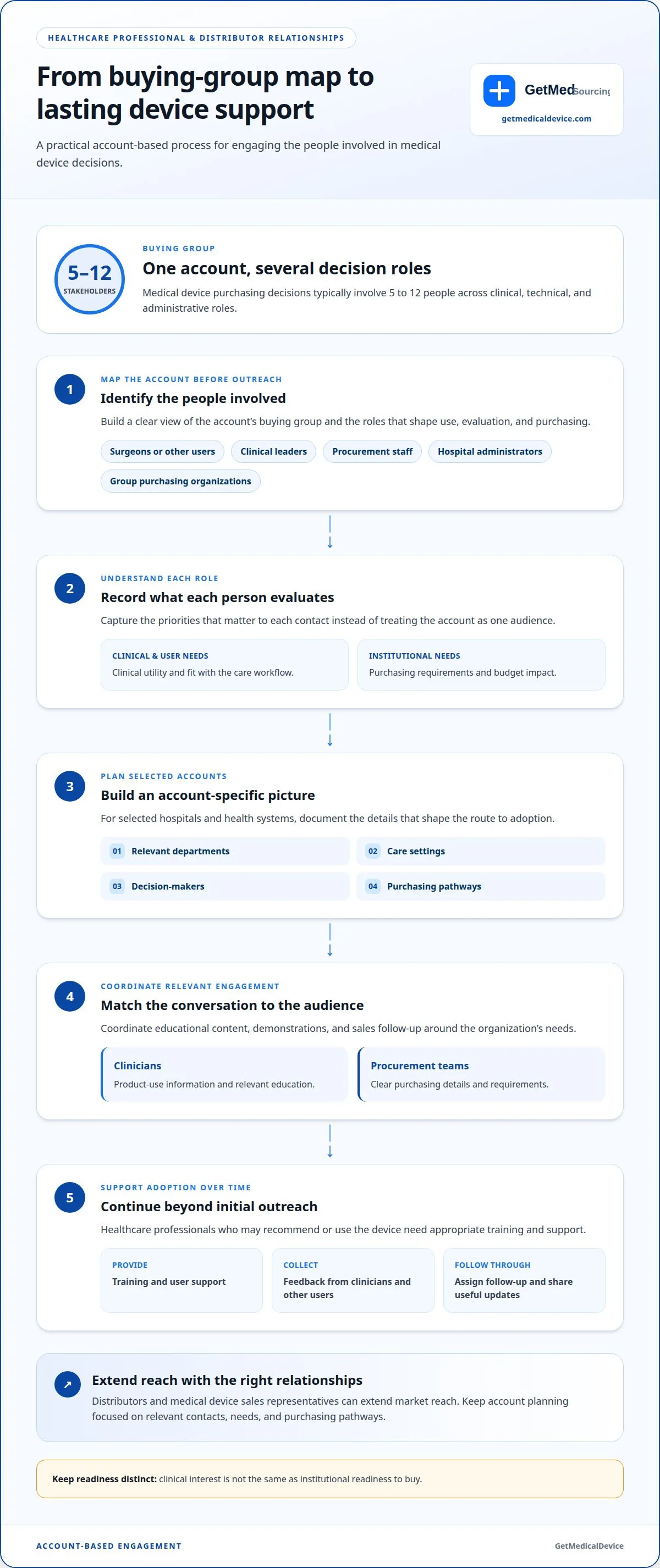
Medical device purchasing decisions typically involve 5 to 12 stakeholders across clinical, technical, and administrative roles. Map each account before outreach: identify surgeons or other users, clinical leaders, procurement staff, hospital administrators, and group purchasing organizations. Record what each evaluates, such as clinical utility, workflow fit, purchasing requirements, or budget impact. This map helps teams plan relevant conversations instead of sending one message to every contact.
Account-based marketing applies this market map to selected hospitals and health systems. For each organization, document relevant departments, care settings, decision-makers, and purchasing pathways. Coordinate educational content, demonstrations, and sales follow-up around the account’s needs. Clinicians may need product-use information, while procurement teams need clear purchasing details. Consistent account planning builds awareness without confusing clinical interest with institutional readiness to buy.
Relationships continue after initial outreach. Healthcare professionals who may recommend or use a device need appropriate training and support, and user feedback can reveal adoption barriers and inform improvements. Set a process to collect input from clinicians and other device users, assign follow-up, and share useful updates. Distributors and medical device sales representatives can extend market reach. Choose distribution channels based on how the device will reach end users, and define responsibilities for product communication and account coverage.
Hospitals, clinics, distributors, and direct sales can all play a role; the strongest channel depends on the intended end user and route to procurement. Direct sales led the global medical devices market by sales channel in 2025, but that market-level fact does not make direct sales the right choice for every device. Compare how target customers purchase, where professional relationships are essential, and what support each route requires. Review account engagement, qualified opportunities, adoption, and customer feedback to identify which relationships support sustainable growth.
4. Audience segmentation and personalized campaigns
Start audience segmentation with the device’s cleared indications and the specialties it serves. Identify who uses it, who influences selection, and who controls procurement. Messaging for a device intended for a specific clinical specialty should reflect that specialty’s workflows and patient-care context. Address clinicians, administrators, and procurement professionals separately because each group evaluates different information.
Define the unique selling proposition using substantiated factors such as efficacy, product features, or cost-effectiveness. Connect each point to a documented customer need. If clinicians prioritize ease of use, for example, explain the relevant device features and supporting evidence. If administrators focus on operational impact, address workflow and purchasing considerations. This keeps campaign claims relevant and recognizes that buyers have different priorities.
Choose channels based on how each segment consumes professional information. LinkedIn can support outreach through relevant posts and educational content, while direct email can deliver focused messages to defined contacts. Webinars, events, social media, and partnerships offer other ways to build awareness. Match the format to the purpose: a webinar can explain clinical evidence, while a concise email can direct procurement teams to practical product information.
Use campaign results to refine segments and messages. Track indicators tied to each objective, such as engagement with educational content, qualified inquiries, or movement from inquiry to sales conversation. Review these signals by specialty, role, and account instead of relying only on total reach. Gather feedback from healthcare professionals and device users to identify unanswered questions or adoption barriers. Then adjust content and channels, keeping every message consistent with the device’s cleared indications. This process helps teams address specific needs, build useful insights, and focus resources on audiences relevant to the launch.
GetMedicalDevice: Verified Supplier Membership
GetMedicalDevice helps medical device suppliers gain visibility among buyers. Its Verified Supplier Membership and Premium Product Listings let suppliers showcase inventory to a global network of buyers. RFQ Response Credits enable suppliers to respond to procurement requests from hospitals, clinics, and international distributors.
Consider these tools when your company is ready to present medical devices to professional buyers or respond to relevant sourcing requests. A listing makes product information accessible to prospective buyers, while an RFQ response provides a way to engage with procurement demand. These tools support market outreach but do not replace clinical evidence, regulatory compliance, or a focused commercial strategy.
Visit GetMedicalDevice to explore supplier membership and listing options.
Turn Your Market Strategy Into the Next Step
Set a focused objective for the next stage of your launch: choose the customer segment you intend to reach, identify the evidence that matters to its decision-makers, and define how you will measure progress. This creates a practical basis for adapting as buyer needs and market conditions develop. Gaining market share for a new medical device is an ongoing commercial process, not a single campaign. It requires consistent decisions about where to focus and how to respond to what the market reveals.
For suppliers seeking a business-to-business channel to present medical devices and respond to procurement requests, GetMedicalDevice offers tools that support visibility and buyer engagement. Choose the Verified Supplier Membership, Premium Product Listings, and RFQ Response Credits that fit your commercial priorities.
Contact GetMedicalDevice to discuss your strategy and identify a clear path for your next phase of growth.
Frequently Asked Questions
Why does medical device marketing require a specialized strategy?
Medical device marketing must connect product communication with clinical use, purchasing requirements, and regulatory boundaries. Distinguish what clinicians need to assess from what procurement teams need to evaluate. For example, organize sales materials so claims, supporting evidence, and purchasing information are easy to find. This makes communication more relevant throughout the decision process and helps teams identify gaps before broader promotion.
How should medical device companies identify target customers and unmet clinical needs?
Start with the device’s intended use, then identify the specialties and care settings where the need arises. Examine current workflows, treatment protocols, and recurring operational problems through structured discussions with relevant healthcare professionals. Compare those findings with existing alternatives to distinguish an unmet clinical need from a preference for another product. Record which users experience the problem and who influences purchasing, then validate the segment before building campaigns.
How can clinical evidence and health-economic data persuade clinicians and hospital purchasing committees?
Present clinical evidence in terms of the question each audience must assess: patient outcomes, comparative performance, or use in a specific setting. Explain study design and limitations clearly instead of relying on broad claims. For health-economic discussions, show relevant resource use, budget implications, and the assumptions behind any value analysis. A purchasing committee can then assess whether the evidence applies to its patient population and operational context.
What risks should a new medical device company plan for when entering a competitive U.S. market?
Plan for risks such as regulatory pathway and claims misalignment, evidence gaps, reimbursement uncertainty, entrenched alternatives, and lengthy procurement processes. These issues can affect launch timing and adoption even when a device addresses a genuine clinical need. Maintain a risk register that assigns an owner, an early warning indicator, and a response to each issue. For example, flag stalled purchasing discussions for review of workflow fit, coverage assumptions, or evidence relevance.
What are typical U.S. medical device launch, sales, and marketing costs?
Costs vary with a device’s classification, regulatory pathway, clinical evidence needs, and campaign scope. Budget separately for evidence generation, market access planning, sales enablement, and audience-specific promotion.


