

Finding suppliers for catheterization lab equipment starts with making the request specific enough for suppliers to respond to each item. A cath lab may need imaging systems, monitoring equipment, room equipment, or interventional products, and each category calls for different product details. If RFQs use inconsistent identifiers or leave out the destination and documentation expectations, it becomes harder to compare responses.
A structured sourcing process turns your requirements into a clear RFQ and keeps procurement decisions under your control. Define the equipment scope, include product identifiers and quantities, then compare supplier responses against the same fields, including destination, timing, and requested documents. GetMedicalDevice provides an RFQ-first route to supplier options from a network spanning 80+ countries. Its listed brands include Abbott, Boston Scientific, and Asahi. Supplier availability and commercial terms vary, so use responses as a starting point and independently verify supplier legitimacy, documentation, regulatory compliance, and clinical suitability before purchase.
Key Takeaways
- Set the sourcing scope by separating capital equipment, procedural packs, disposable devices, and other requirements by function.
- Make finding suppliers for catheterization lab equipment more systematic with an RFQ that specifies identifiers, quantities, destination, timing, and documentation expectations.
- Compare supplier responses in a consistent format, distinguishing supplier-provided details from your own findings and unresolved questions.
- Use GetMedicalDevice’s RFQ workflow to organize supplier communication, while retaining responsibility for checks, procurement decisions, and agreement on sales and delivery terms.
Table of Contents
- Define the catheterization lab equipment your procurement request must cover
- Build a catheterization lab equipment RFQ suppliers can respond to
- Compare cath lab supplier responses without treating a match as approval
- GetMedicalDevice RFQ: From Request to Supplier Contact
Define the catheterization lab equipment your procurement request must cover
Before contacting suppliers, define what the request covers. A cath lab project might involve a major capital system, room equipment, procedural packs, disposable devices, or a combination. These categories describe the sourcing scope; product specifications identify the exact item or configuration. A general overview of catheterization laboratory equipment can help procurement teams map the environment, but the RFQ should reflect the facility’s own requirements.
Separate major systems, room equipment, and procedure supplies
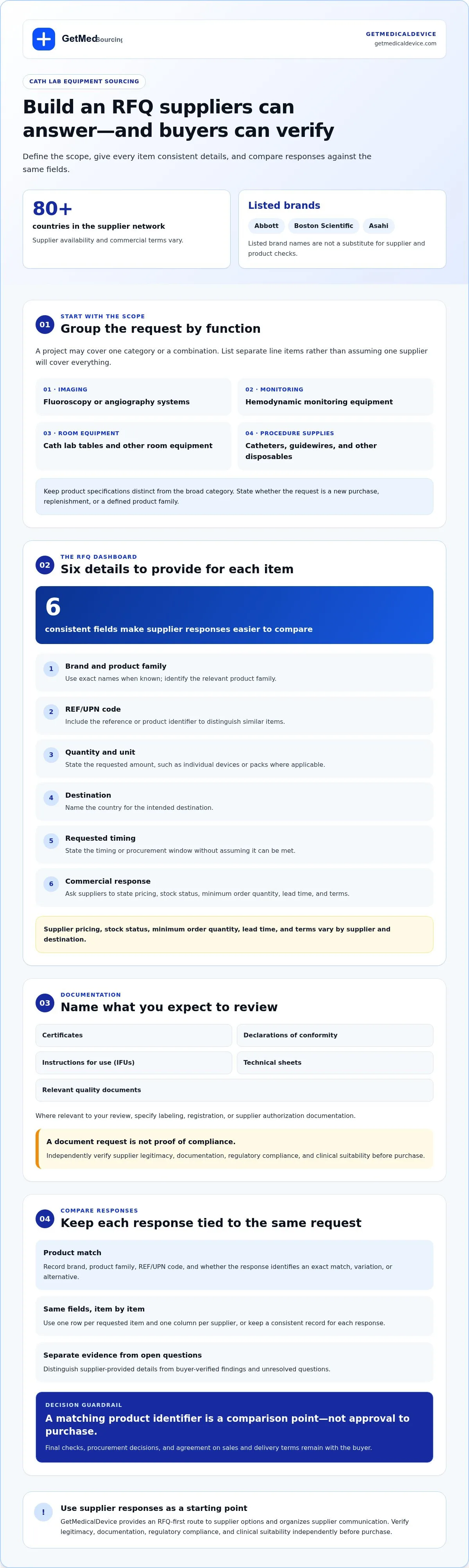
Group items by function so suppliers can respond to the relevant part of the request. Imaging may include fluoroscopy or angiography systems. Hemodynamic monitoring equipment and cath lab tables are separate categories, while catheters, guidewires, and other disposable procedural supplies belong under procedure supplies. This is not a complete inventory, so include only categories relevant to your request. For product-family context, distinguish coronary intervention products from equipment or supplies associated with interventional radiology.
Turn an equipment list into a sourcing scope
State whether the request covers a new purchase, replenishment, or a defined product family. Then record the facility or procedure area, destination country, requested timing, and purchasing context. Separate products into individual line items rather than assuming one supplier will cover every category. This makes it clearer which parts of the request each response addresses.
Use a concise scope statement before adding individual product details:
- Scope: Cath lab imaging system, monitoring equipment, room equipment, procedure supplies, or a stated combination.
- Context: Facility or procedure area, destination, timing, and whether this is a new purchase or replenishment.
- Product detail: Brand, product family, and available identifiers, recorded separately for each item.
Describe intended use factually, such as the procedure area or equipment function. Leave clinical suitability decisions to the buyer and qualified stakeholders. This gives the RFQ a defined scope while leaving room to specify each product precisely.
Build a catheterization lab equipment RFQ suppliers can respond to
A useful RFQ turns the sourcing scope into fields suppliers can answer consistently. For each item, provide the product identifiers and commercial context you have, then state which documents you expect to review. Separate line items and consistent fields make responses easier to compare and help identify missing information. They do not guarantee a quote or a particular level of detail. This approach supports finding suppliers for catheterization lab equipment without assuming that every supplier covers every category.
Which product identifiers and request details should buyers include?
Use this checklist for each product or product family. Keep separate items on separate lines, even when they are part of one cath lab project.
- Brand and product family: Use the exact names when known. Category searches may include coronary intervention products or interventional radiology supplies.
- REF/UPN code: Include the reference or product identifier to distinguish similar items.
- Quantity: State the requested amount and unit, such as individual devices or packs, where applicable.
- Destination: Name the country for the intended destination.
- Timing: State the requested timing or procurement window without assuming a supplier can meet it.
- Commercial response: Ask suppliers to state pricing, stock status, minimum order quantity, lead time, and terms. These vary by supplier and destination.
How should documentation expectations be stated?
Name the documents you expect, such as certificates, declarations of conformity, instructions for use (IFUs), technical sheets, and relevant quality documents. Where relevant to your review, specify labeling, registration, or supplier authorization documentation. The IAC Cardiovascular Catheterization accreditation resource provides context on accreditation, but it does not establish whether a particular product or supplier meets your requirements.
Requesting documents is not proof of compliance. Buyers must independently verify supplier legitimacy, documentation, regulatory compliance, and clinical suitability before purchase. A structured RFQ through GetMedicalDevice’s sourcing platform captures product and destination details for supplier communication. Final checks and purchasing decisions remain with the buyer.
Compare cath lab supplier responses without treating a match as approval
Supplier responses are easier to assess when each is recorded against the same request fields. A matching product identifier is a useful comparison point, not confirmation that the supplier, documentation, or product is suitable for purchase. When finding suppliers for catheterization lab equipment, keep supplier statements distinct from buyer-verified findings and questions that remain open.
What belongs in a supplier-response comparison?
Build one row per requested item and one column per supplier, or keep a consistent record for each response. Record the requirement alongside what the supplier actually states:
- Product match: Brand, product family, REF/UPN code, and whether the response identifies an exact match, a variation, or an alternative.
- Quantity and destination: Requested versus quoted quantity, destination country, and any supplier-stated limits or conditions.
- Documents: Record each document received, its identifier or version where provided, and any requested item still missing.
- Commercial terms: Note supplier-stated price, stock status, minimum order quantity, lead time, delivery terms, and other conditions separately.
Label each entry as “supplier stated,” “buyer reviewed,” or “unresolved.” This prevents an unanswered field from appearing settled. Stock, delivery, pricing, minimum quantities, and terms may vary by supplier and destination. A response does not guarantee that those details will remain available.
What verification remains the buyer's responsibility?
A platform verification status relates to the platform’s supplier-listing process. It is not proof of regulatory compliance, product documentation validity, or clinical suitability. Before purchase, independently assess supplier legitimacy, review the submitted documents, and verify compliance for the product and destination through your own processes. Qualified buyer-side stakeholders must determine clinical suitability.
Buyers retain final responsibility for procurement, documentation review, compliance verification, and product-suitability decisions. Use the comparison to organize evidence and identify gaps, not to replace those checks. GetMedicalDevice provides a structured way to compare supplier responses as part of your sourcing process.
GetMedicalDevice RFQ: From Request to Supplier Contact
Finding suppliers for catheterization lab equipment involves more than identifying a product listing. GetMedicalDevice is a professional B2B sourcing and RFQ support platform that structures the process from request to supplier communication. The workflow has four steps:
- Capture the request: Record product and destination requirements, including identifiers, quantity, timing, and documentation expectations.
- Match supplier options: Use the request details to identify relevant supplier options. A match is a starting point for communication, not a procurement recommendation.
- Compare responses: Review supplier-provided product details, documents, availability, and commercial terms against the original request.
- Proceed with control: Complete buyer-side checks and decide whether to negotiate or purchase.
This RFQ-first approach organizes supplier contact across a platform with suppliers from 80+ countries. It follows the same broad considerations as the Global Medical Device Sourcing Guide: define the request, account for destination, and assess responses before deciding how to proceed.
What happens after a buyer submits an RFQ?
Structured details help match the request with supplier options and provide a consistent basis for comparing replies. Suppliers determine their own availability, pricing, lead times, minimum order quantities, delivery arrangements, and commercial terms. These vary by supplier, destination, stock status, and market conditions. Submitting an RFQ is not a purchase contract and does not guarantee a response, availability, or sourcing outcome. Sales, invoices, delivery terms, and commercial commitments are handled by the supplier.
How to proceed while retaining procurement control
Review each response, then independently verify supplier legitimacy and documentation, assess regulatory compliance for the relevant product and destination, and have qualified stakeholders determine clinical suitability. Final procurement and compliance decisions remain with the buyer. A purchase proceeds only through a separate buyer-supplier agreement on commercial terms.
Procurement teams can use GetMedicalDevice’s structured cath lab RFQ workflow to organize supplier communication.
Put Your Cath Lab Sourcing Process Into Action
Use your next procurement request to establish a repeatable process. Assign responsibility for reviewing supplier information, recording unresolved questions, and coordinating the buyer-side stakeholders who assess documentation and clinical suitability. Keep supplier claims distinct from findings your team has independently established.
Finding suppliers for catheterization lab equipment is not complete when responses arrive. The next step is a deliberate buyer-led review, followed by a separate agreement with the selected supplier if the requirements and terms meet your needs. Maintain that distinction throughout procurement.
GetMedicalDevice provides a structured route for submitting an RFQ and communicating with supplier options. Submit a structured cath lab equipment RFQ through GetMedicalDevice to organize your sourcing request and begin supplier communication.
Frequently Asked Questions
How do I find suppliers for catheterization lab equipment?
To find suppliers for catheterization lab equipment, define the scope, identify relevant product families, and prepare a structured RFQ. Include known product identifiers, quantities, destination, timing, and requested documents. For a mixed request, separate items rather than grouping unrelated products. This makes supplier responses easier to map to individual requirements. Before purchase, independently verify supplier legitimacy, documentation, regulatory compliance, and product suitability.
What should I include in a cath lab equipment RFQ?
Include product identifiers and transaction details for each line item, then name the documents you expect. These may include certificates, declarations of conformity, IFUs, technical sheets, quality documents, labeling details, registration information, and supplier authorization documents. Avoid a broad request such as “send all compliance documents.” State which materials you need and for which products. Clear fields define the request but do not ensure stock or particular terms.
Are suppliers on a sourcing platform automatically approved for my purchase?
No. A platform’s supplier verification status is not approval for your specific transaction. It does not establish compliance for the destination, confirm that documents apply to a particular product, or determine clinical suitability. Before purchase, independently verify the supplier’s legitimacy, review relevant documentation, and assess compliance through your own processes. Record who completed each review and what remains unresolved. The buyer retains responsibility for supplier selection, procurement, and product-suitability decisions.
Does submitting an RFQ create a purchase contract?
No. An RFQ communicates the products and terms for which you are seeking a supplier response. Submitting it does not create a purchase contract. A transaction requires a separate agreement between the buyer and supplier on commercial details such as price, payment, delivery, and warranty. Treat responses as supplier-provided information to evaluate, not as a commitment from the platform or a guarantee that a supplier will transact.
Can a sourcing platform guarantee cath lab equipment availability or delivery time?
No. A platform can facilitate supplier matching and communication, but it cannot guarantee stock, shipment, or a delivery date. Availability, pricing, lead time, minimum order quantity, shipping options, and terms vary by supplier, destination, stock status, and market conditions. Treat estimates as supplier-provided information, confirm relevant details with the supplier before committing, and plan procurement schedules around terms agreed separately by both parties.

