

In 2026, finding international buyers for medical devices is no longer a data discovery problem; it's a verification and trust-facilitation challenge. You've likely encountered the high risk of fraudulent inquiries on generic B2B platforms or felt the friction of aligning your documentation with the now-mandatory FDA Quality Management System Regulation and EU EUDAMED modules. The primary difficulty isn't just being seen. It's proving your reliability to procurement officers who prioritize total lifecycle costs and strict regulatory compliance over simple unit pricing.
This article provides the systematic framework necessary to identify, verify, and secure high-intent international procurement partners. You'll learn how to establish a pipeline of verified buyers and reduce the time spent on unqualified RFQs. We'll cover the essential steps to leverage professional B2B marketplaces, satisfy the 2026 UK MHRA and EU MDR requirements, and position your products from brands like Boston Scientific or Abbott Vascular as the gold standard for global healthcare systems. By following this methodical approach, you can transform your export operations into a stable, high-value infrastructure.
Key Takeaways
- Adapt to the 2026 procurement landscape by aligning your operations with digital-first models and updated international regulatory standards.
- Implement a data-driven strategy for finding international buyers for medical devices by leveraging HS codes and trade intelligence to target active importers.
- Enhance your global visibility and reduce buyer friction through Verified Supplier memberships and premium product listings for tier-1 brands like Terumo and Asahi Intecc.
- Optimize your sales funnel by utilizing credit-based RFQ systems to focus resources on high-intent procurement requests from global clinics and hospitals.
Table of Contents
- The Landscape of Global Medical Device Procurement in 2026
- Methods for Identifying High-Intent International Buyers
- Optimizing Your Presence for Global Sourcing Success
- Executing the Sale: From RFQ to Secured Contract
The Landscape of Global Medical Device Procurement in 2026
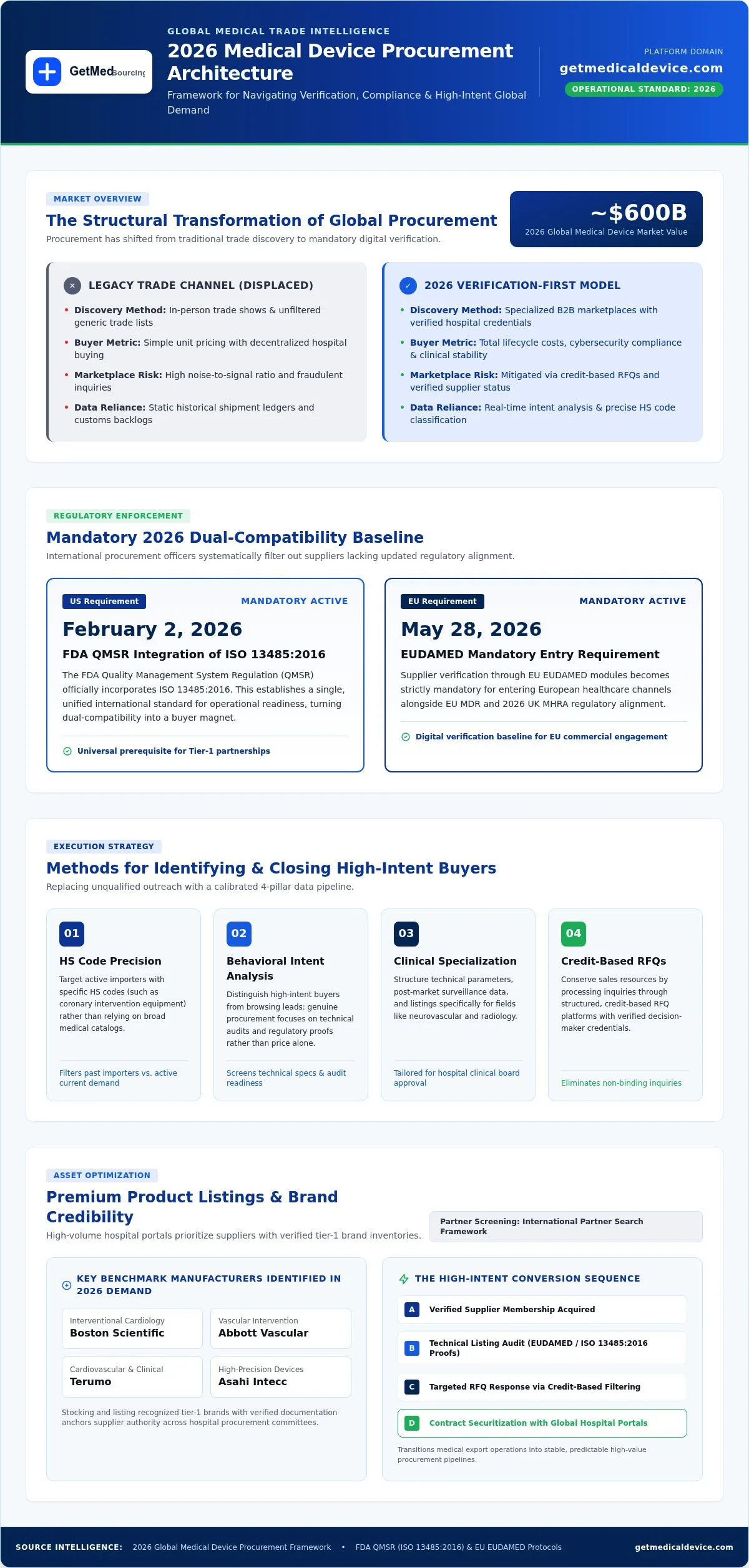
The global medical device market, valued at approximately $600 billion in 2026, has undergone a structural transition. Traditional trade shows no longer serve as the primary engine for high-volume procurement. Instead, finding international buyers for medical devices now requires presence on specialized B2B platforms that prioritize real-time verification over historical shipment data. In this environment, discovery is secondary. Buyers use digital filters to isolate suppliers who prove immediate regulatory readiness and operational stability.
Regulatory Compliance as a Buyer Magnet
Modern procurement directors avoid risk by filtering for dual compatibility. As of February 2, 2026, the FDA QMSR officially incorporates ISO 13485:2016. This creates a unified global standard. Suppliers who maintain these certifications and adhere to medical device classification and regulations attract tier-1 partners more efficiently. Verification through EUDAMED became mandatory for EU market entry on May 28, 2026. Buyers treat these digital credentials as the mandatory baseline for any commercial engagement.
Digital Transformation in Hospital Sourcing
Hospital procurement teams have moved away from decentralized purchasing. They now utilize centralized B2B portals to source high-demand surgical products and interventional equipment. This shift allows for better oversight of total lifecycle costs and cybersecurity compliance. Specialized marketplaces facilitate these high-value interactions by providing a structured environment where verified suppliers respond to live RFQs. This system replaces the friction of traditional outreach with a streamlined, data-driven workflow, making the process of finding international buyers for medical devices more predictable and efficient.
Methods for Identifying High-Intent International Buyers
Identifying active procurement partners requires a shift from historical data to real-time intent analysis. While customs records provide a list of past importers, finding international buyers for medical devices in 2026 demands a focus on current RFQ activity. Suppliers should utilize specific HS codes to filter for categories such as coronary intervention equipment. This precision ensures you target distributors who actively stock tier-1 brands like Abbott Vascular or Boston Scientific. It's about data accuracy.
Behavioral analysis is essential for distinguishing between "browsing" entities and high-intent procuring buyers. High-intent buyers typically engage with technical specifications and regulatory documentation. They don't just look at price. For additional vetting, the International Partner Search service provides a framework for screening potential distributors through government-assisted channels. Use these resources to verify operational stability before entering negotiations.
Leveraging Specialized B2B Marketplaces
Generic platforms often suffer from high noise-to-signal ratios and unverified inquiries. Niche marketplaces focus exclusively on medical-grade equipment, offering curated buyer networks that outperform raw lead lists. These platforms verify the credentials of hospital procurement officers, ensuring your responses reach legitimate decision-makers. You can review premium product listings to understand how top-tier suppliers structure their offerings for this professional audience.
Targeting by Clinical Specialization
Generic marketing fails to capture the attention of specialized procurement officers. Strategies for reaching buyers in fields like neurovascular or radiology must center on clinical relevance. Providing detailed technical parameters and post-market surveillance data attracts higher-quality leads. This specialized approach ensures your visibility is concentrated where the clinical need is greatest. It makes finding international buyers for medical devices a more predictable process for specialized manufacturers.
Optimizing Your Presence for Global Sourcing Success
Finding international buyers for medical devices requires a digital presence that mirrors the clinical precision of the products themselves. Standard marketing materials are insufficient for 2026 procurement cycles. Buyers now perform deep technical audits of listings before initiating an RFQ. By aligning your documentation with global medical device procurement standards, you provide the necessary data for clinical board approval. Premium product listings further enhance this by ensuring high-demand inventory from brands like Terumo or Asahi Intecc remains visible to active procurement officers in high-growth regions.
The Anatomy of a High-Converting Product Listing
Listings for critical care categories, such as vascular access, must prioritize technical clarity over promotional language. Essential elements include UDI-DI records, sterilization specifications, and precise shelf-life data. These parameters allow buyers to verify compatibility with local healthcare protocols immediately. The Verified Supplier badge serves as a formal credential that confirms a manufacturer's regulatory standing and operational capacity within the 2026 global trade environment. This badge reduces the perceived risk for international buyers, facilitating a faster transition from discovery to contract negotiation.
Establishing Professional Authority
Establishing authority requires more than a product catalog. Large-scale hospital contracts often depend on a supplier's ability to demonstrate a verified transaction history and successful case studies. Use these data points to build a digital trust portfolio that proves your reliability as a stable global intermediary. For a deeper analysis of these standards, refer to our guide on Verified Medical Device Suppliers: A Global Procurement and Verification Guide for 2026. This structured approach is the most efficient method for finding international buyers for medical devices who prioritize long-term stability.
Apply for Verified Supplier Membership to start listing premium products.Executing the Sale: From RFQ to Secured Contract
Finding international buyers for medical devices is only the initial phase; the objective is converting high-intent inquiries into secured contracts. In 2026, the RFQ process on specialized platforms requires a dual-track communication strategy. You must provide technical data that satisfies clinical stakeholders while meeting the budgetary and compliance parameters of procurement officers. For complex items like neurovascular devices, your response should highlight supply chain stability and immediate availability to address urgent hospital requirements. It's about positioning your inventory as the most logical and lowest-risk solution.
Strategic Bidding with RFQ Credits
Efficient resource allocation is vital for maintaining a profitable export operation. Before committing RFQ Response Credits, evaluate the inquiry's quality by checking for specific technical parameters and defined procurement timelines. Don't bid on generic or vague requests that lack clinical depth. Maximize your ROI by focusing on inquiries that align with your current stock of tier-1 brands like Terumo or Asahi Intecc. This targeted approach ensures that your bidding activity remains a precise operation rather than a speculative exercise.
Scaling Global Sales with GetMedicalDevice
Scaling your international presence involves integrating professional B2B tools into your daily business development workflow. The platform facilitates direct interaction with a global network of hospitals and clinics, removing the ambiguity found in traditional trade channels. By maintaining a Verified Supplier status and utilizing strategic bidding, you establish a reputation for reliability in the global market. This systematic method is the most effective way to ensure a consistent pipeline of high-value contracts without the friction of unverified leads.
Explore our Verified Supplier Membership to start connecting with international buyers and optimize your global sales strategy today.
Securing Your Position in the 2026 Global Medical Market
The transition to digital-first procurement models is complete. Success in finding international buyers for medical devices now depends on your ability to demonstrate immediate regulatory compliance and operational transparency. You've seen how optimizing technical listings and utilizing strategic RFQ bidding allows you to reach high-intent procurement officers efficiently. This methodical approach replaces speculative outreach with a verified, data-driven workflow that prioritizes accuracy and clinical relevance.
Establishing a verified status for premium brands like Terumo and Asahi Intecc provides the trust signals necessary for large-scale hospital contracts. Our global B2B network specialized in interventional radiology ensures your inventory reaches the correct clinical stakeholders without the friction of generic directories. By integrating these systematic frameworks into your business development workflow, you can build a stable pipeline of international sales. Access Global Buyers with a Verified Supplier Membership to begin responding to direct hospital RFQs and scaling your global footprint. We look forward to facilitating your expansion into these high-growth international markets.
Frequently Asked Questions
What are the best platforms for finding international medical device buyers?
Specialized B2B marketplaces like GetMedicalDevice are the most effective for finding international buyers for medical devices in 2026. Unlike generic directories, these platforms focus on verified procurement requests from hospitals and clinics. They allow suppliers to list products from brands like Boston Scientific and Abbott Vascular to a targeted audience. This specialization ensures that inquiries originate from legitimate healthcare entities rather than unqualified or fraudulent leads.
How do I verify the legitimacy of a global medical equipment buyer?
Verification requires a multi-step process involving digital audit trails and platform-level screening. You should audit the buyer's historical activity and check for a history of active procurement within specialized marketplaces. GetMedicalDevice facilitates this by providing a structured environment where only verified buyers can issue RFQs. Utilizing such a platform reduces the risk of fraudulent inquiries and ensures you engage with legitimate hospital procurement officers globally.
Which medical device categories have the highest international demand in 2026?
High-growth categories for 2026 include interventional radiology, neurovascular catheters, and specialized surgical products. Demand is particularly strong in the Asia-Pacific region where hospital infrastructure is expanding rapidly. Products from tier-1 brands like Terumo and Asahi Intecc are consistently sought after by international distributors. Focusing your inventory on these clinically essential categories increases your chances of finding international buyers for medical devices who require high-precision equipment.
What is the role of a B2B marketplace in the medical device export process?
A specialized B2B marketplace acts as a formal intermediary that streamlines the connection between suppliers and global healthcare facilities. It provides the infrastructure for listing premium products and managing the RFQ process through a credit-based system. This allows suppliers to bid strategically on high-value requests without the friction of traditional trade channels. The marketplace ensures that all participants adhere to standardized documentation and verified operational procedures.
How can I increase the visibility of my medical products to hospital procurement officers?
Increasing visibility requires obtaining a Verified Supplier status and utilizing premium product listings. Hospital procurement officers prioritize suppliers who demonstrate regulatory readiness and operational capacity. By showcasing inventory from brands like Boston Scientific or Abbott Vascular on a specialized platform, you align your products with high-demand search queries. Providing comprehensive technical data sheets within your listings also ensures your equipment passes initial clinical board reviews efficiently.