

A distributor commission commonly ranges from 20% to 50% of margin, while a commission based on total sale revenue commonly ranges from 10-25%. Finding distributors for interventional medical devices means comparing the calculation basis, product category, and negotiated terms, not just the headline rate.
The commission matters, but it is only one part of a viable distribution arrangement. A partner’s customer relationships, market coverage, operational capacity, and regulatory readiness all affect whether the arrangement supports your product and commercial goals.
This article explains how commission structures work, what to assess when evaluating market fit and distributor requirements, and how direct, indirect, and hybrid models compare with using an In-Country Representative. You’ll also see how to evaluate a distributor’s commercial and operational capabilities, and where a B2B platform can support supplier visibility and buyer connections.
Key Takeaways
- Match a distributor’s customer relationships and experience with similar products to the specialties and care settings your device serves.
- Assess regulatory readiness, financial capacity, service operations, and sales plans together to judge whether a distributor can support the market.
- Compare direct, indirect, and hybrid models by the level of control, resources, and market access each requires.
- Separate commercial distribution from regulatory representation when you need sales and regulatory responsibilities handled through distinct roles.
Table of Contents
- Customer-base fit and experience with similar products
- Distributor regulatory, operational, and commercial requirements
- Direct, indirect, and hybrid distribution models
- Distributors versus In-Country Representatives
- GetMedicalDevice: Verified Supplier Membership
Customer-base fit and experience with similar products
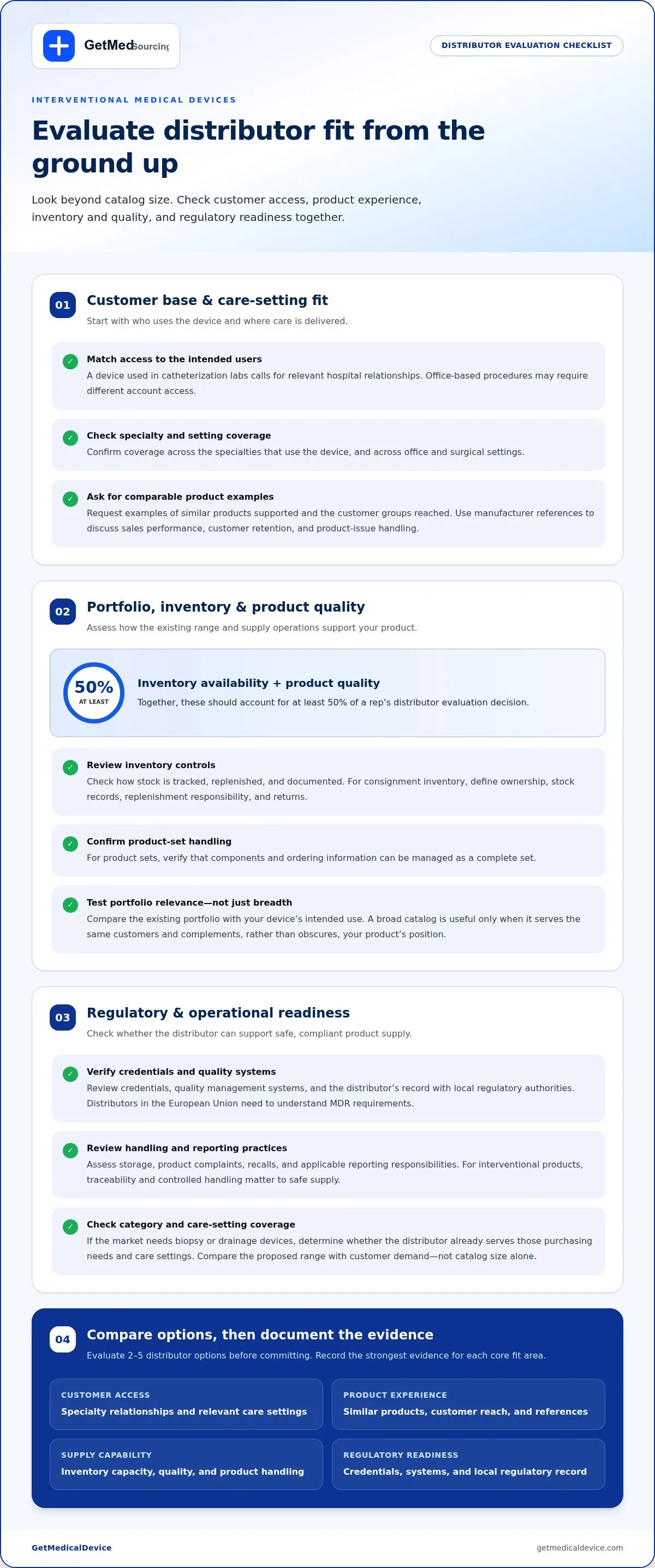
Start with the buyers and care settings the device is designed for. An interventional product used in catheterization labs needs a distributor with relevant hospital relationships; a product used in office-based procedures may require different account access. Look for coverage across the specialties that use the device and across office and surgical settings. Ask for examples of similar products the distributor has supported and the customer groups it has reached.
Assess the distributor’s record using references from manufacturers it has represented. Discuss sales performance, customer retention, and its handling of product issues. Compare its existing portfolio with your device’s intended use. A broad catalog is useful only if it serves the same customers and complements, rather than obscures, your product’s position.
Inventory and quality deserve substantial weight. Together, inventory availability and product quality should account for at least 50% of a rep’s distributor evaluation decision. Review how the distributor tracks stock, replenishes products, and maintains product documentation. For consignment inventory, define ownership, stock records, replenishment responsibility, and the process for returns. For product sets, confirm that the distributor can manage the components and ordering information as a complete set.
Check regulatory readiness alongside commercial fit. Verify the distributor’s credentials, quality management systems, and record with local regulatory authorities. Distributors in the European Union need to understand MDR requirements. Assess how the partner manages storage, product complaints, recalls, and applicable reporting responsibilities. For interventional products, traceability and controlled handling are important to safe supply.
Finally, assess portfolio coverage at the level of relevant product categories. If your target market needs biopsy or drainage devices, determine whether the distributor already serves those purchasing needs and care settings. Compare the proposed product range with customer demand, not catalog size alone. Evaluate 2-5 distributor options before committing, then document the strongest evidence of specialty access, product experience, inventory capacity, and regulatory readiness.
Distributor regulatory, operational, and commercial requirements
Assess regulatory readiness alongside financial stability, sales capability, and market coverage. These factors shape both market entry and ongoing control of product supply.
Market Authorization and Local Representation
Market authorization and local representation define a device’s regulatory pathway and responsibilities in each country. For U.S. sales, FDA requirements depend on the device and each party’s role, so establish applicable authorization and responsibilities before distribution begins. In Texas, medical device manufacturers and distributors are subject to state licensing standards, and inspections support compliance. Across markets, document applicable requirements and clarify who maintains regulatory records, handles incident reporting, and communicates with local authorities. Include government pricing controls in market planning because pricing rules can affect commercial terms.
Distributor Qualifications
Qualified distributors combine market access with financial, regulatory, and operational capability. Assess financial stability, ability to manage large orders and make timely payments, regional or national coverage, and capacity to scale. Verify required licenses and certifications, quality management systems, and the distributor’s record with local regulatory authorities. During recruitment and onboarding, compare commercial plans and sales forecasts, then document responsibilities, reporting, product training, inventory processes, and compliance expectations. In Brazil, for example, distribution capability includes familiarity with ANVISA processes.
Third-Party Distributor Risks
Third-party distribution can reduce the manufacturer’s direct control over customer interactions, stock, and market execution. Poor financial stability can disrupt orders or payments; weak inventory controls can affect replenishment and delivery. Contract terms can also create exposure through exclusive territorial rights or minimum purchase commitments. In the United States, define territory boundaries, sales reporting, inventory records, training responsibilities, and compliance escalation in writing. Align performance indicators with regular reporting, and specify how complaints, recalls, and applicable adverse event reports are handled. These controls make performance gaps visible and clarify accountability without relying on informal expectations.
Direct, indirect, and hybrid distribution models
Distribution structure determines who sells the device, manages customer relationships, and controls market execution. Manufacturers can sell directly, use third-party distributors, or combine both approaches. The right model depends on available resources, desired control, and the market access the product needs.
With direct distribution, the manufacturer sells to hospitals or other healthcare facilities. This model gives the manufacturer greater control over pricing, customer communication, and product positioning. For instance, specialized imaging developers like Animage demonstrate how direct engagement allows makers of advanced diagnostic platforms to maintain close oversight of technical training and client support. It must also provide the infrastructure for sales and market coverage, including customer support and order coordination.
Indirect distribution relies on wholesalers, distributors, or agents to reach end users. A distributor may draw on existing relationships with hospitals and clinics, helping a manufacturer enter markets without building an equivalent local commercial network. The trade-off is less direct control over sales execution and customer interactions. Contracts and reporting should therefore define territory, responsibilities, and performance expectations.
Hybrid distribution combines direct sales with third-party coverage. A manufacturer might manage strategic hospital accounts directly while using a distributor to serve other facilities or regions. This structure can preserve direct engagement with priority customers while extending reach through an established network. Clear account boundaries help prevent overlap between the manufacturer’s team and distributor representatives.
When evaluating models, compare the resources required for direct coverage with the reach a distributor can provide. Consider product complexity, the number and type of healthcare facilities involved, and the support required after a sale. A specialized interventional device may need close manufacturer involvement in product education, while a distributor can contribute local customer access and commercial execution. In other technical and scientific sectors, niche distributors like eoillc.com illustrate how specialized product knowledge and customer support bridge complex equipment with end users. Assign training, service, inventory, and customer communication responsibilities to fit the selected model.
Market conditions can also change the balance. Distribution rationalization and business consolidation may affect partner coverage, while government pricing regulations can shape commercial planning. Review the structure periodically against sales results, customer access, and operational demands. A hybrid arrangement can be adjusted as direct capabilities develop or market coverage requirements change.
Distributors versus In-Country Representatives
A distributor and an In-Country Representative (ICR) perform different functions in a medical device market. A distributor generally purchases, imports, and resells devices; an ICR serves as a regulatory contact and does not conduct commercial activities. Assigning each role clearly helps manufacturers plan sales and regulatory responsibilities separately.
Distributors can include wholesalers, distribution or sales agents, marketing agents, brokers, commercial agents, and independent sales representatives. Their commercial networks may connect manufacturers with healthcare facilities and support product sales. An ICR can assist with device registrations and incident reporting requirements. Separating regulatory representation from distribution can allow a manufacturer to change commercial partners without disrupting its regulatory standing in that market.
Assess each role against the work required. If the priority is purchasing, importing, and reselling devices, the distributor’s commercial capacity is central. If the need is regulatory contact, an ICR may suit that responsibility. Some markets may require both functions, so the agreement should distinguish who manages customer accounts, regulatory communication, and incident reporting.
Contract terms shape the working relationship. A 180-day termination notice period is described as better for a distributor agreement. Some agreements provide a 3-6 month commission tail on accounts developed by the representative. Review how these terms interact with territory rights and account ownership. A 24-month non-compete covering all orthopedic devices in a representative’s territory is described as a business death sentence, illustrating why scope and duration matter.
Reputation and continuity also affect performance. Ask how many representatives have left during the past 12 months, then consider how turnover could affect account relationships and product knowledge. Assess references and track record alongside the proposed coverage plan. For a distributor, an extensive network can support timely delivery to healthcare facilities. For an ICR, defined reporting duties can keep regulatory communication organized. Distinguish these outcomes before assigning responsibilities.
To explore supplier listings as part of your distribution search, review medical device supplier options.
GetMedicalDevice: Verified Supplier Membership
GetMedicalDevice provides a practical next step for medical device suppliers seeking buyer visibility and procurement opportunities. Verified Supplier Membership supports a supplier presence on the B2B platform, while Premium Product Listings let companies showcase inventory to a global network of buyers. These options can complement direct distributor outreach by making product information visible to hospitals, clinics, and international distributors.
For suppliers pursuing procurement requests, GetMedicalDevice’s RFQ Response Credits enable responses to buyer requests. Use the platform to present relevant medical devices and engage potential buyers as part of a wider distribution strategy. These options support visibility and RFQ participation, not regulatory representation or logistics.
Visit getmedicaldevice.com to explore the supplier options.
Build a Focused Next Step for Market Growth
Keep your distribution strategy active after selecting a partner. Review how buyer interest, product demand, and market priorities align, then use those signals to refine the regions and accounts you pursue. Finding distributors for interventional medical devices is an ongoing process of market development, not a one-time partner search.
For suppliers seeking additional visibility, GetMedicalDevice offers Verified Supplier Membership and Premium Product Listings. RFQ Response Credits let suppliers respond to procurement requests on the platform. These options can support visibility and buyer engagement alongside your distributor strategy.
If you’re ready to explore supplier visibility and procurement opportunities, contact GetMedicalDevice for distributor support. A clear next step can help you advance your market plans with purpose.
Frequently Asked Questions
What commission rate should I expect from a medical device distributor?
Rates vary by product category and calculation method. On a margin basis, orthopedic hardware commissions commonly range from 25-35%, spine hardware from 20-35%, biologics from 30-50%, and sports medicine instruments from 25-40%. Compare proposals only after defining the margin calculation, discount treatment, returns, and when commissions are earned. Document the agreed calculation method in the contract.
Do distributors provide consignment inventory, or do I need to purchase sets?
Either arrangement can work, depending on the commercial agreement and product requirements. With consignment, stock is placed for use or sale while ownership terms are defined by contract; purchased sets are acquired under agreed purchasing terms. Specify how the agreement handles set components, stock records, replenishment, damaged or expired items, and returns. These details affect inventory accountability and the distributor’s working capital.
How Do You Evaluate and Select the Right Distribution Partner?
Use a consistent evaluation framework so each candidate is assessed against the same commercial assumptions. Separate mandatory eligibility requirements from scored performance criteria, then record the evidence behind each decision. For example, compare proposed territory coverage and forecasts with your target accounts and internal sales plan. Resolve gaps before negotiating exclusivity, minimum purchases, or reporting expectations, and document why the arrangement fits the product’s market strategy.
How Do You Identify Qualified Distributors in Target Markets?
Start with candidates serving the device’s product family and intended care settings, then assess their market record and references. Industry directories, trade associations, conferences, and professional referrals can help identify candidates for review. A promising profile is not enough: independently assess supplier legitimacy, documentation, local regulatory compliance, and clinical suitability before purchase. A directory listing or platform presence is a discovery tool, not a substitute for due diligence.
What factors should be considered when selecting a medical device distributor?
Consider whether the distributor’s portfolio complements your product or creates competing priorities for the same accounts. Examine how it communicates sales activity, customer feedback, complaints, and changes in market demand. Clarify account ownership and rules for leads generated by the manufacturer or distributor. These details help prevent channel conflict and make performance easier to assess than a broad sales forecast alone.
What contracts, licensing, and insurance should medical device manufacturers require from distributors?
Put territory, sales reporting, inventory, training, compliance, and responsibility for complaints, recalls, and applicable adverse event reports in writing. Verify that the distributor has the licenses and certifications required for the intended market.


