

Compliance failures can turn routine distribution into significant financial exposure. The financial risks for medical device distributors include gaps in supplier contracts, state licensing requirements, liability under the Federal Food, Drug, and Cosmetic Act (FFDCA), and FDA actions that disrupt sales or distribution. The specific exposure depends on the products handled, states served, and distributor’s role in the supply chain.
Inventory and customer relationships are only part of the financial picture. Contract terms, licensing obligations, product handling, and regulatory responses can also affect operating costs and revenue continuity.
This article explains how these risks develop and where they can put pressure on finances. It covers supplier diligence and contracts, state-by-state licensing, FFDCA liability, and the financial implications of FDA clearance, inspections, and corrective actions.
Key Takeaways
- Assess supplier reliability and compliance before finalizing agreements, then align ongoing oversight with the supplier’s risk profile.
- Map licensing and operational requirements across every state where prescription devices are distributed, since obligations can vary by jurisdiction.
- Understand how handling, relabeling, modification, or promotional claims can affect FFDCA exposure and distributor liability.
- Account for clearance requirements and potential FDA actions when evaluating how regulatory interruptions could affect distribution and revenue.
Table of Contents
- Supplier diligence and FDA compliance contract terms
- Licensing and compliance across states where devices are distributed
- Distributor liability under the FFDCA
- FDA clearance, inspections, and corrective actions
- GetMedicalDevice: Medical devices
Supplier diligence and FDA compliance contract terms
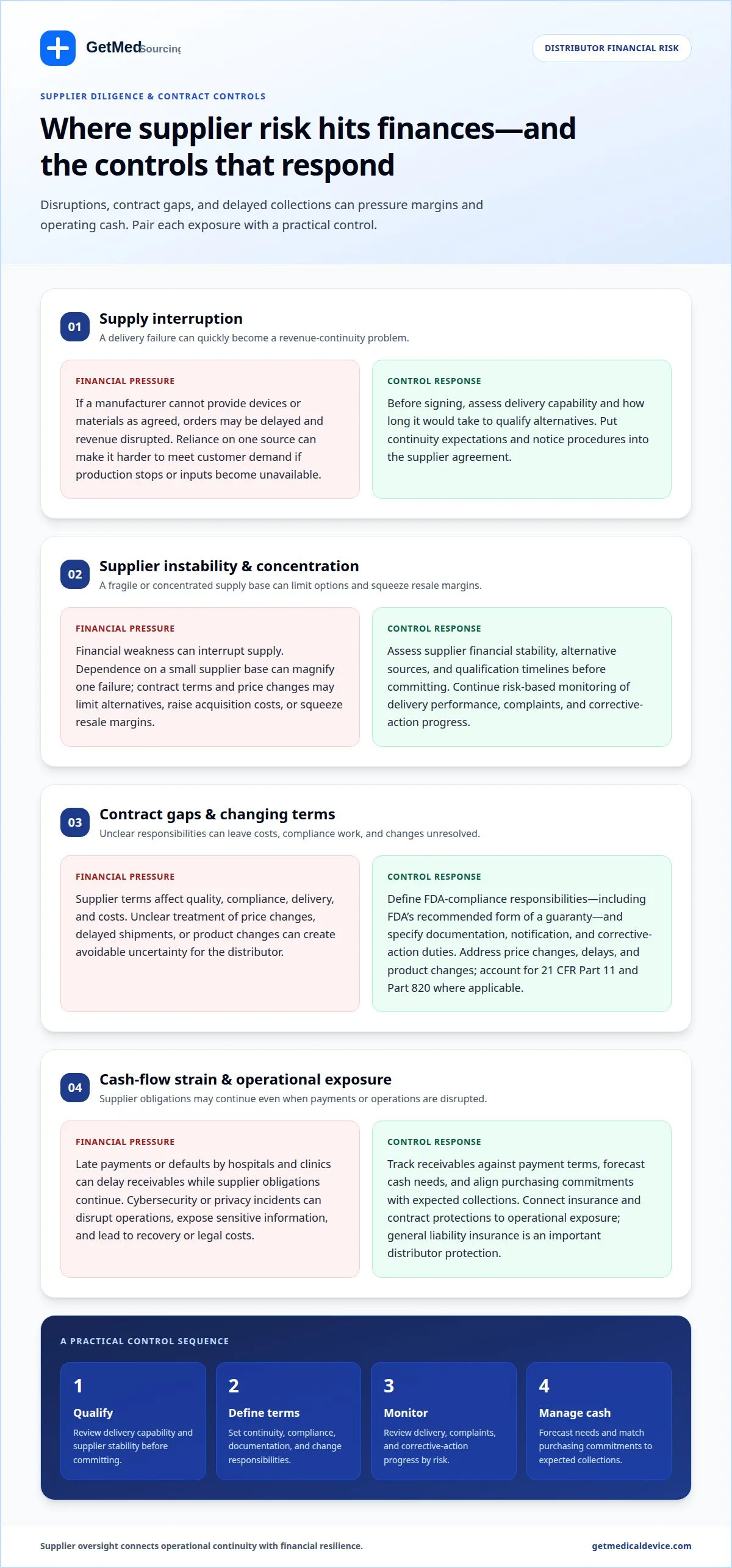
Supplier exposure starts before an agreement is signed and continues through delivery, payment, and performance reviews. Qualification, contract protections, and cash-flow controls help distributors assess how supply disruptions could affect margins.
Supply Interruptions and Continuity Risks
A supply interruption occurs when a manufacturer cannot provide devices or materials as agreed, delaying orders and revenue. Distributors that rely on one source may struggle to meet customer demand if production stops or inputs become unavailable. Before signing an agreement, assess the supplier’s ability to deliver and how long it would take to qualify alternatives. Set out continuity expectations and notice procedures in supplier agreements.
Supplier Stability and Concentration
Supplier stability means being able to sustain production, delivery, and compliance over time. Financial weakness can interrupt supply, while dependence on a small supplier base can magnify the impact of a single failure. Supplier concentration, contract terms, and price changes can limit alternatives, raise acquisition costs, or squeeze resale margins. Assess financial stability, alternative sources, and qualification timelines before committing. Reassess suppliers through risk-based monitoring of delivery performance, complaints, and corrective-action progress.
Contract Terms and Price Changes
Contract terms define responsibilities for quality, compliance, delivery, and changes that affect the distributor’s costs. Address FDA compliance, including FDA’s recommended form of a guaranty, and specify documentation, notification, and corrective-action responsibilities. For applicable records and systems, account for FDA 21 CFR Part 11 and 21 CFR Part 820. Clarify how price changes, delayed shipments, and product changes are handled. Qualification before signing helps expose gaps in a supplier’s ability to meet these terms.
Financial Risk Controls
Financial controls should connect insurance, contract protections, and cash-flow oversight to operational exposure. General liability insurance is an important protection for distributors, and contracts should assign responsibilities for interruptions, product issues, and data handling. Cybersecurity and privacy incidents can disrupt operations, expose sensitive information, and lead to recovery or legal costs. Late payments or defaults by hospitals and clinics can delay receivables even as supplier obligations continue. Track receivables against payment terms, forecast cash needs, and align purchasing commitments with expected collections.
Licensing and compliance across states where devices are distributed
For U.S. distributors, compliance obligations can vary by state and product category. A licensing gap can interrupt distribution and add administrative work.
Most U.S. states require licenses to distribute prescription medical devices. Requirements may cover records, storage, quality assurance, facilities, security, reporting, training, and know-your-customer or supplier processes. Review requirements in the home state and every destination state before distributing equipment. State oversight generally focuses on prescription devices rather than over-the-counter devices. Some state rules stem from laws originally written for pharmaceutical distribution, so requirements may not align across jurisdictions.
Operating costs and margins vary by product category because acquisition costs, inventory needs, and compliance work differ. Calculate contribution margins by product and compare them with the costs of handling and distributing each category. This helps identify products that contribute less after operating expenses.
Inventory and recall costs depend on the products and quantities affected, as well as the work required to respond. Obsolescence can leave stock unsold, while a recall may require product identification, customer communications, returns, and replacement or disposal. Traceability and accurate inventory records help define the affected stock and manage the response.
U.S. liability insurance costs depend on the distributor’s exposure, products, sales, and coverage terms. Product liability and general liability cover different exposures, so evaluate coverage in relation to the equipment distributed and the business’s operations.
Tariffs, import requirements, and foreign exchange movements can change acquisition costs and cash needs. Currency shifts affect the converted purchase price, while import charges depend on the transaction and product. Include these variables in product-level cost analyses rather than assuming landed costs will stay stable.
Medical device regulations also create costs for records, training, quality processes, and state-by-state monitoring. The EU MDR is relevant to supplier oversight, while U.S. distributors must track applicable state requirements. Maintain a jurisdiction matrix showing license status, renewal dates, responsible staff, and required operating controls. Review it whenever distribution territories or product categories change.
Distributor liability under the FFDCA
The Federal Food, Drug, and Cosmetic Act (FFDCA) prohibits introducing or delivering an adulterated or misbranded medical device into interstate commerce. It also prohibits receiving a violative device in interstate commerce. A distributor’s role in the supply chain does not remove potential exposure when a device violates these requirements.
The FFDCA is a strict liability act with potential criminal penalties. Distribution controls should identify devices, suppliers, and transactions so teams can respond promptly to suspected violations. Receiving records, for example, can link a shipment to its supplier and customer. Product identifiers and transaction records can help isolate affected inventory without disrupting unrelated device lines.
Activities such as kitting, device modification, packaging or labeling changes, and new or different promotional claims may raise regulatory questions beyond routine distribution. A distributor that repackages a device or changes its claims may therefore raise regulatory questions beyond routine resale. Define permitted handling and promotional responsibilities in operating procedures. Document the review of proposed label, packaging, or claims changes before distribution.
Patient injury creates another potential exposure: distributors may be held liable if a device they distribute injures a patient. Record complaints about devices used in healthcare, including the product identity, supplier, customer, and reported issue. Escalating complaints through established quality channels supports investigation and preserves a clear record of actions taken.
Medical device distribution requires controls across purchasing, storage, sales, and complaint handling. Practical measures include documenting supplier and shipment records, preserving device labeling, restricting unapproved modifications, and training staff on escalation procedures. These controls help teams trace affected products and coordinate a response to a suspected violation or reported patient injury.
Liability can also affect business continuity. A suspected misbranding issue may require a review of inventory, customer communications, and sales activity, while an injury claim may require records tracing the device’s distribution. Assign responsibility for preserving records and coordinating internal responses. Clear documentation shows what the distributor received, handled, and supplied.
FDA clearance, inspections, and corrective actions
FDA clearance status can affect whether a device enters distribution, while inspections and corrective actions can disrupt sales. Distributors need accurate product records and a defined response process because regulatory concerns may affect inventory, customer orders, and revenue.
The company amended its statement that certain new or significantly modified medical devices generally needed FDA 510(k) clearance or premarket approval unless an exemption applied, according to the U.S. Food and Drug Administration. This requirement concerns specified devices, not every product in a distributor’s catalogue. Keep clearance or approval information connected to each product record, and distinguish the manufacturer’s regulatory responsibilities from the distributor’s role.
An FDA inspection or inquiry may require prompt access to product, supplier, and transaction records. Designate an accountable contact, preserve relevant documentation, and route requests through a controlled response process. Records linking a device’s identifying information to its supplier and customer can help pinpoint related inventory or transactions. Disorganized documentation can slow the review and complicate customer communications.
Corrective actions address identified problems and establish how affected products or processes will be handled. A distributor’s response may include isolating relevant inventory, documenting decisions, communicating with affected customers, and tracking assigned actions to completion. Clear roles matter: staff should know who records complaints, approves customer notices, and maintains the action log. These controls help limit unnecessary disruption while teams address the specific concern.
Promotional claims also need careful review. New or different claims can affect how FDA views distributor activities, particularly when combined with packaging changes, kitting, or device modification. Keep approved product information separate from sales materials, and review proposed claim changes before use. This reduces the risk that commercial content creates a separate compliance issue during an active review.
For commercial planning, browse medical devices while maintaining separate clearance records and inspection-response controls for each product.
GetMedicalDevice: Medical devices
GetMedicalDevice provides access to medical devices and supports B2B connections between suppliers and buyers. When distribution planning requires product sourcing or a clearer route to procurement opportunities, its platform offers a practical next step.
Suppliers can use Verified Supplier Membership and Premium Product Listings to present inventory to buyers. RFQ Response Credits let suppliers respond to procurement requests from hospitals, clinics, and international distributors. These tools support product visibility and buyer engagement; they do not replace state licensing, FDA compliance, or legal advice.
For distributors, the platform helps connect product requirements with supplier listings and procurement requests. Contact GetMedicalDevice to discuss your medical device sourcing needs.
Build a More Resilient Distribution Strategy
Stronger financial control starts when risk information informs routine commercial decisions. Use exposure analysis to guide which products to carry, which supplier relationships to develop, and how to structure purchasing and sales. This makes financial risks for medical device distributors part of ongoing planning, rather than something reviewed only after a disruption.
For supplier visibility and procurement activity, GetMedicalDevice offers Verified Supplier Membership, Premium Product Listings, and RFQ Response Credits. These platform options help suppliers present inventory and respond to buyer requests, while distributors manage their own licensing, compliance, and financial controls.
Set a defined review cycle for business assumptions and update it when suppliers, product mix, or distribution markets change. A current view of commercial needs can support more deliberate sourcing decisions. Contact GetMedicalDevice to discuss your needs and identify the next practical step for your medical device requirements.
Frequently Asked Questions
What are the main financial risks for medical device distributors?
The main financial risks for medical device distributors include supply interruptions, inventory losses, delayed customer payments, licensing gaps, and product-related liability. Their combined effect can exceed any single exposure: a shipment delay may push a customer order into a later period while operating commitments continue. Grouping exposures by product line and customer helps identify which risks may affect cash availability first.
How do reimbursement changes and healthcare payment delays affect medical device distributors' cash flow?
Reimbursement changes can affect what healthcare providers buy and how quickly they place orders, while late payments from hospitals or clinics delay cash receipts. Distributors may still need to pay suppliers and meet operating commitments during the delay. Track receivables by customer and compare expected collections with scheduled payments. Flag slow-paying accounts early and adjust purchasing commitments to prevent a widening cash gap.
How do FDA regulations, quality-system requirements, and compliance violations create financial risks for distributors?
FDA rules and quality-system failures can create costs through product holds, investigations, corrective actions, and disrupted sales. A violation involving one model may require a review of related lots, customer records, and promotional materials. Maintain traceable files for each product line, assign owners for complaints and regulatory correspondence, and document decisions. These steps help teams coordinate responses and assess which transactions or inventory may be affected.


