

The Latin American medical devices market was valued at USD 48.00 billion in 2025. For companies expanding medical device sales to Latin America, the opportunity is substantial, but regional demand doesn’t translate into a single route to market: country size, competition, regulatory requirements and reimbursement conditions differ.
That complexity is a practical concern for medical device companies assessing where to invest and how to establish market access. More than 40% of healthcare spending in Latin America is out-of-pocket, making local payment and purchasing structures an important part of commercial planning.
This article compares six major markets by size, explains how local competition and intellectual property considerations can affect expansion, and outlines differences in national regulatory systems. It also covers reimbursement barriers and practical factors for prioritizing markets, preparing for country-specific requirements, and setting realistic commercial plans.
Key Takeaways
- Compare country markets by device category and expected business impact to prioritize where to focus entry efforts.
- Assess local competitors and protect intellectual property as part of a country-specific commercial strategy.
- Map each target market’s regulator, documentation requirements and registration pathway before planning launch activities.
- Factor reimbursement and out-of-pocket payment patterns into market selection and commercial planning.
Table of Contents
- 1. Medical device market size across six Latin American countries
- 2. Local competition and intellectual property concerns
- 3. Country-specific regulatory systems and authorities
- 4. Regulatory fragmentation and reimbursement barriers
- GetMedicalDevice: Verified Supplier Membership
1. Medical device market size across six Latin American countries
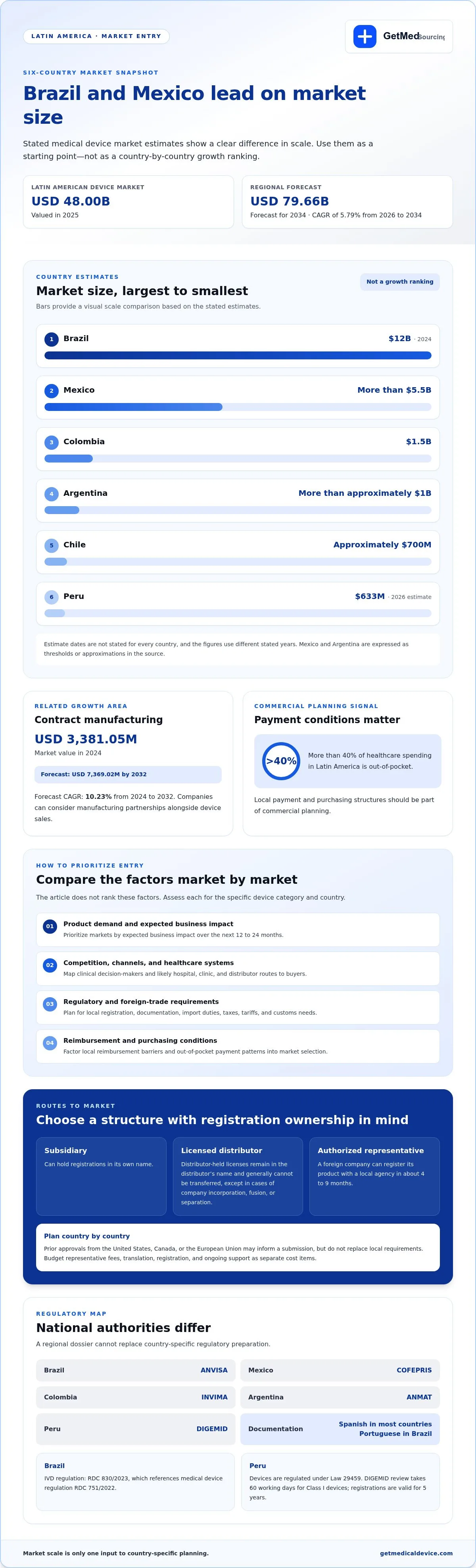
Brazil and Mexico are the region’s largest medical device markets among these six countries. The broader Latin American device market is forecast to grow at a CAGR of 5.79% from 2026 to 2034. For companies expanding medical device sales to Latin America, these regional figures are a starting point, not a country-by-country growth ranking. Contract manufacturing is another growth area, forecast to grow at a CAGR of 10.23% from 2024 to 2032.
Country market estimates show clear differences in scale. Brazil’s medical device market was valued at $12 billion in 2024, while Mexico’s is valued at more than $5.5 billion. Colombia’s market is valued at $1.5 billion. Argentina’s is estimated at more than approximately $1 billion, and Chile’s at approximately $700 million. Peru’s market is estimated at $633 million in 2026. These comparisons help manufacturers assess potential reach, while product demand and local purchasing conditions shape the opportunity in each country.
Across the region, the medical device market was valued at USD 48.00 billion in 2025 and is forecast to reach USD 79.66 billion by 2034. The Latin American medical device contract manufacturing market was valued at USD 3,381.05 million in 2024 and is forecast to reach USD 7,369.02 million in 2032. Companies expanding medical device sales to Latin America can consider both device sales and manufacturing partnerships when assessing their regional strategy.
For market entry, assess product demand, local competition, channels, healthcare systems, regulatory requirements and foreign-trade requirements country by country. Prioritize markets by expected business impact over the next 12 to 24 months. A subsidiary, licensed distributor or authorized representative offers a distinct route to market. A subsidiary can hold registrations in its own name; distributor-held licenses remain in the distributor’s name and generally cannot be transferred except in cases of company incorporation, fusion or separation.
Prior approvals may inform a submission, but they do not replace local requirements. Regulators may consider approvals from the United States, Canada, or the European Union, yet each country has its own registration requirements. Treat approval in another market as a planning input, not a substitute for country-specific regulatory preparation.
Brazil and Mexico are the largest medical device markets among the six countries. The figures provide no country-by-country growth ranking; the broader Latin American device market is forecast to grow at a 5.79% CAGR from 2026 to 2034.
2. Local competition and intellectual property concerns
Competition in medical devices depends on clinical relationships, local sales channels, and product fit. Influential surgeons can shape or hold competitive positions across Latin America, making clinical adoption and established purchasing relationships important parts of market assessment. For each device category, map the decision-makers and identify which hospitals, clinics, or distributors are likely routes to buyers.
Import dependence can create openings for manufacturers, but it also affects supply planning. Brazil imports 60% of its imaging equipment, while more than 80% of high-end medical equipment across Latin America comes from the United States, Germany and China. These figures show substantial global sourcing, not automatic demand for a local substitute. Assess whether local production, contract manufacturing or supply-chain realignment improves product fit and continuity. Automation and 3D printing are creating opportunities to manufacture complex devices in the region; evaluate their relevance by product and production capability.
Documentation must be tailored to each market. Most Latin American countries require Spanish documentation, while Brazil requires Portuguese documentation and regulates medical devices through ANVISA. Prepare translated product information, labeling, and clinical materials early, keeping controlled versions for each target country. A global source file can support the process, but localization must reflect language and country-specific regulatory expectations.
Protect intellectual property before distributor discussions. Define which technical documents can be shared, record ownership of designs and branding, and use contracts that set limits on confidential information. These steps help organize commercial risk across countries with different requirements. For entry planning, compare a subsidiary, licensed distributor or authorized representative against registration ownership and control. A foreign company using an authorized representative can register its product with a local agency in about 4 to 9 months. Budget representative fees, translation, registration and ongoing support as separate cost items. This comparison helps clarify the representative’s role and the responsibilities the company retains.
3. Country-specific regulatory systems and authorities
Plan regulatory compliance separately for each country. ANVISA oversees Brazil, COFEPRIS oversees Mexico, INVIMA oversees Colombia, ANMAT oversees Argentina, and DIGEMID oversees Peru. Their registration, quality, and clinical requirements differ, so a regional dossier cannot replace country-specific preparation.
ANVISA, COFEPRIS and other authorities classify devices under national systems and review applications against local technical and documentation requirements. Brazil identifies IVD regulation as RDC 830/2023, which references medical device regulation RDC 751/2022. Peru regulates devices under Law 29459; its DIGEMID review takes 60 working days for Class I devices, and registrations are valid for 5 years.
Import duties, taxes, tariffs, and customs documentation depend on the importing country, product classification, origin, and transaction structure. Latin America has no single customs process or rate, so calculate landed costs separately for each destination.
Localize language and labeling as well. Spanish is the primary language in Mexico, Colombia, Argentina, Peru, and Chile, while Brazil requires Portuguese documentation. Submissions may also call for translated product information and legalized administrative certificates. After approval, companies may need to manage renewals, change notifications, labeling updates, UDI requirements, and ongoing compliance.
Hospital equipment counts can help identify where clinical infrastructure is changing. In 2023, hemodialysis machines in Argentine hospitals increased nearly 9%, while endoscopy equipment counts rose 8.3% in Argentina and 12% in Brazil. Chile has over 1,200 diagnostic facilities serving a population of 19.5 million. Use such indicators to frame channel and service planning, not as substitutes for regulatory review.
Distribution arrangements can affect who controls a registration. A subsidiary can hold product registrations in its own name. Distributor-held licenses remain in the distributor’s name and generally cannot be transferred except through company incorporation, fusion, or separation. Compare ownership, technical responsibilities, and post-market obligations before choosing a route.
4. Regulatory fragmentation and reimbursement barriers
Regional growth does not remove country-level compliance work. Brazil and Mexico have enhanced their medical device frameworks in recent years, while national rules and frequent changes still create administrative burden. ISO 13485 is an international standard that countries are aligning with. Treat FDA and CE mark approvals as useful references, not replacements for local requirements.
Chile introduced a major regulatory change in 2026. On March 6, Chile published a decree expanding medical device regulation to all medical devices and IVDs. The decree provides transition periods of 24 to 36 months, depending on device classification. Manufacturers should map affected products, documentation gaps and transition milestones in a centralized regulatory register.
Centralized information management helps teams coordinate submissions across countries. Keep a controlled record for each product’s classification, local registration status, approved labeling, renewal dates, change notifications, and UDI obligations. Link each record to its supporting technical documents and assign owners to maintain it. Manufacturing transfers, supplier changes, software updates, or new product claims can affect registrations in multiple markets, so assess the impact in each country before making changes.
Reimbursement creates a separate commercial constraint. More than 40% of healthcare spending in Latin America is out-of-pocket, which can influence affordability and access. For makers of personal wellness and preventative health equipment like Pureffect, high out-of-pocket spending means commercial success relies heavily on direct consumer channels rather than institutional coverage. Before selecting a launch market, identify who pays for the device, how hospitals or clinics purchase it, and whether patients bear part of the cost. Compare public and private purchasing pathways, then test whether the device’s clinical value aligns with the available payment route. Approval alone does not establish a reimbursement pathway.
For market planning, connect regulatory readiness with purchasing access. A diagnostic device may meet local registration requirements but face different budget and reimbursement conditions across countries. Bring country-level evidence, purchasing assumptions, and approval milestones together in one decision framework. Explore medical device categories to find products relevant to your market assessment.
GetMedicalDevice: Verified Supplier Membership
GetMedicalDevice provides medical device suppliers with a platform to present products and respond to procurement requests. Once your market assessment identifies suitable buyers or distribution opportunities, Verified Supplier Membership and Premium Product Listings can help showcase your inventory. RFQ Response Credits enable responses to requests from hospitals, clinics, and international distributors.
These services support supplier visibility and buyer connections, but do not replace country-specific regulatory, reimbursement, or market-entry planning. Use your target-market priorities to decide which devices to list and which RFQs align with your commercial goals. To explore supplier membership and listing options, contact GetMedicalDevice or visit getmedicaldevice.com.
Turn market assessment into a focused launch plan
Expanding medical device sales to Latin America is best approached as a sequence of country-level decisions, not a single regional launch. Turn your market priorities into an implementation plan with clear owners, decision points, and dependencies. Set the order for commercial preparation, local documentation, and buyer engagement, then track progress against each market’s requirements.
A practical plan also connects product positioning to the purchasing pathway. Identify the evidence and materials your team needs for buyer discussions, then decide which opportunities fit your current resources. This keeps expansion aligned with commercial priorities and operational capacity.
GetMedicalDevice can support supplier visibility and responses to procurement opportunities as you develop that plan. Contact GetMedicalDevice to discuss market entry and determine how its platform fits your next steps. A disciplined launch plan gives your team a clear basis for moving forward.
Frequently Asked Questions
What are the medical device import volumes, market sizes, and growth forecasts by country in Latin America?
Brazil and Mexico are the largest markets in the six-country comparison, followed by Colombia, Argentina, Chile, and Peru. The growth forecast applies to the regional market, not to each country individually. Analyze import volumes by category: compare shipment quantities and values for the same device types, then assess them alongside local demand and sourcing patterns.
What are the regulatory registration requirements for medical devices in Brazil, Mexico, Colombia, Chile, and Argentina?
Each country requires a market-specific submission to its national authority: ANVISA in Brazil, COFEPRIS in Mexico, INVIMA in Colombia, ISP in Chile, and ANMAT in Argentina. Prepare a product dossier that matches the device’s intended use and classification, then align technical documents, labeling, and administrative certificates with local expectations. Prior approvals can inform submissions, but they do not replace local requirements.
What local representative, importer, or in-country establishment requirements apply to foreign medical device companies?
Foreign companies can assess three market-entry structures: establish a subsidiary, work through a licensed distributor, or use an authorized representative. Compare who holds registrations, who controls local commercial relationships, and how a partner change could affect continuity. Before appointing a representative or importer, set out responsibilities for document coordination, product communication, and ongoing market obligations in written agreements.
What are the typical costs and timelines for medical device registration in major Latin American markets?
Costs and review periods depend on the country, device class, and registration route. Budget separately for translation and dossier preparation.
How can companies find and evaluate medical device distributors and sales partners in Latin America?
Begin with a shortlist of countries and devices, then compare potential partners’ relevant product portfolios, buyer relationships, and ability to support the intended sales channel. Request evidence of experience with comparable devices and review how each partner handles product information and customer requests. Assess registration ownership separately from sales capability: a distributor’s commercial role and the holder of a product registration are distinct considerations.
What pricing, reimbursement, public procurement, and tender processes affect medical device sales by country?
There is no single regional pricing or tender model. For each country, identify the payer, purchasing institution, and route used to acquire the device. Review tender documents for product specifications, eligibility criteria, submission requirements, and commercial terms, then compare these conditions with the device’s clinical value and expected costs for the buyer. Include private purchasing and out-of-pocket payment in the market assessment, not just public procurement.
