

A pristine distributor catalog is often the weakest indicator of actual instrument performance. Sourcing from orthopedic surgical instrument suppliers based strictly on glossy brochures introduces severe operational vulnerabilities, from substandard metallurgy and premature tool pitting to canceled elective cases caused by sudden supply chain bottlenecks.
You already know that protecting operating room uptime demands absolute batch traceability and uncompromising material standards. With recent regulatory shifts, such as the FDA's Quality Management System Regulation (QMSR) aligning with ISO 13485:2016 and mandatory EUDAMED registration rules, institutional buyers can't afford the liability of unverified broker networks or opaque pricing tiers.
This guide provides a repeatable framework to audit, qualify, and source from vetted orthopedic surgical instrument suppliers. We'll examine the technical inspection protocols, metallurgical criteria for surgical stainless steel and titanium, and structured RFQ workflows required to establish a compliant, resilient procurement pipeline.
Key Takeaways
- Verify material integrity early by demanding certified mill test reports and ASTM F899 compliance to prevent intraoperative stress fractures and corrosion.
- Audit prospective orthopedic surgical instrument suppliers against ISO 13485:2016 and updated FDA QMSR requirements to guarantee regulatory alignment and batch traceability.
- Deploy a standardized four-step qualification framework to systematically eliminate unverified intermediaries and assess vendor manufacturing capabilities.
- Streamline institutional procurement and mitigate supply risks by leveraging pre-screened distributor networks and structured RFQ workflows.
Table of Contents
- Core Procurement Criteria for Orthopedic Surgical Instrument Suppliers
- Auditing Supplier Quality Management Systems and Regulatory Compliance
- A Structured 4-Step Framework for Vetting Orthopedic Tool Vendors
- Sourcing Orthopedic Surgical Instruments via GetMedicalDevice
Core Procurement Criteria for Orthopedic Surgical Instrument Suppliers
Orthopedic procedures subject instrumentation to intense cyclic loading, dynamic torque, and repeated thermal processing. Sourcing managers evaluating orthopedic surgical instrument suppliers must look beyond basic catalog dimensions to audit raw material grades, hardening treatments, and surface chemistries. Institutional buyers reviewing specialized surgical products should establish rigorous baseline criteria to ensure tools endure high-demand joint reconstruction and trauma interventions without mechanical failure.
Metallurgy and Raw Material Integrity
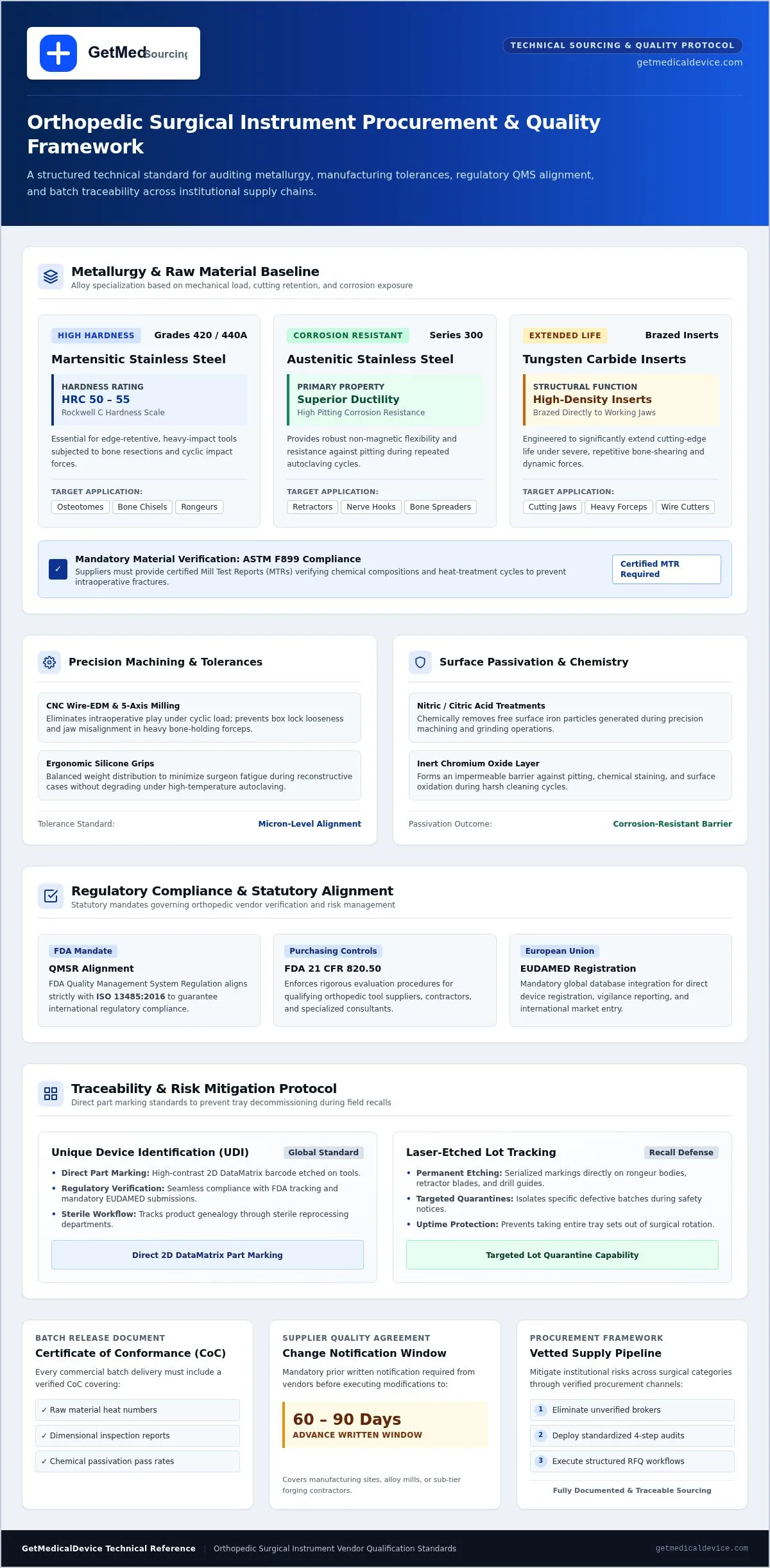
Tool longevity begins with correct alloy selection. A comprehensive Surgical Instrument Overview demonstrates that high-stress instruments require distinct metallurgical properties based on their functional role:
- Martensitic Stainless Steels: Grades such as 420 or 440A provide high Rockwell hardness (HRC 50–55), making them essential for edge-retentive tools like osteotomes, bone chisels, and rongeurs.
- Austenitic Stainless Steels: Series 300 alloys deliver superior ductility and resistance to pitting corrosion, ideal for retractors, nerve hooks, and bone spreaders.
- Tungsten Carbide Inserts: High-density carbide inserts brazed to working jaws significantly extend cutting edge life under repetitive bone-shearing forces.
Reliable orthopedic surgical instrument suppliers must provide certified Mill Test Reports (MTRs). These documents verify compliance with ASTM F899 standards, confirming exact chemical compositions and heat-treatment cycles.
Manufacturing Tolerances and Ergonomic Engineering
Precision CNC wire-EDM and 5-axis milling prevent box lock looseness and jaw misalignment in heavy bone-holding forceps. Micron-level tolerances eliminate intraoperative play under load. Surface passivations, such as nitric or citric acid treatments, remove free surface iron to create an inert, corrosion-resistant chromium oxide layer. Additionally, ergonomic silicone grips and balanced weight distributions prevent surgeon hand fatigue during complex reconstructive cases without degrading under high-temperature autoclaving.
Auditing Supplier Quality Management Systems and Regulatory Compliance
Hospital risk management demands exhaustive quality verification before onboarding orthopedic surgical instrument suppliers. Sourcing teams can't rely on unverified claims when entering purchase contracts. Institutional buyers should align their vetting criteria with statutory mandates like FDA Purchasing Controls (21 CFR 820.50), which require manufacturers and distributors to establish rigorous procedures for evaluating suppliers, contractors, and consultants. To protect patient safety and prevent clinical downtime, reference a structured sourcing model to guide vendor qualification.
Verifying Device Traceability and Identification Standards
Complete product genealogy prevents unverified parts from entering sterile processing workflows. Institutional audit checklists must enforce two critical identification requirements:
- Unique Device Identification (UDI): Direct part marking using high-contrast 2D DataMatrix barcodes ensures compliance with global registries, including mandatory EUDAMED submissions and FDA tracking systems.
- Laser-Etched Lot Tracking: Permanent serial or lot codes on rongeur bodies, retractor blades, and drill guides enable targeted quarantine actions during field recalls without taking entire tray sets out of circulation.
Supplier Quality Agreements and Batch Documentation
Formal Quality Agreements define operational accountability between healthcare procurement networks and distribution partners. Vetted orthopedic surgical instrument suppliers must maintain active ISO 13485:2016 certifications, which align with the FDA Quality Management System Regulation (QMSR). Each commercial delivery requires an associated Certificate of Conformance (CoC) confirming raw material heats, dimensional inspections, and passivation pass rates.
Procurement agreements must mandate written notification windows, typically 60 to 90 days, prior to any change in manufacturing sites, alloy vendors, or forging sub-tier contractors. Healthcare teams looking to mitigate supply risks across diverse surgical categories can explore verified distribution partners on GetMedicalDevice to establish fully documented, traceable procurement channels.
A Structured 4-Step Framework for Vetting Orthopedic Tool Vendors
Establishing an uninterrupted clinical pipeline requires a disciplined qualification sequence that eliminates unverified intermediaries before contracts are finalized. Procurement teams can't depend on surface-level catalog claims when evaluating potential orthopedic surgical instrument suppliers. Implementing an objective audit framework protects institutional budgets and maintains surgical tray readiness.
Step 1 & Step 2: Credential Verification and Sample Autoclave Testing
The vetting sequence begins with strict regulatory reconciliation. Sourcing managers must cross-reference manufacturer establishment registrations against federal databases, verifying compliance with active FDA Quality System Requirements before evaluating physical inventory.
Following administrative clearance, teams should acquire production samples for practical stress testing. Hospital sterile processing personnel should subject sample retractors, drivers, and forcep assemblies to repeated high-temperature autoclave cycles. Substandard passivation, improper laser welding, and micro-fissures quickly reveal themselves through surface oxidation, pitting, or hinge stiffening after consecutive sterilization runs.
Step 3 & Step 4: RFQ Issuance and Lead-Time Auditing
The third phase establishes commercial clarity through structured RFQs. Sourcing documentation must mandate fixed dimensional tolerances, specific ASTM alloy designations, and defined volume pricing tiers. Detailed specification sheets prevent unexpected line-item adjustments and eliminate ambiguity during commercial negotiations.
The final phase requires auditing production throughput and regional buffer stock. Reputable orthopedic surgical instrument suppliers maintain dedicated inventory reserves to absorb sudden seasonal surges in joint replacement procedures. Verify that the vendor enforces guaranteed dispatch schedules and transparent replenishment intervals before signing master purchasing agreements.
To eliminate unreliable third-party brokers and connect directly with vetted healthcare manufacturers, submit your structured RFQ on GetMedicalDevice.
Sourcing Orthopedic Surgical Instruments via GetMedicalDevice
Traditional cross-border device procurement often involves fragmented networks of unverified brokers, variable fulfillment lead times, and opaque markups. GetMedicalDevice eliminates these structural friction points by Structured medical sourcing procurement teams directly with pre-screened medical equipment distributors and manufacturers through a secure B2B marketplace. Rather than navigating single-vendor portals or closed catalogs, institutional buyers access a global network of vetted orthopedic surgical instrument suppliers capable of fulfilling precision specifications.
Mitigating Procurement Risk Through Verified Vendor Status
Sourcing teams must ensure that commercial partners hold legitimate regulatory documentation before initiating capital outlays. The platform implements a structured screening protocol to authenticate commercial entities before granting Verified Supplier status. This multi-layered vetting process delivers distinct procurement safeguards:
- Credential Authentication: Confirms establishment registrations, active business licenses, and ISO certifications to prevent unverified grey-market intermediaries from entering supply lines.
- Direct Communication Channels: Enables direct technical dialogue between clinical engineers and qualified suppliers, accelerating the retrieval of material certificates and device technical files.
- Catalog Transparency: Allows buyers to review specialized medical devices and instrumentation through the centralized GetMedicalDevice products directory.
Streamlined RFQ Workflows for Hospital and Clinic Buyers
Procurement efficiency relies on standardizing the transition from technical specifications to commercial commitments. Instead of sending non-standardized email requests to unvetted lists, procurement officers submit structured RFQs that clearly define lot requirements, alloy grades, and tolerance drawings directly to global networks.
The marketplace utilizes an RFQ response credit model. Verified suppliers allocate credits to quote directly on active hospital solicitations, ensuring that only suppliers with genuine production capacity, validated regulatory documentation, and available buffer inventory bid on your contracts. This mechanism filters out passive brokers, yielding fully auditable and competitive fulfillment proposals for institutional healthcare buyers.
Streamline Your Orthopedic Procurement Infrastructure
Securing resilient clinical supply chains requires moving past superficial vendor catalogs to enforce material-level standards. Institutional risk management relies on rigorous ASTM F899 metallurgy verification, comprehensive ISO 13485:2016 alignment, and direct batch traceability. When sourcing teams audit prospective orthopedic surgical instrument suppliers through standardized testing and structured documentation, they eliminate unexpected tray downtime and protect clinical outcomes.
GetMedicalDevice provides the operational infrastructure to execute these audits efficiently. Through its Verified Supplier Membership system, the platform systematically screens credible global medical device distributors, validating business legitimacy and regulatory documentation prior to engagement. By deploying a structured RFQ credit mechanism, the marketplace connects institutional buyers with verified vendors bidding directly on exact clinical requirements. Take control of your surgical inventory pipeline today and Source Verified Surgical Equipment on GetMedicalDevice to build an auditable, high-performance procurement network.
Frequently Asked Questions
What steel grade is recommended for orthopedic surgical instruments?
Recommended steel grades depend strictly on instrument mechanics. Cutting instruments like osteotomes, bone chisels, and rongeurs require martensitic stainless steels, specifically AISI 420 or 440A, to achieve proper hardness and edge retention. Structural, non-cutting instruments like retractors and spreaders use austenitic alloys like 316L for ductile strength and corrosion resistance. All raw metals should meet ASTM F899 standards verified by certified mill test reports.
How do I verify if an orthopedic instrument supplier is compliant with EU MDR?
Procurement teams can verify compliance by checking the manufacturer's Single Registration Number (SRN) within the mandatory EUDAMED database. Reliable orthopedic surgical instrument suppliers must present a valid CE mark certificate issued by an accredited EU Notified Body under Regulation (EU) 2017/745. Buyers should also inspect the supplier's Declaration of Conformity and ensure their quality system maintains EN ISO 13485:2016+A11:2021 certification with up-to-date surveillance audit records.
What is the difference between single-use and reusable orthopedic instruments?
Reusable instruments are forged from heavy-duty surgical stainless steel or titanium, designed and passivated to withstand hundreds of sterilization cycles without mechanical breakdown. Single-use tools arrive sterile and eliminate central sterile reprocessing risks, but generate ongoing operating costs and medical waste. Sourcing teams typically reserve single-use kits for specialized trauma cases or procedures where sterile processing capacity is constrained, while relying on reusable sets for core orthopedic procedures.
How does Unique Device Identification (UDI) impact surgical instrument procurement?
UDI mandates direct part marking, typically a 2D DataMatrix code, on reusable surgical tools. For hospital procurement teams, this system standardizes inventory tracking, accelerates tray assembly, and isolates recalled lots without pulling entire hospital sets. Working with orthopedic surgical instrument suppliers that strictly adhere to FDA and EUDAMED UDI guidelines prevents inventory discrepancies, simplifies automated reprocessing documentation, and protects hospital compliance during clinical audits.
What documentation should accompany an institutional orthopedic instrument shipment?
Every institutional shipment must include a formal Certificate of Conformance (CoC) matching delivered lot numbers with purchase order specifications. Shipments should also supply validated Instructions for Use (IFU) detailing approved reprocessing and autoclaving parameters. For high-stress cutting or joint-holding instruments, buyers should mandate lot-specific Mill Test Reports (MTRs) and dimensional inspection reports to confirm raw material composition and adherence to technical manufacturing tolerances.