
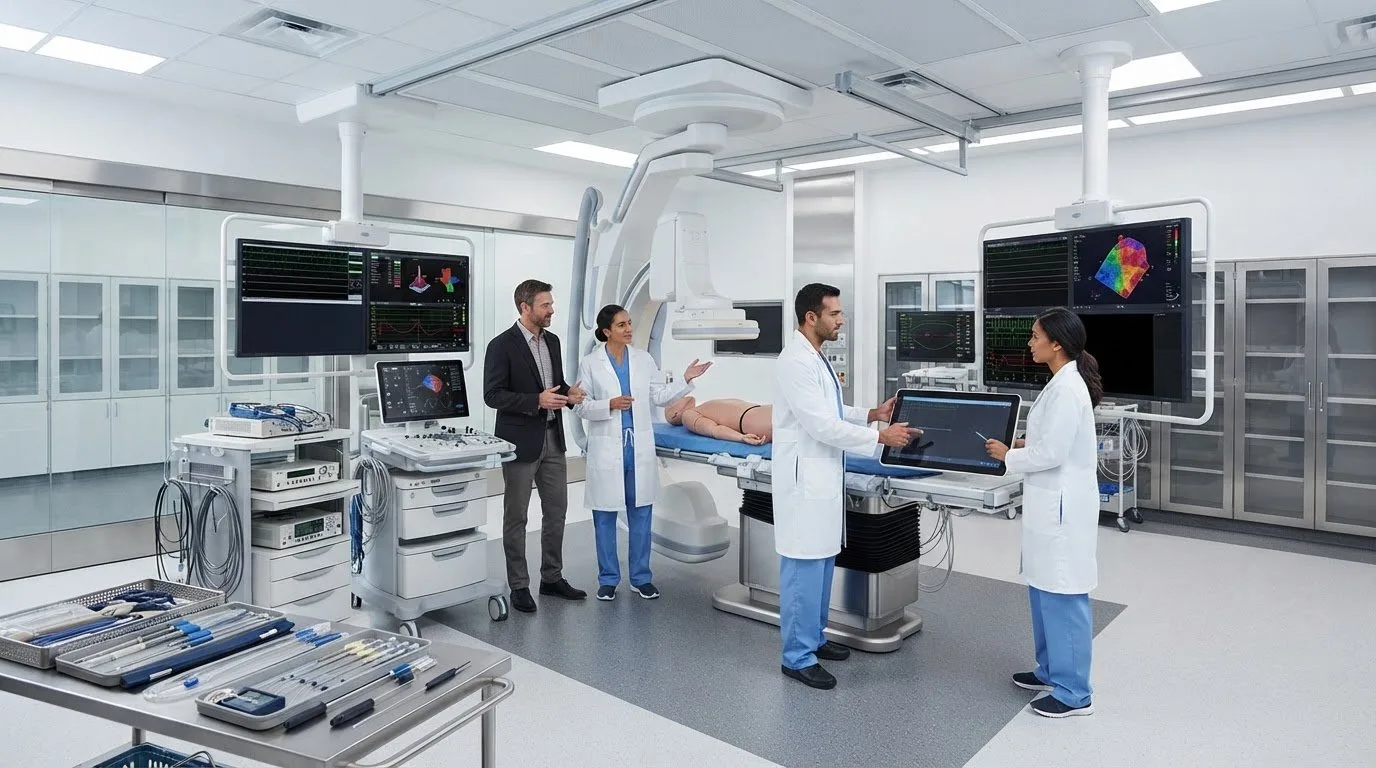
An EP lab upgrade can involve 3 to 6 months of downtime in the best-case scenario. Electrophysiology lab equipment suppliers support temporary and long-term planning by helping facilities identify cath lab imaging equipment and specialized instrumentation suited to the lab’s intended use.
Facilities need to plan for more than one machine. Imaging needs, procedure mix, room constraints, and each instrument’s role all shape procurement. This article explains how to plan a temporary setup or a long-term EP lab investment without treating the two as interchangeable.
It covers key cath lab equipment and EP instrumentation, factors to consider when selecting systems, and how to organize requirements for supplier discussions. The aim is to turn clinical and operational needs into a clear equipment request, whether the project addresses a short-term gap or a long-term lab plan.
Key Takeaways
- Separate temporary equipment needs from long-term lab requirements to define a practical procurement scope.
- Match cath lab imaging capabilities to EP procedures, including the views and magnification the work requires.
- Distinguish specialized EP instrumentation by what it measures and how its data supports analysis.
- Use supplier and product listings to organize equipment research and prepare a focused request for quotation.
Table of Contents
- Temporary and long-term EP lab solutions
- Cath lab equipment for electrophysiology
- EP lab instrumentation
- Who are the leading electrophysiology lab equipment suppliers in the United States?
- GetMedicalDevice: Verified Supplier Membership
Temporary and long-term EP lab solutions
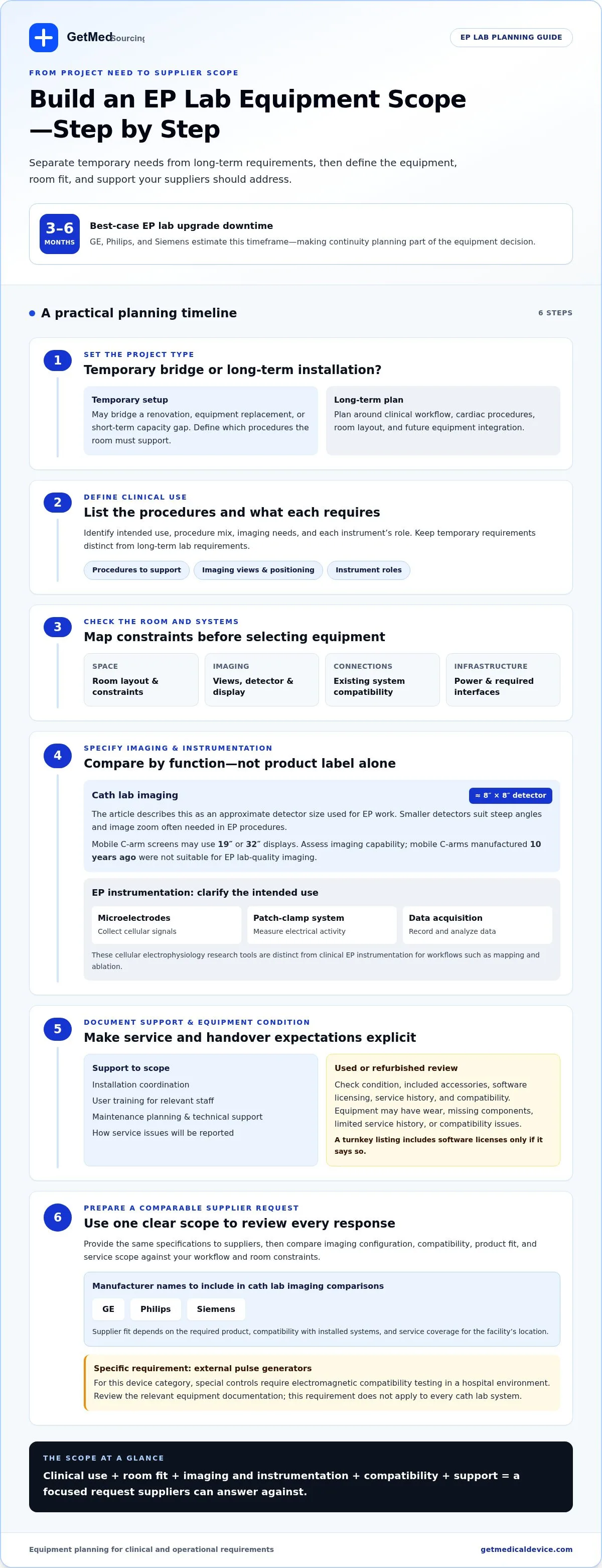
Temporary and permanent EP lab plans solve different operational problems. A temporary setup may bridge a renovation, equipment replacement, or short-term capacity gap. A long-term installation must support the facility’s clinical workflow, cardiac procedures, room layout, and future equipment integration. GE, Philips, and Siemens estimate best-case downtime for an EP lab upgrade at 3 to 6 months. That timeframe makes continuity planning part of the equipment decision, not a separate task.
For a temporary arrangement, define the procedures the room must support and the equipment each requires. Map the available space, imaging needs, power, and connections to existing systems. For a long-term plan, also document intended use, integration needs, staff workflows, and equipment that may need replacement. A defined scope helps suppliers respond to the actual requirements.
Prices for electrophysiology equipment and complete lab installations depend on the configuration, equipment mix, installation scope, and project requirements. A quote reflects factors such as system components, room preparation, integration, and support needs.
Supplier support may include installation coordination, user training, maintenance planning, and technical support. Specify these needs in the procurement scope: who will coordinate setup, which staff need training, and how service issues will be reported. A documented handover helps the clinical team understand system operation before procedures begin.
Used or refurbished equipment may have wear, missing components, limited service history, or compatibility issues with existing systems. As part of the purchase review, request documentation on condition, included accessories, software licensing, and service history. A turnkey listing includes software licenses only if it says so.
For external pulse generators, special controls require electromagnetic compatibility testing in a hospital environment, according to the Office of the Federal Register. Include this requirement when assessing the relevant equipment and documentation. A clear scope also helps distinguish temporary needs from long-term requirements and makes supplier responses easier to compare.
Cath lab equipment for electrophysiology
EP imaging equipment must support the views and positioning required for cardiac procedures. Compare detector size, display configuration, compatibility with existing systems, and supplier support when defining the facility’s equipment needs.
Product, Service, and Compatibility Comparisons
Compare each system’s imaging configuration, technical support, and compatibility with the facility’s existing equipment. Cath lab detectors used for electrophysiology work are approximately 8” x 8” inches, and smaller detectors suit steep angles and image zoom often needed in EP procedures. Mobile C-arm screens may use 19” or 32” displays. Mobile C-arms manufactured 10 years ago were not suitable for EP lab-quality imaging, so assess imaging capability rather than age alone.
GE, Philips, and Siemens are manufacturer names to consider when comparing equipment portfolios. Assess the proposed detector and display against intended procedures, room configuration, and current systems. Also compare the stated support scope, including installation coordination, training, and technical assistance.
Supplier Evaluation and Selection
Hospitals can evaluate suppliers by documenting procedure requirements, existing equipment, compatibility needs, and support expectations. Use the same specifications when reviewing proposals, then compare each response against the facility’s clinical workflow and room constraints. This makes differences in imaging configuration and service scope easier to identify.
For US requirements, FDA special controls for an external pulse generator require testing to validate electromagnetic compatibility in a hospital environment, according to the Office of the Federal Register. This applies to the specified device category, not every cath lab system. Review documentation relevant to the equipment under consideration.
Leading Suppliers in the United States
GE, Philips, and Siemens are manufacturer names to include when comparing cath lab imaging options in the United States. The right supplier for a hospital depends on the required product, compatibility with installed systems, and service coverage for the facility’s location.
To identify suppliers serving a particular area, define the facility’s location and equipment scope, then compare suppliers’ regional service coverage and product fit. For adjacent device categories, browse cardiac rhythm management equipment as part of the procurement search.
EP lab instrumentation
EP instrumentation can refer to clinical systems or research tools, so define its intended use before procurement. In cellular electrophysiology, patch-clamp systems, microelectrodes, and data acquisition systems measure and analyze electrical activity in neurons and muscle fibers. A clinical EP lab has a different workflow, with instrumentation aligned to procedures such as mapping and ablation. Keep the requirements distinct to avoid mistaking a research instrument for a complete clinical setup.
Build the equipment specification around the signal being measured and how staff will review it. For example, state whether the project needs microelectrodes to collect cellular signals, a patch-clamp system for measurement, or data acquisition equipment for recording and analysis. Document the required connections and outputs, and how results will be viewed. Comparing proposals by function, rather than product label alone, makes gaps easier to spot.
Monitoring and imaging have different roles in an EP lab. Imaging supports visualization during procedures, while an instrument monitor or data display presents recorded electrical information. List each display and instrument separately in the equipment plan. Specify which system captures the signal, where staff need to view it, and how the output fits the procedure workflow. Clear distinctions help teams assess how the components work together.
- Measurement: Identify the electrical activity and the instrument used to capture it.
- Recording: Define how data acquisition equipment records the signal.
- Review: Specify how staff analyze and monitor the resulting data.
Before purchasing, match each instrument to a defined use case and list its required connections to other equipment. A neuron study, for example, needs a different specification from a clinical ablation workflow. Organize the equipment schedule by function, including measurement, recording, display, and analysis. This gives procurement and clinical teams a shared basis for reviewing proposals and identifying gaps.
Who are the leading electrophysiology lab equipment suppliers in the United States?
No single supplier covers every EP equipment category. GE, Philips, and Siemens are manufacturer names to consider for cath lab imaging. Boston Scientific, Terumo, Asahi Intecc, and Abbott Vascular are medical device brands relevant to sourcing. Compare each by the specific equipment category required, rather than assuming any one offers a complete lab setup.
For imaging, define the required system configuration and compatibility with the facility’s existing equipment. Philips, founded in 1891, is one named manufacturer in this market. GE and Siemens are also relevant names for imaging comparisons. Their inclusion in a shortlist should reflect the equipment scope, technical fit, and support needs, not an assumed ranking across every EP product type.
For specialized devices, identify the components needed for the intended procedures, then compare product documentation and fit with the lab’s workflow. Boston Scientific, Terumo, Asahi Intecc, and Abbott Vascular are examples of medical device brands. Their relevance depends on the product category requested. A brand name alone does not establish that a supplier covers imaging, instrumentation, installation, and ongoing technical support.
To identify suppliers serving a particular US area, start with the facility’s location and required equipment categories. Compare coverage for delivery, installation coordination, training, maintenance, and technical support. Include these needs in the request so responses address the same scope. Local presence matters most when the project requires work at the site or continuing support.
Create a comparison table with manufacturer, equipment category, compatibility requirements, support scope, and service area. Assess an imaging system separately from a specialized EP device, and note which supplier addresses each need. This clarifies whether one supplier can meet the full scope or procurement should source by category. Select based on documented fit for the facility, not a broad “leading supplier” label.
For imaging, consider GE, Philips, and Siemens; for specialized devices, consider Boston Scientific, Terumo, Asahi Intecc, and Abbott Vascular. Supplier coverage depends on the facility’s location and the delivery, installation, training, maintenance, and technical support required.
GetMedicalDevice: Verified Supplier Membership
GetMedicalDevice offers Verified Supplier Membership for medical device suppliers in the EP equipment market. Suppliers can use Premium Product Listings to present their products and RFQ Response Credits to participate in quotation requests. For buyers, the platform’s listings offer a starting point for reviewing products and identifying relevant categories during procurement research.
This platform is most relevant when suppliers want to present their medical devices or respond to RFQs, and when buyers are organizing product research across equipment categories. It complements the technical evaluation process by bringing supplier and product information into a B2B marketplace context. Prepare clear equipment requirements before reviewing listings so product searches align with clinical and facility needs.
Contact GetMedicalDevice or visit getmedicaldevice.com to learn more.
Move Your EP Procurement Forward
A defined procurement scope helps electrophysiology lab equipment suppliers present relevant products and respond to requests. Organize requirements by equipment category, intended use, and compatibility needs, then use that scope to guide supplier discovery and prepare a request for quotation.
GetMedicalDevice supports supplier participation through Verified Supplier Membership, Premium Product Listings, and RFQ Response Credits. These offerings help suppliers present medical devices and respond to quotation requests. Buyers can use the platform’s product listings to review relevant categories as procurement requirements take shape.
Use the platform when you are ready to move from general research to structured supplier and product discovery. Contact GetMedicalDevice to discuss the next step for your procurement needs. A clear scope can help keep the work focused as your EP lab plans develop.
Frequently Asked Questions
What equipment is required for a cardiac electrophysiology lab?
A cardiac EP lab typically needs imaging, an EP recording and mapping system, a stimulator, an ablation generator, and compatible patient-side accessories. The configuration depends on the procedures and room workflow. Separate core systems from consumables and accessories in the equipment schedule. List catheters, electrodes, cables, displays, and data interfaces as distinct items so procurement teams can compare requirements clearly.
Which suppliers offer EP recording systems, mapping systems, stimulators, and ablation generators?
Supplier coverage varies by product category. GE, Philips, and Siemens are cath lab imaging manufacturers, while Boston Scientific, Terumo, Asahi Intecc, and Abbott Vascular are medical device brands relevant to sourcing. Don’t assume one supplier covers EP recording, mapping, stimulation, and ablation generation. Prepare a category-based request that names the required systems and interfaces, then compare responses against the lab’s technical scope.
Do EP equipment suppliers offer refurbished systems, financing, or leasing?
Refurbished equipment, financing, and leasing are seller-specific options, not standard features of every EP equipment supplier. Refurbishment concerns device condition and included components; financing and leasing involve different payment or use arrangements. Compare each option separately, including ownership terms, accessories, software licensing, service history, and end-of-term conditions. These commercial terms are separate from whether a system meets the lab’s technical requirements.
What are typical prices for electrophysiology lab equipment and full lab installations?
Complete lab installation prices depend on the equipment mix, installation scope, room preparation, integration, and support requirements. A quote reflects the specific project needs.
Which electrophysiology equipment suppliers serve hospitals in my area?
GE, Philips, and Siemens are options to compare for cath lab imaging, while Boston Scientific, Terumo, Asahi Intecc, and Abbott Vascular are medical device brands relevant to sourcing. Define the facility’s location and equipment needs, then compare regional service coverage, product fit, compatibility, and support.
