

Currency risk can affect a medical device purchase before the invoice arrives. In cross-border medical device procurement, exchange-rate changes between quotation, approval, and settlement can shift the final budget. If quote currencies and payment dates aren’t clear, supplier comparisons become harder and exposure may go unrecorded.
Teams can manage this uncertainty by identifying where currency exposure enters a transaction and reviewing it at each decision point, not just when payment is due. No single approach fits every purchase. Procurement, finance, and operations need shared information about the terms and timing that shape each decision.
This article explains how to map currency exposure, compare practical commercial and financial approaches, and assign responsibility for reviewing currency terms. It also shows how specific RFQ requirements, including product, quantity, quote currency, delivery terms, and payment timing, support consistent supplier comparisons. Structured sourcing and clear requests for quotation provide useful inputs, while currency management remains a separate financial decision.
Key Takeaways
- Map currency exposure across quotes, approvals, invoices, and settlement so changes in transaction value are visible before payment.
- Compare operational controls and financial instruments against transaction timing and certainty. No single method suits every purchase.
- Use an exposure register to track currencies, quote validity, payment dates, and the person responsible for review.
- Clear RFQ requirements make supplier offers easier to compare on commercial terms during cross-border medical device procurement.
Table of Contents
- Where Currency Risk Enters Cross-Border Medical Device Procurement
- Compare Practical Ways to Manage Currency Risk in Device Transactions
- A Step-by-Step Process for Managing Currency Exposure in Procurement
- Connect Currency Controls to Supplier Discovery and Procurement Next Steps
Where Currency Risk Enters Cross-Border Medical Device Procurement
Currency risk is the uncertainty in a transaction’s value when exchange rates move between pricing, commitment, and settlement. Transaction currency is the currency specified for the purchase. Reporting currency is the currency a buyer or seller uses to record and assess its finances. A change in the exchange rate between them can alter the recorded cost or revenue, even if the agreed transaction amount stays the same. This is one form of foreign exchange risk.
Currency exposure is separate from product quality, supplier verification, freight, and regulatory risks, which need their own checks and controls. A supplier may meet product requirements while the buyer still faces uncertainty because the quote and budget use different currencies.
Which procurement stages create foreign-exchange exposure?
Exposure can begin with a supplier quote and continue through approval, invoicing, shipment milestones, and payment. Quote validity determines how long the offered amount applies. Approval delays can create a gap before commitment, while payment terms determine when the buyer converts or settles funds. Record each date and currency to identify when the exchange rate could change.
Comparing offers in different currencies can obscure the commercial differences. A lower quoted amount may reflect another currency, payment schedule, or validity period, rather than a more favorable offer overall. Before ranking bids, put the terms on a consistent basis and note any assumptions that could affect the payable amount.
Why medical device transactions need clear commercial context
Imagine comparing two offers for the same device and quantity. One is quoted in the buyer’s reporting currency; the other is priced in the supplier’s transaction currency and has a different payment date. The product specifications may match, but a like-for-like budget comparison also requires the currencies, quote validity, delivery milestones, and payment terms to be recorded.
For wider sourcing considerations, consult Global Medical Device Sourcing and Procurement: The 2026 Strategic Framework. Clear commercial context helps teams distinguish exchange-rate exposure from other procurement risks and make decisions using comparable information.
Compare Practical Ways to Manage Currency Risk in Device Transactions
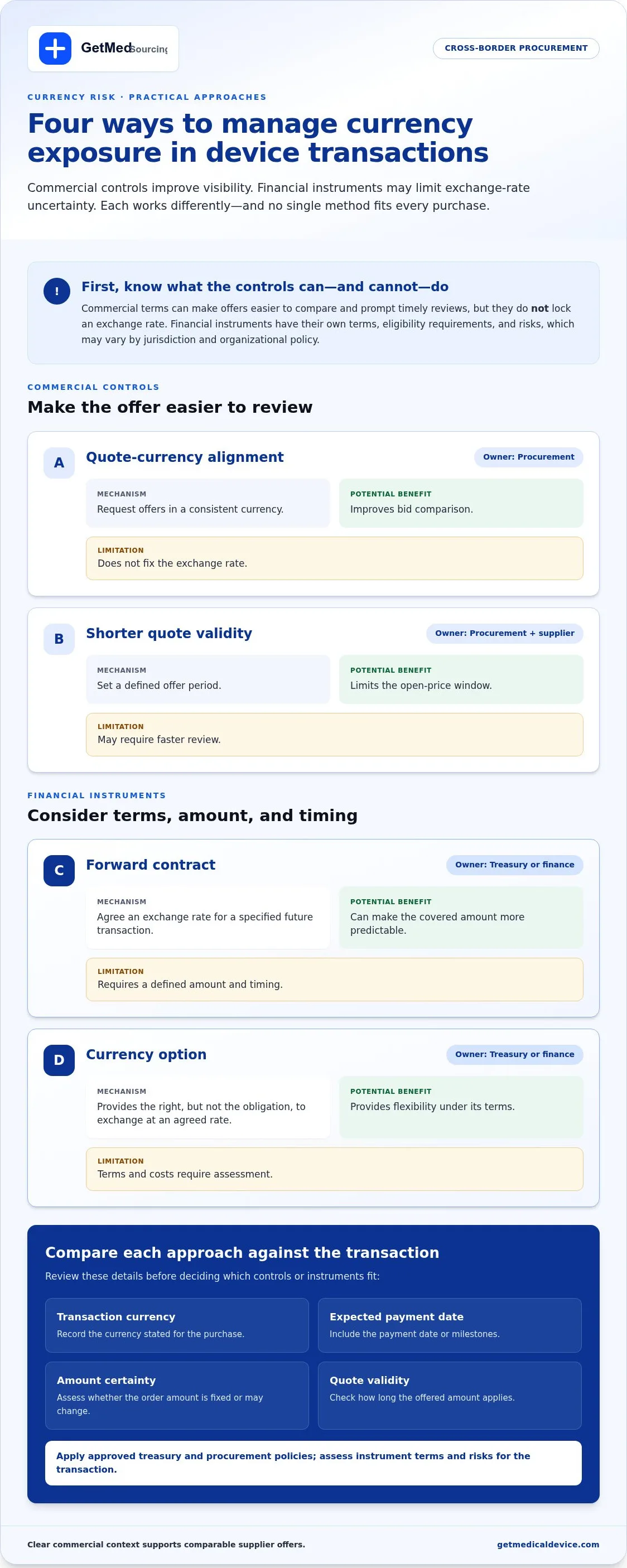
Currency controls generally fall into two groups: commercial terms that improve visibility and financial instruments that may limit exchange-rate uncertainty. Commercial controls do not lock an exchange rate. Financial instruments have their own terms, eligibility requirements, and risks, which can vary by jurisdiction and organizational policy.
Operational controls versus financial instruments
Requesting quotes in a consistent currency makes offers easier to compare. Shorter quote validity limits how long a price remains open, and defined review points prompt teams to reassess exposure before approval or payment. These steps clarify decisions but don’t guarantee a fixed exchange rate. For an overview of international trade finance and foreign-exchange considerations, consult the U.S. International Trade Administration’s Trade Finance Guide.
Financial instruments work differently. A forward contract sets an exchange rate for a specified future transaction. A currency option gives the holder the right, but not the obligation, to exchange at an agreed rate. Terms and treatment depend on the transaction and applicable policies.
| Approach | Mechanism | Potential benefit | Limitation | Decision owner |
|---|---|---|---|---|
| Quote-currency alignment | Request offers in a consistent currency | Improves bid comparison | Does not fix the rate | Procurement |
| Shorter quote validity | Set a defined offer period | Limits the open-price window | May require faster review | Procurement and supplier |
| Forward contract | Agree a rate for a future exchange | Can make the covered amount more predictable | Requires defined amount and timing | Treasury or finance |
| Currency option | Secure a right to exchange at an agreed rate | Provides flexibility under its terms | Terms and costs require assessment | Treasury or finance |
How to compare approaches for a specific transaction
For each cross-border medical device procurement decision, review the transaction currency, expected payment date, certainty of the amount, and quote validity. Apply approved treasury and procurement policies rather than treating one method as suitable for every purchase. GetMedicalDevice’s supplier discovery platform supports sourcing visibility, separate from currency-risk management.
A Step-by-Step Process for Managing Currency Exposure in Procurement
Use a documented workflow to keep a clear record from the initial quote through settlement. Before approval, record the device and quantity, transaction currency, quoted amount, quote date and validity, planned payment date or milestones, delivery terms, and responsible owner. This gives procurement and finance a shared basis for review. The International Trade Administration explains how the uncertainty of future exchange rates affects international trade.
- Identify currencies: Note the quote, invoice, payment, and internal reporting currencies.
- Record amounts and dates: Capture the quoted amount, quote date, validity period, and expected payment schedule.
- Assess certainty: Flag whether the order amount and payment timing are fixed or may change.
- Select controls: Apply commercial or financial controls permitted by organizational policy.
- Review outcomes: Reconcile the final settlement with the initial record and note changes that may inform future decisions.
What to include in an RFQ and quote comparison
Use consistent RFQ fields for product specifications, quantity, quote currency, quote validity, payment milestones, and delivery terms. Compare offers using the same assumptions, and flag terms that could change the payable amount. For example, note when the payment schedule differs or the order quantity remains subject to confirmation. Clear inputs improve comparison, but they don’t promise a particular exchange rate.
How to record and review currency exposure
A simple exposure register can include: transaction currency | quote date | validity | planned payment date | responsible owner. Add the amount and relevant milestones so reviewers can see the transaction’s scale and timing. Set formal review points at approval, order placement, and settlement rather than relying on informal updates. For wider documentation practices, see Checklist for International Medical Device Sourcing.
This record supports more consistent cross-border medical device procurement decisions. To structure product and quantity requirements for supplier comparisons, explore medical device sourcing on GetMedicalDevice.
Connect Currency Controls to Supplier Discovery and Procurement Next Steps
Supplier visibility and currency controls address different parts of cross-border medical device procurement. Clear supplier and product information helps teams identify relevant offers. Consistent RFQ fields and recorded commercial terms make those offers easier to compare. Procurement and finance can then assess currency exposure using transaction details rather than incomplete or inconsistent quote information.
Use supplier and product information in a consistent comparison
GetMedicalDevice is a global B2B sourcing platform with medical device listings, Verified Supplier Membership, and RFQ response credits that suppliers use to bid on procurement requests. Buyers can use the listings as a sourcing input, then structure RFQs to specify the product, quantity, delivery terms, quote currency, quote validity, and payment terms. Consistent inputs make commercial differences between offers easier to assess.
Supplier discovery and RFQ tools do not hedge exchange rates or replace an organization’s financial controls. They support procurement visibility, while internal treasury and procurement processes remain responsible for assessing exposure and applying approved controls.
Turn the framework into a procurement action plan
Before advancing a purchase, document the transaction, amount, currency, quote date and validity, expected payment timing, relevant delivery milestones, and internal review owner. Use these details to compare supplier offers and schedule reviews at approval, order placement, and settlement. This creates a traceable link between sourcing decisions and currency-exposure oversight.
Explore supplier and product information, then apply your organization’s procurement and treasury processes to the transaction. Explore medical device sourcing options.
Make Currency Clarity Part of Every Procurement Decision
Effective cross-border medical device procurement starts with recognizing that currency exposure can arise well before settlement. Map the currencies, amounts, and key dates across each transaction, then compare commercial controls and financial instruments according to the purchase details and your organization’s approved policies. No single approach fits every transaction.
Consistent RFQ requirements and clear records of quote validity, payment timing, and review ownership help procurement and finance assess offers on a comparable basis. Supplier discovery supports this process by improving visibility into devices and commercial terms, but it doesn’t replace internal currency controls.
GetMedicalDevice is a global B2B medical device marketplace with Verified Supplier Membership, premium product listings, and RFQ response credits for supplier bids on procurement requests. Use it as a sourcing resource while your team manages financial exposure through its established processes. Explore medical device sourcing options and take the next procurement step with clearer requirements and greater visibility.
Frequently Asked Questions
What is currency risk in cross-border medical device procurement?
Currency risk is the possibility that exchange-rate movements change the home-currency value of a quoted, contracted, or paid transaction. In cross-border medical device procurement, exposure may arise when a buyer reviews a quote, approves a purchase, receives an invoice, or settles payment in a currency different from its reporting currency. Record the transaction currency, relevant amounts, and key dates before comparing offers or assessing potential financial effects.
How can a medical device buyer reduce currency risk when sourcing internationally?
Start by documenting each quote’s currency, validity period, expected payment date, amount certainty, and payment milestones. Compare suppliers using consistent commercial assumptions, then set internal review points for approval, order placement, and settlement. These steps make exposure easier to track, but they don’t guarantee a particular exchange rate. Assess any financial instruments under your organization’s approved treasury policies and with appropriate expertise.
Should an international medical device RFQ specify a currency?
Yes. State the requested quote currency, or ask suppliers to clearly identify the currency they propose. Include quote validity, payment terms, and relevant payment milestones so offers can be compared on a consistent basis. Procurement and finance teams can then assess the commercial terms against the organization’s budget and policies. Record assumptions that could affect the final payable amount, including currency differences or changes in payment timing.
Do forward contracts eliminate currency risk for medical device purchases?
No. A forward contract can set an exchange rate for a specified future transaction, subject to its terms, but it doesn’t remove every commercial or operational risk. The amount, timing, and conditions of the purchase matter, especially if the order or payment schedule changes. Before considering a forward contract, understand its terms and apply your organization’s approved treasury policies to the specific procurement exposure.
Can a medical device marketplace hedge foreign-exchange risk?
No. A marketplace can support supplier discovery, product listing review, and structured procurement requests, but these tools don’t fix exchange rates or hedge a transaction. GetMedicalDevice is a global B2B medical device marketplace with Verified Supplier Membership, premium product listings, and RFQ response credits. Use sourcing information alongside internal financial controls, which remain separate from supplier discovery and RFQ processes.
