
The $623 billion medical device market in 2026 demands a more systematic approach to global procurement than traditional trade shows can provide. For manufacturers of specialized devices like catheters and stents, manual RFQ processes and high lead acquisition costs often erode profit margins. You likely recognize that building trust with international buyers requires verified status. This reduces perceived risk. This article provides a comprehensive framework for calculating ROI of a supplier marketplace membership. We'll move beyond surface-level metrics to analyze deep financial impact.
We'll provide a quantitative formula to determine your exact cost per lead. This demonstrates how a verified membership leverages organizational competence to secure high-value contracts. You'll learn to evaluate direct savings from streamlined workflows and the qualitative value of global visibility. By the end of this guide, you'll possess a structured methodology to justify marketplace investment. It's about measurable performance data and improved procurement efficiency.
Key Takeaways
- Establish a financial baseline by categorizing ROI into three distinct pillars: Direct Revenue, Cost Avoidance, and Brand Equity.
- Implement a precise framework for calculating ROI of a supplier marketplace membership by comparing digital acquisition costs to traditional sales overhead.
- Leverage verified status as a high-level trust signal to shorten procurement cycles and bypass international trade barriers.
- Apply a standardized net benefit formula to accurately reconcile marketplace expenditures with the total gross profit from new contracts.
Table of Contents
- The Core Components of Medical Marketplace ROI
- Quantitative Metrics: Measuring Lead Quality and Conversion
- The Trust Premium: The Value of Global Verification
- Calculating Your Net Benefit: The ROI Formula for Suppliers
The Core Components of Medical Marketplace ROI
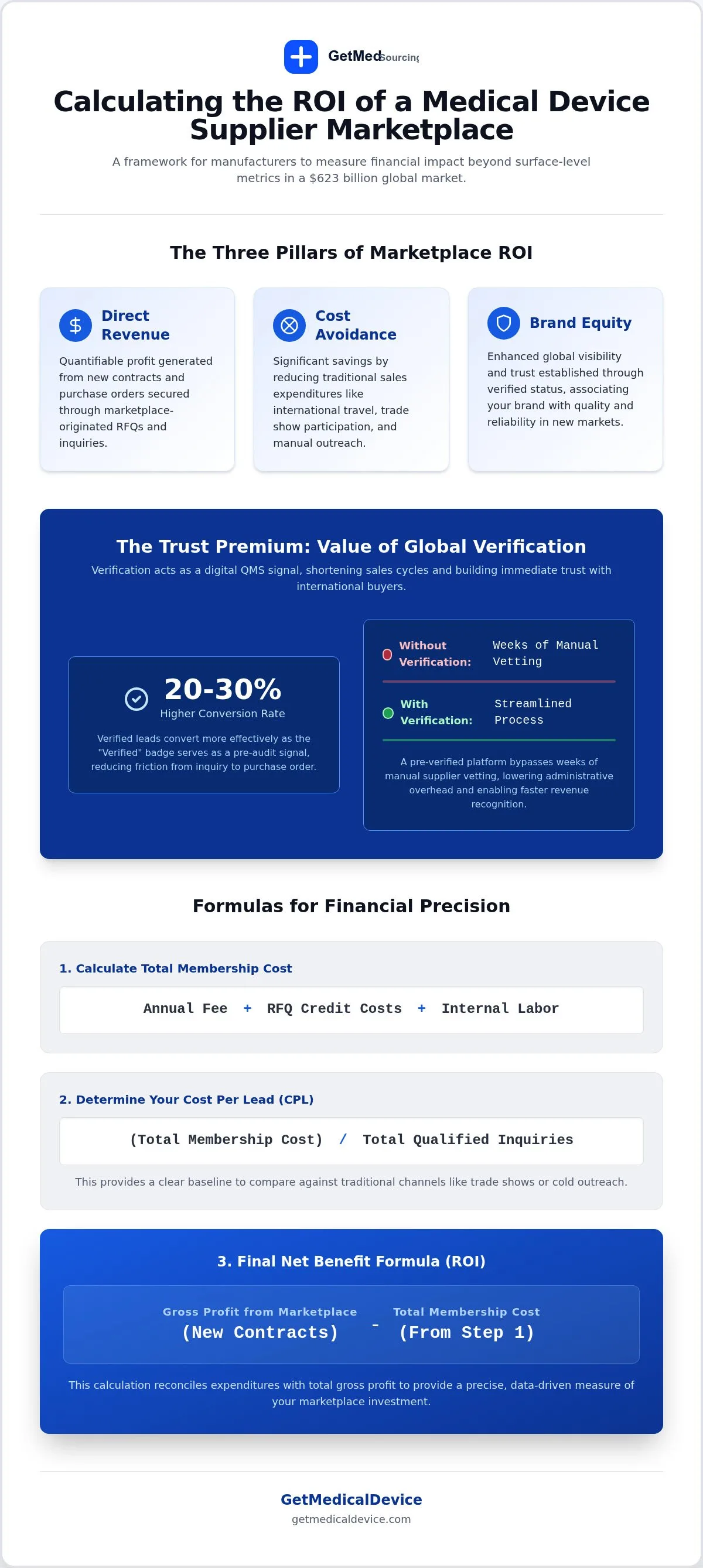
In the medical device sector, Return on Investment (ROI) serves as a critical metric for evaluating procurement infrastructure. For a manufacturer, calculating ROI of a supplier marketplace membership involves measuring the ratio of net profit generated from marketplace-originated sales against the total expenditure of the membership. This analysis is more complex than standard B2B models due to extended sales cycles and stringent regulatory verification requirements. A successful framework relies on three primary pillars: Direct Revenue, Cost Avoidance, and Brand Equity. The total cost of membership includes the annual subscription fee, the acquisition of credits, and the internal labor hours required for profile management.
Direct vs. Indirect ROI in Medical Sourcing
Direct ROI is quantifiable through revenue closed from RFQs and inquiries generated by premium listings. Conversely, indirect ROI focuses on cost avoidance. By utilizing a digital marketplace, firms reduce traditional expenditures such as international travel for sales teams and high-cost trade show participation. These savings contribute directly to the bottom line by lowering the overall cost of customer acquisition in competitive global markets. It's a shift from physical presence to digital authority.
The Role of RFQ Credits in Your Financial Model
A credit-based bidding system introduces a variable cost component that requires precise tracking. You must monitor how many credits are consumed relative to the volume of purchase orders secured. Integrating RFQ Response Credits into your strategy allows for targeted bidding on high-value requests. This systematic approach ensures that bidding costs remain proportional to potential contract value. It doesn't just manage costs; it optimizes the financial efficiency of your entire membership by aligning spend with high-intent buyer behavior.
Quantitative Metrics: Measuring Lead Quality and Conversion
Precision in data validation is essential for procurement leaders. When calculating ROI of a supplier marketplace membership, you must compare the Customer Acquisition Cost (CAC) of the platform against traditional cold-outreach or high-cost social media advertising. Marketplace leads typically arrive with higher intent. This improves the Lead-to-Opportunity ratio significantly. Tracking the Average Contract Value (ACV) for specialized categories, such as Coronary Intervention, helps quantify the revenue impact of bulk orders for stents or balloons. You should also monitor your RFQ Win Rate. This percentage reflects how many submitted bids result in a formal purchase order. Effective resource allocation starts with calculating ROI of a supplier marketplace membership using standardized financial benchmarks.
Calculating Cost Per Lead (CPL) for Verified Members
To determine the efficiency of your spend, apply the standard CPL formula: (Annual Membership Fee + RFQ Credit Costs) / Total Qualified Inquiries. This metric provides a baseline for comparing different lead generation channels. Some industry professionals report that verified leads have a 20-30% higher conversion rate in clinical procurement. This occurs because the verified badge serves as a pre-audit signal. It reduces the friction between the initial inquiry and the purchase order. You don't have to spend weeks proving your regulatory standing before the technical discussion begins.
Time-to-Close Efficiency
Sales cycle duration is a critical variable in the medical device industry. Manual vetting of unverified international suppliers can extend procurement timelines by several weeks. By contrast, a pre-verified platform streamlines this process. A shorter sales cycle increases your team's capacity to handle more RFQs simultaneously. You can optimize this further by reviewing your Premium Product Listings to ensure technical specifications are immediately accessible to buyers. This efficiency translates to lower administrative overhead and faster revenue recognition for high-stakes surgical equipment.
The Trust Premium: The Value of Global Verification
Verification functions as a digital Quality Management System (QMS) signal. It provides immediate assurance to procurement officers that a supplier adheres to industry standards. This is a qualitative factor often overlooked when calculating ROI of a supplier marketplace membership. In international trade, the "Verified" badge bridges the gap in markets where your organization lacks a physical office or local sales team. It aligns with the Global Medical Device Sourcing Strategy. This framework emphasizes verified digital channels to mitigate cross-border procurement risks. Listing inventory from established brands like Abbott Vascular or Boston Scientific creates a "Halo Effect." It associates your business with global leaders in medical technology, elevating your standing among high-value clinical buyers.
Reducing the "Risk Discount" in B2B Sales
Procurement departments often apply a "risk discount" to quotes from unverified sources. They demand lower prices to compensate for the perceived risk of regulatory non-compliance or supply chain instability. Securing a Verified Supplier Membership removes this barrier. It allows you to maintain stable pricing and protect your margins. This stability is essential for long-term financial planning. It ensures that your internal ROI projections remain accurate over multiple fiscal quarters. When buyers trust the verification process, they prioritize reliability over the lowest bid.
Expanding into Specialized Niches
Membership provides entry into high-barrier medical categories. These include Neurovascular and Peripheral Intervention. These sectors require high levels of trust due to the critical nature of the procedures involved. Accessing these niches is a key component when calculating ROI of a supplier marketplace membership for specialized manufacturers. The technical requirements for these devices are rigorous. Buyers prioritize platforms that have already conducted the baseline due diligence on supplier legitimacy. Marketplace verification facilitates access to global clinics searching for these specialized devices, ensuring your products are visible to qualified buyers.
Calculating Your Net Benefit: The ROI Formula for Suppliers
A rigorous financial assessment requires a four-step reconciliation process. First, aggregate all fixed and variable expenditures, including the annual membership fee and RFQ credit costs. Second, calculate the total gross profit generated specifically from contracts sourced through the platform. Third, estimate avoided costs. These include the reduction in third-party lead generation services and the labor hours saved through automated procurement. Finally, apply the formula for calculating ROI of a supplier marketplace membership: [(Total Profit + Avoided Costs) - Membership Investment] / Membership Investment. This calculation provides a percentage that reflects the true efficiency of your digital procurement infrastructure.
Projecting ROI for the First 12 Months
Financial performance typically follows a non-linear trajectory. During the first quarter, focus on listing optimization and initial RFQ engagement. You shouldn't expect peak conversion immediately. However, the value of a verified status compounds over time. As your profile accumulates data and positive interactions, the trust premium reduces friction in high-value bids. By the fourth quarter, the established digital presence often yields a more consistent volume of qualified inquiries from global hospitals and clinics.
Optimizing Your Membership for Maximum Returns
Strategic use of Premium Product Listings is essential to capture passive search traffic from procurement officers. These listings ensure high visibility for specialized devices like neurovascular catheters. Additionally, response speed is a critical variable. Industry professionals report that rapid RFQ response times correlate directly with higher win rates. Buyers in the medical field prioritize suppliers who demonstrate organizational competence through prompt and technical communication. Integrating these practices ensures your membership operates as a high-yield asset rather than a sunk cost.
Optimizing Global Procurement Infrastructure for 2026
Systematic implementation of this framework ensures that your procurement strategy remains data-driven and financially viable. By calculating ROI of a supplier marketplace membership using the net benefit formula, you transition from speculative marketing to precise resource allocation. This methodology accounts for the compounding value of verification and the reduction in administrative overhead. You're now equipped to evaluate how digital authority translates into measurable profit margins in high-barrier medical categories. Establishing a verified presence today secures your position in the evolving medical device landscape.
To leverage these efficiencies, you can Apply for a Verified Supplier Membership on GetMedicalDevice. This provides immediate access to a global network of hospitals and clinics seeking specialized devices. Our platform offers verified status for top brands like Terumo and Asahi Intecc, alongside a targeted RFQ bidding system designed to optimize your conversion rates. It's a strategic investment in organizational competence and long-term market growth.
Frequently Asked Questions
How do RFQ credits impact the overall ROI of a membership?
RFQ credits function as a variable cost component within your procurement model. They allow for targeted bidding on active requests from global hospitals and clinics. By monitoring the conversion rate of these credits into purchase orders, you can refine your bidding strategy. This data is essential for calculating ROI of a supplier marketplace membership. Efficient credit allocation ensures that your marketing spend aligns directly with high-intent procurement opportunities.
Can I see a positive ROI without premium product listings?
You can generate returns through active RFQ bidding alone, but omitting premium product listings limits your passive lead generation. These listings ensure your inventory, such as specialized surgical products, remains visible to buyers during the discovery phase. Capturing this inbound traffic reduces your total customer acquisition cost. Relying solely on credits requires more manual labor, which can lower your overall administrative efficiency and net profit.
How long does it typically take to see a return on a medical marketplace membership?
Most medical device suppliers observe a positive return within six to twelve months. This timeline accounts for the extended sales cycles typical of clinical procurement. The initial quarter focuses on profile optimization and establishing a presence. As your verified status builds authority, conversion rates generally improve. Significant financial impact often follows the successful closure of bulk contracts for high-value items like neurovascular or coronary devices.
Does a verified status really help in sourcing interventional radiology devices?
Verified status is critical for sourcing interventional radiology devices. Procurement officers in this sector prioritize regulatory compliance and supply chain stability above all else. A verified badge serves as a pre-audit signal, reducing the friction of international vetting. It positions your organization as a reliable partner for high-stakes equipment. This trust allows you to maintain stable pricing and bypass the heavy risk discounts unverified suppliers often face.
What is the difference between hard and soft ROI in medical device sales?
Hard ROI consists of quantifiable financial gains, such as direct revenue from closed RFQs and reduced lead generation costs. Soft ROI involves qualitative benefits like brand equity and global visibility. When calculating ROI of a supplier marketplace membership, you must account for the halo effect of appearing alongside brands like Terumo or Abbott Vascular. This association enhances your professional standing in the global market, leading to long-term procurement advantages.