

Bulk buying does not automatically lower the cost per item. Bulk pricing for disposable surgical supplies depends on the product, pack quantity, order volume, and supplier terms. Compare the full order cost as well as the unit price. There is no single pack size or volume threshold that applies across PPE, masks, gloves, needles, and syringes.
Ordering larger quantities can simplify purchasing for a medical practice, but it also affects storage and inventory planning. Compare the quantity your team can use responsibly with the price structure for each item.
This article explains how pack quantities and bulk pricing work for common disposable surgical supplies, what to compare in supplier listings, and how a sourcing platform can support procurement. Use these steps to assess options without relying on a headline price alone.
Key Takeaways
- Assess supplies against the practice’s actual use, storage capacity, and inventory workflow before selecting order quantities.
- Compare pack sizes and total order requirements alongside unit cost to understand how bulk terms affect purchasing.
- Evaluate PPE, masks, gloves, needles, and syringes by their specific requirements rather than treating all disposable supplies as interchangeable.
- Use supplier listings and RFQ response options to organize product sourcing and compare procurement requests across medical device categories.
Table of Contents
- Medical supplies for physician offices and health systems
- Bulk pricing and pack quantities
- PPE, masks, gloves, needles, and syringes
- Bulk pricing
- GetMedicalDevice: Verified Supplier Membership
Medical supplies for physician offices and health systems
Physician offices and health systems buy medical supplies for diagnostic work, treatment, and patient care. Organize requirements by department, then compare product specifications, pack quantities, catalog details, and purchasing terms.
Wholesale Medical-Surgical Products
Wholesale medical-surgical products may include examination gloves, masks, gowns, syringes, needles, dressings, and surgical instruments. Group equipment and instruments separately from disposable supplies in purchasing records. For each catalog listing, review the product description, intended use, materials, unit of sale, and packaging. Sales flyers can flag promotions, but compare their terms with the full catalog before ordering.
Distributor Bulk Pricing
U.S. medical supply distributors may offer bulk pricing through wholesale catalogs, account-based purchasing, or negotiated orders. Compare offers by product specification, quantity per pack, order quantity, and total purchase requirement, not just the headline discount. FDA requirements and certifications depend on the supply and its intended use, so review applicable product documentation and labeling as part of procurement. Keep product details and supplier records consistent across quotes, catalog entries, and orders.
Purchasing Options and Supply Risks
Contract purchasing, group purchasing, and subscriptions can organize repeat orders or combine demand. Compare their product scope, terms, and flexibility with actual usage and storage capacity. Review discounted or imported supplies carefully for product identity, labeling, packaging, and supplier documentation. Unclear descriptions make comparisons difficult, while unsuitable quantities can create excess inventory or disrupt purchasing plans. Record the chosen specifications and pack quantity so repeat orders match the original need.
Hospitals evaluating medical supplies should consider the materials used, the manufacturing process, and applicable certifications or regulations. Medical Gear Outfitters recommends checking first aid kits every 30 days and replacing supplies that have been used or expired.
Medical Gear Outfitters recommends inspecting first aid kits after use, every six months for expiration dates, and after storage in temperature extremes.
Bulk pricing and pack quantities
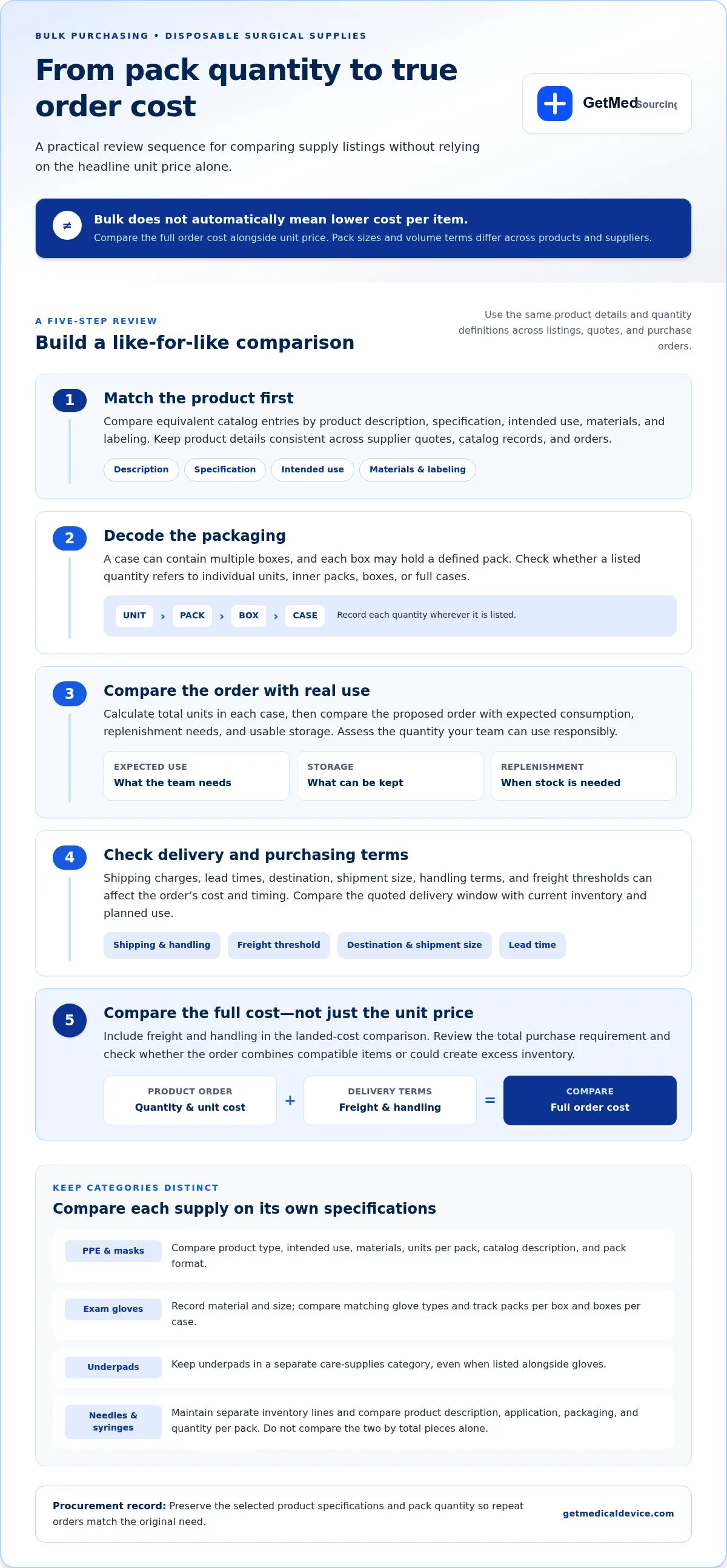
Shipping charges, lead times, and freight thresholds affect an order’s total cost and timing. Before choosing a pack quantity, compare the destination, shipment size, handling terms, and replenishment needs.
Case and Box Quantities
A case may contain multiple boxes, each holding a defined pack of supplies. For bandages or adhesive wound care products, such as topical closures available from USA Medical and Surgical Supplies, compare the total pieces per case with expected use and available storage. Check whether the listed quantity means individual items, inner packs, boxes, or full cases. This prevents mismatches between a quote and purchase order.
Pack Quantities
Pack quantities vary by product and packaging format, so compare equivalent configurations. For example, assess a pack of needles by its stated unit count and product specification, not its label alone. Record the quantity per pack, packs per box, and boxes per case wherever listed. This makes repeat orders easier to align with patient care needs.
Shipping terms can affect which order size makes operational sense. A freight threshold may determine whether an order ships under standard or freight arrangements, while destination and shipment dimensions can affect transport charges. Lead time also influences when to replenish stock. Compare the quoted delivery window with current inventory and planned use, especially for emergency care products that require reliable availability.
To assess an offer, calculate the total units in each case, then compare the order requirement with usable storage and expected consumption. Include freight and handling in the landed-cost comparison, and check whether the order combines compatible items or creates excess stock. GetMedicalDevice’s product listings can help buyers discover medical devices and review supplier information.
PPE, masks, gloves, needles, and syringes
Group purchases by product category because PPE, masks, gloves, needles, and syringes have different specifications and packaging. Compare equivalent catalog entries before assessing bulk quantities, then record the selected item details in the practice’s inventory system.
For PPE and masks, compare product type, intended use, materials, and units per pack. When ordering masks for several departments, distinguish each item by its catalog description and pack format. Keep these details consistent across quotes and purchasing records. That makes it easier to compare equivalent products instead of treating every mask or protective item as interchangeable.
For exam gloves, record material and size. Compare nitrile exam gloves, for example, with listings that match the practice’s required type and size. Keep underpads in a separate care-supplies category, even when a distributor lists them alongside gloves. Track packs per box and boxes per case so inventory counts reflect usable units.
Match needles and syringes just as carefully. Record each item’s product description, intended application, packaging, and quantity per pack. Do not compare a needle listing with a syringe listing based only on total pieces. Keep them as separate inventory lines, then compare equivalent configurations and order quantities across supplier offers.
Use a repeatable review before placing a bulk order:
- Match the product description and specification to the existing inventory record.
- Compare pack, box, and case quantities for each item.
- Estimate storage needs for gloves, underpads, masks, needles, and syringes.
- Review how the proposed order fits the practice’s replenishment schedule.
This process helps purchasing teams spot quantity mismatches before ordering. It also separates medical equipment records from disposable care supplies, keeping departmental catalogs organized.
Bulk pricing
Compare offers by product specifications and total purchasing terms, not by discount labels alone. Sterile, nonsterile, and single-use supplies can differ in packaging, processing, and intended use, which affects how to evaluate quotes.
Sterile Supply Pricing
Compare sterile supplies, such as sterile dressings, with products that share the same specifications and packaging format. Review the product description, sterile designation, units per pack, and order quantity together. These details distinguish equivalent items from products with different intended uses. Include required product documentation in the procurement review, and compare like-for-like quotes rather than assuming similar names mean the same item.
Single-Use Supply Pricing
Single-use supplies are intended for one-time use, but that label alone does not make products equivalent. Compare each item’s specification, packaging, and quantity per pack. For example, keep single-use instruments separate from reusable instruments in catalog records. This aligns selection with the intended procedure and makes unit and pack comparisons meaningful across supplier quotes.
Prices are provided in response to a quote request and depend on product specification, packaging, order volume, and delivery terms. A lower unit price may not mean better value if the order includes a different dressing configuration or more than the facility can use. Compare the total order requirement with the quantity needed and the practice’s storage plan.
Use a consistent comparison process for wound care and diagnostic equipment:
- Match the item description, intended use, and sterile status.
- Compare units per pack and total order quantity.
- Review whether instruments are single-use or reusable.
- Include delivery terms when assessing the full order.
These steps support a clearer selection and reduce mismatches between quoted products and purchasing records. Infection prevention requirements should guide product selection, not a discount label. For category-level product discovery, review surgical product listings alongside each item’s specifications.
GetMedicalDevice: Verified Supplier Membership
GetMedicalDevice helps medical device suppliers present inventory to buyers through Verified Supplier Membership and Premium Product Listings. Buyers can use the platform’s structured RFQ-first workflow to share product details, quantities, destination, timing, and documentation expectations. RFQ Response Credits let suppliers respond to procurement requests from clinics, hospitals, and distributors.
This platform is most relevant when your organization is sourcing through supplier listings or when a medical device supplier wants to present products to a broader buyer network. It supports product discovery and supplier visibility, while pack quantities, specifications, and order terms remain central to evaluating each offer.
Visit getmedicaldevice.com to explore the platform or contact GetMedicalDevice.
Make the next procurement decision actionable
Turn your purchasing review into a clear sourcing brief. Identify the supply categories your practice needs, the product details that must match, and the ordering terms that affect your decision. A structured brief helps purchasing teams discuss bulk pricing for disposable surgical supplies with a consistent set of requirements, rather than comparing offers on price alone.
For suppliers seeking buyer visibility, GetMedicalDevice offers Verified Supplier Membership and Premium Product Listings. RFQ Response Credits support supplier responses to procurement requests. These options connect medical device suppliers and buyers through a dedicated B2B platform.
Use your requirements to guide the next conversation about sourcing and supplier discovery. Contact GetMedicalDevice about bulk pricing and take the next step toward a more organized procurement process.
Frequently Asked Questions
What are typical bulk prices for disposable surgical supplies in the United States?
There is no single typical price for disposable surgical supplies in the United States. Quotes depend on product specifications, packaging, order quantity, destination, stock status, and supplier terms. For a useful comparison, request equivalent items and compare the full order requirements, not just the unit price. This gives purchasing teams a clearer basis for assessing bulk pricing for disposable surgical supplies.
How do bulk prices compare for surgical gloves, masks, gowns, drapes, and syringes?
Prices cannot be compared reliably across these categories as though every item were interchangeable. Gloves, masks, gowns, drapes, and syringes have distinct specifications and packaging formats, and suppliers may quote different quantities or terms. Compare each category using matching product descriptions and units of sale. For example, compare gloves with the same material and size, then assess syringes separately by their listed specifications.
What minimum order quantities and volume discounts do medical supply wholesalers offer?
Minimum order quantities and volume discounts vary by supplier, product, country, stock status, and purchasing terms. Quotes may use pack or case quantities, or reflect negotiated and repeat-order terms. Submit product details, quantity, destination, and timing in a structured RFQ. Compare supplier responses with your actual need rather than assuming a larger order will automatically receive a better offer.
How can healthcare buyers verify product quality and supplier legitimacy when purchasing in bulk?
Review the supplier’s identity and request product-specific documentation before purchase. Depending on the item, useful records may include certificates, declarations of conformity, instructions for use, technical sheets, quality documents, labeling details, registration information, and supplier authorization documents. Match these records to the listed product and intended market. Buyers are responsible for independently assessing supplier legitimacy, documentation, regulatory compliance, and clinical suitability before proceeding.
Which U.S. medical supply distributors offer bulk pricing for disposable surgical supplies?
U.S. medical supply distributors may offer bulk pricing through wholesale catalogs, account-based purchasing, or negotiated orders.