

What can a supplier show online to give a medical device buyer enough confidence to start a procurement conversation? Building trust with medical device buyers online depends less on polished claims than on clear, consistent information buyers can assess. They need to understand who the supplier is, compare relevant product details, and know what information is available before sharing confidential requirements. Missing details create friction, while unsupported assurances can undermine confidence.
This article offers a practical framework for making supplier and product information easier to evaluate without disclosing sensitive business details. Learn how to structure supplier profiles, present product information consistently, and distinguish visibility signals from proof of regulatory status, product quality, or buyer acceptance. It also explains how marketplace tools, including Verified Supplier Membership, Premium Product Listings, and RFQ Response Credits, can support discovery and procurement conversations.
Key Takeaways
- Build trust with evidence buyers can assess, while keeping supplier visibility distinct from formal procurement due diligence.
- Use consistent supplier identity, product details, inventory information, and buyer communication to make evaluation clearer.
- Use a four-step workflow to prioritize online information by buyer audience, product category, and procurement stage.
- Building trust with medical device buyers online also means using marketplace profiles and RFQ responses for discovery without overstating what verification establishes.
Table of Contents
- Building Trust with Medical Device Buyers Online Starts with Credible Evidence
- Which Online Trust Signals Help Medical Device Buyers Assess a Supplier?
- A Practical Workflow for Building Buyer Confidence Across Digital Touchpoints
- How a Medical Device Marketplace Can Support Trust and Buyer Discovery
Building Trust with Medical Device Buyers Online Starts with Credible Evidence
Building trust with medical device buyers online starts with information they can assess, not claims they must take on faith. Online trust means buyers can find supplier details that are clear, consistent, and relevant enough to support an informed next step. A polished profile may help buyers discover a supplier, but credibility depends on whether its details explain who the supplier is and what it offers.
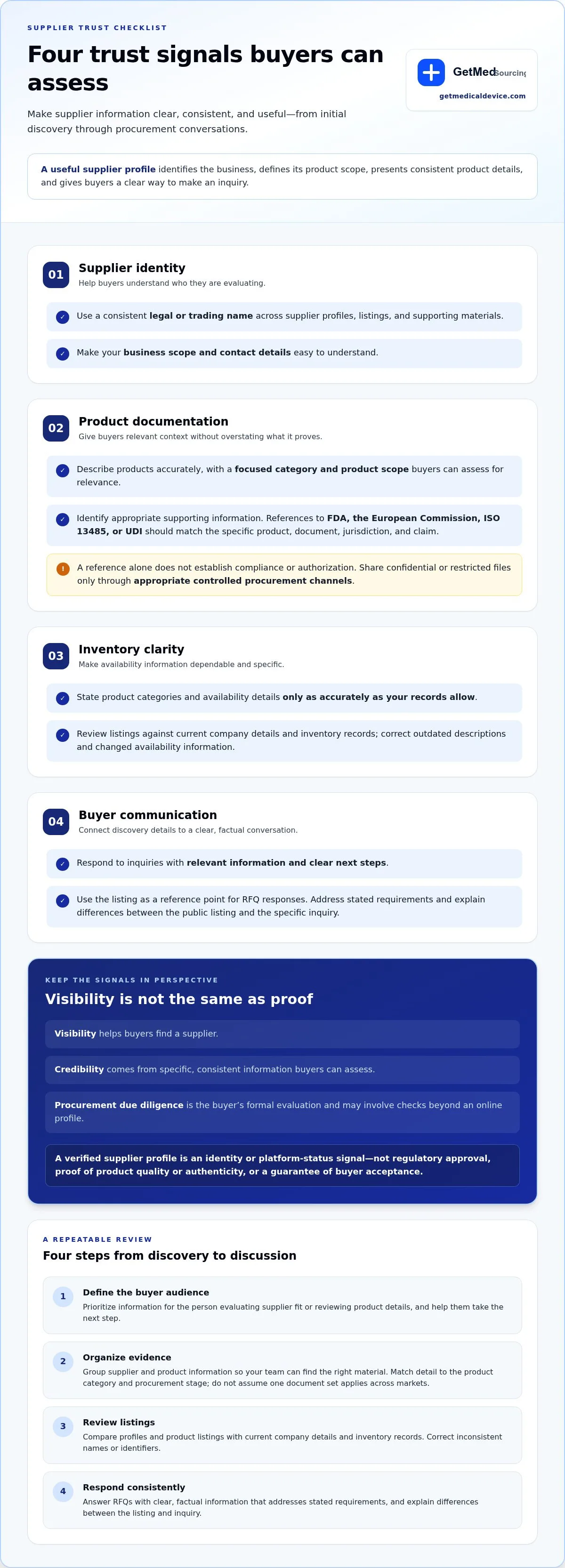
These concepts are related but distinct. Visibility helps buyers find a supplier. Credibility comes from specific, consistent information. Procurement due diligence is the buyer’s formal evaluation, which may involve checks beyond an online profile. A general overview of what a medical device is can help frame the category, but product-specific details are needed to evaluate a sourcing opportunity.
What buyers need to understand before making contact
Initial research should make the supplier’s identity, business scope, and contact route easy to understand. Product information should help buyers judge relevance: does the listing relate to a category they source, and does its description provide enough context to ask a focused question? For example, a specialized device listing is more useful when it clearly names the product type and category. To learn more about specialized niche categories such as anatomical models and medical simulation manikins, buyers can look at focused supplier inventories. The aim is to reduce uncertainty, not to claim superiority.
Why online presence is not the same as proof
A professional website or marketplace listing is a starting point for evaluation, not a substitute for procurement checks. Buyers may need to assess requirements specific to their organization, transaction, product, or market. A profile badge should be understood within its stated scope, not as confirmation of every product’s regulatory status, authorization, quality, or authenticity.
A verified supplier profile is an identity or platform-status signal. It is not regulatory approval, proof of product quality or authenticity, or a guarantee of buyer acceptance. Making this distinction clear keeps claims credible and helps buyers decide what to evaluate next.
Which Online Trust Signals Help Medical Device Buyers Assess a Supplier?
Useful trust signals make supplier information easier to compare and follow up. Organize buyer-facing information into four areas:
- Supplier identity: Use a consistent legal or trading name, business scope, and contact details.
- Product documentation: Describe products accurately and identify appropriate supporting information.
- Inventory clarity: State product categories and availability details only as accurately as your records allow.
- Buyer communication: Respond to inquiries with relevant information and clear next steps.
A useful supplier profile identifies the business, defines its product scope, presents consistent product details, and gives buyers a clear way to make an inquiry.
Make supplier and product information consistent
Keep company names, contact details, product descriptions, and identifiers aligned across supplier profiles, listings, and supporting materials. Inconsistencies can make it difficult for buyers to tell whether two references describe the same supplier or product. Define product scope precisely. A focused category description helps buyers identify relevance without relying on broad claims of expertise or superiority. For example, categorize inventory by the device area it serves rather than using unsupported wording such as “best-in-class”-an approach demonstrated by specialized equipment developers like Jett Medical Canada when outlining clear clinical applications across dermatology and ophthalmology.
Present supporting information responsibly
Public listings can summarize relevant product details and identify information available for buyer evaluation. Share confidential or restricted files only through appropriate controlled procurement channels, and avoid publishing sensitive business information openly. References to FDA, the European Commission, ISO 13485, or UDI should match the specific product, document, jurisdiction, and claim. Check that the wording reflects the scope of the supporting information. A reference alone does not establish compliance or authorization.
For another discovery channel, suppliers can present organized information through a medical device marketplace. Consistent profiles and direct responses help buyers connect initial discovery with more detailed evaluation.
A Practical Workflow for Building Buyer Confidence Across Digital Touchpoints
Building trust with medical device buyers online takes a repeatable process, not a one-time profile edit. Use this four-step checklist to keep information relevant from discovery through procurement discussions:
- 1. Define the buyer audience. Identify who needs the information, such as a sourcing professional assessing supplier fit or a technical evaluator reviewing product details. Prioritize information that helps that person take the next step.
- 2. Organize evidence. Group supplier information and product details so your team can find the right material efficiently. Match the level of detail to the product category and procurement stage. Do not assume one set of documents applies across markets.
- 3. Review listings. Compare online profiles and product listings with current company details and inventory records. Correct outdated descriptions, changed inventory information, and inconsistent names or identifiers.
- 4. Respond consistently. Use the listing as a reference point for RFQ responses. Address the buyer’s stated requirements with clear, factual information, and explain any differences between the public listing and the specific inquiry.
Organize discovery around the buyer’s task. Someone researching coronary intervention products should be able to distinguish that category from specialized neurovascular products. Focused descriptions help buyers find relevant inventory without suggesting that every item suits every use or procurement requirement.
Set a regular review routine and assign responsibility for checking company details, product descriptions, identifiers, and inventory information. Review them when details change and before responding to an RFQ. If a response differs from a listing, explain the distinction directly instead of leaving buyers to resolve conflicting information.
Clear, prompt, factual communication carries confidence from online discovery into buyer evaluation. Explore supplier visibility options on GetMedicalDevice to present focused listings and respond to procurement requests.
How a Medical Device Marketplace Can Support Trust and Buyer Discovery
A supplier website, marketplace profile, and RFQ response each play a different role in buyer evaluation. A website can provide broader company and product context. A marketplace profile helps buyers find supplier information in a procurement-focused setting. An RFQ response addresses a specific request and lets the supplier share details relevant to that buying task. Together, these touchpoints can support building trust with medical device buyers online when the information is consistent.
Where marketplace membership fits into the trust journey
GetMedicalDevice’s Verified Supplier Membership supports supplier visibility on the marketplace. Premium Product Listings help suppliers present products for discovery, while RFQ Response Credits let suppliers bid on active procurement requests. Buyers can browse the medical device products directory to explore listed products. These tools support discovery and participation, but membership or a listing does not guarantee a procurement decision, regulatory acceptance, product quality, or buyer trust. For additional context on supplier verification, see this verified medical device supplier guide.
Use each touchpoint for its intended purpose. Keep marketplace listings focused so buyers can judge whether a product category appears relevant before submitting a request. Then use the RFQ response to answer the specific inquiry accurately, rather than relying on broad profile language to represent every product or transaction.
Marketplace visibility is one part of evaluation. Buyers determine whether a supplier and product meet their procurement requirements, and platform status is not a substitute for that assessment.
Suppliers seeking a structured marketplace presence can explore Verified Supplier Membership and use listings and RFQ responses to support discovery and procurement conversations.
Make Your Next Buyer Interaction More Informed
Use buyer inquiries as practical feedback. Repeated questions may show that a detail needs clearer presentation. Requests that reveal a mismatch can help you refine how you describe product scope. Over time, this feedback can make future conversations more focused without requiring you to disclose confidential information publicly.
Building trust with medical device buyers online is an ongoing process shaped by the accuracy of each profile, listing, and response. GetMedicalDevice offers suppliers tools for different stages of that process: Verified Supplier Membership and Premium Product Listings support marketplace visibility, while RFQ Response Credits provide access to bidding on active procurement requests. These tools create opportunities to present information and engage with procurement activity, while buyers make their own decisions.
Choose marketplace tools that fit your priorities and strengthen your supplier presence step by step. Explore Verified Supplier Membership to take a clear next step toward more informed B2B conversations.
Frequently Asked Questions
Does a verified supplier profile guarantee regulatory approval or product authenticity?
No. A verified profile indicates a supplier status within the marketplace; it does not independently establish regulatory approval, product authenticity, product quality, or authorization for a particular market. Buyers should assess product-specific information and supporting records relevant to their procurement requirements. Suppliers can keep profile claims precise by describing what the status represents and avoiding wording that suggests broader product-level verification.
Can online trust replace a medical device buyer’s supplier due diligence?
No. Online information can help buyers decide whether to begin a discussion, but it cannot replace their organization’s supplier qualification and procurement review. A buyer may need to assess a supplier against internal purchasing procedures or product-specific requirements before placing an order. Suppliers can support that process by answering follow-up questions consistently and providing relevant information through appropriate channels.
How often should medical device suppliers update their online product information?
Review product information whenever a relevant detail changes, including product scope, identifiers, or inventory status. A regular review can also catch errors that do not trigger an immediate update. Assign someone to compare active listings with current internal records at planned intervals and before responding to a related request. Set the review interval according to how often your information changes.
What information can a supplier share online without exposing confidential documents?
Share non-confidential details that help buyers understand your business and product scope, such as a clear category description and a route for procurement inquiries. Avoid posting restricted records, sensitive commercial terms, or documents intended for a specific buyer. If a buyer needs additional evidence, provide it through a controlled channel appropriate to the discussion and follow your organization’s information-handling practices.
Can a smaller medical device supplier build trust online without a large brand portfolio?
Yes. A broad brand portfolio is not the only way to communicate supplier relevance. A smaller supplier can focus its profile on the categories it serves, keep descriptions accurate, and respond directly to the buyer’s stated requirements. Building trust with medical device buyers online depends on useful, consistent information, not portfolio size alone. Specific scope helps buyers assess fit without relying on inflated claims.
