

What if a larger inventory buffer is masking the supply risk you need to manage? Building a resilient medical supply chain takes more than holding extra stock. Inventory can provide time to respond, but it will not reveal when different products, suppliers, or regions depend on the same source. For clinically important devices, that visibility matters because a disruption can affect continuity of care.
Start with product criticality and clear supply dependencies. Then assess where alternate sourcing may be feasible, what inventory buffer makes sense, and which product and procurement requirements shape the decision. This guide offers a practical framework for prioritizing vulnerabilities, diversifying sourcing, and improving procurement visibility without treating stockpiles as the only answer. It also explains how searchable product categories and RFQs can help teams explore sourcing options as part of a broader procurement process. The goal is a workable plan that connects supply choices to clinical needs and operational constraints.
Key Takeaways
- Prioritize devices by clinical criticality, then map supplier, manufacturing, transport, and substitution dependencies to identify concentrated risks.
- Building a resilient medical supply chain means weighing qualified alternate sources against inventory needs, workload, and oversight requirements.
- Turn risk findings into a continuity workflow by assigning owners, setting response triggers, and monitoring indicators such as stock status and substitution readiness.
- Use searchable listings and RFQs to explore potential suppliers, while keeping qualification, regulatory review, contracting, and logistics planning within procurement governance.
Table of Contents
- Building a Resilient Medical Supply Chain Starts with Mapping Critical Dependencies
- Compare Sourcing and Inventory Strategies for a Resilient Medical Supply Chain
- Turn the Medical Supply Chain Risk Map into an Actionable Continuity Plan
- Use Digital Supplier Discovery to Strengthen Medical Supply Chain Resilience
Building a Resilient Medical Supply Chain Starts with Mapping Critical Dependencies
Resilience is the capacity to anticipate, absorb, and recover from supply disruption. It reduces exposure, but does not eliminate risk. For procurement teams, building a resilient medical supply chain starts with linking each clinically important device to its suppliers, manufacturing locations, transport routes, and clinically acceptable substitutes. This product-level view applies the broader principles of supply chain management to decisions that can affect continuity of care.
Supply resilience is the ability to respond to disruption, not simply the amount of inventory held. Prioritize products by clinical impact, consequences of delayed availability, replenishment uncertainty, supplier concentration, and substitution constraints. Together, these factors help distinguish products that need active contingency planning from those that can be managed through routine purchasing.
Which medical devices deserve priority in a resilience assessment?
Group products according to the clinical consequences of delay and the availability of suitable alternatives. Routine consumables may have broader substitution options, while devices with constrained specifications or limited alternatives can require closer review. Coronary intervention and neurovascular categories illustrate why sourcing needs should be assessed separately: product requirements and clinically relevant substitutes can differ. Reviewing coronary intervention products alongside other categories can help structure that assessment.
How should procurement teams map supply dependencies?
For each priority device, record product identifiers, known suppliers, sourcing regions, manufacturing locations, transport routes, and available documentation. Flag single-source dependencies, then look for shared upstream suppliers or locations across product lines. A second supplier may not reduce risk if it relies on the same upstream source. Record potential substitutes alongside the clinical and procurement requirements that must be reviewed before use.
Use the map to identify missing information and assign someone to maintain each record. This gives procurement and clinical stakeholders a shared basis for prioritizing vulnerabilities and evaluating sourcing options before a disruption occurs.
Compare Sourcing and Inventory Strategies for a Resilient Medical Supply Chain
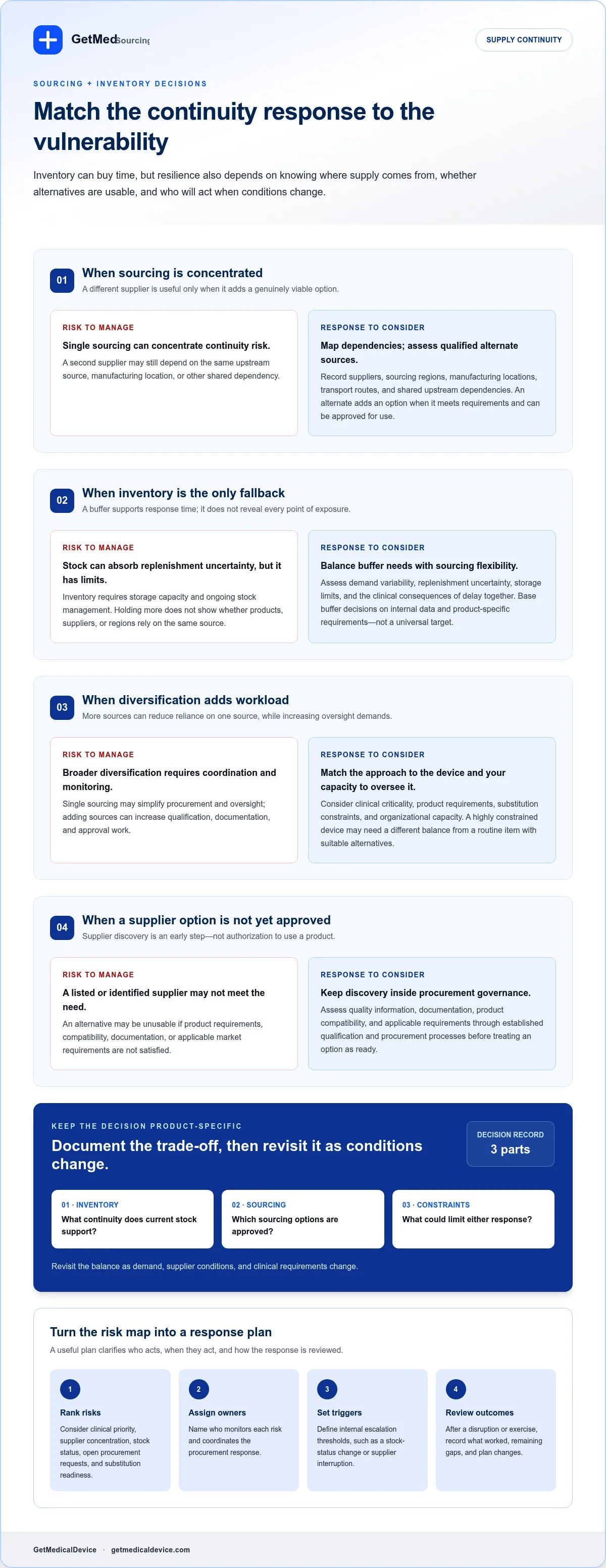
No single sourcing or inventory tactic fits every device category. Single sourcing can simplify procurement and oversight, but concentrates continuity risk. A qualified alternate source adds another option, while requiring teams to maintain supplier qualification, documentation, and approval. Broader diversification can reduce reliance on one source, but increases coordination and monitoring demands. Building a resilient medical supply chain means matching the approach to clinical criticality, product requirements, and the organization’s capacity to oversee suppliers.
When can alternate sourcing improve continuity?
An alternate source can strengthen continuity when its product meets applicable requirements and organizational processes permit its use. Treat supplier discovery as an early step, not approval. Procurement and relevant stakeholders still need to assess quality information, documentation, product compatibility, and applicable market requirements. Supplier visibility can help teams identify options to evaluate. Explore medical device supplier listings as one input to that assessment, alongside established qualification and procurement processes.
How should teams balance inventory buffers and sourcing flexibility?
Compare the protection offered by safety stock with the practical readiness of alternate sources. Inventory can help absorb replenishment uncertainty, but requires storage capacity and ongoing stock management. Sourcing flexibility may reduce reliance on a buffer, but only if alternatives are qualified and usable when needed. Assess demand variability, replenishment uncertainty, storage limits, and the clinical consequences of delay together. Base buffer decisions on internal data and product-specific requirements rather than a universal target.
For each category, document the trade-off: what continuity current inventory supports, which sourcing options are approved, and what constraints could limit either response. A highly constrained device may warrant a different balance from a routine item with suitable alternatives. Revisit the decision as demand, supplier conditions, and clinical requirements change. This makes sourcing and inventory decisions deliberate rather than relying on stock accumulation alone.
Turn the Medical Supply Chain Risk Map into an Actionable Continuity Plan
A risk map becomes useful when it clarifies who acts, when they act, and how the response is reviewed. Use this four-step workflow to turn findings into a plan:
- Rank risks: Consider clinical priority, supplier concentration, stock status, open procurement requests, and substitution readiness.
- Assign owners: Identify who monitors each risk and coordinates the procurement response.
- Define response triggers: Set internal thresholds for escalation, such as a change in stock status or a supplier interruption.
- Review outcomes: After a disruption or exercise, record what worked, which gaps remain, and what needs to change in the plan.
Building a resilient medical supply chain depends on clear accountability, not just documented risks. Procurement can track sourcing options and requests, while quality, clinical, regulatory, and logistics teams manage the assessments and actions within their remit.
What belongs in a medical-device disruption playbook?
Document escalation roles, decision rights, communication routes, and product prioritization. Set review triggers using internal thresholds that reflect operating conditions and product needs. Test scenarios such as a supplier interruption, delayed replenishment, or sudden demand change. Each exercise should clarify who communicates the issue, who evaluates alternatives, and who approves the next step.
How can teams improve supplier and product visibility?
Maintain consistent product identifiers, supplier records, documentation status, and procurement request histories. A dashboard or structured record can bring supplier concentration, stock status, open requests, and substitution readiness into one review. Keep records current so teams can distinguish a potential sourcing option from an approved response. Structured product listings and sourcing visibility can support this work by making products and potential suppliers easier to review.
Schedule reviews at defined intervals and after material changes or exercises. A resilience plan is actionable only when owners are assigned and reviews are scheduled. This cadence helps teams spot outdated information and update response steps before they are needed.
Use Digital Supplier Discovery to Strengthen Medical Supply Chain Resilience
Searchable product listings and RFQ workflows can help procurement teams explore potential suppliers and organize sourcing requests. They make options more visible, but discovery is only one part of building a resilient medical supply chain. It does not replace supplier qualification, regulatory review, contracting, or logistics planning. Procurement teams remain responsible for internal approval and continuity decisions.
How can a B2B marketplace support procurement resilience?
Start with the product category and requirement identified in the risk assessment. For example, teams can review coronary intervention products or neurovascular products when those categories match their needs. Listings help teams review supplier and product information, while RFQs communicate procurement requests to potential suppliers. Treat responses as inputs for evaluation, not as proof that a source is approved or available.
GetMedicalDevice supports supplier visibility through Verified Supplier Membership and Premium Product Listings. Its RFQ response workflow enables suppliers to respond to procurement requests. These tools support sourcing discovery, while qualification, product quality assessment, and regulatory compliance remain part of the buyer’s procurement process.
What should teams do after identifying a sourcing gap?
Translate the gap into a clear request. Specify product requirements, quantity, destination, and relevant procurement conditions. Then review listings and RFQ opportunities as part of the broader sourcing workflow. Keep qualification, documentation review, contracting, and continuity decisions within established organizational processes.
Suppliers seeking visibility to global buyers and the ability to respond to procurement requests can explore GetMedicalDevice supplier membership. Buyers can begin by identifying priority product categories and preparing relevant sourcing requests.
Make Your Resilience Plan Operational
Building a resilient medical supply chain is an ongoing process, not a one-time sourcing decision. Start by identifying the products with the greatest clinical risk, then connect those priorities to supplier dependencies, qualified alternatives, and inventory policies grounded in operational needs. Turn the assessment into a continuity plan with named owners, clear response triggers, and scheduled reviews.
Supplier discovery can support this work by making potential sourcing options and procurement requests more visible. GetMedicalDevice’s Verified Supplier Membership provides verified status and visibility to global buyers. Premium Product Listings showcase medical-device inventories, while RFQ response credits enable suppliers to respond to procurement requests. These platform features support discovery, while procurement teams retain responsibility for qualification, approval, and continuity decisions.
Suppliers looking to increase visibility and respond to procurement requests can explore GetMedicalDevice supplier membership. Start with your priority categories and relevant sourcing needs, then build from there. A focused plan, reviewed regularly, gives teams a practical foundation for improving supply readiness.
Frequently Asked Questions
How can a medical supply chain become more resilient?
Building a resilient medical supply chain starts with mapping critical products, suppliers, and dependencies. Rank risks by clinical impact, supplier concentration, and replenishment uncertainty. Then assign owners, set response triggers, assess alternate sources where appropriate, and review the plan regularly. Combine these steps with product-specific inventory policies and useful procurement visibility. No single measure removes every disruption risk, so coordinate controls across relevant functions.
What is the difference between supply chain resilience and holding more inventory?
Inventory can provide time to respond to a disruption, but it is only one component of resilience. Teams also need visibility into product and supplier dependencies, workable response plans, and assessed sourcing alternatives. Larger buffers can create storage, expiry, or resource challenges. Set inventory policies using product-specific requirements and operational information, including demand patterns, replenishment uncertainty, and the clinical consequences of delayed availability.
Can digital marketplaces improve medical supply chain resilience?
Yes, a B2B marketplace can support supplier discovery, product visibility, and procurement requests. These functions help teams explore sourcing options and organize buyer-supplier interactions. Digital discovery does not itself qualify a supplier, establish regulatory compliance, guarantee product availability, or manage freight. Treat marketplace information and RFQ responses as inputs to a broader procurement process that includes internal review, approval, contracting, and continuity planning.
How should hospitals identify critical medical-device supply risks?
Start with devices whose interruption could materially affect clinical operations. Map known suppliers and dependencies, then assess supplier concentration, replenishment uncertainty, substitution constraints, and stock visibility. Involve procurement, clinical, quality, and regulatory stakeholders so each risk is reviewed from the relevant perspective. Record the rationale for each priority, name an owner for its response, and revisit assessments when products, requirements, or supply conditions change.
Does having multiple suppliers guarantee a resilient medical supply chain?
No. Additional supplier options may improve flexibility, but each still requires appropriate assessment and organizational approval. Product specifications, supporting documentation, applicable requirements, and procurement processes can limit substitution. Compare the potential continuity benefit of another source with the oversight it requires. Maintain a response plan that accounts for alternatives that may not be immediately usable, rather than assuming supplier count alone will prevent or resolve disruption.