

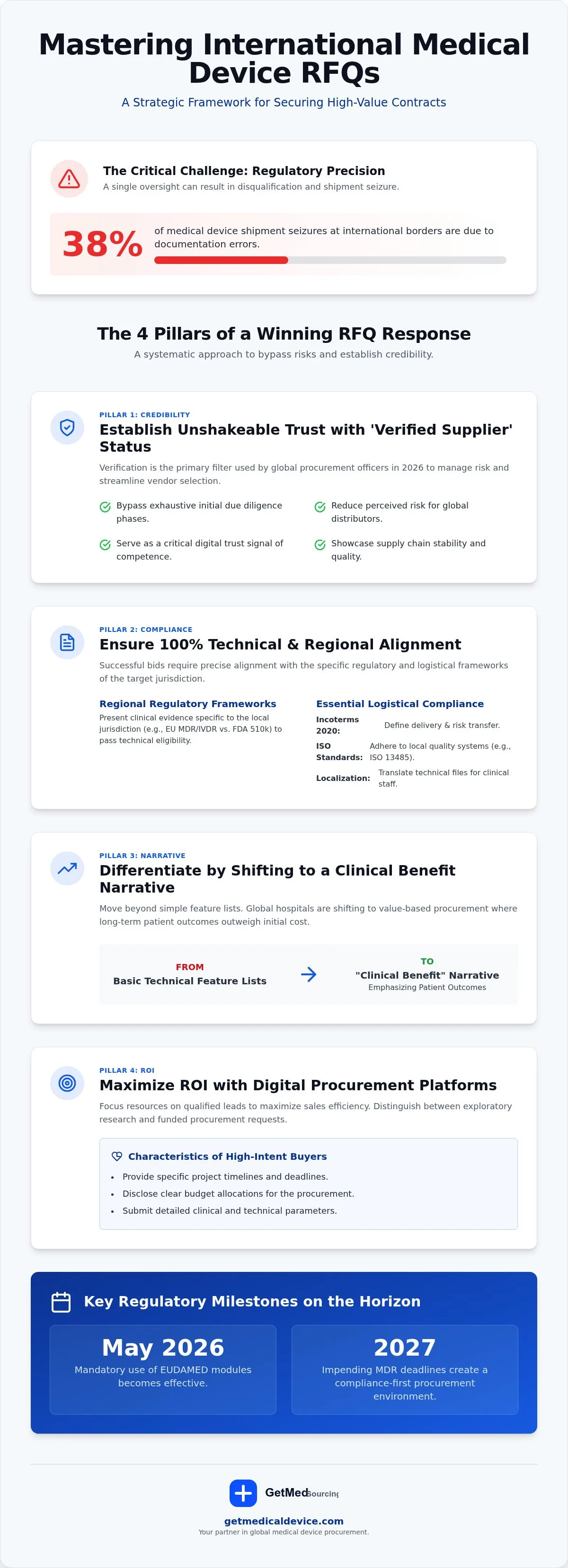
Documentation errors account for 38% of medical device shipment seizures at international borders, illustrating the high stakes of regulatory precision in global trade. For suppliers, a single oversight in a technical file often results in immediate disqualification from lucrative procurement cycles. Implementing best practices for responding to international RFQs is essential to mitigate these risks and ensure clinical superiority is not lost in administrative complexity. You likely understand that the mandatory use of EUDAMED modules as of May 2026 and the impending 2027 MDR deadlines have created a procurement environment where compliance is the primary barrier to entry.
This guide provides the systematic framework required to master the technical and strategic requirements of high-value international contracts. By following these protocols, you'll streamline your response workflow and establish the verified credibility necessary to compete with established global entities. We'll analyze the integration of Unique Device Identification (UDI) standards, the necessity of Good Distribution Practice (GDP) certification, and the specific documentation hierarchies required to secure successful bids throughout 2026 and 2027.
Key Takeaways
- Secure "Verified Supplier" status to bypass initial due diligence and satisfy the primary filtering criteria used by global procurement officers in 2026.
- Implement best practices for responding to international RFQs by aligning technical specification matrices with regional regulatory frameworks to ensure 100% compliance.
- Transition from basic technical feature lists to a "Clinical Benefit" narrative that emphasizes patient outcomes to differentiate your bid from local competitors.
- Leverage digital procurement platforms and credit-based bidding to aggregate global demand and optimize sales ROI through high-intent procurement requests.
Table of Contents
- Navigating the Complexity of International Medical RFQs
- Establishing Credibility Through Supplier Verification
- Technical Response Strategies: Best Practices for Medical Bids
- Maximizing ROI with Digital RFQ Platforms
Navigating the Complexity of International Medical RFQs
An international Request for Quotation (RFQ) in the medical sector is a formal procurement process requiring precise alignment between clinical requirements and regional regulatory frameworks. It's no longer a simple transactional exchange. Global hospitals are shifting toward value-based procurement, where long-term patient outcomes and device reliability outweigh the initial purchase cost. By 2026, the procurement landscape heavily favors suppliers with pre-verified credentials because they reduce the administrative burden on hospital committees and ensure immediate compliance with safety standards.
To implement best practices for responding to international RFQs, you must address specific logistical and technical barriers. These include:
- Incoterms 2020 Compliance: Clear definition of delivery responsibilities and risk transfer for sensitive medical equipment.
- ISO Standards: Adherence to varying quality management systems, such as ISO 13485, across different jurisdictions.
- Language Localization: Translating technical specifications into the local language to ensure clinical staff can accurately assess device utility.
Understanding Regional Regulatory Requirements
Successful responses distinguish between the technical file requirements of EU MDR/IVDR and the FDA 510(k) pathway. While a device might be cleared in one region, the RFQ package must present the specific clinical evidence required by the local jurisdiction. Clinical reviewers often prioritize local language technical summaries to expedite their internal evaluation. Regulatory certificates serve as the mandatory threshold for technical eligibility within any international bid.
Identifying High-Intent International Buyers
Not all inquiries lead to a contract. Distinguishing between exploratory market research and funded procurement requests is critical for resource allocation. You can use medical device sourcing and procurement frameworks to vet these opportunities. High-intent buyers typically provide specific timelines, budget allocations, and detailed clinical parameters rather than generic product requests. Utilizing best practices for responding to international RFQs involves focusing efforts on these qualified leads to maximize sales ROI.
Establishing Credibility Through Supplier Verification
Verification is no longer optional. In 2026, international procurement officers utilize "Verified" status as the primary filter to manage risk and streamline vendor selection. This designation indicates that a supplier has already undergone rigorous third-party auditing of their operational licenses and quality management systems. By securing this status, you bypass the exhaustive initial due diligence phases that often delay high-value contract awards. It serves as a critical digital trust signal, confirming your organizational competence and reliability before a single technical document is reviewed, which is vital when exporting medical devices to new markets.
The Value of Verified Supplier Memberships
A verified badge significantly reduces the perceived risk for global distributors who must adhere to strict regional compliance. You should integrate these credentials directly into the executive summary of your bid to establish immediate authority with the procurement committee. For a detailed roadmap on this process, consult the Verified Medical Device Suppliers Guide. Maintaining a verified supplier membership ensures your business remains visible to high-intent buyers seeking reliable long-term partners.
Leveraging Brand Authority in Bids
Credibility is further reinforced by showcasing direct access to Tier 1 inventory. Highlighting your availability of coronary intervention or neurovascular products from established brands like Boston Scientific, Terumo, or Abbott Vascular provides a benchmark for clinical quality. Premium product listings further validate your inventory levels, proving you can meet the high-volume demands of international hospitals without delay. One of the best practices for responding to international RFQs is using these verified listings to demonstrate supply chain stability and technical superiority. This systematic approach transforms your bid from a simple proposal into a verified procurement solution that satisfies even the most stringent clinical committees.
Technical Response Strategies: Best Practices for Medical Bids
Technical precision is mandatory for bid acceptance. Best practices for responding to international RFQs require a technical specification matrix that maps product features directly to the buyer's requirement list. When you propose products from brands like Asahi Intecc or Abbott Vascular, it's necessary to provide documented evidence of equivalence if the specific brand isn't mandated. This ensures 100% compliance with technical thresholds. It's also vital to include 'Sterile Use' certifications within the technical annex to verify device safety and regulatory alignment.
Beyond specifications, successful bids employ a 'Clinical Benefit' narrative. This approach moves past raw data to emphasize patient outcomes and procedural efficiency. For multi-year consumables contracts, financial transparency is essential. Quotes must be structured to account for long-term volume commitments while clearly defining Incoterms, lead times, and sterile chain maintenance protocols. This level of detail demonstrates a sophisticated understanding of the operational risks involved in global medical logistics. Clinical committees favor suppliers who anticipate these logistical variables early in the process.
Optimizing the Response Workflow
Efficiency in bidding is achieved through a modular content library for frequently asked regulatory questions. This reduces manual input and ensures consistency across multiple submissions. Utilizing RFQ credits allows your team to prioritize high-value, high-intent bids over speculative inquiries, maximizing your sales ROI. This systematic approach ensures that resources are allocated to the most viable contracts. To access these targeted procurement opportunities, you should browse our premium medical device listings and connect with verified buyers.
Maximizing ROI with Digital RFQ Platforms
Digital marketplaces have fundamentally restructured medical procurement by aggregating demand from global hospitals and international distributors into centralized hubs. This shift eliminates the inefficiencies of traditional cold-calling, replacing it with a data-driven approach to lead acquisition. By utilizing these platforms, suppliers can implement best practices for responding to international RFQs by focusing exclusively on active, funded procurement requests. Premium product listings further enhance this strategy, attracting passive buyers while your team actively manages high-priority bids. Continuous improvement requires a systematic analysis of lost bids to refine your 2026 sales strategy and technical documentation.
Scaling with Credit-Based Bidding
A credit-based bidding system ensures superior resource allocation by requiring a pay-per-response commitment. This model filters out low-intent inquiries, allowing your sales team to dedicate technical expertise to qualified leads. Tracking conversion rates from initial RFQ response to the final purchase order is essential for measuring departmental ROI. This methodical approach ensures that every credit spent aligns with high-value opportunities in sectors like interventional cardiology or peripheral intervention. It's a precise way to manage sales costs while maintaining a high win-rate on global tenders.
Integrating Global Distribution Networks
Centralized portals provide a secure bridge to verified buyers in emerging markets, where local regulatory knowledge is often a prerequisite for entry. These networks facilitate immediate connections with procurement officers who prioritize pre-vetted suppliers. Maintaining a consistent presence on these platforms establishes long-term credibility and ensures your inventory is visible during critical procurement cycles. To secure your position in the global market, you should explore Verified Supplier Membership options at GetMedicalDevice and begin scaling your international reach through our systematic bidding framework.
Optimizing Your Global Procurement Strategy
Mastering the transition to value-based procurement requires a systematic integration of regulatory compliance and technical authority. By implementing best practices for responding to international RFQs, your organization can bypass administrative bottlenecks and address the specific clinical requirements of global hospitals. Verified status remains the most effective tool for establishing immediate trust with international committees, ensuring your technical files meet the rigorous standards of the 2026 regulatory landscape. This structured approach transforms your bidding process from a speculative administrative task into a reliable growth engine.
Accessing high-intent procurement requests for specialized brands like Abbott Vascular and Terumo requires a platform designed for clinical precision. You should utilize credit-based bidding to manage your sales ROI effectively while maintaining a constant presence in emerging markets. This methodical framework ensures your team focuses only on the most viable, high-value opportunities. Become a Verified Supplier and access international RFQs to secure your position as a trusted partner in the global medical device sector. Your successful expansion into international markets begins with verified credibility.
Frequently Asked Questions
What is the most common mistake in international medical RFQ responses?
The most frequent error is failing to align technical documentation with specific regional regulatory modules, such as the 2026 EUDAMED requirements. Suppliers often submit generic data sheets instead of localized technical files. This oversight leads to immediate disqualification during the initial compliance screening. Implementing best practices for responding to international RFQs requires a granular review of local clinical standards to ensure every technical claim is supported by region-specific evidence.
How do I prove my regulatory compliance to a buyer in a different region?
You must provide a comprehensive technical annex that includes valid Certificates of Free Sale and region-specific certifications like the EU MDR or FDA 510(k). As of May 2026, the Actor Registration and UDI modules of EUDAMED are mandatory for European trade. Providing these verified registration numbers within your bid documentation establishes immediate legitimacy. This systematic verification process confirms that your inventory meets the quality standards of the buyer's jurisdiction.
Is AI software safe for drafting medical device tender responses?
AI tools are useful for structuring administrative layouts, but they often lack the clinical precision required for complex device specifications. Relying solely on automated drafts can result in inaccuracies regarding guidewire dimensions or stent coating properties. It's safer to use a modular content library of verified technical data. This ensures that every response maintains the accuracy required by clinical committees while streamlining the documentation workflow without risking technical non-compliance.
What are RFQ credits and how do they help medical device suppliers?
RFQ credits are a strategic procurement tool used to bid on active, high-intent procurement requests within the GetMedicalDevice platform. This system ensures that your sales resources are allocated to qualified leads rather than exploratory inquiries. By utilizing these credits, you can prioritize responses for premium brands like Asahi Intecc or Abbott Vascular. This methodical approach is one of the best practices for responding to international RFQs to maximize sales ROI.
Which Incoterms are best for international medical device shipping?
CIP (Carriage and Insurance Paid To) and DAP (Delivered at Place) are generally preferred for sensitive medical equipment. These terms provide clear definitions of risk transfer and insurance responsibilities during transit. Since documentation errors cause 38% of shipment seizures, using precise Incoterms 2020 definitions helps mitigate logistical delays. It's essential to specify these terms in your bid to ensure the buyer understands the exact point of delivery and liability.

