

A marketplace’s global reach does not prove it can support your procurement requirements. When comparing b2b marketplaces for medical devices, look for evidence of supplier checks, relevant product listings, access to the right buyers, and a clear RFQ process.
A marketplace can make sourcing more efficient, but features and checks vary. A “verified” label may not explain what was checked, broad categories may not cover specialized device needs, and an unclear RFQ workflow can make it hard to assess response effort or lead quality.
This guide explains how to compare marketplace functions with your actual sourcing or selling requirements. Learn what to ask about supplier verification, how to assess listings and product-specific documentation, and how to evaluate buyer access and RFQ steps. You’ll also find practical criteria for choosing a channel and structuring requests with details such as brand, product codes, and documentation requirements.
Key Takeaways
- Compare b2b marketplaces for medical devices by the procurement functions they support, not by claims about reach alone.
- Check whether category coverage, buyer roles, supplier checks, and RFQ workflows match your device type and purchasing pathway.
- Before submitting an RFQ, confirm supplier and listing details, including manufacturer, model, intended market, condition, traceability, and required documents.
- Assess whether GetMedicalDevice’s supplier memberships, premium listings, and RFQ response credits align with your visibility or sourcing objectives.
Table of Contents
- What B2B Marketplaces for Medical Devices Do, and Where Their Role Ends
- How to Compare B2B Medical Device Marketplaces
- How to Vet Suppliers and Medical Device Listings Before an RFQ
- When GetMedicalDevice May Fit Your Marketplace Requirements
What B2B Marketplaces for Medical Devices Do, and Where Their Role Ends
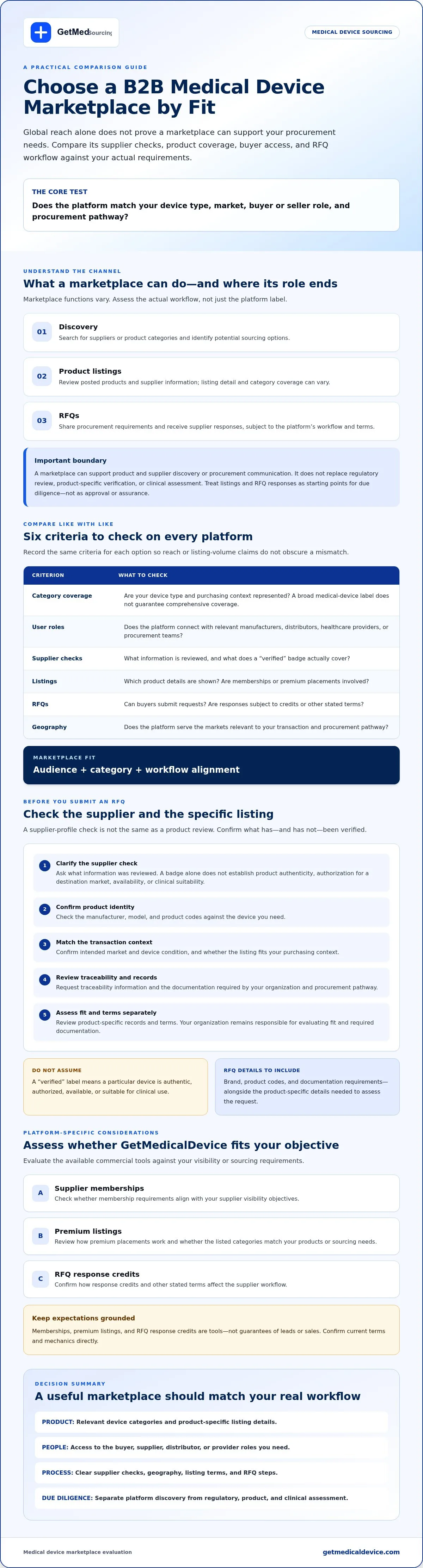
B2B marketplaces for medical devices are digital channels where organizations discover products, suppliers, or procurement opportunities. Like other online marketplaces, they can support business-to-business discovery and exchange, but their functions vary. A discovery platform helps users find potential suppliers. A product-listing marketplace displays items and supplier information. An RFQ-enabled channel lets buyers submit requirements and suppliers respond. These functions can overlap, so assess the actual workflow rather than relying on the marketplace label.
- Discovery: Search for suppliers or product categories.
- Listings: Review posted products and supplier details.
- RFQs: Share procurement requirements and receive supplier responses.
Definition: A medical device marketplace supports product and supplier discovery or procurement communication. It does not replace regulatory review, product-specific verification, or clinical assessment.
Who uses medical device marketplaces?
Manufacturers and distributors may use marketplaces to present products and reach potential buyers. Healthcare providers and procurement teams may use them to identify suppliers or source devices. Needs differ by product category and geography. A buyer sourcing surgical equipment may need different listings and supplier information from one sourcing vascular devices. Confirm that a platform covers both the relevant product type and your role as buyer or seller.
What a marketplace does not automatically guarantee
A supplier-profile check is not the same as a product review. A “verified” badge may indicate that some supplier information was checked, but it does not by itself establish that a particular device is authentic, authorized for a destination market, available, or suitable for a clinical purpose. Ask what the verification covers, then request and review product-specific records and terms. Buyers remain responsible for assessing fit and required documentation.
Marketplace participation also does not guarantee sales, supply, or compliance. Treat listings and RFQ responses as starting points for due diligence, not as approval or assurance. A platform can support discovery and communication, while procurement decisions require separate checks against your organization’s requirements.
How to Compare B2B Medical Device Marketplaces
Compare b2b marketplaces for medical devices against your product, audience, and procurement process. Record the same criteria for each platform so claims about global reach or listing volume do not obscure a mismatch.
| Criterion | What to check |
|---|---|
| Category coverage | Are your device type and purchasing context represented? |
| User roles | Does the platform connect with relevant suppliers, distributors, providers, or procurement teams? |
| Supplier checks | What information is reviewed, and what does a verification badge actually cover? |
| Listings | Which product details are shown, and are premium placements or memberships involved? |
| RFQs | Can buyers submit requests? Are responses subject to credits or other stated terms? |
| Geography | Does the platform serve the markets relevant to your transaction? |
Marketplace fit depends on audience, category, and workflow alignment.
Check category and buyer fit
Match the platform’s stated categories to the device type and purchasing context you need. For example, buyers sourcing coronary intervention devices can review coronary intervention products. Neurovascular sourcing requires relevant category coverage and suppliers. Confirm that the listed products and intended buyer roles suit your requirement. Do not assume that a broad medical-device label means comprehensive coverage.
Geography matters as well. Compare the buyers and suppliers a platform says it serves with the markets relevant to your procurement pathway. For healthcare-facing business interactions, review applicable organizational policies and references such as the AdvaMed Code of Ethics.
Compare access and commercial workflows
Find out whether buyers browse product listings, submit RFQs, or use both routes. Suppliers should document how visibility works, including any membership requirements, premium listing options, and RFQ response credits. GetMedicalDevice offers these tools, but they do not guarantee leads or sales. Confirm current terms and mechanics directly, and review listed medical device products to see whether the available categories align with your needs.
How to Vet Suppliers and Medical Device Listings Before an RFQ
Use a consistent review sequence before requesting a quote through b2b marketplaces for medical devices. This helps you identify whether a supplier response includes the information needed for procurement review.
- Specify the requirement. Identify the device type, manufacturer, model or product code, quantity, intended market, and required condition.
- Review supplier identity. Check the supplier’s name and profile details. If the marketplace displays a verification status, ask what documented checks that status represents.
- Request product documents. Ask for documentation relevant to the specific device and destination. Requirements vary by product and market, so confirm them against your organization’s procurement and compliance process.
- Clarify terms. Confirm availability, condition, traceability information, destination, and delivery expectations. Resolve gaps or inconsistencies before proceeding.
- Submit a structured RFQ. Include product identifiers, quantity, destination, requested documents, and delivery expectations so suppliers can respond to the same requirements.
What supplier verification can, and cannot, tell you
Rely on the checks a marketplace documents. A supplier badge may describe a profile-level review, but it should not be treated as proof of every listed product’s authenticity, authorization, or regulatory status. Marketplace verification and product authorization are separate checks. Confirm GetMedicalDevice’s current criteria for verified status before interpreting its Verified Supplier Membership as evidence of a particular review.
Make an RFQ specific enough to evaluate
Request comparable information from each supplier. Check replies for completeness and consistency across model, condition, requested documents, quantity, and delivery expectations. If a response leaves key fields unanswered, ask for clarification before using it to support a purchasing decision.
To begin your review, browse listed medical device products and note which product details you’ll need to confirm with the supplier.
When GetMedicalDevice May Fit Your Marketplace Requirements
GetMedicalDevice may suit suppliers seeking marketplace visibility and access to RFQ opportunities, or buyers sourcing within its interventional, vascular, and surgical categories. Its offerings include Verified Supplier Membership, Premium Product Listings, and credit-based RFQ responses. These features support specific marketplace activities. They do not establish that a particular product is listed, suitable, or available, and they do not guarantee leads or sales.
Category fit is specific. If interventional radiology matches your requirement, review the interventional radiology products category. Compare available listings with your product needs rather than assuming the platform covers every device within a broad specialty.
Supplier considerations before joining
Assess whether the platform’s buyer audience matches your target market and whether its listing format lets you present relevant product information. Before selecting a membership or premium listing, confirm current terms and requirements. For RFQs, review how response credits work and estimate the internal effort needed to evaluate and answer requests accurately. Treat visibility and RFQ access as channel capabilities, not promises of lead volume, conversions, or return.
Buyer considerations before sourcing
Use listings to identify potential suppliers, then verify supplier details and assess each product against its documentation and your procurement requirements. A category match is a starting point, not a substitute for product-specific checks. Map marketplace searches to your organization’s sourcing process, destination, required documents, and purchasing criteria.
Practical fit-check: Review categories relevant to your device needs, confirm current membership, listing, and RFQ credit terms, then assess how the platform handles a sample request. Check whether the resulting listings or responses provide enough information for your next procurement step. This structured review helps you decide whether GetMedicalDevice fits your objectives among b2b marketplaces for medical devices.
Choose a Marketplace That Fits Your Procurement Workflow
The right marketplace for your needs is one that aligns with your device category, intended audience, and purchasing process. Compare supplier checks and listing information, then confirm product-specific documentation and terms before moving an opportunity forward. These steps help you evaluate b2b marketplaces for medical devices using practical evidence rather than broad claims about reach.
GetMedicalDevice serves a global network across interventional, vascular, and surgical equipment. Its stated platform offerings include Verified Supplier Membership, premium listings, and RFQ response credits. For suppliers, these may support visibility and RFQ participation. For buyers, listings can help identify potential suppliers. Confirm current category coverage and terms, and assess each supplier and product against your requirements.
Review the platform against a real sourcing need or sample request, then decide whether its categories and workflow suit your needs. Review GetMedicalDevice’s medical device marketplace as part of your comparison. Use clear criteria and product-specific checks to choose a channel that supports your next procurement step. Start by reviewing the platform’s listings and supplier options against your sourcing or visibility goals.
Frequently Asked Questions
What is a B2B marketplace for medical devices?
A B2B marketplace for medical devices is a digital channel where businesses discover products, suppliers, or procurement opportunities. Depending on the platform, users can browse listings, contact suppliers, or submit and respond to requests for quotation (RFQs). These platforms support discovery and communication, not purchasing approval. Buyers still need to assess supplier credentials, product documentation, intended-market suitability, and whether a device meets their organization’s requirements.
How do I choose a medical device marketplace?
Start with the procurement task. Define the device category, your role as buyer or seller, the target geography, and the workflow you need. Compare b2b marketplaces for medical devices on category coverage, supplier checks, listing visibility, RFQ functions, and disclosed membership terms. Ask what any supplier badge represents, then assess supplier and product documentation. Broad reach matters only if the platform fits your actual requirements.
Does a verified medical device supplier guarantee an authorized product?
No. A verified supplier status reflects checks performed by the platform, and the scope may differ between marketplaces. It does not automatically prove that each listed product is authentic, authorized for a particular market, or appropriate for a specific use. Request product-specific documentation and confirm that it matches the manufacturer, model, and intended destination. Treat supplier-profile verification and product authorization as separate procurement checks.
Are B2B medical device marketplaces suitable for hospitals and distributors?
They can support product discovery and supplier outreach for hospitals and distributors if the platform’s categories and workflows match their needs. A hospital may need documentation for internal review, while a distributor may prioritize supplier terms and access to relevant markets. Neither audience should assume a listing satisfies its procurement criteria. Assess the supplier, product details, destination, and required documentation independently before proceeding.
How do RFQs work on medical device marketplaces?
An RFQ lets a buyer describe a sourcing requirement and request supplier responses through a marketplace that supports this function. Include product identifiers, quantity, destination, requested documentation, and delivery expectations. Suppliers respond according to the platform’s process, and some platforms may specify terms for submitting responses. GetMedicalDevice offers RFQ response credits for suppliers. Compare replies for completeness and consistency, then verify product and commercial details before proceeding.


